Author: Jim Motavalli

  • Rare 1993 Porsche 928 GTS is a Pristine Example

    Rare 1993 Porsche 928 GTS is a Pristine Example

    In Goddard, Kansas, and listed on eBay, lives perhaps the world’s best-preserved example of the Porsche 928 GTS. It’s a 1993 model and one of only 54 built that year with a five-speed manual transaxle. The condition is attached to a pretty stellar price, $210,000, but there’s definitely some bargaining room there.

    (more…)

  • Ready To Assemble: 1970 Jaguar E-Type Coupe

    Ready To Assemble: 1970 Jaguar E-Type Coupe

    Since many of the Jaguar E-Types that appear on Craigslist, eBay, or Facebook Marketplace are rust-bucket “projects,” it’s worth giving a second look at this 1970 Series II coupe (not a 2+2) here on Craigslist in Richmond, Virginia. The price is $40,000, and it’s firm.

    Oddly enough, 30 years ago I encountered a just-painted Series I that was as nice as this car, and also needing the interior, plus the glass reinstalled. The asking price: $3,500. Ah, it was a lot of money then. The photo below may or may not be the same car, but it’s in the ad.

    Far from being a rust bucket, it’s a professionally painted car with all new chrome and stainless, plus a brand-new windshield and perfect glass all around. Also new are the radiator, alternator, and front and rear shocks. The owner has less to say about the motor (which should be a 4.2-liter version of the famous six-cylinder Jaguar XK powerplant), other than that it was removed and perhaps, painted and freshened up. Per the ad, If the car has only 20,000 miles on it, then that engine should be reusable. No guarantees, though. “Too much too list.” Really? Craigslist doesn’t charge by the word.

    From what little of the interior that’s visible, it needs a complete overhaul, but a seat form kit is included. These cars have fairly minimal interiors—the door panels, headliner, and seats mostly.

    The paint and trim do look good, and the floors are fine. The steering wheel appears quite nice. But there still could be significant challenges here, such as a possible motor and transmission rebuild (the four-speed unit appears to be in place), suspension, brakes, wiring, etc.

    The Series II, built from 1968 to 1971, was a compliance car, making changes necessary to meet U.S. regulations. The glass headlight covers were beautiful, but they didn’t produce much light so they were gone. The Citroën DS lost its covers, too. No one would argue that the Series II is better looking than the Series I since it’s burdened with a wrap-around rear bumper, big front indicators and taillights, and side marker lights.  But the twin electric fans did aid cooling.

    The II also lost the push-button starter in favor of a steering lock and plastic rocker switches replacing the toggles. The steering column became collapsible, and new headrests met the letter of the law.

    In place of triple SUs (which I also had on my Mark X), the II had twin two-barrel Strombergs. Horsepower was down to 246 from 265, and torque to 263 pound-feet from 283. But as the E-Type went upscale, air and power steering became available. Total production of the Series II was 13,490, most of which were exported from Britain. That seems like a very low number now. Some Series IIs and IIIs are getting the restomod treatment.

    Classic.com lists the Series II E-Type at $62,306 and trending down. So, there’s some wiggle room on this one. If you can verify the engine and transmission, they are usable. And that mileage is actual. That red looks a little too, well, red, to be an original color. But I’m no expert.

  • Some Assembly Required: 1965 Cobra Kit Car
    Some Assembly Required: 1965 Cobra Kit Car

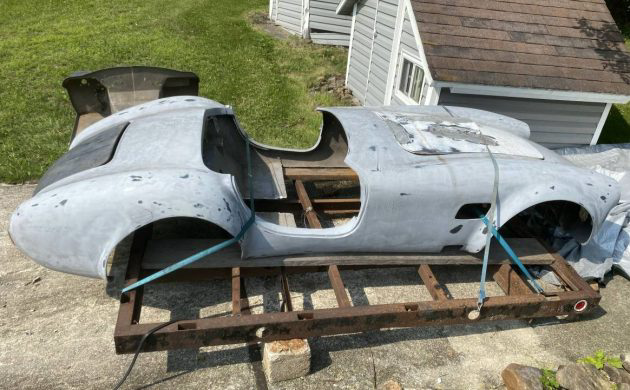
    Auto sellers should keep a dictionary handy. Perhaps this Shelby Cobra kit was intended for flower car duty, since it comes with “petals.” And the engine evidently needs somewhere to stay, because it “could be boarded out” to a 427. OK, now that’s off my chest, what we have here is the skeleton of an unnamed Cobra replica with no apparent interior, trim, top, suspension, instrumentation, glass, wheels, or many of the other things that make a car a car. On the positive side, it’s $8,000 (cryptocurrency ok), and on Craigslist near Allentown, Pennsylvania.

    Thanks to Mitchell G. for this tip. There’s a transmission, but do you really want an automatic in a Cobra? What’s included are a hood, trunk, unibody chassis, trunk lid, bare dashboard, taillight lenses and the aforementioned pedals.

    The body looks decent enough, if a bit weather-beaten, and the owner says it’s ready for paint.” The 400-cubic-inch engine, provenance and operational state unknown will cost the buyer another $2,000.

    The owner says the car will be sold “with bill of sale. You would have to apply for a specialty title.” It might be complicated to get this registered if there’s no VIN number. Personally, because you see fake Cobras every day, I’d rather have a clone of, say, the BMW 507 roadster. But Shelby American doesn’t go after companies that build replicas, and BMW and other OEMs definitely would.

    Let’s make it clear that you need to be a multi-millionaire or someone who was smart 50 years ago to have a title to an original Cobra. Only 998 were made between 1961 and 1968 (655 289s and 343 427s), and even derelict they’re well into six- and seven-figure valuations.

    Some of the more reputable replicas come from Shelby American itself, Factory Five, Kirkham Motorsports, Superformance, Backdraft Racing, and ERA. The problem here is we don’t know if this is one of those, or something far more problematic. The owner says it’s a “CSX-9000” body, which kind of suggests a Shelby American connection. But that’s a number given to the continuation series of the Shelby Daytona Coupe. One of those, completed, would be worth $174,200, says Classic.com. But this is the body of a Cobra roadster.

    The vendor suggests that his offering is worth far more than what’s being asked, and maybe that’s correct, but any buyer should clarify exactly what this is before proceeding.

  • Cheap Project? Fiat 1200 Spider

    Cheap Project? Fiat 1200 Spider

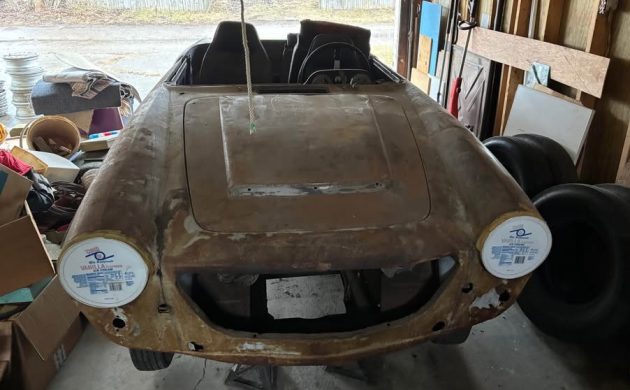
    Generally, when I own a car, I have a pretty good idea of what it is, but that’s not always the case, even with classics. The owner of this Fiat in Fishers, Indiana, put it up on Facebook Marketplace as a “1960 Fiat 124 Spider,” but of course, there was no such animal. Thanks to Chuck Foster for the tip.

    The car is being offered for a mere pittance, $825, and it’s worth considering because these cars, unlike the plentiful 124, are really rare in the U.S. I only saw one (at a gas station in Long Island) that wasn’t part of a car show. Some car people inform the vendor that what he/she has is a “desirable 1960s or 70s Fiat 1200 Spider.” I’m thinking this is the later Pininfarina 1200 Spider, produced from 1959 to 1966, and not the earlier 1200 Spider (1957 to 1959). But maybe a Fiat expert in the crowd can say for sure.

    The car is completely stripped, though the steering wheel, seats, and a couple of dials are still in place. It’s not clear how much of what’s missing is included. We’re told, “It’s a roller, bring a trailer, make an offer as it has to go asap. There are many parts, moldings, engine, and transmission.” The latter two, looking reasonably complete, are shown in the gallery. What isn’t shown are the bumpers, grille, door panels, dashtop, trim, lights, windshield, top and frame, and a whole lot more. Maybe they’re part of the deal, maybe not. There’s rust in the rocker panels, and surface rust everywhere. Plus dents. We can’t see the undercarriage but don’t expect it to be pristine.

    The 1200 model was first shown at the 1957 Turin Motor Show as a sedan, coupe and Spider, and based on the earlier 1100 (first seen in 1953). The 1200 TV Trasformabile two-seater’s new 1.2-liter gas engine produced all of 55 horsepower and 60 pound-feet of torque. The new model got a redesigned split-grille front end, bigger bumpers, and a three-speed manual gearbox lacking synchro on first gear.

    Pininfarina produced the 1200 Cabriolet, with modernized styling, at its own factory until the handsome 124 Spider (designed by Tom Tjaarda) was introduced for a two-decade run. None of these cars were fast, but then neither were the contemporary English roadsters. Road & Track reported that a 1958 Spider took 18.8 seconds to 60, and did the quarter mile in 21 seconds.

    Like the lovely and later 850 Spider (with even less displacement!) the point is not to get somewhere quickly, but to get there in style. And these Fiats had that. Classic.com says the 1200 Cabriolet, if that’s what this is, is worth a cool $18,124 when restored. So, the brave and handy buyer of this car, which looks to have been sitting for quite a while, stands to do quite well in the end.

  • Rare 1954 Messerschmitt KR175 Project

    Rare 1954 Messerschmitt KR175 Project

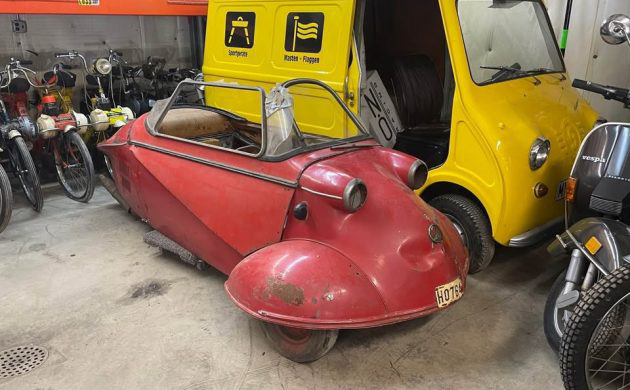
    Yes, indeed, as the owner says, these German-made Messerschmitt KR175 Kabinenroller microcars are indeed very rare–only 15,000 were built. But it’s the later 200 model (1955 to 1964) that’s a more valuable example of the breed, and the cream of the crop is the Tg500, or “Tiger,” built from 1958 to 1961 by FMR, which took over from Messerschmitt. That one got a sprightly two-stroke, two-cylinder engine. Thanks for the tip, Zappenduster!

    The Tg500 was a four-wheeler, unlike the three-wheelers that came before, and it was fast, at least for a microcar. It made it to 60 mph in 28 seconds, which sounds incredibly slow today, but the contemporary Austin-Healey Sprite took 21 seconds.

    This 1953 or 1954 KR175 (the owner doesn’t seem definite on which it is) can be obtained from Facebook Marketplace in Hudson, Massachusetts, for $18,000. It’s rusty and needs a complete restoration, but the original single-cylinder, two-stroke engine, gearbox, accessories, and trim are still with it. The iconic plexiglass canopy is clearly long gone, though fragments remain.

    We’re told the Messerschmitt is in “remarkable original condition except for a single repaint in the original color….The engine is free and turns and has good compression. I believe it will fire up quite easily.” The vendor claims these early KR175s were only offered for one year, adding to their rarity.

    The Kabinenroller looks like a World War II fighter plane cockpit because, well, that’s what Messerschmitt made in those years—the V-12-powered Bf 109. Frankly, the Kabinenroller looks very cool when restored with shiny paint and trim. The KR175 was actually produced from 1953 to 1955, so not only one model year.

    The KR175 had a monocoque structure, tandem seating for two, and, most often, the bubble canopy that should be on this car. There was also a limited-production “Sportster” roadster. The able designer was Fritz Fend. His lines were largely retained for the four-wheel Tiger, which is seen in a Wikipedia image below.

    The good points of this car include the fact that it’s all in one piece, and the body panels don’t look too bad–though there’s a big dent in the nose. Although there’s no interior photo to show just how bad they are, the floorboards are said to need replacing. These cars are tiny, but restoration can get expensive. Buyers may want to consider a fully revitalized example instead. A restored Kabinenroller KR175 is worth $32,768 (and trending down), says Classic.com, so not a whole lot of room here for avoiding the dreaded upside-down position. But any Messerschmitt microcar is a find, and they aren’t seen in barn find condition often, so there’s that to consider. It’s a bird in hand…

  • Huge Price Cut! 1964 Chevrolet Corvette Custom
    Huge Price Cut! 1964 Chevrolet Corvette Custom

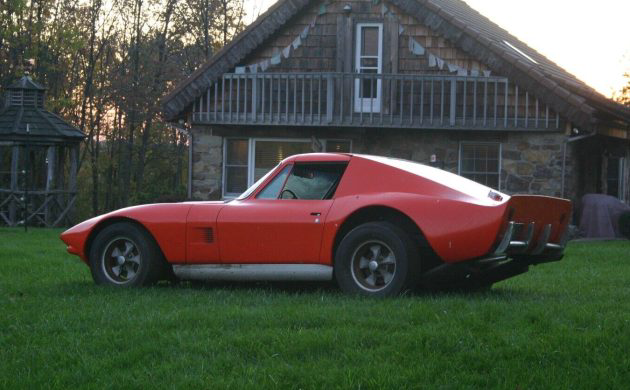
    Beauty is in the eye of the beholder, and that’s how would-be purchasers will see this custom creation, which once was a 1964 Chevrolet Corvette convertible with VIN # 40867S103144. The owner bought it when it was nearly new from an insurance company, which recovered it after it was stolen and stripped. It went back on the road as a full custom targa top, and it’s now for sale here on eBay in Portersville, Pennsylvania with $55,000 being asked. It’s reportedly been driven only 300 miles since completion. We featured it back in 2019 when it was being offered with a $90k asking price. Is their price cut enough to find a new home for this odd creation?

    (more…)

  • Same Family For 40 Years: 1964 Triumph TR4

    Same Family For 40 Years: 1964 Triumph TR4

    This cherry red 1964 Triumph TR4 has been in the same family for over 40 years! It’s currently listed for sale here on Facebook Marketplace in Durand, Illinois. It looks like the family took great care of their European sports car. Thanks for the tip, T.J. The asking price is $18,850.

    This is not a jump-in-and-drive situation, though. The seller informs us the car was “gone through” 1o years ago “with tires, belts, hoses, and more to make it reliable, but it has not been driven since.” The vendor pulled it out of storage, but it still has the old fuel and will need a battery installed. The mechanicals should revive—the simple-as-all-get-out Triumph has only 48,000 miles on it.

    “Very clean inside and out.” In this case, the car lives up to the hype. The paint gleams, the chrome is intact and shiny, and the interior looks tidy, with a decent wood dash, all of the Smiths gauges, and either the original seats or a re-upholstery in the correct pattern. Nothing appears missing, and the wooden shift knob is a nice touch. We have to guess about the top because there’s no picture with it up. The undercarriage looks clean.

    The TR4 is, of course, a styling upgrade of the more basic TR3, with a then-modern Italianate design from Michelotti. Development began in 1956, and the first prototype was built by Vignale on a stock TR3 chassis. The “Zest” design was shown in Geneva in 1957 but was deemed too expensive to produce. A second Michelotti design with a full-width body, “Zoom,” was also created. The finished design used elements of both creations. Finally, a Triumph sports car had roll-up windows, a concept that took quite a while to take hold in Britain despite its wet weather.

    Mechanical progress was incremental. The rack-and-pinion steering was an upgrade. The TR4 retained the Standard four-cylinder engine of the TR3, but now it was 2,138-cc instead of 1,991. Both Zenith and SU carbs were used. And now the four-speed had synchro on all forward speeds. An electric Laycock de Normanville overdrive (also used on the P1800 Volvo) was an option.

    The TR4 was produced from 1961 to 1965, so the 1964 example offers benefits from a series of continuous improvements. Total production of the TR4 was 40,253, with 37,661 being exported—mainly to the U.S. Britons looking for rust-free cars head for California or the southwest.

    It’s very likely this TR4 needs a minimal amount of work to get back on the road, but you never know—it’s been 10 years. These cars have been dropping in value, and Classic.com has them at $23,322. The TR4a IRS with independent rear suspension is worth a bit more. Some buyers will want to pony up a few more dollars and get a car that’s a known quantity and already on the road. But this pretty one certainly is enticing.

  • Beautiful 1966 Buick Electra 225 Convertible

    Beautiful 1966 Buick Electra 225 Convertible

    The owner wants to “make room for new toys,” which is interesting because the photos make clear that this beautiful 1966 Buick Electra 225 convertible with 60,000 original miles in Loveland, Colorado on Facebook Marketplace is just one of many vehicles in his/her existing garage/warehouse. There’s gorgeous ‘50s and ‘60s iron all around it. Thanks for the tip, T.J.

    We’re told that the Buick has always been garage kept, and runs and drives perfectly. It’s a “beautiful car, inside and out.” The pictures “don’t do it justice,” but they’re actually pretty good. It’s darned tidy, this big boat Buick. The asking price is a very specific $38,500.

    I have a soft spot for these Electras, despite their inability to pass a gas station, because they have a regal presence. I once saw the Shah of Iran pass by in an Electra 225. Flag staffs look good on the front fenders. But the convertibles were more for fun.

    The Electra first reared its top-of-the-line head in 1959, taking over from the Roadmaster. There were two versions, with the second the more tasteful, before this third iteration appeared in 1965. There were initially base and Custom trim levels, and a new chassis with a perimeter frame. The standard engine was a 325-horsepower 401-cubic-inch V-8, but there were also two versions of the 425 with either 340 or (with two four-barrel carbs) 360 horsepower. A three-speed Super Turbine 400 auto was standard.

    There were only minor styling changes, including a new grille and some modified trim, for 1966. And now the dual-quad 360 was no longer a factory option, but had to be installed by the dealer. The instrument panel was also revised. The buyer could order a four-door hardtop or sedan, a two-door hardtop, or this convertible. Only 7,175 of these heavyweight (4,255 pounds) ragtops were built and they weren’t cheap, priced over $4,200 in 1966 dollars. This was at a time when the average car cost $2,650 (and the average household income in the U.S. was $6,900).

    This car would make a wonderful Sunday cruiser, and there’s no indication you need to do anything but get in and drive. The price is a bit high, though, even for a convertible. Classic.com says they average $24,225.

  • 16k Mile 1979 Lincoln Continental Sedan

    16k Mile 1979 Lincoln Continental Sedan

    The attrition rate for mid-to late-70s big boats is really high. When the Arab oil embargo happened, everyone wanted smaller, more fuel-efficient cars, and 1979 Lincoln Continental sedans like this one on Craigslist in Austin, Texas, yielded a dismal 13 mpg around town and maybe 16 mpg on the highway.

    (more…)

  • Sporty Shooting Brake: 1972 Volvo 1800 ES

    Sporty Shooting Brake: 1972 Volvo 1800 ES

    We’re told very little about this 1972 Volvo 1800 ES sporting station wagon here on Facebook Marketplace in Henderson, Nevada. It “runs well and is in good shape.” And darned if that doesn’t appear to be true. The ES has 83,457 miles, an automatic transmission (with a nice wooden knob), and is an unfashionable gold in color. The car is being sold as part of an estate sale and can be viewed as of November 8. Thanks to T.J. for the tip.

    (more…)

  • Pristine French Survivor: 1996 Renault Twingo

    Pristine French Survivor: 1996 Renault Twingo

    The 1996 Renault Twingo urban runabout on Craigslist in Washington, DC, is an Edition Spéciale Alizé that adds features such as A/C, tinted glass, power windows, central locking, airbags, and the “fun velour ‘cumulus’ interior.” The owner wants $15,000.

    (more…)

  • 1950 Buick Special Sedanette Is All Original

    1950 Buick Special Sedanette Is All Original

    I was misinformed. I thought the “sedanette” body style on Buicks (debuted in ’42) ended with the 1949 model, but here’s a 1950 Special sedanette to prove me wrong. It’s being offered on eBay in Le Mars, Iowa, with bidding at $8,000 and plenty of time left.

    The vendor is correct that this is an “original, unmolested 1950 Buick Special two-door fastback,” and its straight eight is in place, coupled to a Dynaflow automatic transmission. “Original” means not restored, and this one has the slings and arrows of 72 years in existence, albeit with only 43,000 miles covered in that time. It appears to have been stored under cover. But it’s not running.

    “The condition of the engine, transmission, and brakes are unknown,” says the seller. The powerplant certainly looks like no one has called on it for work in recent memory. The paint looks good, but some is flaking off, and there are scratches. Surface rust is present on the roof along the drip rails, and the lower driver’s bumper guard has a few dents. Well, that’s what it’s there for, right?

    The interior is much worse than the interior. It needs new cloth seat upholstery, a headliner, and probably door cards at a minimum. The driver’s door glass is cracked, and the rest is aged. The trunk floor is said to be solid, though peppered with surface rust. The frame is solid.

    “A perfect candidate for restoration or leave the outside patina and rebuild the rest,” the owner says. If it were me, I’d get it running with the original drivetrain and restore the interior, then take the owner’s advice on preserving the patina (though that roof rail rust needs to be taken care of).

    This is the ’49 to ’53 edition of the big Buicks. The Special (Series 40) came out in late ’49 and in 1950, sporting the full-length “bucktooth” grille I find so attractive. Specials were entry-level and had three Ventiports. With Dynaflow, the venerable 248-cubic-inch cast-iron engine (in production since 1937) produced 120 horsepower. It’s not the “Fireball” eight; that one didn’t debut until 1951.

    This appears to be a Special Deluxe model, with a nicer interior, as it has the Special script on the front fenders. Classic.com has an average of $44,968 for 1950 Buicks, but the cars making anything near this money are fully restored Woodies, convertibles, Roadmasters, and restomods.

    This Buick would undoubtedly make a really classy restomod with a modern V-8, transmission, suspension, and brakes. Bluetooth audio, anyone? But it would also be quite remarkable restored with its original engine in place for leisurely Sunday cruising. The styling is beautiful either way—an inspiration for the Bentley Continentals with the same roofline, perhaps?

  • Package Deal: 1956 And 1957 Citroen 11n

    Package Deal: 1956 And 1957 Citroen 11n

    Many would-be restorers are adept at assembling all the parts needed to complete a restoration, but that by no means ensures the project will be completed. That’s the unfortunate story with this 1956 Citroen Traction Avant model 11N here on Craigslist in Downington, Pennsylvania, near Philadelphia. The cool thing is that it was a diplomat’s car from Tunisia and still bears the local license plate. The owner wants $3,000. Thanks for the tip, Mitchell G.

    (more…)

  • Original Patina: 1946 Crosley Sedan

    Original Patina: 1946 Crosley Sedan

    All we know about this long-time-stored 1946 Crosley panel two-door sedan is that it “needs restoration,” and that the “engine is out and turns free.” The owner may consider parting it out. It’s on Facebook Marketplace in Easton, Connecticut, a rural town a few miles from where I live. The owner wants only $1,750 for this 41,000-mile car, which seems appropriate.

    One thing this Crosley has in spades is patina. It was used by Shappee’s Lawnmower Shop, Dial 2-6885. That phone number was in use a long time ago. Crosley made a cute panel van, but this is not one of those. Interestingly, they could get lawnmowers into it, but the push variety in vogue then was fairly small.

    This base Crosley is rough. Some glass is missing, and everything has surface rust. It’s been sitting a long time. The right side of the two-part windshield is missing, and the back glass is cracked. No seats or other interior details are evident. Though hardly pristine, the body is solid enough, and the floor looks good. The instruments are still there, as is the radio speaker grille.

    The cheap-and-cheerful Crosley is a bit of a cult car, so some parts are available through the clubs. The cars were built in Cincinnati by Powel Crosley, Jr. (a radio pioneer), from 1939 to 1952, with production interrupted by World War II. The range was ambitious, with a Hotshot sports model (from 1949), the aforementioned panel van, station wagons (popular), sedans, pickups, convertibles, and a Jeep-type thing.

    Crosley produced the first mass-market car with an overhead-cam engine in 1946, and used the phrase “Sport Utility” as early as 1947. The cars weighed 1,100-1,500 pounds, and were body-on-frame with front and rear solid axles and leaf springs. The tiny engines had displacement of only 61 cubic inches (less than a liter). The Crosleys sold well until gas rationing was rolled back, and the company lasted only seven years after the war.

    Classic.com has the 1947-1948 Crosley at only $16,141. So, restoring this one would probably not turn out to be economic. It’s got some good panels, though, to aid an ongoing sedan turnaround. And maybe that engine is good. Alternatively, it could make a great advertising vehicle parked outside a place that fixed lawnmowers. It won’t take much money to buy this car.

  • Beautiful Fiat 850 Spider Needs Reviving

    Beautiful Fiat 850 Spider Needs Reviving

    I must admit to always lusting after one of these. They were just such a perfect design, in miniature, by the legendary Giorgetto Giugiaro when he was at Bertone, which also built the bodies. This one is on Facebook Marketplace in Garden Grove, California, with $4,500 as the asking price. It looks relatively original, but needs plenty of work.

    The vendor tells us only that this “all original” car has a clean title and “needs gas tank clean out” and replacement of the rusted battery tray. But it’s also going to need brakes, tires, probably suspension, engine work and an interior. But, yes, this is a “California car” that is “endless fun.” But I’d depart from the idea that someone with “little money” could fully restore it.

    The body is the good news, since these cars started rusting the day they left the showroom. Only surface rust on the hood and trunk is visible. The seats need recovering, but the interior otherwise looks surprisingly good. A top isn’t seen—maybe it has one, maybe it doesn’t. The undercarriage is an unknown quality. The engine is there, and doesn’t look hopeless. Everything is there.

    The pretty 850 Spider—it’s formal name—was introduced in 1965 at the Geneva Motor Show, alongside the less-pretty (but still nice) Coupé. The 843-cc four-banger produced a mighty 49 horsepower (two more than the Coupé), and could supposedly reach 90 mph—in a while.

    The top is folded under a metal body panel, as seen in the photos. The Spider had the friendliest face and was initially popular in the U.S. until rust and reliability problems cropped up. The recessed headlights with plexiglass covers probably didn’t produce much light, but they looked cool.

    The U.S. versions got a version of the engine with only 817 cc but with higher compression (which meant premium fuel in the little bugger). This one is a 1968, so it should have the 903-cc version of the engine that debuted that year to make the “Sport Spider.” There was a minor front-end styling that year, too. Spider production ended in 1973, two years after the Coupé. A total of 2.3 million 850s were sold, mostly sedans. Production continued in Spain as the SEAT 850.

    Classic.com says one of these in pristine condition is averaging only $8,548, so the smart money might be in buying a restored example. Or getting this one needing to be revived for a bargain price.

  • Garage Find: 1962 Austin-Healey Sprite Project

    Garage Find: 1962 Austin-Healey Sprite Project

    This California car, a 1962 Austin-Healey Sprite Mark II convertible, is on eBay in West Covina, California. Bidding is at just $3,333, and there is not much time left. The red beauty has been sitting in a garage for more than eight years. Its 948-cc Austin engine produces 47 horsepower, coupled with a four-speed manual. The car starts, runs, and drives but, as they say, needs some TLC.

    Since it was pulled out of storage, some $5,000 has been invested in new parts: clutch, master cylinder, wheel and slave cylinders, tires, rebuilt twin carbs, tune-up, professional fuel tank removal and clean, fuel pump, carpet, seats (not leather), and battery. One of the seats is not bolted down for some reason.

    The lights and gauges reportedly work. “Floorboards under the seats were replaced. Otherwise, it appears to be rust-free,” the consignor says. It is said to need breaking in and some brakes and/or clutch adjustments. “The car is amazingly easy and fun to work on,” it’s asserted, and indeed, these cars are as simple as can be.

    The paint job looks rough, but at least it’s not peeling off. There’s some top frame and a loose top that probably needs to be mounted properly. The Sprite was initially produced in its famous Bug Eye configuration between 1958 and 1971. The Mark II was announced in May of 1961, using the same 948-cc engine but with larger SU carbs and a close-ration gearbox. The slight power gain was probably offset by the 100 extra pounds. Mechanically, it was about the same, but the styling was much more conventional, and now it had an opening trunk.

    At this point, the Sprite was basically a badge-engineered MG Midget, but that doesn’t mean it’s not worthwhile. My friend had one of these and loved it. She called it “my little car.” It rotted away, though, as early British cars tend to do when they’re not leaking oil.

    In late 1962, the Sprite got a bigger 1,098-cc engine that was good for 56 horsepower, but this is presumably not one of those. This is a pity because front disc brakes were part of the package. Wire wheels also became an option, another thing this one doesn’t have.

    The Mark II Sprite was cheap and cheerful and sold relatively well. Some 31,665 Mark IIs were produced. In testing by Britain’s The Motor in 1961, it reached 85.8 mph and could hit 60 mph in—wait for it—20 seconds. But on the other hand, it delivered more than 36 mpg. A deluxe version of the car cost £705 at the time. These Sprites have no huge valuation, being at $9,889 on Classic.com for 1962. Maybe you could snare this one for less than $5,000 and have a fun open-air ride that won’t require much additional work. But do tune it up and bolt down the passenger seat.

Barn Finds