
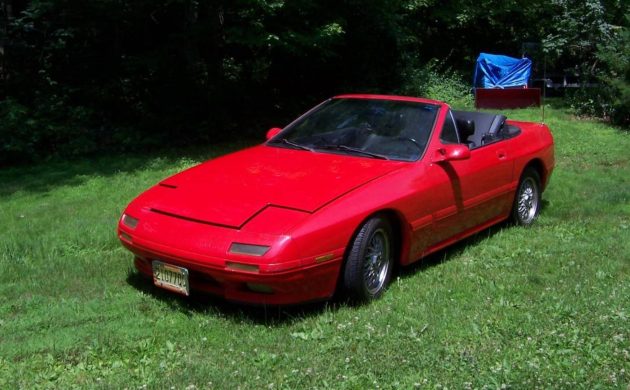
Mazda’s second-generation RX-7 already had a loyal following, but the convertible variant brought open-air fun to the rotary party. This 1991 RX-7 convertible, finished in bright red with a black interior, features a 5-speed manual transmission and a power-operated top with a glass rear window. According to the seller, it’s fully powered, air-conditioned, and equipped with a recently replaced OEM injector oil pump sourced directly from Japan. The car is listed here on craigslist in Hewitt, N.J. and, while it reportedly runs fine, the seller notes that it will need some interior attention and minor fixes before it’s truly at its best. Thanks for the tip Mitchell G.!
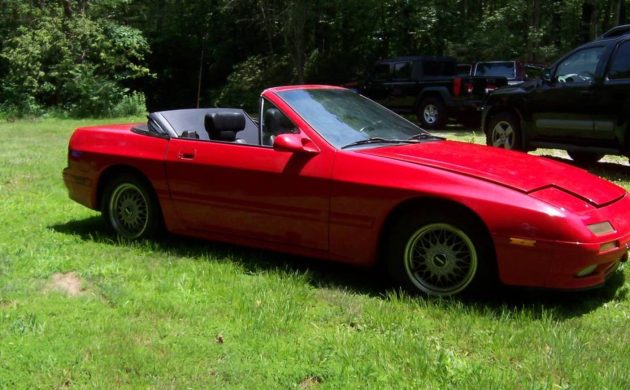
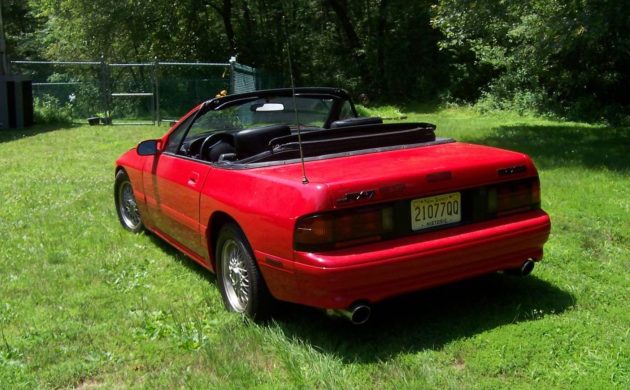
Mazda introduced the convertible RX-7 in the late ’80s as a premium version of its sporty two-seater, aimed at buyers who wanted a mix of performance and luxury. Unlike some rivals, this wasn’t just a coupe with its roof chopped off; Mazda reinforced the chassis and designed a unique power top with a heated glass rear window. This example’s bright red paint still has a good shine in the photos, and the body lines appear straight. Factory BBS-style alloy wheels complete the period look, and the car retains its original mirrors, bumpers, and lighting.
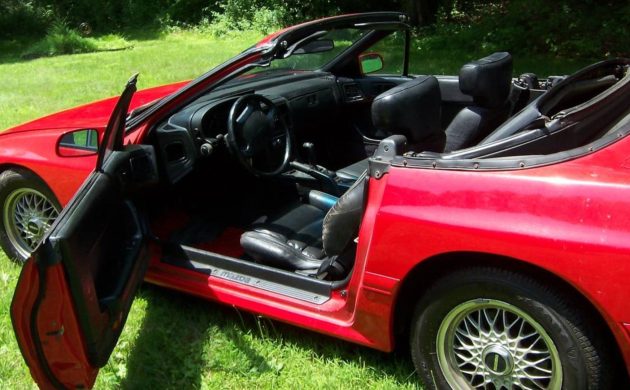
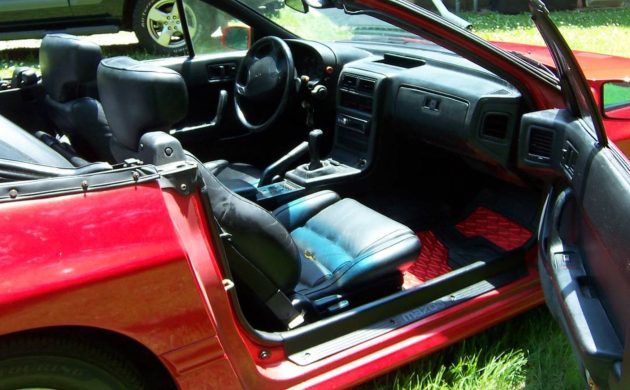
The black interior shows wear, with visible rips in the seats, but remains largely stock. The dash, console, and door panels appear intact, and the seller notes the power accessories are functional. The A/C is still in place, a nice bonus for top-down cruising in warmer weather. Given that these interiors are relatively simple to refurbish, this could be a rewarding project for a buyer who wants to bring it back to show-worthy condition.
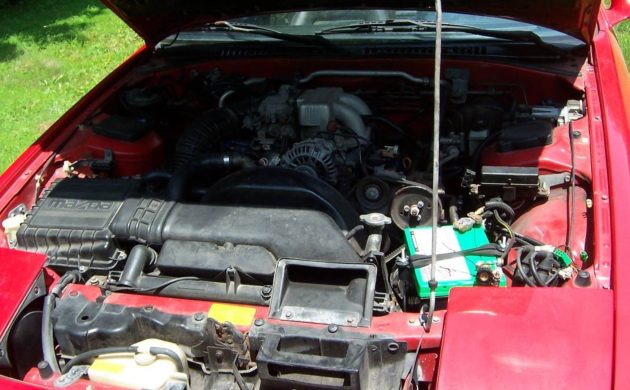
Under the hood sits Mazda’s signature rotary engine, paired with the 5-speed manual gearbox for maximum driver engagement. The seller reports that the engine and transmission are in good working order, with the oil injector pump replaced by a genuine Mazda unit shipped from Japan. A dual exhaust setup adds a sportier tone. Due to a recent hip surgery, the seller hasn’t been able to drive it, so they recommend that the next owner address any minor needs before putting serious miles on it.
With its combination of rarity, fun-to-drive character, and distinctive styling, this RX-7 convertible is an appealing choice for rotary fans or anyone looking for a unique weekend cruiser. Would you restore it to factory-fresh condition, or simply drive and enjoy it as a sunny-day toy?




I hate to be negative, but have owned 3, 2nd generation and found that these do not have the same longevity as the first generation rotary. Actually have owned all 3 versions of the RX-7 and not a convertible as they are a bit heavier. But the 2nd generation was my favorite long distance driver. The handling is great and the engine loves to rev. Got usually 150 K out of the motors. My first generation sold it with 180K and still was going strong. Now my 3rd generation didn’t make 100K.
I’m glad you said something, Cadman, because I didn’t want to be the only one to post something negative about this generation RX-7.
A guy I worked with had one of these in the same red, probably 2009 or so, and it looked good. He said that people kept asking him if he wanted to sell it, and he should have. The guy never had 2 nickels in his pocket and was a single Dad. Since I knew he must have bought it cheaply, I advised him to sell it to the next person who asks, since lack of maintenance is like waiting for a grenade to go off. Sure enough, the car died.
I knew someone with a nice Civic EX that had been parked for awhile, and I got it running and did a bit of brake work on it. I convinced the person to sell it to him on a payment plan, and he did pay on time. Yeah, not a flashy car, but sometimes you’ve got to think of your situation and do the right thing.
I like the styling of these. They always look more of a sportscar than it really is. Although I think the price is a bit steep . I’d pay not more than $3000 for it
If I still lived across the river in Ossining, I’d be across the Tappan Zee in a heartbeat with cash in hand, even though it’s red (not my favorite). I’ve looked at a few of these in the past and always passed on them due to work required or price or automatic transmission or black color (terrible choice for a convertible IMO). Still looking but will probably never pull the trigger. They’re getting harder to find. Another of this ilk is the 94-95 Nissan 300ZX convertible (extremely rare) that a buddy of mine had in a dark purple color that was a treat to drive. He’s moved on to Corvettes (traded a low mileage 2018 for the first mid-engine, 2022?).
Never liked the idea of a rotary. Mazda makes great little normal engines, why something as weird and hard to get worked on as a rotary? Say you are in the middle of nowhere, Mississippi and your Miata breaks down. Chances are Clem at the filling station is good with a wrench (and if he isn’t, Goober or Gomer are) and he can get right on it. Now, your RX7 in the same place? I see a large tow bill on the way to Jackson. Rich guys in Ferraris don’t care, they can afford the tow, but more regular guys bought RX7s.
The idea was that the rotary engine was going to revolutionize the auto industry and would become a new standard. So many autos were designed around the small package – the Pacer to name just one.
When the fuel mileage was reported as being very bad, it killed the marketability of the engine, and only Mazda for some reason held onto it.
So, since the dream never became reality, you are going to have a tough time getting service beyond the rotary specialist shops.
Hate to dismiss this cool engine so easily. For those who don’t know how a Wankel or rotary engine works, in a standard piston engine, the cylinder is stationary and the piston moves up and down. In other words, the combustion chamber is stable. In the rotary, the triangular rotor spins around in a vessel that is shaped a little like Porky Pig, with intake and exhaust ports that are just holes. The tips of the rotor create the dynamic combustion chamber. Hence the tips of the rotors need to have very effective seals. The early cars did not. From 1979 on, the seals were very good, and if you took care of your engine (regular oil changes with filter) they could last 150K miles or more. My own went 160K and even then I later learned I hadn’t needed to replace it.
Part of the beauty of the design was how few moving parts there actually are in it, allowing it to rev very high. In fact, my car’s torque only kicks in around 4000 RPM (the 12A with 4 bbl Nikki carb, to which I have made some modifications). The 13B, slightly larger and with fuel injection was a nice motor too. Both are 2 rotor engines which is the rough equivalent to a 6 cylinder (6 dynamic combustion chambers).
Yes, they didn’t get great gas mileage, although mine gets 21 or 22 on the highway and 16-17 in town, not great, but not shabby either. They also generate a lot of heat given that they don’t have a lot of metal to disburse it. And, they don’t combust the fuel as well as piston engines, requiring additional pollution controls. They also use a little oil to lube the rotors. Mine has a small pump that siphons a tiny bit of oil into the fuel mixture. Some people add 5 or 6 ounces to their gas tank when filling up.
In conclusion, they’re really easy to work on, given that you don’t have to adjust valves or worry about blown head gaskets. So if Clyde or Clem get one in their shop, there’s nothing for them to do that’s exotic. Water pump? Brakes? Exhaust? Clutch? Normal systems and no big deal. Folks who have issues typically don’t do the minor maintenance needed.
Yes, the rotary promised a revolution, but failed to deliver. It was set to go into the GM H-body cars (Chevy Monza, et al.), the Pacer and several motorcycles, but other than the Mazda offerings, the only other vehicle to make it to North American shores sporting a rotary engine was Suzuki’s short-lived RE-5 rotary-engined motorcycle. The other two (2) Asian motorcycle manufacturers, Honda and Yamaha, showed rotary-engined prototypes at theTokyo motorcycle show in Japan, but I don’t know if any were actually available for public sale in Japan. They certainly were never sold here in North America.
https://en.wikipedia.org/wiki/Suzuki_RE5
The poor fuel consumption during an era of “oil embargoes” was a tough sell, but what really helped to do the rotary in was the inability to clean up the Wankel engine’s notoriously dirty exhaust emissions, so it could meet ever more stringent exhaust emission rules.
These are my favorite generation of RX-7, as they were the only version fitted with a drop top and were the first version equipped with an Independent Rear Suspension (IRS) that replaced the solid rear axle in the first generation cars. It’s too bad that your health no longer allows you to enjoy such a fine machine! My sympathies are with you. GLWTS!
I bought a new ’86 RX-7. Really wanted a Porsche 944 but really couldn’t afford it (the dealer I bought the RX-7 from sold both). I’ll never know if I would have been happier with the 944 but I do know that I loved everything about my RX-7. Good luck with the sale and I hope the new owner enjoys it as much as I did mine.
I always thought that the second-generation RX-7 bore more than a passing resemblance to the Porsche 924/944. Depending on your point of view, ether they stole, er,”borrowed” the 924/944’s styling, or were paying “homage” to the Porsche design. Which opinion is correct is largely a matter opinion, so I’ll not add to the discussion further.
I don’t think that there is any doubt that the RX-7 was designed to emulate the 924/944. And Mazda did a great job of it.
Especially with their fast Turbo II model Larry.
This convertible is one generation too late. The first gen. RX7 was a much better sports car.
Glad you cleared that up for everyone. I assume you’ve owned both?