
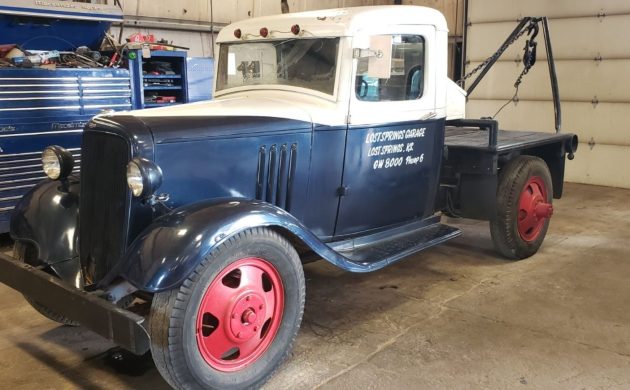
Some vehicles carry more than just mechanical history, they hold the stories of the communities they served. This 1935 Chevrolet tow truck, now offered here on eBay, is one such machine. Once a working rig for Lost Springs Garage in Lost Springs, Kansas, it served the area through the 1940s and ’50s, hauling stranded cars and trucks from the roadside. It was rescued from the collapsing garage about 40 years ago, given a fresh coat of paint to match its period look, and occasionally pressed into parade duty. The seller notes it’s very solid, with no mention of significant rust, and while not restored to show condition, it’s a fully recognizable piece of working history. The PTO-operated wrecker winch is still functional, and the original paperwork and title are included.
Painted in navy blue with a white cab roof and red steel wheels, the truck retains a look close to its working days. The hand-lettered “Lost Springs Garage” on the doors adds authenticity and charm, even if the paintwork is described as a “garage job” rather than a high-dollar respray.
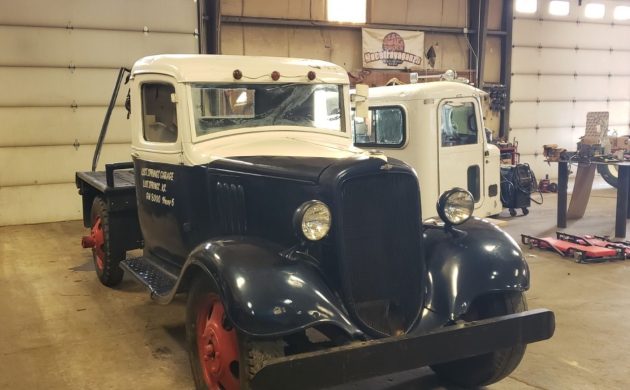
The flatbed-style rear carries the tow boom and chain assembly, with dents and dings telling a story of decades of honest work. The seller emphasizes that while it’s not a show truck, it draws attention everywhere it goes.
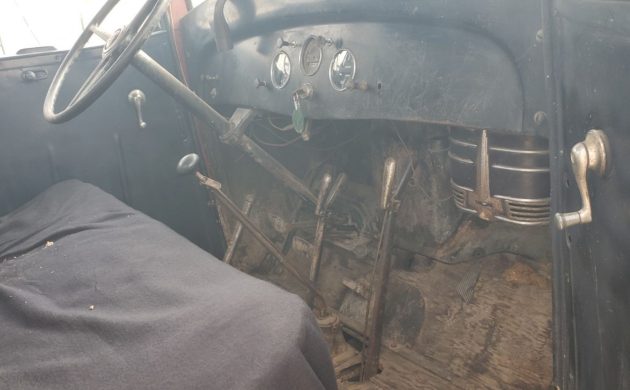
Inside, the cabin is basic and purposeful, typical of a mid-’30s work vehicle. The seller hasn’t addressed the lighting or hydraulic brake system, but reports the hand brake works well enough for yard driving.
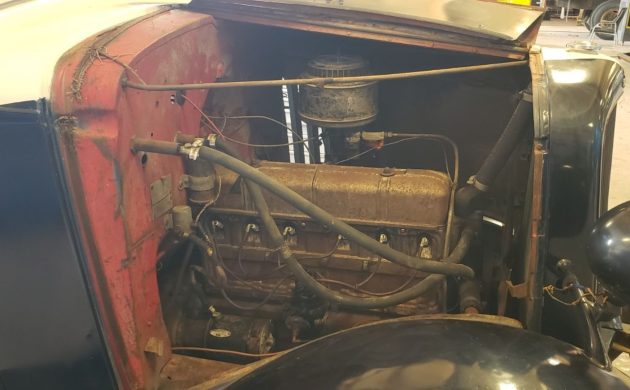
The inline-six engine has received fresh gas, a new fuel pump, spark plugs, oil, and antifreeze. The seller recommends completing the tune-up with points and wires for optimal running. The PTO-driven winch reportedly operates as it should.
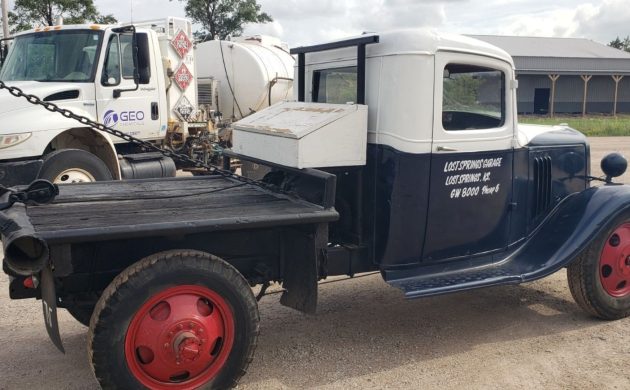
This Chevy is a rare surviving example of a small-town service vehicle—one that worked through an era when rural America relied on local garages to keep them moving. Its patina and imperfections are part of its story, and for the right owner, it could continue as a parade piece, be sympathetically restored, or even preserved exactly as-is. Would you keep it in parade-ready working order, or give it a full period-correct restoration?



Amazing find, rolling history.
Very sweet little truck. And the fact its still functional is amazing. Love the history too
Nice to see one in this condition rather than rusting away in a field.
Hired a guy with a truck like this to come to my college dorm parking lot on a Sunday to put the engine/transmission in my ’53 Studebaker. Cost me $20.
keep as is, towers in the 40s, 50s, 60s were much like this, not show pieces and highly respected any time you needed roadside help. Note that the owner must have worked many early morning, late night tows, even during winter–this one has a heater. Spit and polish would be a disservice to it’s lifelong existence, keep it as is.
Calling Gus Wilson!
Who else–proprietor of the great Model Garage!
Finish the tune-up, check the brakes and drive, drive, drive it!
Yes, bring them on! Old Chevy’s are good trucks too. This one would still be sporting a wood frame in the cab and doors so if the wood is in decent shape the truck would be good for years.
From the 30s to the early 50s you would likely see some variants from the GM clan. Here’s a ’35 Maple Leaf, which is essentially a GMC that was sold through Chevy dealers in Canada.
Don’t think that’s the original engine under the hood; it looks for all the world like a good ol’ 216 (’37 – ’53) in that bay. Still a babbitt-pounder, similar to the original 206.
This truck would get my vote for prominence in my driveway. Not many of these at the cars-N-coffee on Sunday morning…
I rescued this 38 Chevy from behind an old lumber yard. It had been very deluxe, having a Weaver Power Auto Crane 3 ton wrecker unit, powered by a gasoline engine, which in turn was started by an electric motor. I have gathered parts for many years – including NOS rear fenders! I traced it’s history back to a nearby Chevrolet dealership, suspect it was their pride and joy in 1938.
Now I just have to live long enough to do something with it. Trucks like this have limited use – nice for parades, local shows and just the pride of ownership. They’re not so much fun if you have a ways to drive with modern traffic. If touring is a goal, find something more modern and FUN to drive.
Gone.
Sold for $7500. Nice to see such a wonderful piece of auto history being kept for other to enjoy.
geomechs, I agree with the 216 assessment. Cool old truck!
I neat truck to have for local shows, coffee and cars, and parade use.. I hope the new owner keeps it like it is!!!
Cool Truck!
I worked at a small garage back in the early 70’s that had a ’58 Dodge Tow Truck, single winch line similar to this truck. No power anything, except when we had a 60s Caddy or Lincoln on the hook, then we had power steering! A non-synchro gearbox provoked the driver into exercising their flowery cuss words.
Very cool old wrecker. Kind of an oxymoron–today you usually see modern Chevies on Ford wreckers (LOL) !
That sure was priced right for a quick sale
Anybody know what all the levers in the driver’s compartment are for? Looks like it has two emergency brakes, and maybe another lever besides that. The gear shift has what looks like a lock out for reverse.
My best guess would be a “parking brake” for the PTO/winch
Brake. PTO. 2 Speed Axle on shifter?
Bovey, Not likely a two-speed rear axle “splitter” on the shift lever. Those didn’t come along on GM trucks until the 1950’s. Then, in heavier applications, you’d see air-powered axle splitters. You can definitely tell if there’s a two-speed axle, not so much by the gear shifter, but looking for the electric motor or a vacuum pump on the rear axle.
The lever to the left of the driver is the PTO which may run both ways, in/out up/down. The lever to the right of the driver is a brake on the cable spool. The transmission is a stright-cut sliding gear Muncie, the little lever is a reverse lockout. The lever to the right of shifter is the parking brake (parking brake levers are most always to the right of the shifter)
Jim, Interesting about the reverse lockout on the gearshift. Our 1964 Ford Falcon had a similar reverse lockout on the floor shifter.
There appears to be a lever on the far left side by the kick panel. My guess is that’s the PTO engagement lever. The next lever to the left of the shifter would be the parking brake. Then you would have the shifter and I think that 356A said would be a brake for the PTO chain. The only thing that I have ever seen like the switch on the shifter (other than trans brakes or line locks on drag cars) is 2 speed rear differential gears. But back then they used vacuum shifters and I doubt that this has a 2 speed rear diff. IDK. A one else got a,clue?
Looks like it sold, bringing $7500. Nice price for such a classic piece of Americana. I hope the new owner treasures it. Would have loved to have it, myself. My mom was raised in that very town. My dad was born in Abilene, KS. At some point, his family moved to Florence, KS, and when the Cottonwood River flooded in 1951 he moved in with a cousin in Lost Springs. He worked as a mechanic for many years all around that area, so very well may have driven this very truck. He was well respected around the region, and people knew that my mom’s mother was soon to pass away from cancer. This would leave my mother with nowhere to go. So several people conspired to get the two of them together, and they were married on June 15, 1952 in the little church there in town. They remained faithfully married until dad’s passing in April 1987. Mom remained a single widow until her own passing in January 2017
Dale M., nice story. Sorry to hear of your parents’ passing. My Dad passed in 2001 and Mom is still charging away at 95. She even still drives to the local store. But that’s as far as she is allowed to go.
Nice to see a vehicle that brings home town memories.
Thank you, Wayne. They raised myself and my siblings to be strong, so I’m good with it. Neither one was really recent, and sadness has a way of fading somewhat with the passage of time. My intent was primarily to outline my connection to the area.