

As a Corvair owner of almost 20 years, I’ve long endured Ralph Nader jokes at gas stations, in parking lots, in my nightmares…but the reality is that Ralph Nader is most likely responsible for the car you see here, a 1968 Corvair Monza. GM decided to stop updating the Corvair in April 1965 because it was thought to be unable to directly compete with the Mustang. Unsafe at Any Speed wasn’t even published until November 1965, so without the book, the Corvair almost certainly would have been canceled when the Camaro was introduced. Because of the negative publicity surrounding Nader’s book, it is widely thought that Chevrolet continued building Corvairs to “save face.” So the Corvair soldiered on, selling in small numbers, through 1969. This ’68 model is presented by its owner on Marketplace in Grand Rapids, Michigan, as a “time capsule” with “only 17,037 original miles.” And because it’s a Corvair, one of the most inexpensive collector cars you can buy, its asking price is $5,000.
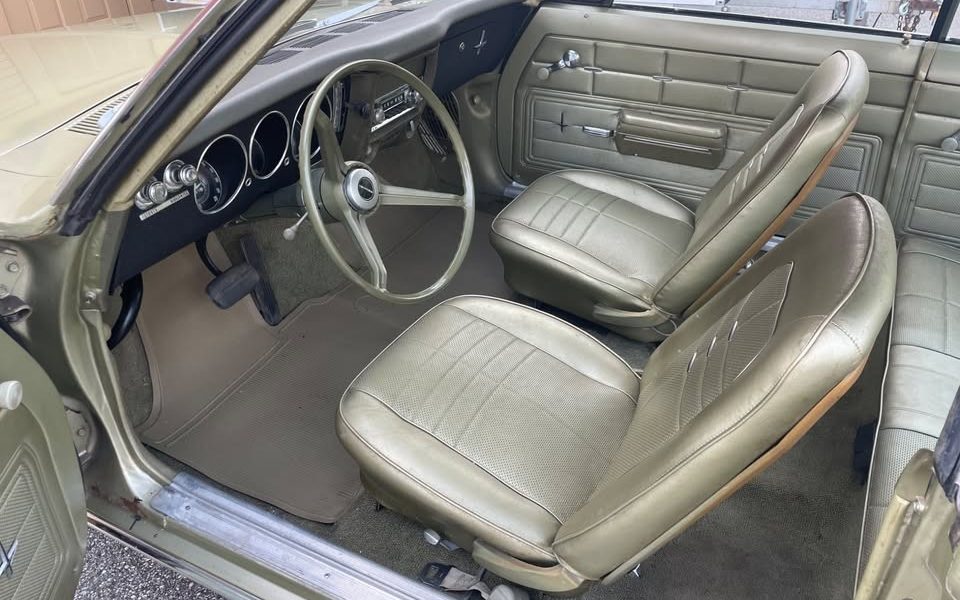
Because this is a Michigan car that was driven by its first owner until 1978, it is not rust-free; there is rust in the lower front fenders (like there is on most second-generation Corvairs), and you can see a little in the lower A-pillar in the picture above. Corvairs used “flush and dry” rocker panels that drained the cowl through the A-pillar, through the rocker, and out a flap in front of the rear tire. Unfortunately, water is not the only thing that got in: leaves, twigs, and dirt all drained down into the fender and created a nice sponge for soaking up moisture. Honestly, the corrosion on this car could be cleaned up, treated, and blended in, in my opinion. There’s probably no need to get too invasive (but you never know with rust).
But look at that interior. It is in spectacular original condition, and it even has an original matching floor mat that covers the entire flat floor. Some minor changes in 1968 included more substantial dashboard padding and a new steering wheel. Outside, a set of side marker lights (white in front in 1968, amber in 1969) was pretty much it.
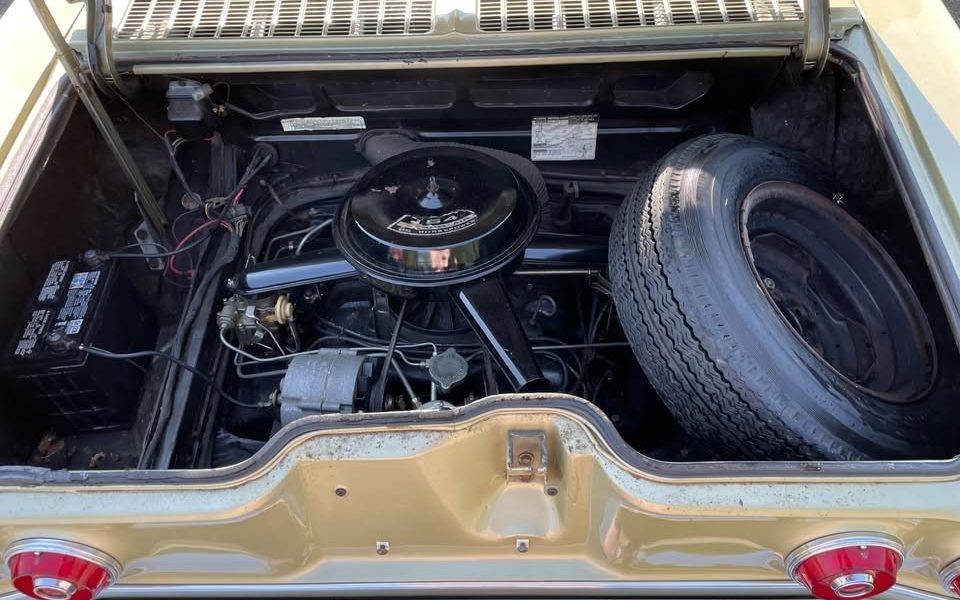
Under the engine cover is the base 95-horsepower 164-cubic-inch flat six bolted to a Powerglide automatic transaxle. Now’s not the time to get into it, but if you’re at all mechanically-minded, it’s worth your time to study how power delivery is handled in a Corvair; it’s a game of back-and-forth. By the way, some of the biggest Corvair stories are less problematic than you might think; for example, the Corvair doesn’t throw fan belts on every trip to the store (at least in my experience). I threw one early in my car’s ownership, and I soon learned that the trick is to set it up a little loose. I’ve had no problems since.
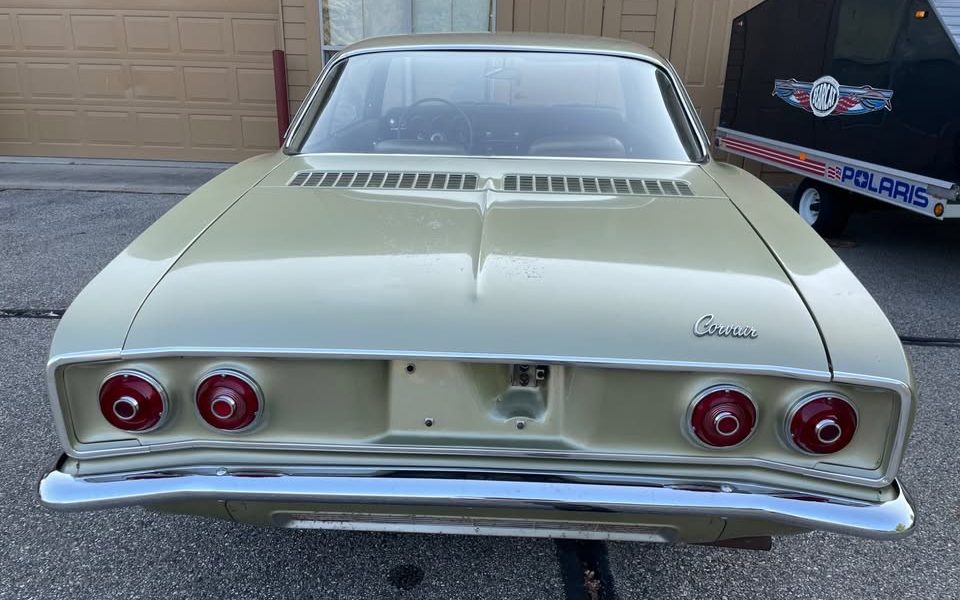
The seller’s ad is refreshingly complete and honest, and it shows pictures of the flaws in the “Ash Gold” paint and tells us the worst news: This is not currently a car you can drive. It will “run briefly on starting fluid but will not run on its own.” It needs a gas tank, and being a car that has sat for some time, probably quite a bit more than that. With that being said, the second-generation Corvair is almost universally regarded as a beautiful car, and it’s very hard to find one that hasn’t rusted into oblivion or been treated to myriad owners’ questionable mechanical abilities and decisions. Five grand seems like a pretty good price for such a low-mileage car, even one that’s been a bit misunderstood over time.




Chevy should have paid a little closer attention to Don Yenko with the Corvair especially, but then they’ve that rep at GM for giving more thought to the accountant’s projections and not the engineers.
I’m telling you, only the Shadow knows what’s behind those garage doors. While I sympathize with the author, tis’ no shame in a Corvair, Laddie, Nader or not. We just can’t get through one Corvair post without mention of that. By rights, the Corvair should have been the most innovative, unconventional US car made, and that was it’s downfall, not Ralph Nader. While Europeans knew full well the advantages of a car like this, Americans just didn’t get it. Didn’t want to get it. We were bamboozled into thinking WHAT? Engine in back? No coolant? Haw, haw, and what heats the cabin? Some gas bomb in the trunk? KABOOM. A VW by any other name, many thought. Nothing was further from the truth. Corvairs were simple, well engineered cars, and this style was the best we’d seen in years, EXCEPT,,it was still a Corvair. Like AMC was still a Rambler to many. While the fan belt was troublesome, an auxiliary pulley solved that, and a Corvairs biggest nemesis, was the pushrod tubes. Like VW, it required major engine dismantling, and with re-refined oil at 5qts for a buck, it was a lot cheaper to add oil. Those oil strips on old highways? Yep, Corvair and Detroit diesel, of course. I remember Corvairs with the entire rear covered with oil, wagons were worse. Grandma held out to the bitter end on selling her cherished Corvair, turn, turn, turn,,, a wonderful find. That spare tire looks like original bias-ply, so it’s the real deal.
Honestly, the whole Nader-joke deal is less of an issue now than it was even five years ago. These days, most people ask me what it is! But I’ll bring him up for the sole point of discussing that he was NOT the reason for the Corvair’s demise; it was the issues you mentioned and the proliferation of more powerful and traditional sporty, small cars.
I think another major issue for GM was cost. Between materials and labor, that Corvair flat-six had to set GM back more than, say an SBC to cast, machine and assemble.
As for handling, the worst issue was keeping the tires aired up, IMO. Learned this to my surprise and dismay when I ground-looped my sister’s ’63 Monza; the rears were down to something around 8 psi. Oddly enough, my other sister had a ’61 coupe her ex-husband fitted with wider wheels and a set of Goodyear Sports Car Special tires he got from a racer we knew. That thing handled beautifully and I had all kinds of fun pushing it on mountain roads.
I don’t even mind that this particular car is an auto. The P-Glide was pretty well-matched to the engine, and did very well for a two-speed. Still, in a perfect world, I’d want a four-speed.
I’ve never lost my appreciation for Corvairs. This one looks a very good deal.
It’s an American VW
Or maybe an American Porsche is a better comparison?
To me, the real story about the fall of the Corvair is told by the Chevy II. After less than a year on the market, GM panicked and started a crash program to build a Chevy Falcon. Nader probably hadn’t even heard of the Corvair yet. And the way all those body styles dropped off until the second generation had only three left…it’s really a shame. But I believe that Nader did keep it alive for at least a couple of extra years, and I’m glad he did.
The Chevy II program was partly the result of perceived buyer resistance to the Corvair’s unconventional engineering and partly the result of the high cost of Corvair production. Each Corvair cost nearly as much to build as a full-sized Chevrolet, yet had to sell for much less. GM repositioned the Corvair as more of a sporty offering once the Chevy II arrived. “Unsafe At Any Speed” wasn’t exactly an endorsement, but you’re correct in that it did extend the Corvair’s life. GM leadership was reluctant to discontinue the car, fearing that doing so would be an admission and open the company to lawsuits.
My parents had a ‘64 4 speed Monza convertible. The only problem it had was oil leaking on the grille located under the rear bumper. I cleaned that for them usually more than once a week. Fun car that I remember had a plastic clip on each side just behind the rear seat. Those clips held the top down after you lowered it by hand. Very easy job. We all enjoyed that car.
Requesting On and On.
Been tardy Mike, just saw this post. I responded above. Still hoping to see you this summer with some ribs and sweetie pie’s cheesecake.
My favorite feature, as a kid, was the heat duct in the rear seat.
BTW. Guess where the Corvair flat six aluminum die cast die ended up? Johnson Outboards in Waukegan Illinois. It was number 69 die cast machine and it was the biggest on the floor at the time. I worked in machine repair and the machine was a monster for it’s day. Soon the machine would be outsized by enormous machines as the engines and parts got bigger. Owning a Corvair, I was sick about this purchase of the die because it meant the absolute end to one of the most innovative cars in the American market.
I used to work in a motorcycle shop outside Schenectady, NY, and half the race bikes we saw had parts made at the huge GE plant there. Did you ever think about becoming a secret supplier to your Corvair buddies?
solid deal here. didn’t take long to sell it looks like.
If this car was closer, it would be mine !
And if my Aunt had nutz she’d be my Uncle.
Have owned a ’63, ’64 (Spyder), ’65, and a ’66. Love Corvairs! Would like to find a well-kept, well-priced late model Monza coupe here in Florida as my last collector car. Need not be perfect, just rust free and mechanically sound. I can still handle cosmetics, but at my age I’d rather not have to do any crawling underneath. Four-speed preferred, but will consider PG if price is right
I have a nice little unrestored 64 Monza 55K on it. They are far better driving/handling cars that any of their competitors form the era in stock form. They weren’t good cars. I fixed all the typical oil leaks on mine when I bought it. It was pouring out everywhere and on the drive home I would have to roll down the window and stick my head out at stops. It stayed dry for like 3-4 years. It leaves small spots on the floor now.
I’d like to have a second series Corvair, but it has to be a stick shift. An earlier wagon would be cool, but decent ones are difficult to find.
Uncle had a new Porsche in 1963, friend had a new Corvair. Got to drive both off and on. Much preferred the Corvair. You had to pay strict attention every second with the Porsche at speed. You could relax in the Corvair. Around town they were about equal. But one other person fit in the Porsche, and you really could put 5 adults in the Corvair (with bucket seats in front, 6 with a bench seat in front.)
I am very impressed with the video …
CORVAIR IN SWAMP _ VINTAGE 1962 CHEVROLET FILM
This is a steal. I wish I was closer
In it’s present condition at 5k this Chevy is worth having regardless of how you feel about the Corvair. This is a savior car. Too bad it’s not a Spyder it would be worth twice as much in it’s present condition.
Spyders were only 1st generation. Corsas were ’65 & ’66 only.
As the owner of a ’67 Monza…I miss the Corvair!
Is Chev bringing it back, possibly as an Electric Vehicle (which I have no interest in)? I recall seeing some sketches, recently, of a prototype and it has some resemblance to its roots. I liked it!
Bargain
Sold
Another Uncle, this time on my mother’s side had a couple of Corvairs. A new 1961, black, beige interior, 3 or 4 speed on the floor. I was 8, I really don’t remember. I do remember going to the drive-in movies with him and my grandmother. It was winter and he had to keep the key on for the heater or maybe the sound came through the car speaker, again, can’t really member. I know he was pissed because the red idiot lights were distracting, so he threw his jacket over the steering wheel and dash.
Pops had a ’64/’65 Covair convertible for a little while. I was probably around 20. He’d never let me drive it. One thing I found odd on that Corvair was the automatic transmission lever was a tiny chrome switch on the dashboard. First time I had ever seen that. I’ve seen on the steering column, on the floor and push-button on the dash and steering wheel (Edsel) but never a lever on the dash. Not until the 1990s when Dodge/Plymouth/Chrysler minivans had that. And those were huge compared to the Corvair