
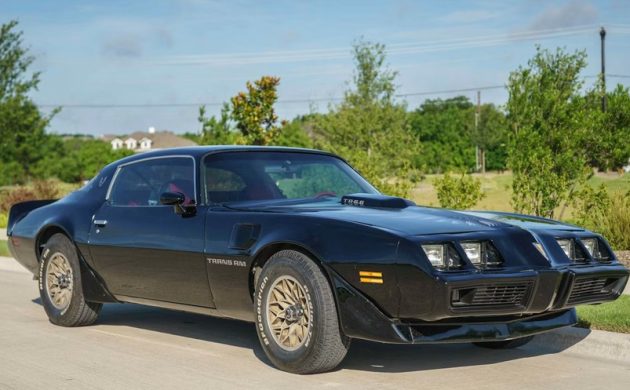
For the second-generation GM F-body Trans Am, the transition from the 1979 to the 1980 model year was visually very minor. From a drivetrain perspective, it represented one of the most drastic shifts in American performance history. As tightening federal emissions standards forced Detroit to retire high-displacement powerhouses like the Pontiac 400 and Oldsmobile 403, the Trans Am’s legendary street presence was suddenly left without the mechanical muscle to back up its aggressive styling. However, for this 1980 Trans Am, a prior owner has swapped the original engine for a Chevrolet 350-cubic-inch V8. This car is listed for sale here on Hagerty Marketplace and has bids up to $16,000. It is located in Rockwall, Texas, just east of Dallas. Many thanks to PRA4SNW for sending us this listing.
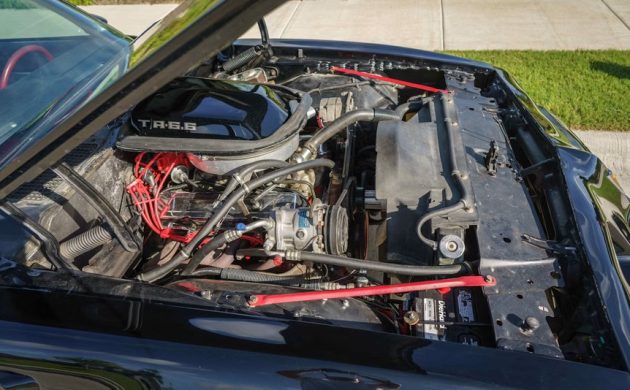
The Hagerty listing highlights a “father-and-son” build that underwent refurbishment starting in 2015. While purists may balk at non-matching numbers, the market’s response to this build underscores a growing appreciation for reliable cruisers. Decoded by its VIN (2W87WAL107476), this Trans Am originally left the Van Nuys, California plant equipped with a naturally aspirated 301-cubic-inch V8. In its place now sits a Chevrolet 350-cubic-inch small-block V8 fitted with a Holley 600 CFM carburetor, tubular headers, and a dual exhaust system terminating in iconic quad split tips. Power is delivered to the rear wheels via a GM three-speed automatic transmission. Visually, the car looks original, finished in classic Starlight Black with multi-color “Screaming Chicken” hood graphics, front and rear spoilers, and 15-inch aluminum snowflake wheels.
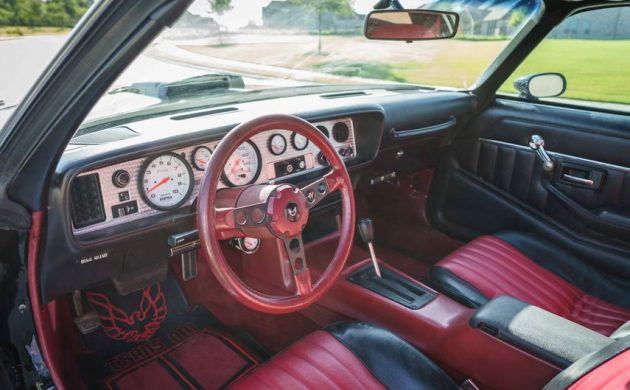
The interior is a different story from the exterior. It has been modified with custom upholstered seats and aftermarket gauges. While 1980 buyers could configure their interiors in standard vinyl or deluxe “Hobnail” cloth in shades of Oyster, Black, Camel Tan, or Carmine Red, the builder of this Trans Am opted for a striking custom theme. The seats have been reupholstered in black vinyl with red pleated inserts, complementing a modern engine-turned dashboard bezel. The cabin is further upgraded for modern usability, housing a suite of AutoMeter digital instruments, an aftermarket air conditioning system, and a Sony head unit.
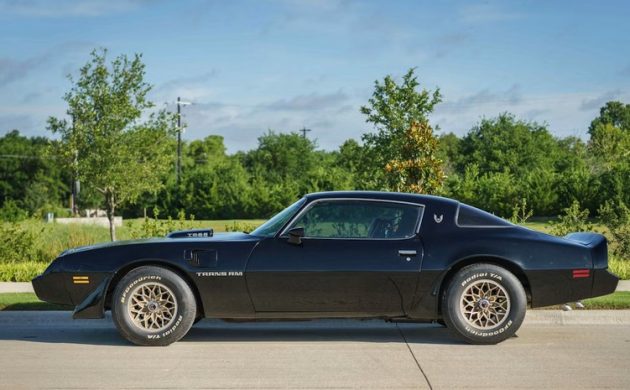
Historically, 1980 marked a steep decline in Pontiac’s pony car sales. Following a record-shattering 1979 model year where Firebird production exceeded 211,000 units (including more than 117,000 Trans Ams), production plummeted. In 1980, Pontiac shipped just 107,340 Firebirds in total, with the Trans Am accounting for 50,896 units. The primary driver of this sales collapse was under the hood. The factory engine lineup was thoroughly compromised. Pontiac attempted to fill the performance void with the ambitious LU8 Turbo 301, which produced 210 horsepower but developed a reputation for detonation issues, heat management problems, and a lack of aftermarket support.

Never understood why they didn’t put 350’s in these anyway. Just from comments on these, the 301 is a trash motor. I don’t know first hand. It seems like Pontiac could have done something better for these cars.
I am all for a tasteful resto-mod on post emissions cars. I dont want a 1000 hp fire breathing demon. These cars should at least match the performance of their 60s predecessors. Modern power with actual fuel mileage so it can be driven. Update the suspension and brakes too.