
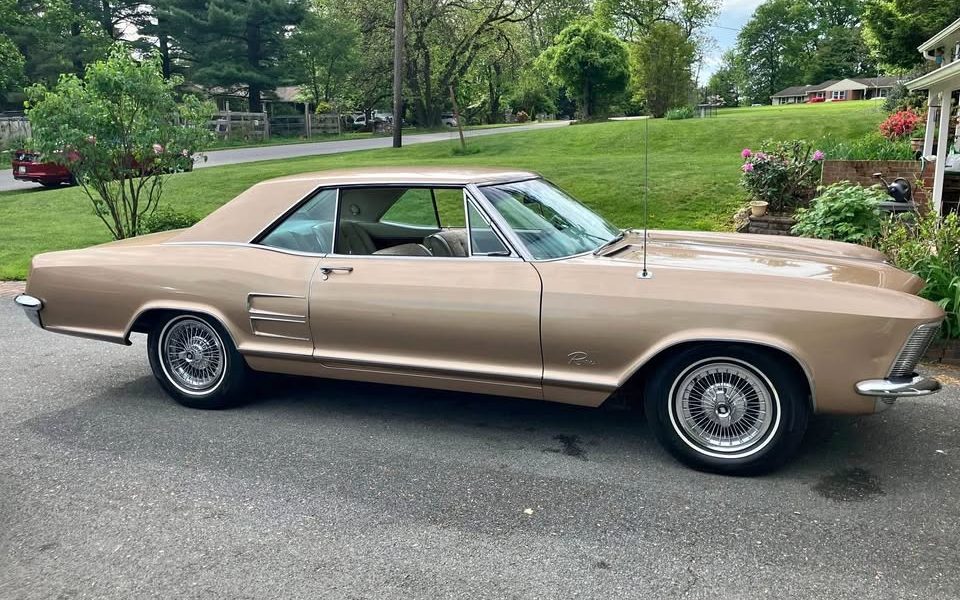
With exactly 40,000 Rivieras built for the 1963 model year and an anecdotally decent survival rate, there’s usually one for sale whenever you’re looking; however, as a guy who spent 20 long years looking for his, I know that it’s hard to find that one that overlaps your price and condition guidelines. Our experienced Barn Finder T.J. saw this one on Facebook Marketplace in Mt. Airy, Maryland, and perhaps it fills out your Riviera bingo card. It’s a 74,000-mile unrestored ’63 with mostly original paint and the top engine option, all for a fairly reasonable $25,500 asking price.
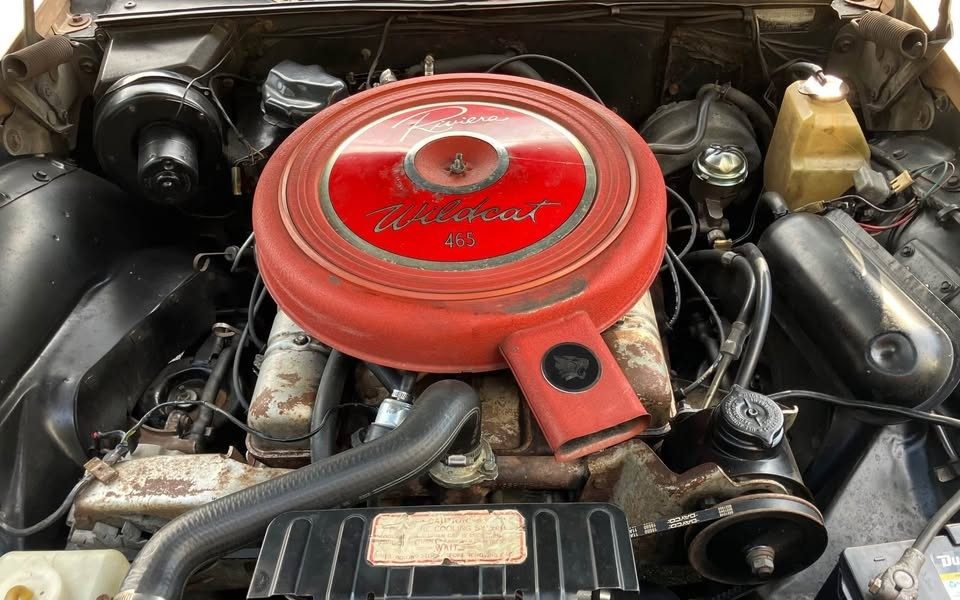
You might be asking, “What about that engine option, Aaron?” It’s the “Wildcat 465,” which is Buickese for the 425-cubic-inch Nailhead with 340 horsepower and 465 lb.-ft. of torque (assuming the air cleaner isn’t lying to us). It didn’t come online as an option over the 325-horsepower, 401-cubic-inch standard engine (the Wildcat 445) until some time in December 1962, and only 2,601 people chose that $48.38 option. For the Riviera’s inaugural year, all engines were painted silver, and from the original examples I’ve seen (mine was one of them), the paint didn’t hold up well over time, so the 74,000-mile claim is most likely accurate.
Aside from the silver engine, another 1963-model calling card is the vacuum tank on the driver’s side fenderwell; the 1964 models got a redesigned brake booster that eliminated it. You’ll notice that this car does not have air conditioning, which might hurt its value to some extent, but it certainly aids spark plug replacement on the passenger side bank (fun fact: the #1 cylinder on the Buick Nailhead is on the passenger side, unlike most GM V8s that start from the driver’s side).
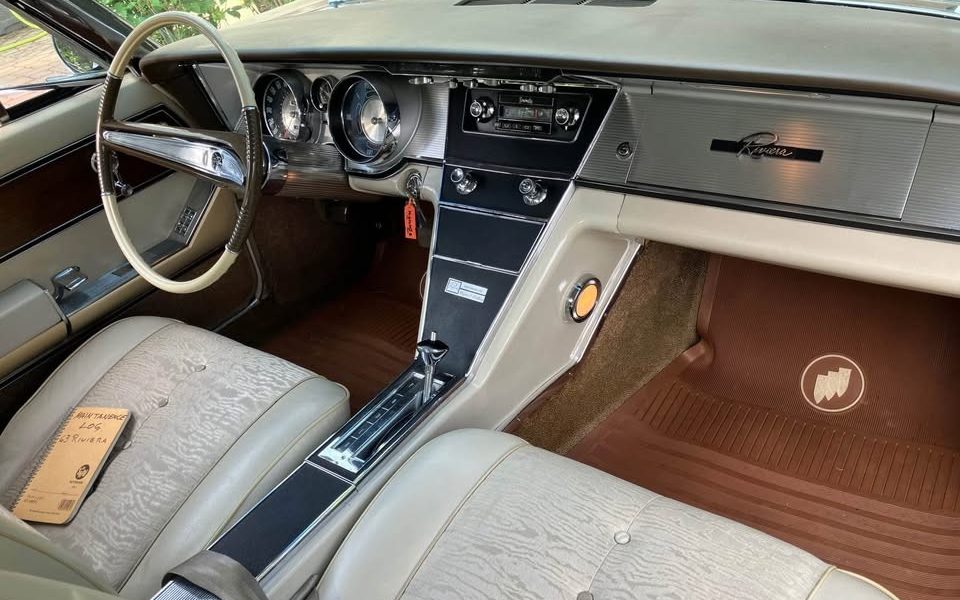
A feature that tempers 1963 Riviera values to a small extent is the transmission, the “Turbine Drive” automatic (aka Dynaflow) in its final year of availability; because it never shifts, it takes some getting used to. Due to the sound of the engine accelerating and lack of first-gear multiplication, some drivers feel as if the car is more sluggish, but in reality, it’s mostly perception. Many owners of ’63 models also know that you can select manual low and leave a tremendous black patch on the pavement; I may or may not have done that a couple weeks ago while out on a country drive.
This Riviera has the optional “Custom Trim” package, which included wooden accents on the door panels, power windows, and double door handles on each door panel (the rear passenger could then open the door to exit the back seat…a bit of a gimmick). Many Rivieras have cracked dash pads, but this one looks excellent.
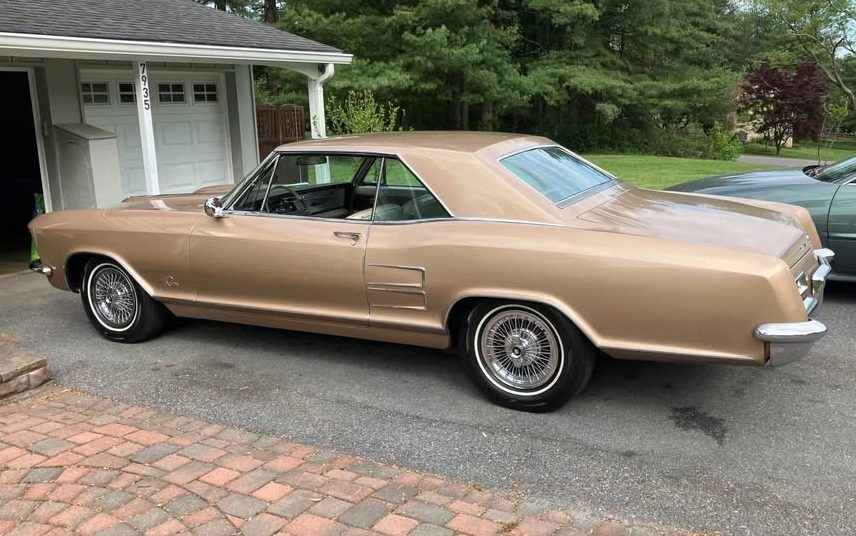
It’s not really an opinion at this point to say that the 1963 Riviera is a styling masterpiece; experts have been saying that since Tom McCahill gushed over the car’s looks in Mechanix Illustrated. This one is painted Bronze Mist (one of 3,077 with that paint color) and has the optional wire wheel covers (final fun fact: the Buick Rally wheels were not available on the 1963 models). You may not be as enamored by the ’63 Riviera as I am, but this is a really nice example that is most likely priced about where it should be, with perhaps a little room for negotiation. The lack of air conditioning may be a turn-off for some, but if you live in a northern climate and don’t mind having the windows down (I’ve been driving old cars my whole life, so it’s second-nature to me), this might be the one. Learn from my mistake, and don’t wait 20 years to buy yours.




My father was car shopping in the fall of 1962 at our local Buick-Pontiac dealer and was struck (figuratively) by a Spruce Green Riviera with the Saddle leather interior. Unfortunately, he didn’t feel that the driver seat would retract far enough for him to be comfortable in it and he ended up buying a Grand Prix instead. That was fine as far as I was concerned, although getting him to let me borrow it almost took an act of Congress.
That is indeed a problem with this generation Riviera (and other full-size Buicks, I believe), and the specifications for front legroom bear this out. I flipped the front floor mount brackets 180 degrees and drilled extra holes in the rear seat brackets for an extra inch of legroom in mine (someone in the Riviera Club made that suggestion), and it made a lot of difference. With my seat all the way back, it’s just about right, but I’m 6’0″ with a 32/34″ inseam; if I were any taller, I’d have to build extension brackets somehow.
Does the car have dual quads?????
Not in ’63, Kelly. The “Super Wildcat” didn’t come around until 1964, and it was rated at 360 horsepower.
Excellent write-up Aaron. Full of details and interesting information. It obviously was a styling triumph. From the minimal info and pics in the ad, this one looks good. I can visualize taking it on a windows-down cruise on country roads, or maybe a trip from the suburbs to the city park to take a pleasant walk on a warm summer evening.
Agreed – great job Aaron. There is nothing like reading an article written by someone with intimate knowledge of the subject. Us BF readers really benefit, and appreciate it!
Thank you! I love these early Rivieras.
My uncle had a silver Riv from this era. He loved that car. He worked at a high school and the shop at school kept it running for years. However, it had no air conditioning, like this one for sale. Get this…he lived in St. Louis! He was part of the WWII generation…tough guy.
My friend Junior had one just like this one and it drove and road perfectly!
When I re-did my door panel with the wood accents, I used a nice Wilsonart laminate, as the wood was long gone. I removed those panels and on the back of the panels was stamped “TERNSTEDT COLUMBUS”.
I googled this, and found that Ternstedt was a Detroit-based company that supplied interior parts for GM cars. In 1946 Ternstedt built a large plant on the West side of Columbus, which basically led to the development of that entire side of town. As a kid I remember that plant ran 24-hours a day.
Fisher Body would eventually buy Ternstedt, and the plant would be called Fisher Guide. The Guide name can be found on just about every GM tail light of the 1960s and 70s. It’s cool to know my Riv has a hometown connection.
Most of those taillights would have the year of the car on them as well
Wow Rex. I’ve always wondered since I was a little kid why all GM tailights had Guide on them…. ( I must have been a unique kid reading tailight lenses lol) I honestly had no idea. And I forgot all about it until you just said something. This is a great write up Aaron, I enjoyed it a lot. I’m kind of surprised that more people didn’t get the Wildcat 465 option.
One of the best looking cars ever made.
The downside,as I’ve read,was the dismal
gas mileage.
I’m sure it was equal to most cars in its category in 1963. Mine averages about 10-11 miles per gallon (same as my ’63 T-Bird), and it’s gotten as much as 13-14. Not great, but in reality, given the number of miles a collector car is driven these days…
The gas mileage in 1963 wasn’t important when gas was 29 cents a gallon.
Nowadays, even the high-octane ethanol-free gas I buy is less than $4.00 per gallon, which in 1963 dollars is probably 50 cents.
I own 3 old cars with 400+ cubic in engines, and I never give a remote thought to gas mileage. If you can afford the car, you can afford the gas.
I’m with you and Aaron. How much do you drive a classic car in reality? Even if you decide to drive it to work on a sunny day, its still just occasional. Modern day gas goes stale quick. Personally I’d rather get 10 mpg to keep that gas moving out of the tank to top it off with fresh gas. ( of course theres also Stabil, but driving I’d think would be more fun.)
When the weather is nIce here I’ll drive my Mustang all week. Granted I’m retired and don’t have to commute anymore and starting in the nineties even V8’s were more fuel efficient than they were. Fuel injection, roller cams, clutch operated fans, free flowing exhausts and over drive transmissions make them more practical to drive more often. But as much as I like cars from the sixties I wouldn’t own one unless I could afford to drive it only occasionally. And I like driving too much. For my daily driver I have a four cylinder Buick, and that thing will surprise you.
I’m with you guys as well. These cars are going to sit in the garage and only come out for the occasional joyride on a nice day / evening. No need to worry about gas mileage, having A/C, etc.
i have a customer with a 63 riv original owner and his car is a 401 with the same air cleaner and same markings on it and same color engine. i have been working on this for the last 30yrs. these are really cool to drive.the Dyna flow takes a bit to get used to. fair price for a nice clean piece. the 63-64 rivs are a bit more affordable than the 65.
Yep, the only obvious visual difference between the ’63 401 and 425 was the number under “Wildcat” on the air cleaner: 445 vs. 465.
In 2011 shortly after I was unceremoniously retired due to having a pacemaker/defibrillator put in my chest I spotted a 1964 Buick Riviera for sale on Craigs list in Northeast Texas. I showed my wife the picture and told her I would like to see it. She agreed telling me about one her dad owned years before. It was blue but the original color was code nn which is Coral Mist top and bottom. The car originated in Southern California and was then owned by a nephew of the original owners. My wife and I both loved the car so we reached a price and bought the car showing 28,000 miles on the odometer. My wife passed in 2021 but I still have the Buick tucked neatly away in my garage for nice day driving. These cars have coil springs on all four corners so they have a very soft ride. The 425 with 400 transmission will burn the rear tires off if you let it. Mine has air conditioning, electric windows and seat. It’s a hoot to drive and everyone loves it and asks more questions than I have answers for. I love to go to Freddy’s steak burgers in Katy, Texas on Wednesday evening when other old cars show up. The food is good, the people are fun and it gives an old man (78) now a chance to mingle.
God Bless America
A swell Buick, as per milage my 4.8 chevy only gets 14 miles per but then its a rather a muscle truck though there other. goodies. I think that I may have grown up a bit and look again for an early 56-57 Buick wagon …HECK I drive less that 10 miles most days.
One of the cleanest designs in American automotive design in my humble opinion.