
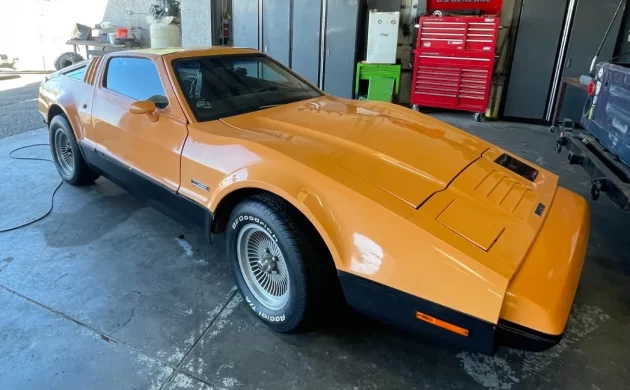
Have you ever thought of scoring a unique, almost one-of-a-kind, little sports car to impress your friends with? Here’s a chance at one, a 1975 Bricklin SV-1 to be exact, and the number attached to it is not daunting. What’s the cost? $13,000 or best offer, for a car that’s here on ebay and needs picking up in Scottsdale, Arizona. Will you drive it home? Might be you could, as it’s a garage-kept, well-maintained example of its type.
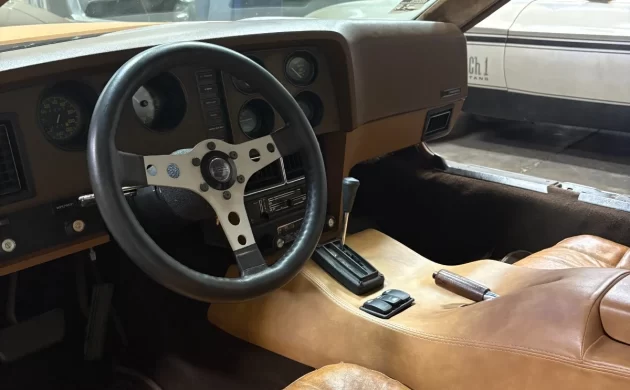
The Bricklin came out in 1974 and was gone after 1975 (1976 model year). Like other cars (think DeLorean) of a certain ilk, it was the product, or brainchild, of one mad genius. This was Malcolm Bricklin, an American whose car ended up being manufactured in Saint John, New Brunswick, Canada, mainly because of tax incentives tied to bringing jobs to the region. With gullwing doors and a resin-and-fiberglass construction, the SV-1 was like some kind of Ferrari that escaped Maranello before being fully integrated into the prancing horse nameplate. SV-1, not sexy like the car itself, stood for “Safety Vehicle 1,” with Bricklin touting the car’s rollover safety as well as its impact-absorbing bumpers. Odd mix, that: are you going to drive it fast enough to roll it, or slow enough to want to escape parking lot incidents? Both? I guess that’s what the engineers were thinking.
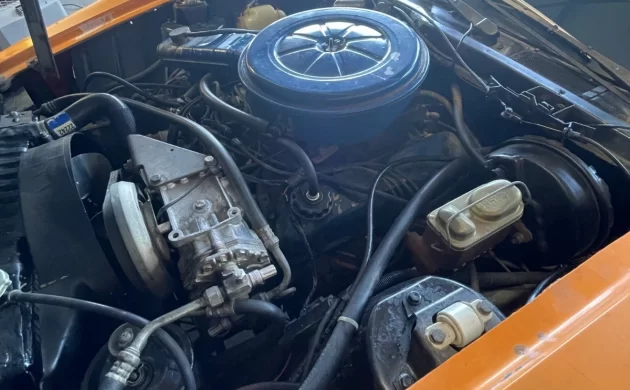
As with any orphan car, concerns with this one would be the viability of maintenance, but the presence of a Ford 351 cubic-inch engine, the “Windsor,” suggests drivetrain reliability will be no issue, and fixes up to and including a rebuild will be easy. Incidentally, that sounds like a lot of engine for what is a fairly small and light car. Mileage indicated is just under 60,000, but that’s what rolled on before the odo quit working, so you’re kind of on your own there. As for other areas of potential concern, the seller is frank about swirl marks and hairline cracks in the body work. Some interior refurbishment is also described, with seats redone as well as carpet and more, all to “near-factory spec.” I’m guessing that means that soft trim was not available and had to be approximated, but it’s up to the astute buyer to eyeball that and decide how close it is, and whether that’s good enough. Paperwork and some service history also comes with the car, which is always appreciated by collectors.
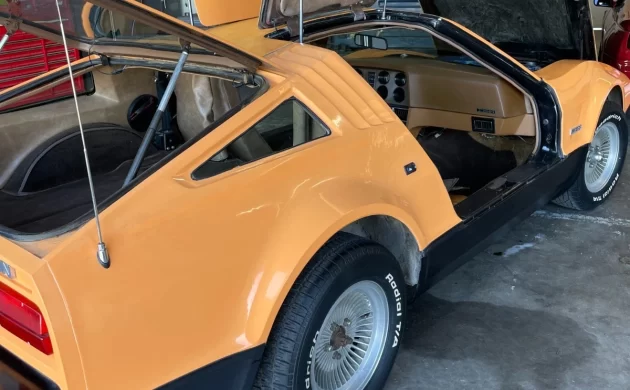
So for possibly down in the $10G range, you can have a car almost nobody else does. (It is thought that maybe 1,500 of these are left.) It should drive well. Its gullwing doors have had work done that makes them open and shut much more quickly than the factory-spec called for, and there’s just a little James Bond cool factor in getting into a ride like this and firing up what is nowadays seen as a monstrous V8 as you leave the burger stand cruise-in.




🍁 🇺🇸
Rollover safety is wonderful, unless the car lands on its roof and the gullwing doors trap the occupants inside.
the windows are roll down unless ur 400lb ull be fine
There was a recent Bricklin show where I live in Noblesville Indiana. They, for the most part, were restored or very good original condition. I wish I could attach some pictures I took.
As i always say i had a red 75 for a few years, these are not a exotic sports car, very kit car like. This looks like a fair deal if you really want one. The center console is a pricey aftermarket addon.
What makes you call it kit car like?
The fit and finish is very poorly made, the body panels and even more so is the poorly made interior. If you get one you will quickly see what i mean.
John DeLorean’s first company after GM was Grand Prix of America, founded with his brother, Jack, After it went bankrupt, the ~300 cars, iming system, several tracks, and personnel were acquired by Malibu Grand Prix. Jack had worked for Bricklin’s Fastrak International, which used Suburu 360s Bricklin had imported, with external roll cages, on a dirt, offroad racer-style course south of Phoenix, Arizona, driving on a timed course. When Bricklin closed it down, the DeLoreans asked if they could borrow the concent, and Bricklin agreed, they took the business model of one lap at a time against the clock, and changed to paved small-scale race tracks, and a 750 lb, 35 BHP Wankel rotary motor-powered single-seater in the style of a 1960s McLaren F1 racer. Before DeLorean launched his own car company, he pitched several European manufacturers on him setting up US sales/service for a sportscar they would build in line with his vision. One came close to pursuing a deal, but after no takers, he did his own.gull wing sports car. I worked for Grand Prix of America and in a personal conversation one evening, John DeLorean described Bricklin as a great promoter (his word at the time, which I interpreted to mean marketeer). Both ventures could be viewed as copies of what Bricklin had concieved. arguably with bigger amounts of money invested, enabling more sophisticated execution.
I have a working knowledge of these. (I worked at a Bricklin dealership for as long as the cars existed) I always (and still do) wanted one of these for a fun autocross or track day car. Strip out the interior, ( which is not a high quality item) remove the bumpers, ( maybe even make molds and lay up some fiberglass ones) lower it and tune the suspension properly. Naturally the engine can really be improved on easily. It could be a fun and interesting car. I would never “fix up/restore one of these. You can’t seal up the water leaks. (and you have to have drain holes in the floor so the water has a place to exit) The suspension is a cross between AMC and Ford. So finding nice suspension parts should be fairly easy. I saw one that was very abused, but was too late to purchase it. I don’t believe that these are a good investment.
The boys at “Fantom Works” restored one of these a few years back. It was in Season 4, Episode 14: “Another Bricklin the Wall” (see link below).
https://barnfinds.com/built-in-canada-1975-bricklin-sv-1/
IIRC, it was quite a task to get the doors to fit and close properly! They almost had to rebuild the entire body to make the doors fit correctly.
I only saw one of these in the flesh once. It was parked in front of the stores where our bank and the local hardware store and variety store were located. I was in high school at the time. It was green.
For many years, I thought these had transverse, mid-mounted V8s. It still doesn’t look to my eye like a small block would fit under the hood.
Oddly, ’75 Bricklins had NO catalytic converter from the factory! & its Ford 351W was used in 1975 because it was EPA exempt!! huh?!! and did not need a converter! How could that be?! Didn’t any ’75 Ford that also had that motor also have/needed a cat? & why didn’t Bricklin put a 4 barrel on it, instead of a 2 barrel? Only 175 hp in ’75 compared to the use of AMC’s 360 220 hp in ’74 was quite a drop.
The Ford 351W was already approved by the EPA as meeting emissions standards without a cat. Cats were being implemented at that time, but not all cars had them in 1975.
I can’t think of ANY(consider how many motors there were back then!) other ’75 car motor that didn’t need a cat! I wonder what’s so special about the 351W ! Later, there was the Honda CVCC that didn’t need a cat, but that had a special cyl head.
& i can’t believe especially even CALIF bound ’75 Bricklins did not need a cat.
The cat mandate in 1975 was that all GM cars needed them for the entire manufacturing year, with the other manufacturers to roll them in later. It may have been a precious metal supply issue. Imagine the sudden uptick in demand for platinum. But believe it, not all new US cars had them in 1975.
Maybe not, but the unleaded gasoline had to be in place by the 1975 model year (autumn, 1974), under the EPA rules, even if not every new car needed it.
Gold medal to anyone who could parallel-park one of these on the first try.
I had to back one off the very front (over the cab) of a transporter covered in ice. Does that count?
I had to back on off of an ice covered transporter. (All the way at the front over the cab) IT WAS VERY SCARY!
Does that count?
How do I get my medal.
Send me $500 and your “Ship To” address. And your bag of Gold Medal flour will be on its way to you.
That’s no fun! It wasn’t fun backing the car off the truck either. The battery was dead and it had to be jumped from underneath. Since the battery was dead the power door would not open very far. I was the only one skinny enough to squeeze through the opening to turn the key. (That wouldn’t be me now! lol) Once in the dealership I had to crawl out through the rear hatch. Because the emergency pin that you are supposed to pull that disconnects the hydraulics when the battery is dead. Wouldn’t release. The Delco battery was junk.
@ Wayne- You should have joined the Union. That sounded like pretty unsafe working conditions. It’s always the young, skinny guys that get picked for the bad end of the stick jobs, See you at the Labor Day parade. I’ll be wearing the Teamsters vest.
Ike Onick, no union jobs for me thanks. Unions were a greatly needed thing many years ago. But in my opinion they have ruined the auto industry. Worried too much about wages and perks. To see the writing on the wall about consistent quality workmanship to PROTECT their future jobs. With the head start the American auto industry had at the end of WW II. IF the unions had been long sited enough to care a out quality work and stress quality hand in hand with wages. Do you really think that competition from foreign auto makers would have even made a dent? Variety is the spice of life they say. And I’m not saying that foreign auto makers would not have had sales here. But most of the market that has been taken over is because of better quality from outside our shores. Even the foreign auto makers had quality issues and the smart ones learned to correct their mistakes. The ones that didn’t aren’t around much anymore. (Renault, Fiat for the most part, Triumph, Austin, Daewoo, etc., etc.,) Some are still around in their home countries. But history shows that these foreign makers with the most quality issues were also the ones with the big workers/union issues. Please don’t get me wrong, unions have their place in keeping corporations “honest” with wages, retirement plans and vacations. Without unions, the greed would have workers working for next to nothing. BUT, unions are very short sided and they should know better. The union’s position should be, we want better wages (within reason) and we are willing to work hard to improve quality,whether it be through processes or actual care in assembly. Since John Power (J D. Power an assoc. I get to call him John because I spent several hours with him when he was on his way to start the company) has the pulse of quality of every manufacturer on the globe. Union wages should also be tied to quality rankings. I have worked in dealerships where that is the case. And yes I know that in some cases NOW that happens. But union were so short sited (as we’re manufacturing companies) of making sure that quality was part of the negotiations. Greed was the largest player and not job longevity.
I will get down now.
Good points and although we differ on our take on unions, we can politely agree to disagree. There is a “Labor Day” , shorter hours, better wages and benefits, etc, thanks to unions. I will also stop now before we both get tossed.
I don’t disagree. BUT, All money and perks with no discussion of quality of work is/was the fault of both sides.
I don’t disagree. BUT, All money and perks with no discussion of quality of work is/was the fault of both sides.