
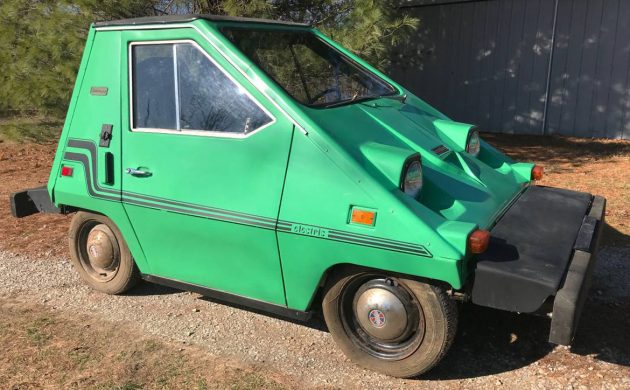
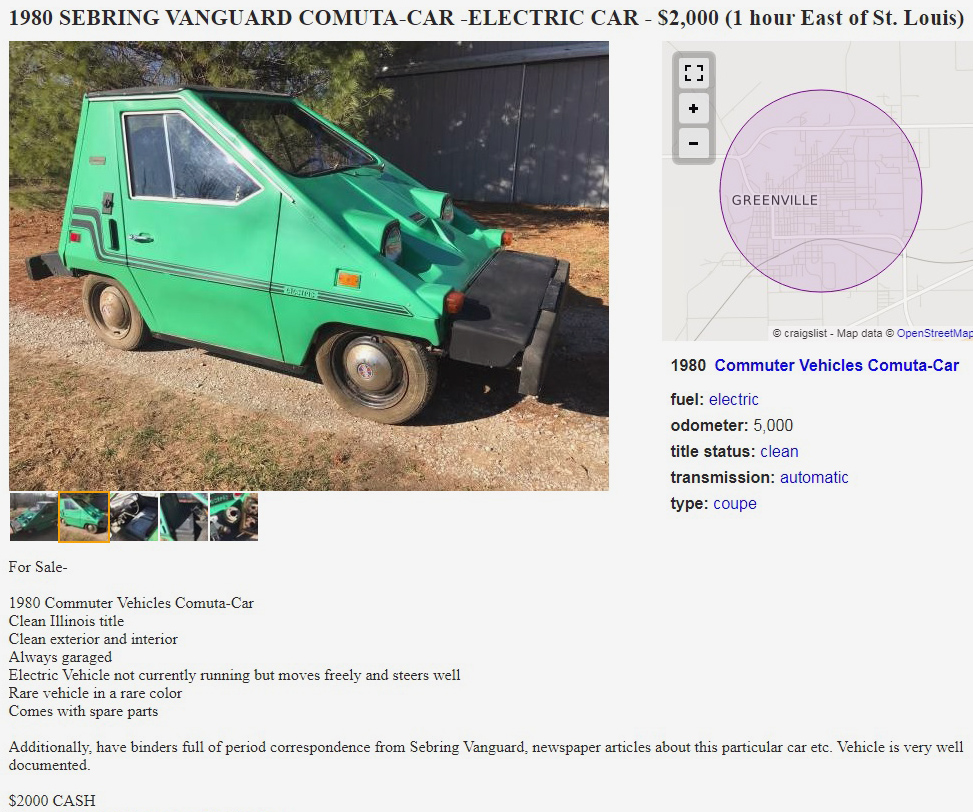
If you have a short commute, in nice, warm weather, on two-lane roads at 40 mph or under, this 1980 Comuta-Car could be something to consider. Although with no air-conditioning, airbags, roll-down windows, or ABS, and having four lead-acid batteries on each end, maybe it isn’t for you. If it is, you can find it posted here on craigslist in Greenville, Missouri, and they’re asking $2,000. Here is the original listing, and thanks to Jack M. for the tip!
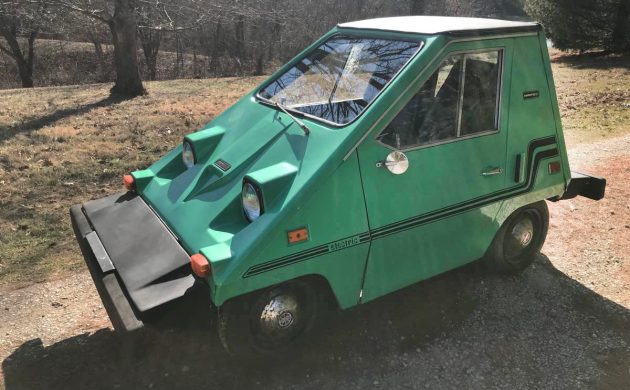
By clean, I mean it looks super clean, as in nice and clean, not “clean” as in the hot-button issue of clean energy. Most of us know that in order to get electric power, it can be a dirty business, even with many clean energy sources out there. If you have solar panels at home, recharging is as clean as it gets, although charging these big lead-acid batteries is rarely clean. Did any of that make sense?
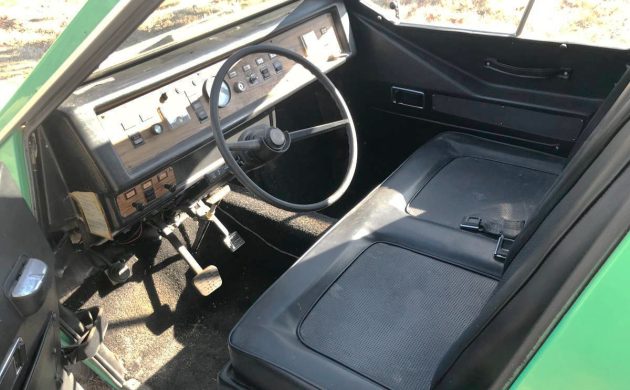
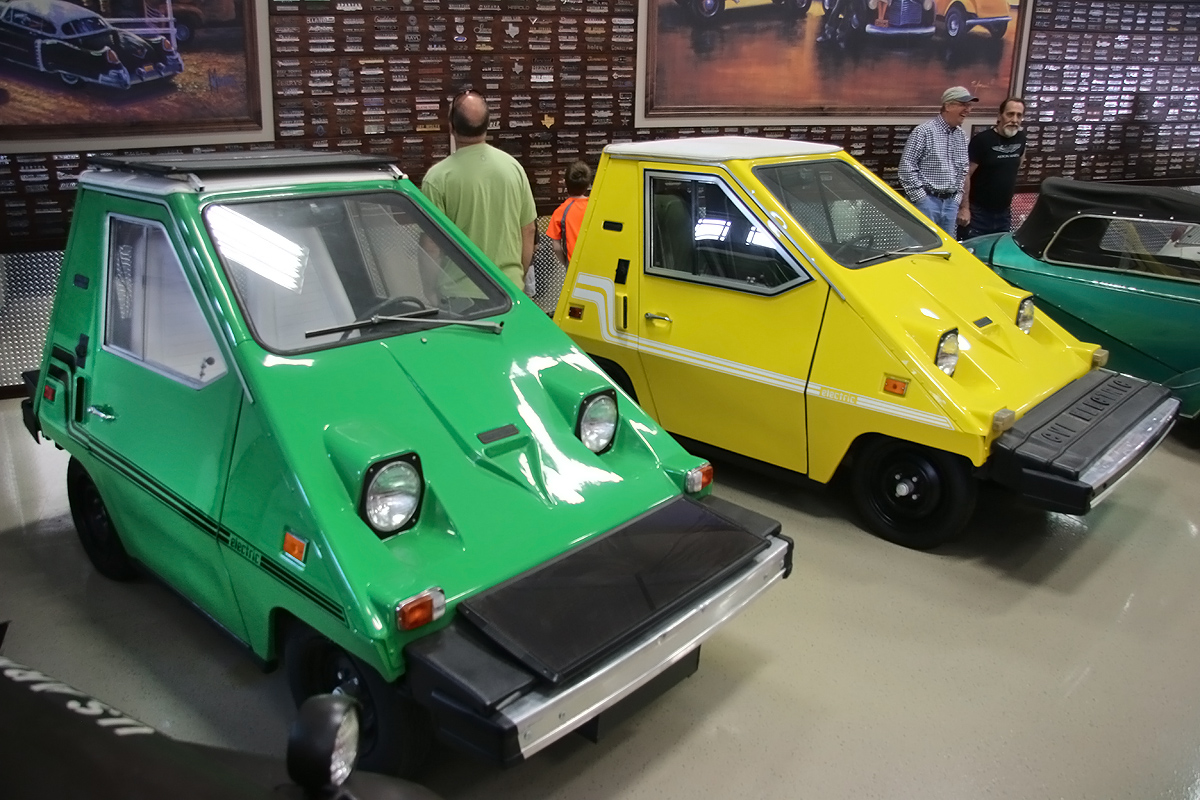
I don’t see many flaws in this car inside or out, or really any flaws. This is another case of a couple of hours of detailing the heck out of this 8-foot-long car could have made it look almost like new. As it looks now, it almost looks new to me, but with a heavy coating of dust and some surface rust on the rare wheel covers. I don’t even see any cracks on the ungainly bumper covers where the eight batteries live, both front and back. Although we don’t get to see a rear 3/4 photo, unfortunately, or one under the seat where a charger should be. I saw a really nice, restored version of this car at a Cars & Coffee event way back in 2015, and the seller was asking $4,500. I should have grabbed that one, or both the green and yellow cars.
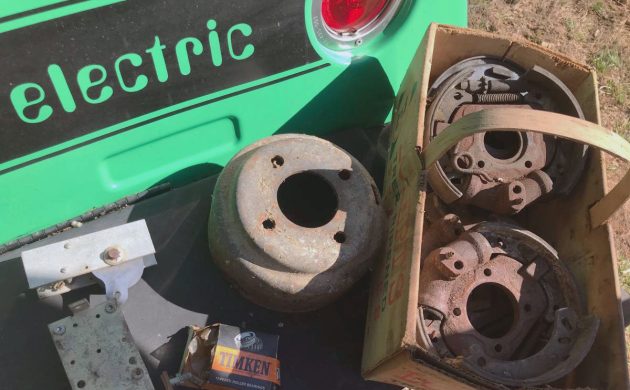
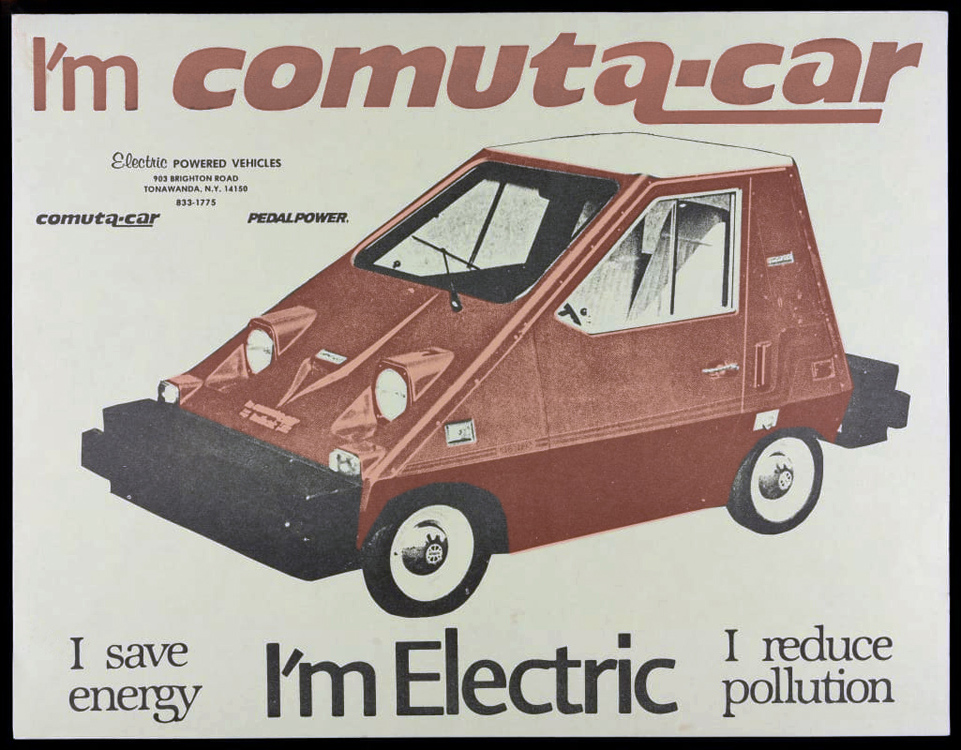
The first iteration of this car was the smaller, extended-bumperless CitiCar. It was arguably a much nicer-looking car, and the batteries were under the seat. They were made from 1974 through 1977 by Sebring-Vanguard in Florida. Production shifted to Commuter Vehicles, Inc. for 1979, and by the end of the Comuta-Car’s run in 1982, over 4,000 of both models had been sold to a public hoping to use them for cheap commuter vehicles during a period of high gas prices. Spare parts are always good, and the seller is including several useful parts, along with some paperwork and binders of information.
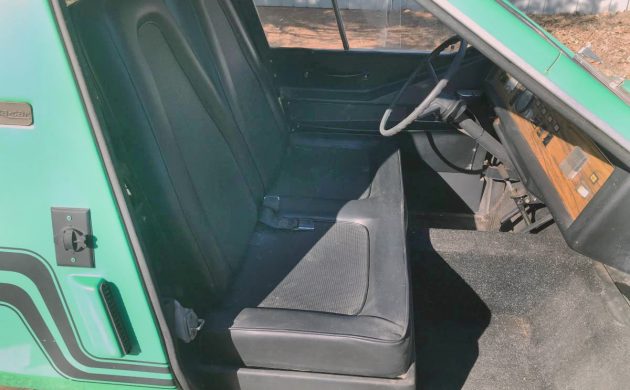
Speaking of clean, there is a clean Illinois title for this Comuta-Car, so that’s good, right? The interior looks basically like new. This l’il commuter is powered by a 6-hp GE electric motor, and you probably already guessed that it isn’t running at the moment. I mean, not running as idling (cough), but as in probably needing new batteries, which is usually the case with old EVs. If a person lived in an area away from major traffic and high-speed roads, this would be a fun way to run errands around town. For the record, I know the following: don’t take it on the freeway, and if you get hit head-on by a texting Chevy Suburban driver, that won’t end well. Otherwise, plug in and go!


It should come as no surprise, I’m the ultimate miser, not so much because of my background, I just love a good bargain. It should also be no surprise, I love tag, rummage, yard, garage, moving and porch sales, so I happen to come up on one, stuff all over, buried under all that drek, is one of these. I said to the seller, “is that a Comuta-Car”? She said, “why yes it is”, and nobody else knew what it was( patting self on back,,OW) I asked was it for sale? No, she said. I happened to watch an episode of “American Restorations”, the one with Rick Dale, not that other one, he restored an electric car for a couple in their 30s,, it was basically like this, and turns out, to be compliant, he couldn’t use ANYTHING from the original except the body. Cost these poor folks over $20grand, their face was priceless, peeing away grandpas millions, but hey, it’s Vegas. I reckon the same holds true here, with a range of about 8 miles( 4 there, 4 back) and a top speed of about 35,,,plan accordingly. In 1980 electric cars were the butt of all jokes, and never in a million years did we ever think they would be a viable alternative to our fume belching, emission ridden contraptions we relied on for 100 years!
And today, we STILL don’t think so!!! What were they thinking???
We just relocated the source of the emissions. ; )
And today, we STILL don’t think so!!! What were they thinking???
SWEET.
So….. You folks know I always say I learn something new on Barnfinds all the time? I did not know the batteries were located on the front and rear ends. I though those were Federally mandated 5 MPH bumpers!! Yikes, I would not want to be in a collision in one of these with those batteries there. ( this is just me, maybe you folks feel differently). But still, the restored ones look great and maybe this can be cleaned up nicely. Cool and interesting find Scotty…. Now…. Wheres my battery charger??
The earlier models did not have these bumpers, so the batteries were located somewhere inboard.
I’m not sure why they made the change, but those bumpers made an homely car even uglier.
Just think of a truck hitting this at 60mph ?
This car would be the size of, and look like a Mountain
Dew can. You’d be ☠️
I started to restore one of these cars and quit for several reasons. Virtually no parts are available, and the cars it’s self is a tremendous POS.
While I don’t care for the appearance of the finished product, I do like the idea of designing something as utilitarian as this, using straight lines & flat pieces of material. There are many reasons not to use a vehicle like this in modern traffic, but if you are already in a community where you’re, say, using a golf cart for travel, then this “car” might be a way to stand apart from everyone else. I’d restore it without the ridiculous bumpers.
I wonder what kinda range you could get, with a set of modern sodium or lithium batteries?
Where would you put the batteries if you took that front bumper off.
I’m sure I could find a more dangerous place for them.
These are basically an overgrown golf cart. They started out as the Citi Car and were built in Sebring Florida by a company called Sebring Vanguard. They had a problem with the car pulling to the left when you hit the brakes hard. I was called in to do some consulting to fix it. Turns out that the shackles for the front LEAF springs were at the back of the spring and when the spring compressed the axle moved aft and it steered to the left as the steering link was parallel to the chassis going forward. I got paid to figure out what was wrong and moved on, don’t know if they ever fixed that issue. Since it was basically a golf cart it was extremely dangerous on roads with a speed limit over 35 mph. The company was interesting in that they cast some of their own aluminum parts in their small facility at the Sebring Airport.
These pop up every now and then. If I remember correctly their range was about 30 miles. I’ve seen one that has been converted to gas. It had a 10 hp, well essentially lawnmower engine in it.
I forgot to mention, that front bumper is hideous
In my retirement community with 7 golf courses golf carts are used like cars to run errands like shopping, dr.appts,or going to one of the rec.centers.No where in the community is the speed limit over 35 mph.Mix that in with poor drivers,especially snowbirds and all ya hear all are sirens.
The locals are the worst..they think they own everything…they fail to realize the monetary benefit of “snowbirds”.
I have never seen one actually on the road they have all been sitting in a yard or car port not working. The overall design makes me wonder if this is where Mercedes got the inspiration for the Smart for two cars. The electric version of those only goes 50 miles on a charge the gas version is a rear mounted 3cyl engine that only gets about 38-40 mpg. $2000 for this or a golf cart if you live in a snow bird community in Florida. Kinda wonder if you can adapt a gas golf cart power plant to fit but I don’t have the energy to find out.
HOW GOSH DARN UGLY CAN IT BE!
Looks better than a Tesla 😂
Really? Huh
Yeah, really. Huh
WOW! A wheel chock on wheels!!!
Say what you want about it, you’ve gotta give ’em credit for at
least trying to produce a vehicle
that would help you bypass a gas
station. Unfortunately, they were
way ahead of their time here. The means to make that happen
were, and are, not quite ready for
prime time in the sense that electric vehicles won’t be practical UNTIL they’re made affordable. You take Tesla. $200K for a 4-door sedan?! 48-50K for a used one?! And throw in the cost of replacement batteries, and you see why hardly
anyone wants to hop on this band wagon. Now this little guy here, I’d upgrade the charge controller
and batteries to modern standards, wrap the car in flexible
solar panels, then drive and enjoy
And yeah, I’d have to take the side
streets on my way to work, but this would be a real boon to sight
impaired folks like me who don’t
wanna be dependant on other people to take them where they wanna go, or get changed $20 every 6 blocks or get robbed by
some very greedy Uber driver out
there. At least that’s what Uber
does here in Florida. Overgrown
golf cart? Maybe, so long as the
person driving it has the smarts
to drive it wisely and use it only
as directed.
…And if you hadn’t guessed yet,
I’m all charged up about this one!
I’ve never seen one with hubcaps before, didn’t know they came with them. Anyone looking to buy one in 2026 isn’t looking for a practical if short range EV daily driver – an early Nissan Leaf even with their infamously range-losing passively cooled batteries is much more car for about the same money – but to preserve a piece of history. Using it as a neighborhood runaround or in parades is gravy on top of that.
As a kid I remember these cars in a car dealership when these cars first came out. They are cute but inpractical.