
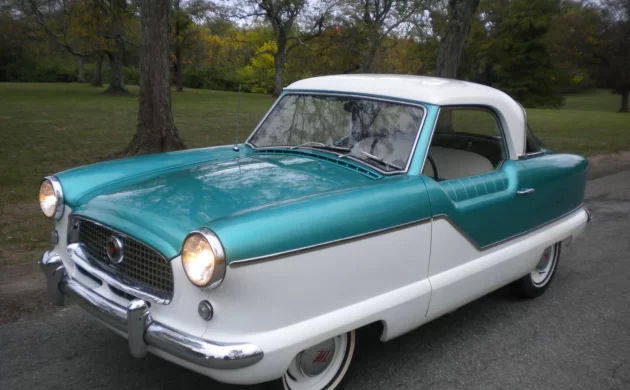
This is bound to turn out well, the listing here on ebay for a 1959 Nash Metropolitan coupe. The car is selling at no reserve in an auction that has a lot of bids—more than 20—and still hasn’t crossed into $5 grand territory. Somebody, it appears, is going to get a nifty little car for not a ton of money. There appears to be a lot of interest, though, so if you’ve been looking for a cute mini-car to tool around in, this might be the time to act. You have three days, and if you win, you’ll have to eventually find your way to Cincinnati, OH to claim your car. You might even be able to drive it home.
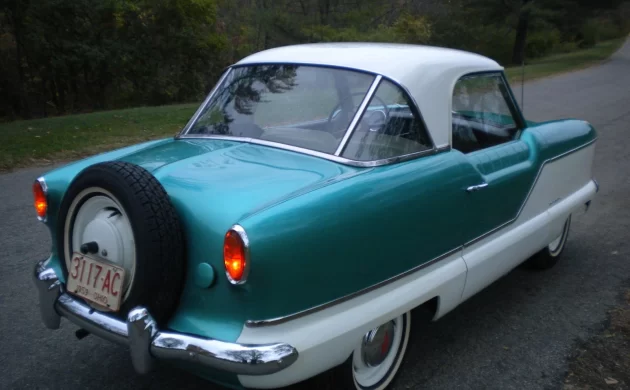
Fair to say that the first time you approach a 1950s American car, you’ll be a bit surprised at its scale. As an example: the classic collectible 1957 Chevy Bel Air is 200 inches long and about six feet wide. By comparison, what’s the benefit of piloting a car only 149.5 inches long and about five feet wide, as you’ll be doing should you buy this Nash? If you’re from across the pond (and this car is, please note, American though assembled in Britain), you’ll be able to negotiate the narrow and often winding streets of your locale. If you’re North American, that’s not so much a concern. But you’ve got to think that this diminutive size and 50 brake horsepower would be a bit of a disadvantage on the open road. The original idea of the car, designed in Kenosha, WI as a second car or a commuter-mobile, was to mirror the styling of the big cars of the era while being economical to own and use. All these years later, you’ll drive the Nash locally on a summer’s evening to hang at the local burger stand.
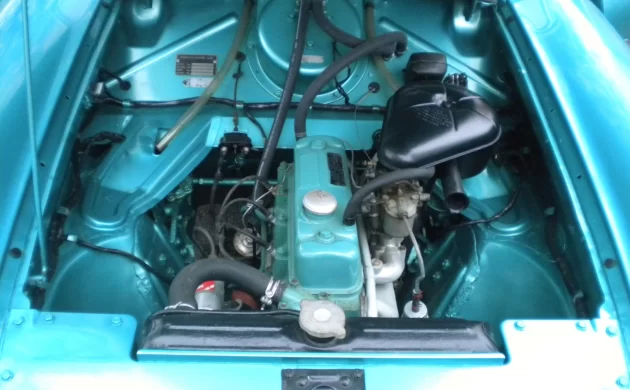
The car here is in ready-to-drive condition. It shows 107,000 miles, which is another way of saying that’s it’s been used just enough to keep it in fine fettle. The seller, who is acting for an estate, says that the tiny coupe is well-maintained and rust-free, having always been garaged, though there is no proof offered of such except the ability to read details out of the photos themselves. (Perhaps a Barn Finder who is super-well-schooled in these cars can weigh in on what you see.) The photos show a car which looks to have been restored, though the seller would say “preserved.” The only clear flaw is a sinking headliner, but a new one is included in the deal if you wish to replace it. Not to bring too skeptical an eye to the party, it does seem odd how clean the engine bay is. I’m not saying I wouldn’t take it, but it looks to have had considerable attention for a car that’s not been under the restoration knife. I’d want to get to the bottom of this before I bid.
So satisfy yourself that all is as claimed by going to visit, then win yourself the auction (a pre-sale number amenable to the seller will end the auction early). From Cincinnati, head out the back roads to return to wherever you come from, and cruise at 50mph home. Tuck this tiny friend into the corner of your garage, and smile at it every time you open the door to get your muscle car out for a drive.




The little Met has at least had a pretty good rattle-can refurbishment. Experience tells me the engine would have been painted dark-ish green when it left the factory (it’s a BMC/Austin engine), and I can’t remember having seen a Met engine bay look so shiny and blue before.
Still, looks nice (if a bit too shiny) and, if it runs as well as it presents cosmetically, it could be a lot of fun. Not fast, as Brian points out, but still a good little cruiser. If 50 horses aren’t enough, increasing output or even swapping in a larger engine (from a later Sprite or MG Midget) is a simple task. A high-school friend and his father put a 283 Chevy engine in one, but that was too much.
Fun fact: the original Nash “NXI” concept, designed for the company by William Flajole back in the early 1950s, used Fiat running gear.
Dropping in a 1275cc Spridget motor with twin SU carbs will help the power situation and as RayT said in earlier comment is that it is an easy job as the A series motors have the same mounts. Many SPM’s (smiles per mile) will be had with one of these. It is interesting to me that in few of the recent British car shows I have attended, The Met section of cars got much more attention than the Triumph TR-6 section in which there were a ton of them! Don’t get me wrong, I like the TR-6s but I have never seen so many over- restored cars in one section. Those cars didn’t come out of the factory that good……….This Met should be driven!!
If I remember correctly, 1959 Metropolitans all had vent windows and trunk lids.
Restored/unrestored – who cares? Smart color combo, alleged rust-free, can be enjoyed immediately. Which checked box did it miss? If it can be bought at less than 2X of the current bid ($4200) smile everytime you look at it and when done plan on getting most if not all of your money back.
While Driving in my Cadillac 🎵 what to my surprise! 🎶A Little Nash Rambler was following me ,about one fourth my size🎵 .Ya all know the story! This is much cuter than a BUG 😉 and I love the retro Nash styling. It just might fit in the trunk of a LAND YACHT! Happy Halloween 🎃 no matter whitch 🧙♀️ 🪄 way you feel. I’m off to look for treats on my Broughamstick.
Engine bay looks like an engine-out tub re-do. Lurking rust repairs? ‘Specially in Cincinnati. Hmmm…
And, yes, the Austin engines of the day were covered with what looked like left over olive drab military surplus stuff.
Yep – all of the 50’s Metro engines were painted in olive drab army paint. — This one has obviously had everything taken out, cleaned up and repainted in model car metallic blue paint, and that means the rest of the car probably had a similar makeover, which the owner does not disclose, and that’s always a red flag.
My dad had a Yellow/White one,our neighbor a Red/White.My brother took his drivers test in 1966 in the Metro but the guy failed him because it popped out of 2nd gear.
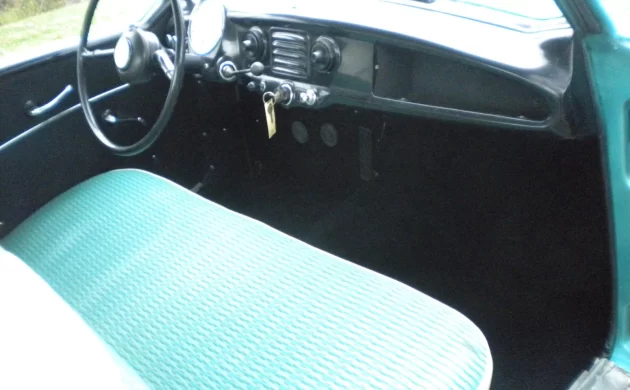
The 1959 & 1960 Mets have an exterior trunk lid. This is probably a ‘57 or ‘58. The engine has been painted a different color and I don’t believe that the seat covers and door panels are correct. Otherwise, it looks to be in very good condition.
If upgrading the engine also install one of the 5 speed kits (Nissan?) that they make for the Spridgets. Although, maybe over 50 mph is not wise in one of these little tubs?
The designers and builders of the Nash Metropolitan matched the engine to the car quite well to its physical capabilities. Putting a more powerful engine in this car would not be a good idea! With its short wheel base and narrow track, getting it up to interstate speeds would be dangerous. One sudden evasive maneuver to change lanes, etc, to avoid a collision at 70+ mph would most likely send it tumbling down the highway like a die in search for the other in a set of dice – resulting in the occupants becoming mince-meat pie filling. The car should be left as is – and driven only as it was intended to be used.
I really like the concept of the Metropolitan; a lightweight urban compact car that could have been made to get exceptionally high gas mileage, that seats two people comfortably with a rumble seat in back for a couple kids or groceries, etc. I really wish it had continued to be developed further – with an option for an automatic tranny – and carve out the wheel wells for a wider track/stability. — The continued development of the concept would have fit perfectly with the increasing market need for high-mileage urban compact cars.
And it’s looks – perfect IMO. I would keep the nostalgia of the 50’s body style as long as it was selling well as such, and then only update the fenders to have stacking or side by side headlights, and the rear quarter panels to have larger tail lights with backup lights included, and maybe some tweaks to the grill / bumpers, etc. — similar to the way the VW bug evolved. It seems a shame to me the Metro faded into the mist of automobile history.
This is one very cool Metro in my opinion, but apparently someone else thought the same because the auction was ended as “Item is no longer available”.
I had a ’60 and loved it. Replaced the horrible column shift (tended to turn off the ignition key when you shifted) with a floor shift kit. Had big chain-tread snow tires on the rear – once drove it from Cleveland to Boston, via the NY Thruway and the Mass Pike in a driving snowstorm. 14 hours at 30-40 mph, but passed many a stuck car on the way. Good times! Had up to five people in it – 3 in front and 2 jammed into the back!