
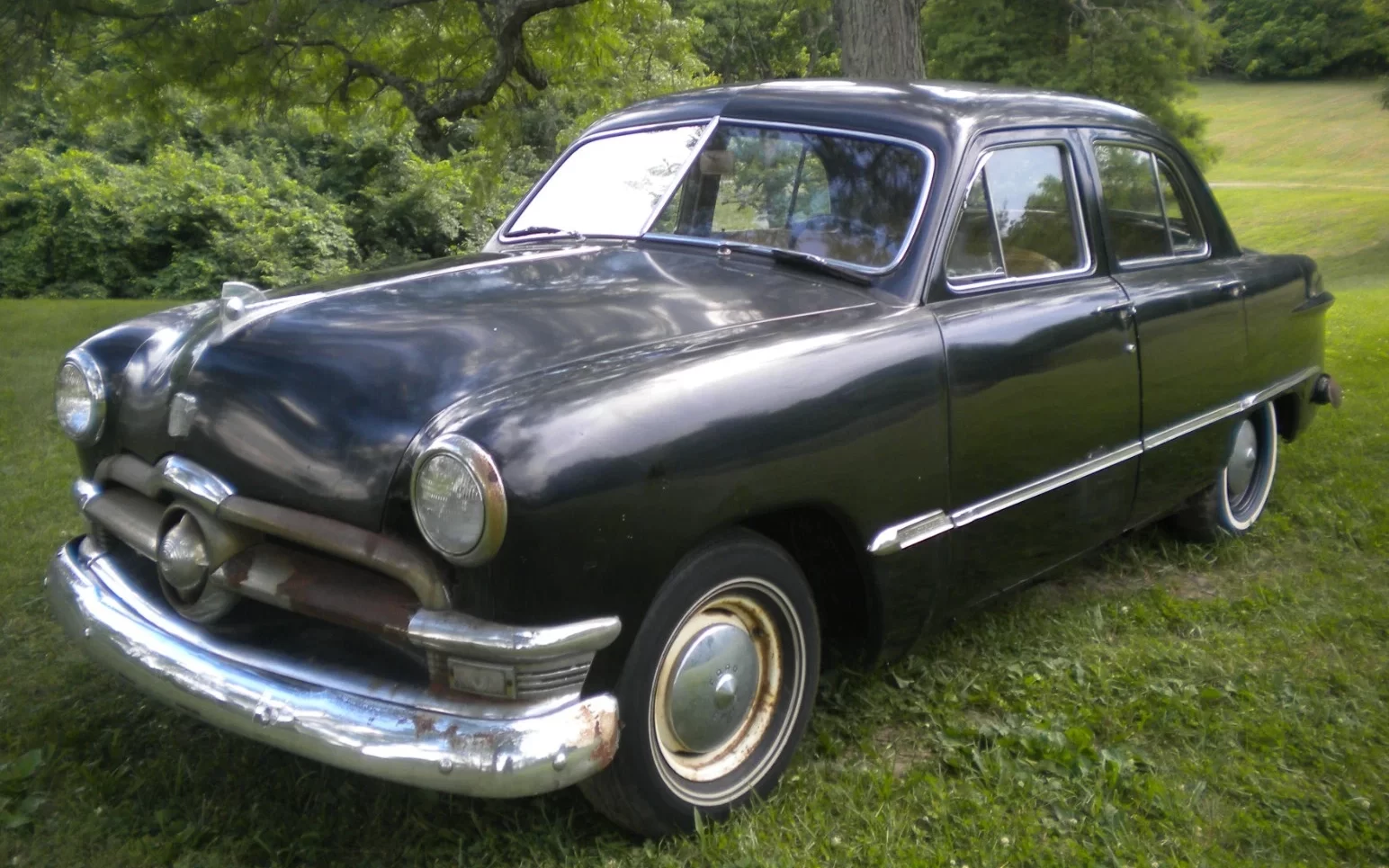
I haven’t owned or worked on a “Shoebox” Ford, but I do have a literary connection with them. When I was a kid, the local bookstore in my local mall (two things that aren’t really things for the most part these days) had a book titled How to Build Shoebox Fords/Mercurys, and I either convinced my patient parents to buy it for me or I used my allowance/lawn mowing money. Either way, I was engrossed in the world of late ’80s/early ’90s customization for a couple months. Some of those trends haven’t aged well, but my affection for these little “Fords that saved the company” has. While few customizers would lay themselves so low as to fix up a “Fordor” (in Ford’s parlance), it would certainly make a fun summer project for bombing around town and having a good time. A Cincinnati-based seller here on eBay is clearing out a collector’s estate, and this ’50 Ford Custom Deluxe Sedan is a part of it. They got it running with a jump box and some gasoline and are selling it with no reserve. With three days left to go on the auction, it’s sitting at a high bid of $3,150.
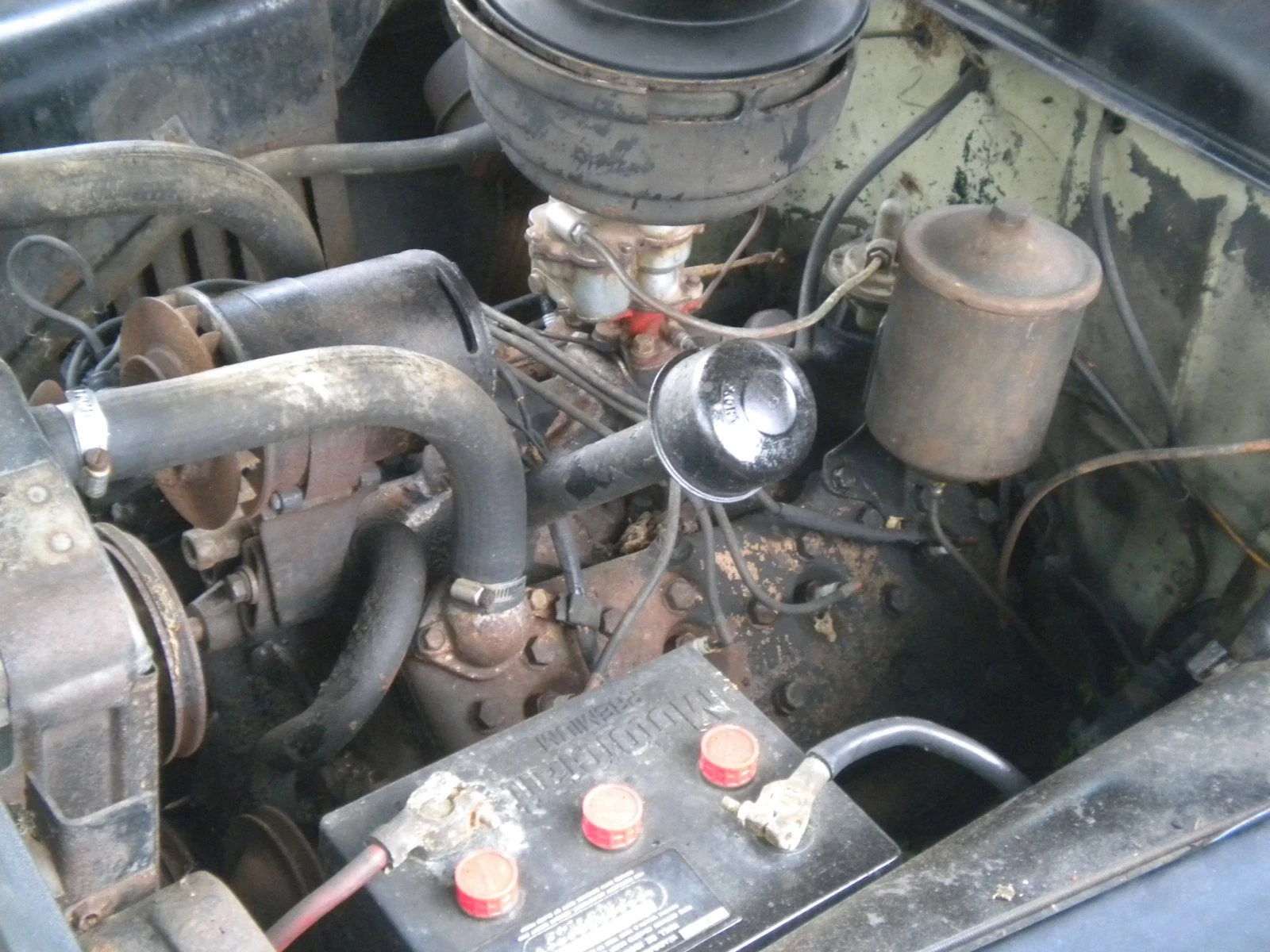
So what makes a Custom Deluxe better than either a Custom or a Deluxe (the two more basic Ford models for 1950)? The lucky buyer got to show off their chrome window moldings, chrome horn ring, two sun visors, arm rests on all doors, and chrome strips on the lower body, in addition to a couple other minor convenience items, all for $92 more than the “Deluxe” Ford. This sedan has the optional 239-cubic-inch flathead, which was rated at 100 horsepower in 1950. (What’s going on with the carburetor? Is that red RTV? I hope not.) The transmission is a three-speed manual, which would have come with a standard 3.73:1 axle ratio (4.10 if it’s an overdrive car). In 1950, Ford buyers were still a model year away from being able to order the Ford-O-Matic.
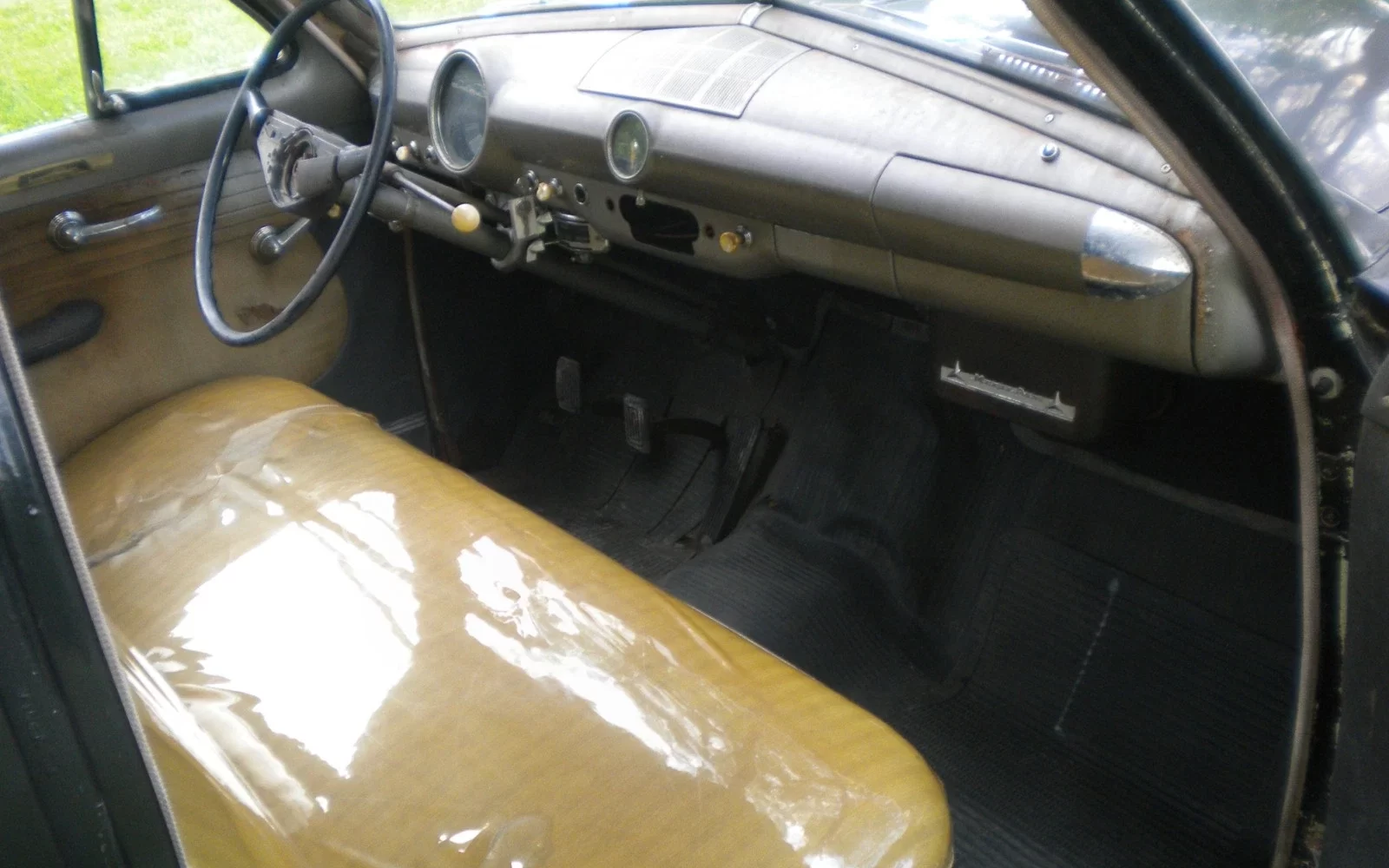
The seller says that the “original, gray striped cloth interior” has been covered up in plastic since the car was new (that’s gray?). It does have some rips and tears, and it does appear that the interior is missing a horn ring, a radio, and maybe a few other things.
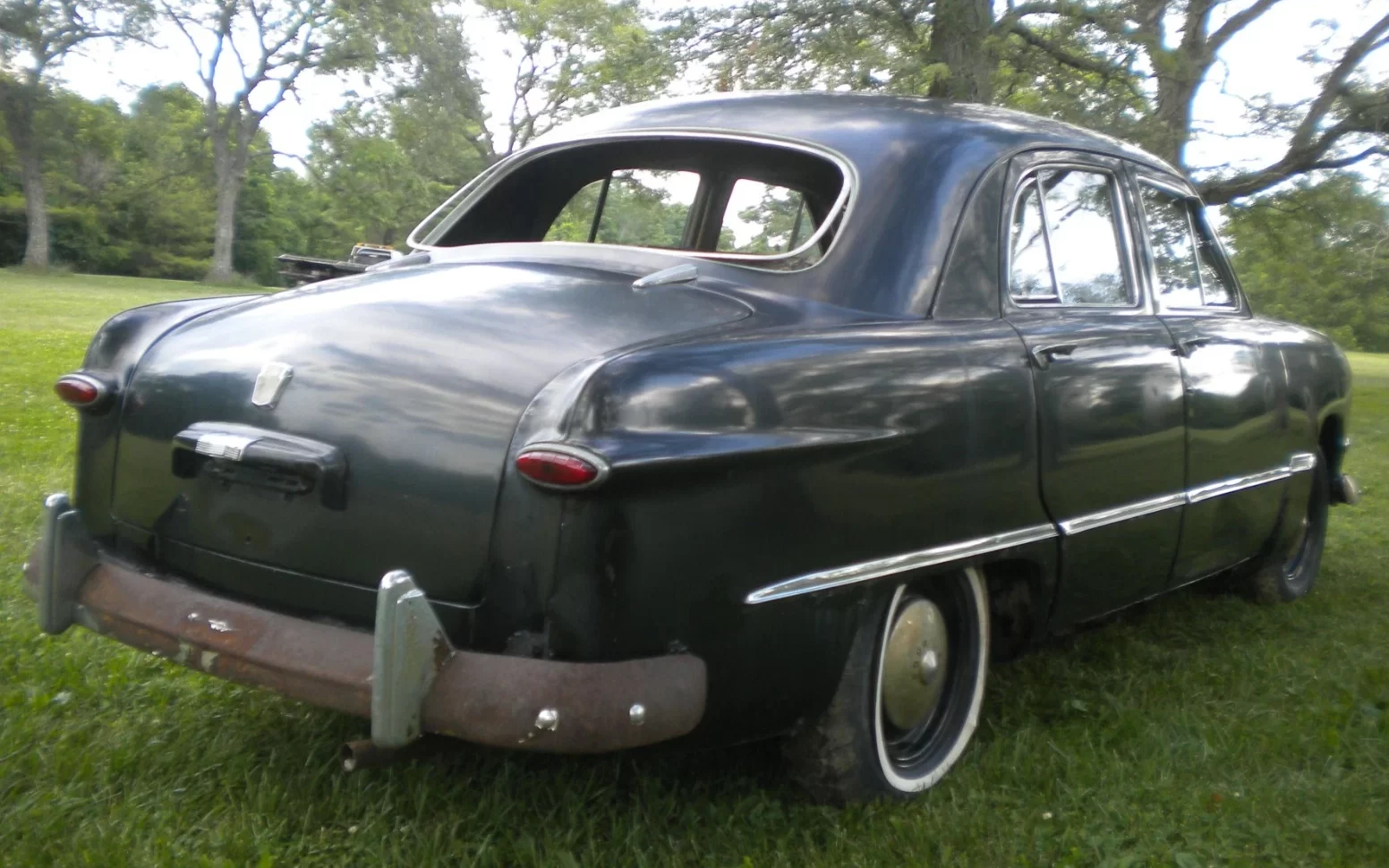
It’s also missing the rear glass, which the seller says is available for $200 on eBay (and they’re not wrong, there are a lot of options for less money, too). The car does come with “brand new – and much needed – rocker panels,” but the pictures don’t show a rusted-out sedan. I think most of us can agree that this car is not really a restoration project; there’s almost no upside to that. As many readers know, however, “will it run?” is a fun trend online, and it might be a fun challenge to make this car reliable for the least financial outlay possible. There’s still a lot of summer to go, so if you’re in southern Ohio, maybe this is a project for you. I know of a book you can use for inspiration.




The plastic on the seats looks like it yellowed with age, (75 year old plastic…wow). Looks like the Custom-Deluxe horn ring is in the trunk. It’s gonna be a project, but maybe a fun one for the whole family. My father’s 1st car was a ’50 Ford, but a 2dr (Tudor) with a six in it. He bought it in ’53 from my uncle, with only 10,000 miles on it, for 300 bucks. They agreed to let my grandmother set the price, my uncle wasn’t too happy. By ’59 the car was so rusty my mother wouldn’t let my father go over 50 mph. He traded it in on a new Hillman Minx, but that’s another story.
So, think you know Andy Griffith trivia? Most folks think the 1960 Ford was the 1st Mayberry police car, and it was, but in the early 1960 episode “The Runaway Kid”, sharp observers will note, Andy is on his porch with the kid, the 1960 is parked out front, then Barney shows up in a shoebox Ford like this with only a spotlight, I presume was the car the 1960 replaced. Never saw it again.
This was the road car for the less of wallet. Not many cars for the masses had a V8 in 1950, and it was clear, a 4 or 6 wouldn’t cut it. After the war, people were spread out all over, and a V8 Ford was ticket for any long travel. Chuck Berry thought so. These cars cost almost $1600 bucks new, when the average yearly income was only twice that. Cars were changing fast in the 50s, and these cars became the standard issue used car. By 1955, only a few years old, were horribly outdated, and $100 all day got you wheels. It’s a really neat car, and as usual, going to miss a slew of buyers with the stick.
i own 3 sedans, a 50 coupe and a 51 auto victoria
In about 1969, I ran into an older lady at the grocery store, driving this exact same model. Had less than 50,000. Gave her my number, told her if she decided to sell it, to call me. About 6 months later, she called. Doctor told her she had to stop driving. She wanted $250, and I bought it. She said she was sorry, but the seat upholstery under the covers was in bad shape. When I did take the covers off later, what was in bad shape was the nap on the cloth, not the seats themselves. The seats were in nearly perfect condition. Drove that daily for over a year. Items installed: gas, oil, ignition coil. Sold it after that year for $750.
Wasn’t Mrs. Lesch, was it?
why not buy the glass and install it makes the seller look cheap. easier for the sale
Drove a ’51 a lot when I was in college, belonged to a cousin who was great with letting me borrow it. Stalled it frequently at stop lights, would ask the guy behind me for a push, almost always he would oblige. Bumpers were useful in those days, chrome, tough. Today you would at the least scratch the plastic, and at worst destroy it. It is no wonder today’s kids can’t drive a standard transmission, I had been raised on them, and still had trouble with the clutch on this Ford. The V8 was powerful for the day, smooth, quiet, and comfortable.
You know I actually remember that episode of Andy Griffith that Howard mentioned. I can’t recall for sure but I also think that there was another episode where either Barney or one of Aunt Bea’s relatives drove a Ford of maybe 1954 vintage that was an evolution from the preceding generation of Fords. Anyway it was these Shoebox Fords that really started what I think was referred to as the “envelope” body style with slab sides and no protruding fenders. The difference in styling between these cars and the preceding ones was quite dramatic in my opinion. They deserve their place in automotive annals for pushing car body design into a new direction. As to this car; If I had any a$$ left I would buy this one and do just what others have said. Get it road worthy and tool around in it. And for WIW, installing that rear window glass would be a bit of a challenge especially if you doing it by yourself. Ask me how I know. A lot of dish washing soap and a good string will be your best friends. Great write up there, Aaron. I too mowed lawns to earn walking around money. If I recall correctly it augmented my allowance which was the princely sum of 50 cents a week. I averaged a whopping $1.50 a lawn and had four regular customers. Man was I flush! Another model car or a Hot Rod magazine? No problem. GLWTS.
Hi Carbob, actually, Barney Fifes 1st car was a ’54, and Aunt Bea is shown learning to drive in a ’55 ragtop.
Toured the River Rouge plant in ’48 when the brand new ’49s were being built. I mostly remember the installation of the rear window. Two gorillas of guys would pick up a small guy in stocking feet off his piece of carpet next to the line. They’d set him on the roof and hand him a huge, long-handled rubber mallet. They’d pick up a glass with the gasket already on it and soaped, with suction-cup grips, put it in place and push it inward at which point the little guy wound up and gave the glass a shot in the center of the glass.
POP! Glass in place. Pick the little guy off roof and set him down on his carpet.
“Next car, please!”
Will, that is the greatest story I think I’ll hear this week. Sometimes, reality is better than fiction.
I remember vividly, around June of 1948, when the ’49 Fords hit the showrooms: what a SHOCKer! Kaiser had slab-sided things in 1947, but NOTHING was like this new Ford! — a TOTAL break from 1940s styling, and it set the trend for the 1950s to come. Sure, it would soon be “dated”, but it established the initial “model” that all others would “update” as the new decade settled-in. One wonders what 1950s automotive-Americana might have been like, without the 1949 Ford.
Harrison: I don’t get it, I would think the shocker would’ve been in ’47 with the slab-sided Kaiser! It looks like ford copied Kaiser with the similar looks in the 49 fords except for the bullet in grille, but Studebaker had that also.
To wind: It wasn’t the slab sides that set the Ford apart: a few odd late 1930s cars had slab sides. When you look at the 1947 Kaiser (even the ’49 Mercury and others), you still see the hood higher than the headlights and the rear sloping down: the Ford was the first to come with a lower profile hood and rear fenders that stood up and squared-off, rather than sloping down. The 1951 Packard advanced this further — but that was 1951, after the initial shock of the Ford had worn-off. The Ford showed up for the summer of 1948, adding to the shock. The new Cadillac and “Futuramic” Oldsmobile were instantly dated, and G.M. did not lower the middle of the hood until 1954 with Cadillac, Buick, and Oldsmobile, Pontiac and Chevrolet getting the new profile in 1955.
To wind: It wasn’t the slab sides that set the Ford apart: a few odd late 1930s cars had slab sides. When you look at the 1947 Kaiser (even the ’49 Mercury and others), you still see the hood higher than the headlights and the rear sloping down: the Ford was the first to come with a lower profile hood and rear fenders that stood up and squared-off, rather than sloping down. The 1951 Packard advanced this further — but that was 1951, after the initial shock of the Ford had worn-off. The Ford showed up for the summer of 1948, adding to the shock. The new Cadillac and “Futuramic” Oldsmobile were instantly dated, and G.M. did not lower the middle of the hood until 1954 with Cadillac, Buick, and Oldsmobile, Pontiac and Chevrolet getting the new profile in 1955.