
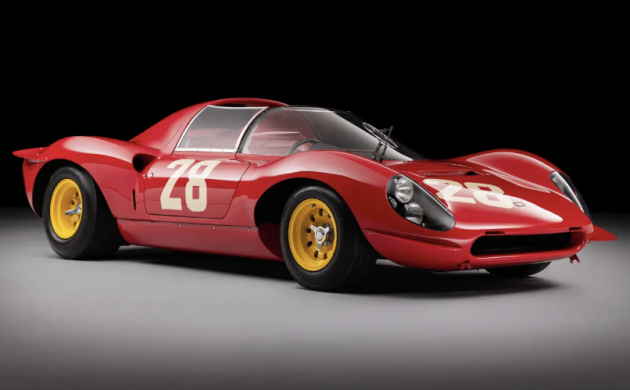
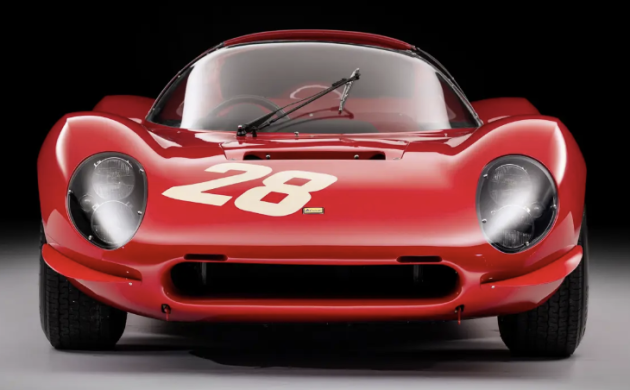
As we tick toward the headline auctions that launch the year, Araknid78 inspires us with a host of tips featuring once-in-a-lifetime cars. So it is that we contemplate this 1967 Dino 206 S – one of 18 produced, and spectacular evidence of Enzo Ferrari’s tenacious passion for racing. Fitted with a replacement Tipo 233 2.0-liter V6 engine, chassis 032 was the last 206 S made, and arguably the most advanced of its kind. RM Sotheby’s is handling the auction of this historic Ferrari on January 28th at Retromobile in Paris. The estimate is $4.45 million to $4.95 million – twice the price of previously offered 206 S cars. Let’s consider why the estimate is so otherworldly, particularly in light of the non-matching engine.
Amid the forest of owners who have piloted chassis 032, one Carlos Monteverde, a Brazilian living in England, raced the car at least twice in the 2001-2002 period. One race resulted in light damage, while the second resulted in far more serious damage. The car was subsequently restored in England and sold some years later. The next restoration was commissioned by the consignor, with the work executed by the Ferrari factory in Maranello. This attention earned the car its “Red Book,” certifying its matching numbers chassis, gearbox, and body panels, but noting a “period correct” engine, the fourth Tipo 233 made.
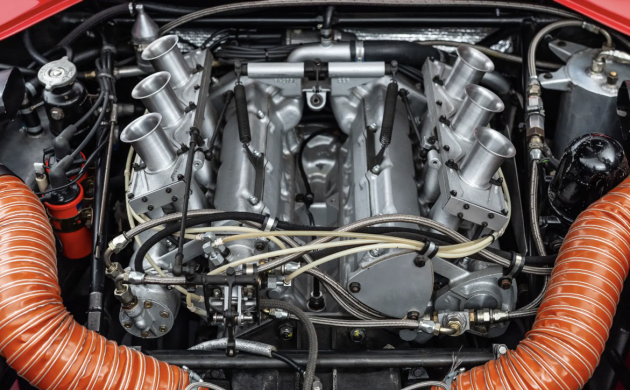
To understand the engine, we must backtrack: the development of Ferrari’s 65° V6 – spearheaded by Vittorio Jano and refined by Franco Rocchi – was aimed at ushering Ferrari into Formula racing with a completely new rear/mid engine configuration. Initially produced in 1.6- and 2.0-liter displacements, the motor was trialed in cars such as the 246P and 156F2. When Porsche entered Group 4 racing, Ferrari followed suit with the purpose-built 206 S, but Group 4 required a 50-car homologation, which Ferrari never met. Without homologation, the new 206 S would have been forced into the more formidable Group 6 prototype class. Aside from collecting a few good results at Targa Florio and Nurburgring, the cars generally competed in circuit racing and hillclimbs. The factory tinkered extensively with the V6 on behalf of its privateers: the Tipo 227 bore Weber carbs and two valves per cylinder for output of around 220 hp; the Tipo 231 was configured with three valves per cylinder (two intake, one exhaust), good for over 235 hp; and this final version, equipped with Lucas injection, registers 270 hp. The Tipo 233 was apparently fitted to only two 206 S chassis, though the second recipient is somewhat of a mystery. Mounted longitudinally in the rear, the 2.0-liter, all-alloy, DOHC construction shed the twin-plug spark arrangement of earlier Ferrari V6s, minutely simplifying its maintenance. A five-speed non-synchro gearbox transmits power to the rear wheels.
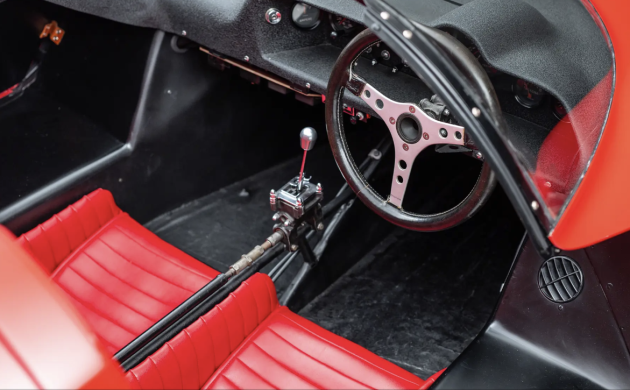
All 206 S cars are right-hand drive, in keeping with circuit racing rules of the day. The interior features a minimum of gauges, red ribbed vinyl seats, a left-hand gearshift, and removable side windows. The spider has no top roof section, just a bubble of glass almost enclosing the cockpit. A single wiper is charged with covering the entire windshield. The engine resides directly behind the driver’s head. Speaking of the driver, the new owner of this car will occupy the same seat in the same chassis that competed in several hillclimbs – a history that’s meticulously presented by Sotheby’s.
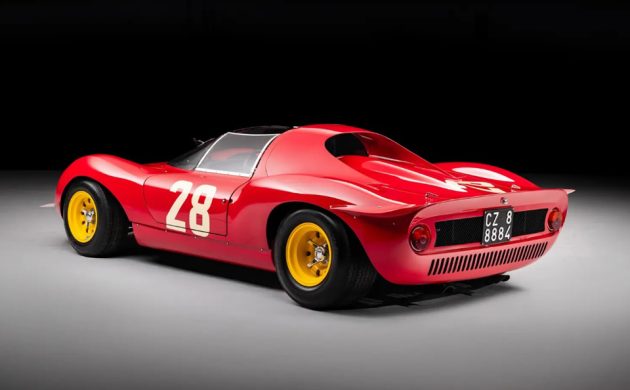
Outside, the aluminum body was built by Piero Drago’s Carrozzeria Sports Car, located in Modena. The design itself originated at Ferrari. Wind tunnels were already in use, coaxing every curve into efficiency. The flying buttresses sending wind currents away from the car’s rear must be one of the most beautiful shapes to ever exist on any car. As we consider the estimate, we admit that rarity and beauty are extant for each 206 S. Despite this example’s non-matching engine, if a 206 S is on your bucket list, you will wait many moons to make the acquisition. Furthermore, this engine is the ultimate iteration of this V6. However, history hints that chassis 032 may not meet its aggressive estimate: prior sales hover in the $2.5 million area; and this exact car was shopped three years ago by Sotheby’s in a sealed bid process, where it apparently failed to sell. What will be the top bid this time around?




Another timeless beauty in an age where the wind tunnel sculpting was improved by the artistry of the engineers. When an engine sounds as amazing as the car looks, that’s an achievement.
As well, your ability to explain a complex engine design in understandable terms any layperson can learn from speaks volumes of your knowledge, Michelle. Kudos!
I’m right with everything Nevadahalfrack said above. Just stop for a minute and look at this Ferrari. Even that V6 engine is a work of art. The whole car is amazing from every angle. One thing that Michelle wrote that caught my attention is that this Ferrari Dino has a non syncro 5 speed. I’m guessing double clutching, or slip shifting is required here. I was going to joke about this car, saying how beautiful it is, how fast it is….. But can it haul 10 tons of Rock out of a mine shaft???? Well???? Can it???? I’m just kidding….. Michelle, you have an amazing treasure trove of knowledge of a vast amount of vehicles, whether they’re Italian, British, American, can go 150MPH or move that 10 tons of rock. I appreciate your time in your research, and alot of us learning something new from you and also the many great comments on here too. Thank you again for another great write up. Can’t wait to see what you write up next.
-Dave
How have designers devolved from these to the Tesla Truck??
Just look at the originating management….
They got their clay taken away and were given computers.
Wow. Just, WOW.
Musta been found in one heck of a barn…
A RED barn, no doubt.
Glad to see it is not on Craig’s List.
Fantastic, exiting, rare exotic and great write up, just that it was Modena’s master coach builder Piero DrOgo who left his signature on this 206.
Takes me back a few years – 16 to be exact. My two sons contributed to the refurbishment of SN 026, raced under number 34. It had been used in vintage racing and needed a few things restored to original in preparation for sale. They contributed a custom made steering hub and drive axle flanges. It seems no original half shafts could be found, so the restorers substituted 250LM drive shafts; you know, the common stuff. I seem to have lost the pictures I took of the work, but I still have one from a local car show, with my car (Maserati Bora) in the background.
I read this piece having just watched FORD v FERRARI for the “umpteenth” time and I am once again overwhelmed by what Ferrari has done with their racing lineage. Absolutely superb write up; a stunning vehicle! Thank you for bringing her to life!
At Pebble Beach in the early 2000’s Gordon Murray and Maurio Forghieri (lead engineer for Ferrari when the Dino was built) were judging together and the came up on a Dino. Gordon was gushing over it, the size, the proportions, the packaging and of course the lovely body. Maurio was not so in love. He’s reported to have said “Gor Don, There was never enough time and Dino was last in line. Lookatta suspension, lookatta brakes, No Gor Don, Dino was sheet”..
Still beautiful even though it was sheet.. I remember Charlie Kolb running his a PBIR in about 1965 and it was glorious.
I think I can relate to a antique Snowmobile better, at least that’s more in my price range.
Another supurb write-up Michelle. And thanks for the acknowlegment.
Thank YOU for the tips! Really appreciate your sleuthing
WANT. Beautiful write-up, too, Michelle.
Yes, it’s so gorgeous. Thanks for the compliment –
Check out Frank Stiller’s amazing drive in one of these at Goodwood Revival 2024. That alone could boost the price on a car known for its beauty rather than its race wins.
Former owner Carlos Monteverde has raced some great cars over the years – but has crashed most of them. A yellow Ferrari 250 LM seemed to suffer most…..
Frank Stippler.
That looks like a piece of jewelry.
Stunning.
Unbelievable!
https://www.goodwood.com/grr/event-coverage/members-meeting/video-frank-stipplers-206s-ferrari-snatches-victory-from-the-jaws-of-defeat/
Thanks for posting this jwaltb, it was totally incredible. Frank made an unbelievable comeback and showed what the car was really capable of in the hands of a very capable driver.
Masterful driving! You can see what a handful this car can be, it’s squirrelly occasionally even in a straight line. It’s so light, I can’t imagine running over the rumble strips at the track edge – teeth rattler!
Interesting video! Thanks jwaltb!
I took 40 minutes and watched the above. I’m so glad I did!
Thanks Martin!
I agree those sensuous flying buttresses help make the rear most callipygian but it’s interesting they delivered such aerodynamic efficiency. The “tunnel” created by the buttresses on the second-generation Dodge Charger created so much drag the Charger 500 was created with the rear-window area “smoothed out”.
Excellent knowledge of the Ferrari culture Michelle! If anyone that thinks about buying this car is interested, the Italians hold the secret of open roof driving without rain getting into the car. My X1/9 1980 has this feature and amazes other drivers in the motorway when i drive it in the rain without the top. Of course slowing down for the toll booth is a different story if not 1st in the line!
I just saw this car in a dealership being talked about on Hagerty. There were some other very interesting and rare cars on the episode.