
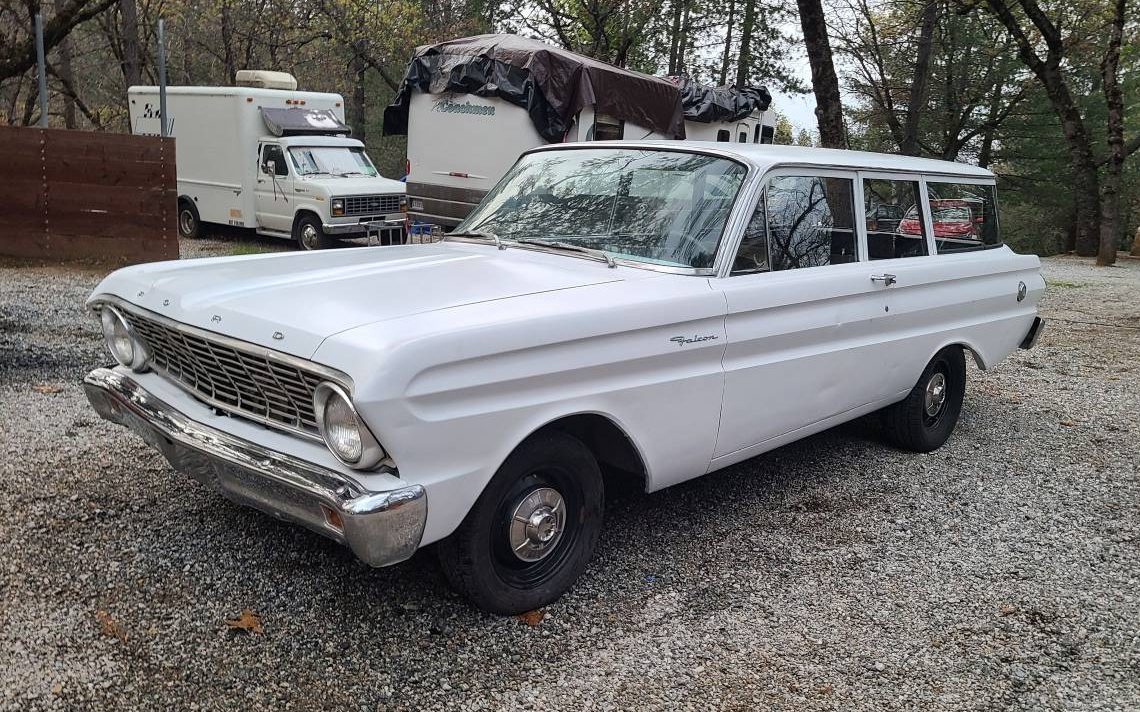
This may be a minority opinion, but I think that every car collection should have at least one compact station wagon from the 1960s. Choose any one you’d like: Valiants, Darts, Chevy IIs, Ramblers, Comets, Falcons, BOPs—they’re all a practical size, they’re easy to drive, they get decent fuel mileage, and they’re as useful as anything this side of a pickup truck. This 1964 Ford Falcon is the uncommon two-door model; only 6,034 were built, and certainly only a fraction of them remain. It started its life in Texas and moved to New Mexico before finding its way to California, where you’ll find it here on craigslist in Diamond Springs. Thanks to Barn Finder Rob for sending it our way; the asking price is $7,500.
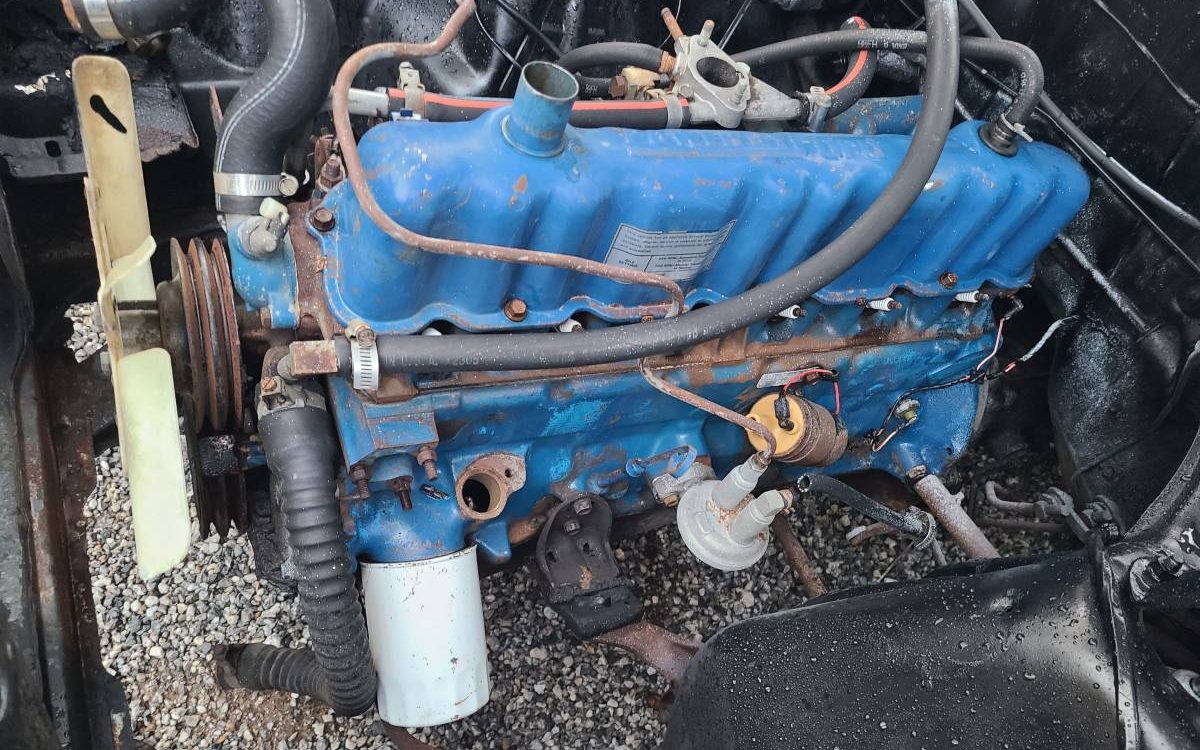
The seller of this Falcon raises the idea of an engine swap, primarily because the engine that’s currently taking up space in the engine compartment is missing a distributor, carburetor, and radiator. On the other hand, a Ford inline-six is a tough engine, and as long as it rotates, the cheapest option would be to get this one running and throw in an aftermarket Mustang radiator. The standard engine in 1964 Falcon Wagons was the 170, but this is clearly a later model (maybe Ford six experts can narrow it down). On an unrelated note, did you know that the 144 was still available in Falcon sedans in 1964? That would have been painfully slow.
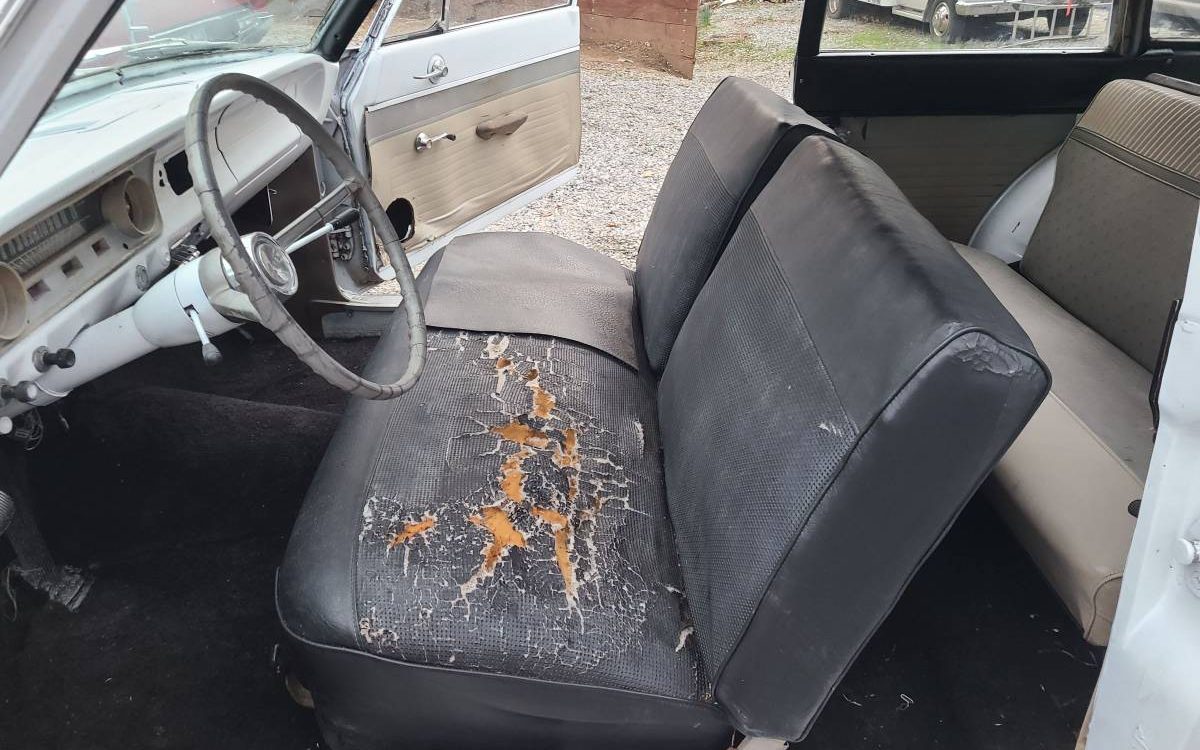
The transmission is listed in the ad as a manual, so it’s certainly the three-speed with a non-synchromesh first gear. If you were planning an engine swap in the little wagon, that would have to be the first thing to go (aside from the engine, of course). Oh yeah, the rear end in a six-cylinder Falcon won’t hold up to a V8’s torque for too long, either.
The interior itself could use a little help: the front seat needs recovering, there are speaker holes in the doors, and the radio is missing.
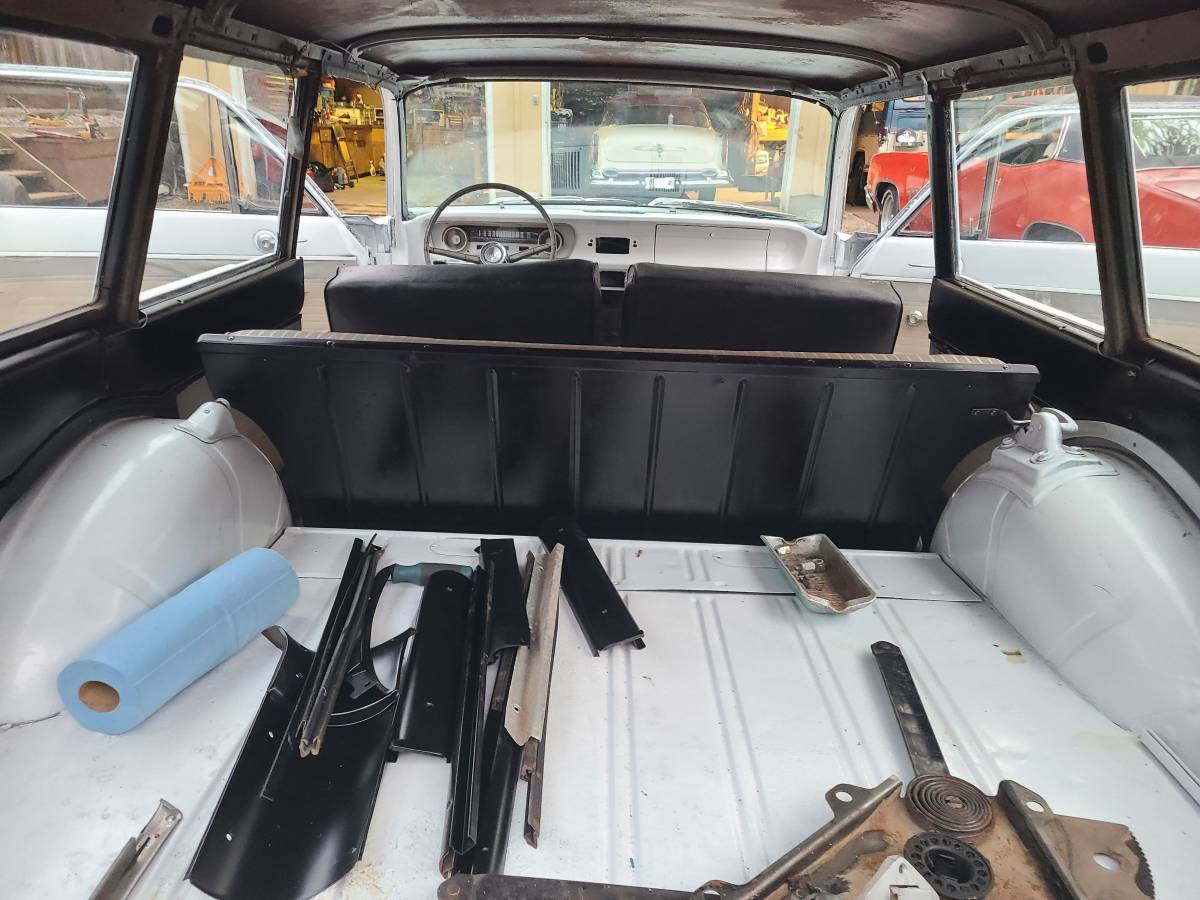
On the other hand, there are some knick-knacks lying on the load floor, so let’s hope that the car comes with enough parts to put the interior back together. This picture shows us why a compact wagon is such a useful collector’s item; you can fold down the back seat and carry almost anything. It’s like a truck with a low roof.
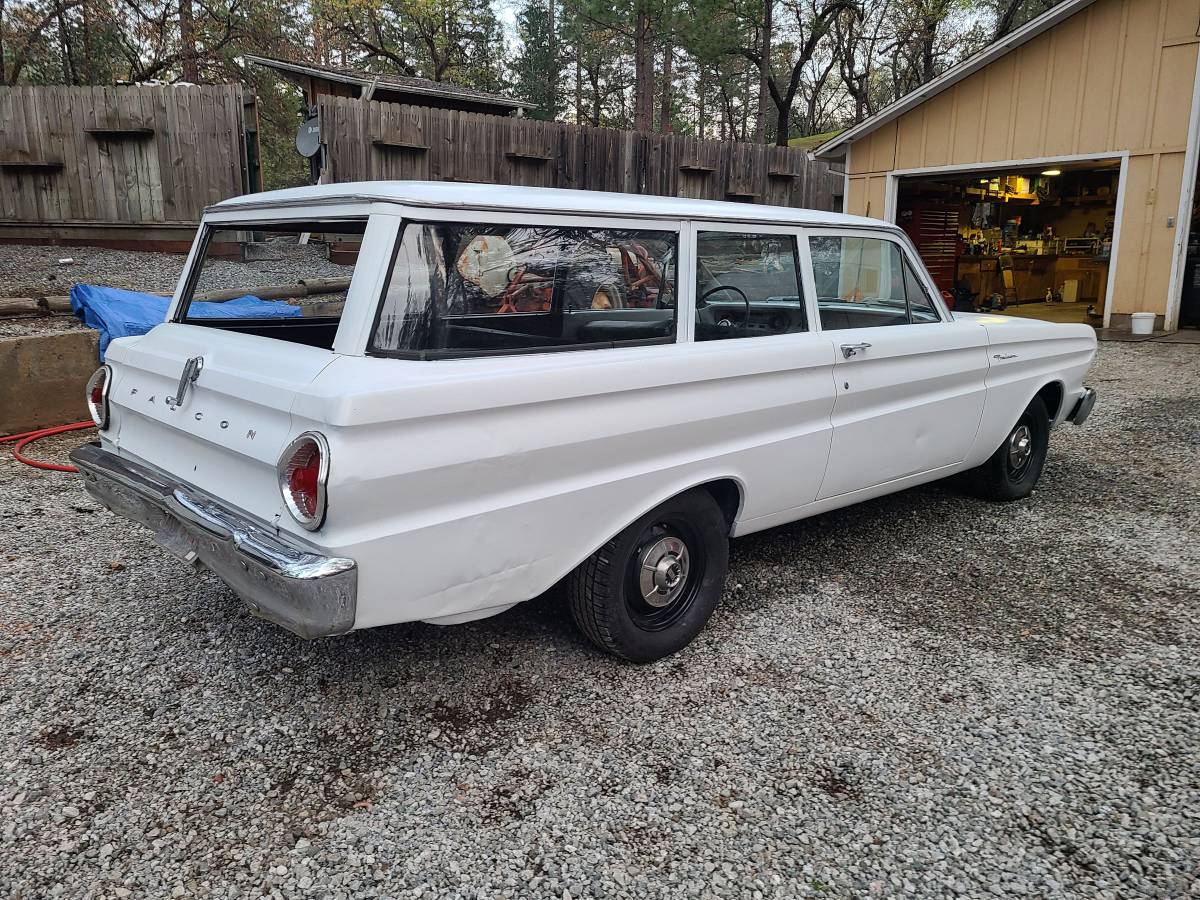
Being a Southern car, you won’t have to worry about much rust (“a small spot at the back of the floor near the tailgate”). There are some dings, dents, and a tweaked rear bumper, but this Falcon is an uncommon ride that is a bit like a “choose your own adventure” story. I would get the six-cylinder running and use it as it sits. Sure, I might try to find another rear bumper (and a front seat cover), but if you’re using it like a wagon should be used, it might get tweaked again anyway. Long live the compact wagon!



Wonder why the engine is missing all those parts. Still a clean 2 door wagon here.
Two door wagons are desirable and sought after. The problem is, $7,500 is a lot for a roller that is registered to someone other than the seller and in a different state. It’s one thing to do that with a $500 wreck, not a project for $7,500. I don’t trust fresh paint on a car being flipped, there isn’t a lot of incentive to do a good job that will last for more than 6 months, potential buyers need to see this car in person and go over it with a fine tooth comb.
Steve R
I have done a 6 to 8cyl conversion on an early Falcon. If you can find a rot box 8 cyl car for parts, you’re golden, if you do it piece meal, it’s a complete torture. Seems like a lot of money for a starting point, but these don’t come around very often. If you just gotta have it, Good Luck, it will be fun upon completion.
This would definitely make for a fun 70’s style rod a small block Ford and a 4 or 5 spd.It would definitely be fun.
Some may remember my trip to Nashville( from Wis) in the mid 80s with my ex-BIL in his K5 Blazer and homemade trailer. Once in Nashville, we got a Trader Joes(?) paper and in it had a column for classic cars. Yep, kids, that’s how you found them and there were plenty to choose from, we had a $500 limit. We narrowed it down to a ’63 Chevy 2 door Biscayne, or a car like this, both ran, both $300. I wanted the Falcon, but my BIL was a Chevy guy and we got the Chevy. Had I known they were that rare, I would have insisted on the Falcon. These 2 door wagons were kind of a sedan delivery with windows, although not sure the same. I am sure they were treated the same, and (ab) used for light delivery. Few survived, except this one. Great find.
Hey it’s a two door wagon that’s a plus. Now someone please explain the gallon or more of white all over this car probably beige or fawn car. Look at the steering wheel, then paint part of the interior black. Been better to have left the outside alone and at least spent the energy getting it running. To V8 this is springs, brakes, complete drivetrain, then probably rewire the car. Not exactly an easy road without a part’s car. Time moves on as well as part availability.
Why even put a V-8 in this car when a well built 250 or 300 Ford
6 is the answer– unless you’ve just gotta have a roaring V-8 under the hood. Tech today has
finally caught up with the trusty
straight 6 and made them fast and powerful speedsters indeed.
I mean just look at the program
Power Nation and what they’ve done along those lines. In recent
years, they built a 300 Ford 6 that
made at least 320 HP with a turbo and beefed up innards. And by running a hot 6, you don’t
effect the car’s center of balance
or suspension the way most V-8
swaps do. Most V-8 swaps put too much weight in the front of the car and create a nose heavy
beast that can’t get the traction it
needs to get anywhere at all. And, there’s cost too. If you’re on
a tight budget like most of us are
today, you can get decent horsepower ratings and save more money at the same time. Unless you wanna try and break the sound barrier with a souped up, temperamental V-8, then a turbocharged 300 6 would be a
great alternative go to for a builder short on cash but long on
individuality. At least that’s the way I’d take it. And besides, there’s nothing like the sound of a
turbo to turn heads at your next
cruise in.
Ken I do understand what you’re saying but that 300 six is not a 170 or 200 cubic inch six. The 300 is no lightweight. And don’t forget the ECM to control the big wonderful turbo engine. The wiring and charging system on this car are not able to run anything more than the wipers, heater motor and bright lights at one time. Very weak transmission and differential. Sure all that can be addressed but logic says you have way more invested than this car will be worth. Sorry as I am still working on revival of a 65 Falcon Sprint 4 speed car and with upgrades to brakes engine and electrical it’s getting to be quite an expensive project. BTW with what I put in the engine 250 maybe closer to 275 HP should not be a problem. Falcons may use some of the same parts as the Mustang but more are different than I realized. Just saying
The 300/4.9 six is a bit lighter than the 5.0 302 V8 (not by much) but though the Windsor V8 is pretty long because the water pump sticks out there a ways, that Ford straight six is about 3″ longer which takes real planning. I started my ’28 RaTT project with a Flathead V8 but it wasn’t worthy so I almost went with a SBC until I came across a 300 Ford six. I had to move the radiator from behind the front cross member to in front of it to squeeze that big inliner in there and add to the hood accordingly. It came out well and with an Offy Dual Port, 500 Edelbrock and FI headers it is a typical carb’d 5.0s equal on the street and way neater. :-) Terry J
really cool wagon. not a fan of the hurry up let’s paint it though as for the engine why did the seller never try to do anything with it? you know what happens when you assume right? it is rare but also a lot of -s as well. i would say 4k tops. would be a sweet ride when done and i bet you would not see another 1 at a cruise or a show
A light weight alternative would be a 2.8 Cologne engine, or maybe even a 4.0 OHV from a Ranger/Explorer. You could even use the 5 speed transmission from a 2wd version of either. Plus if you used the complete unit with the fuel injection and computer. It would have brisk acceleration and decent fuel economy. I’m guessing that this wagon weighs half, to 2 thirds what an Explorer weighs. That is what I would replace that 200 with.
I have a massive car collection of one: ’65 Wagonaire, 3/tree, rear-facing 3rd-row “rumble” seat under the sliding roof. Granted, a V8 Daytona would be sportier, but the bottom line is hell yes: if you’re going to have just one collectible car, let it be a cool compact ’60s wagon.
The 144,170,200, and 250 were all in the same family and were also produced in Australia beginning with the start of Falcon production there. When Ford north America decided to make the switch to V6’s in the early 80’s and took that family of engines out of production they continued on for the Australian market. Changing market conditions and regulations in Oz lead to the development in turn of cross-flow heads, over head cams, and ultimately double overhead cams and 4 valves per cylinder in an engine now known as the Barra. A real powerhouse of an engine. If you have an Aussie connection to source one of those it would be a near bolt in proposition, with of course the appropriate upgrades to the trans and rear end.
Pal of mine had a slant 6 Mopar in a ’49 Dodge Wayfarer. It had a crossflow Ossie head and a 4 bbl carb. :-) Terry J
” I ass u me it will run ” …..neat car.
May have sprayed some white paint at it, but sure didn’t “waste” any effort to smooth it out. I don’t see a panel that isn’t dented or dinged. Wasted time and paint on a fun little project car.