
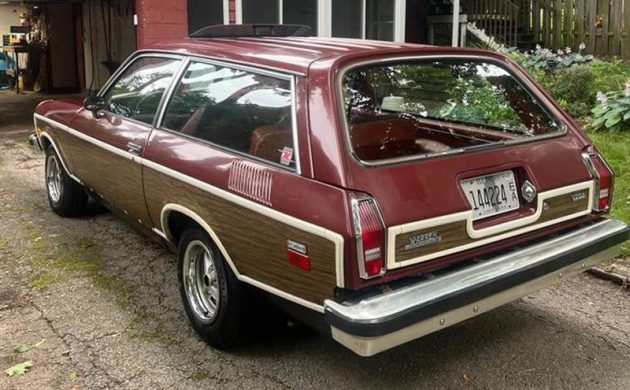
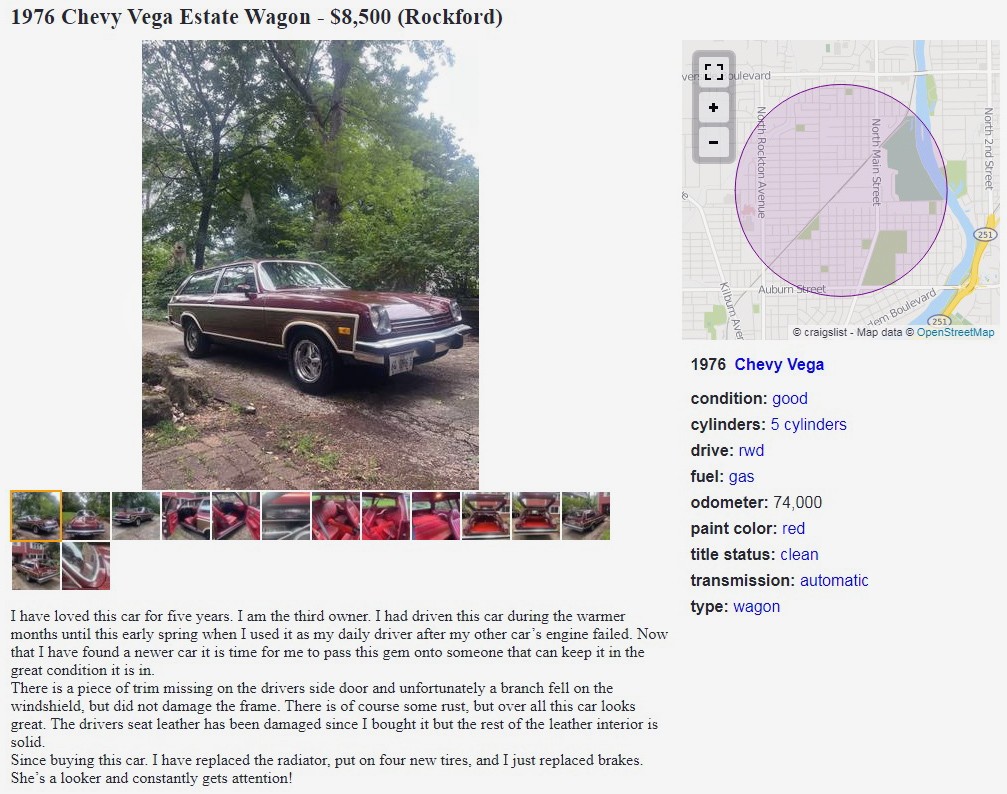
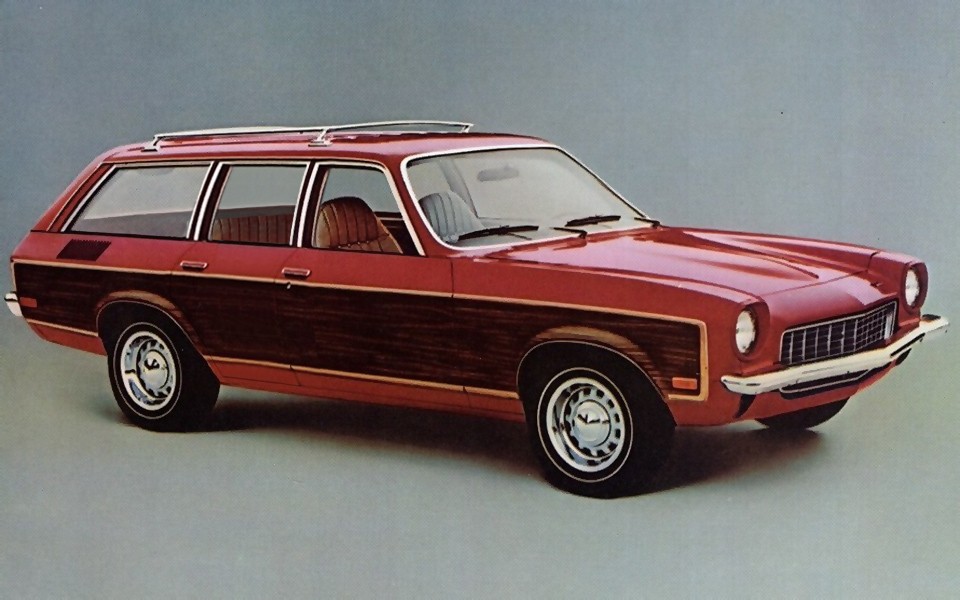
The leading edge of the woodgrain on the Vega Estate Wagons has always made me scratch my head. I’m not sure why more thought wasn’t given to how to end that important part of this feature. Maybe there is no good way to do that, given the front clip. This 1976 Chevrolet Vega Estate Wagon is posted here on craigslist in Rockford, Illinois, and they’re asking $8,500. Here is the original listing, and thanks to Barney for the tip!

There’s a piece of trim missing on the bottom of the driver’s door as you can see above, and the seller says, “There is of course some rust”, but we don’t get to see any of it due to the small, vertical (sigh) photos, no detailed photos, and no underside photos. The seller is the third owner and they’ve had it for five years, most recently as a daily driver.
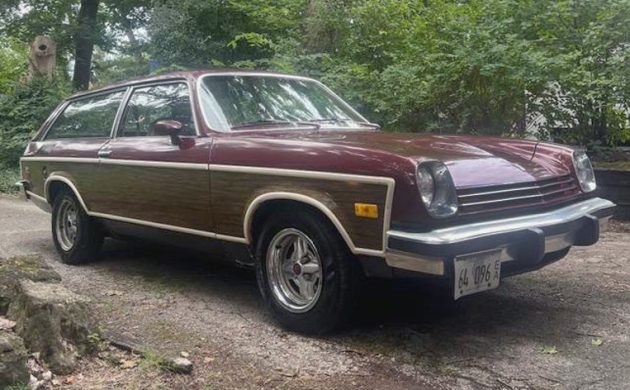
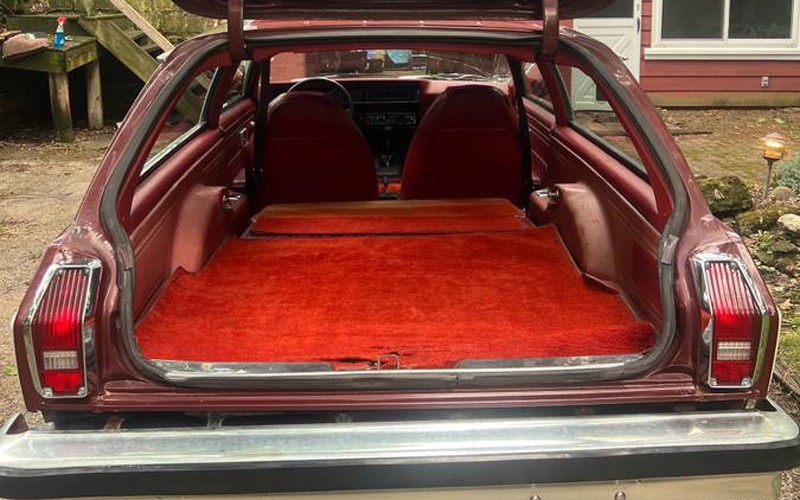
Chevy made the Vega from 1970 for the 1971 model year until the end of 1977, and they came in a two-door sedan with a trunk, a two-door hatchback, and a two-door wagon body style. Also, a sedan delivery wagon, but when was the last time you saw one of those? Never? Same here. I wonder what a four-door Estate wagon may have looked like? The rear bumper appears to be sagging on the left side, and here’s what the rear cargo area looks like.
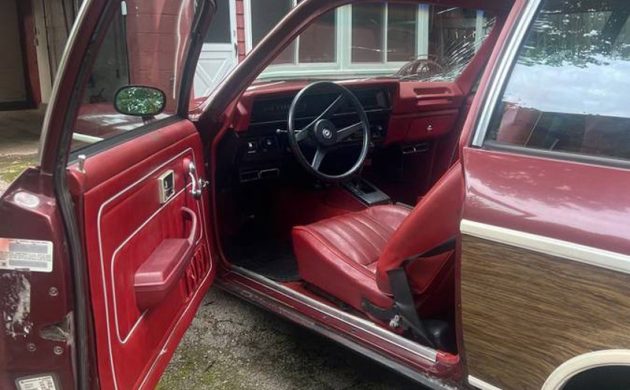
The interior looks nice in the small, vertical photos, but you can’t really zoom in on anything, and there are no detailed photos, other than one showing the odometer with 73,693 miles, and one showing the cracked windshield where a tree limb fell on it recently. It’s pretty cracked and would probably get you a ticket if anyone gets tickets for such things anymore. The seats appear perfect, both front and rear, but they say the driver’s seat “leather” (it’s vinyl) has some damage but we don’t get to see it. This car has an automatic transmission, zapping over a second from the 0-60 time and about 3 mpg.
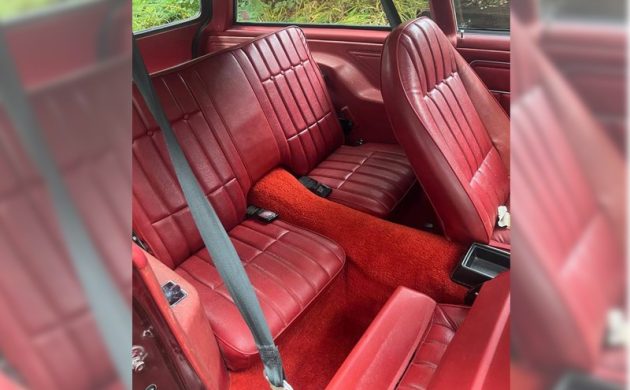
Here are the rear seats, and they look perfect, but I’d much rather see the engine. The engine should be Chevy’s 2.3-liter (140-cu.in.) SOHC inline-four with 79 horsepower and 109 lb-ft of torque. The three-speed automatic sends power to the rear wheels, as seen on the huge driveshaft hump/tunnel. It would be tough to talk a third passenger into sitting in the middle of that back seat. The seller says it has new brakes, a new radiator, and new tires. How much would you pay for this one?




That 4 door looks really believable Scotty. I always liked the design or looks of the Vega. We knew a guy and his wife decades ago, he had a beautiful blue 73 Z28. And his wife had a matching blue Vega. You could see the family resemblance and they looked really cool together ( umm…. The cars not the couple lol). I know the 4
banger had issues. Which is a shame. If GM had done a bit more R&D on them.
The fact this is still here with no visible rust is impressive in my book. Nice little wagon. And the interior looks amazing too.
No one would buy an american 4 door small car back then in the states – which is why even the Vega wagon was 2 door only!. Same with Pintos. Today it’s reversed. Or car makers do not WANT to make 2 door subcompacts anymore.
The 4 door only 1 year only Plymouth Cricket was a failure in the states for 1971.
I’m with Driveinstile, this Vega isn’t bad at all. I guess we should be glad to see one at all, given that most rusted away decades ago. My first thought was the same as yours Scotty, that abrupt end to the woodgrain maybe was designed by an engineer– you know, it’s very efficient just to square it off. The interior looks particularly bright and cheery. The four-door wagon chop looks good. How hard will it be to find that missing piece of trim?
Thanks Bob. To add to the rust issues. I remember reading that in the beginning there were some that actually started to rust on the dealers lots. I’m not sure if its entirety true, but where I grew up they sure went on a weight reduction program within a couple of years with the salt in the winter months.
-Dave
Our ’72 Blazer came with rust off the dealership floor. Must run in the family.
You’d think that car companies would have come up with a foolproof, 100% non-rusting way to make vehicles by now. Or, maybe it’s better to have consumers actually consume vehicles every few years and get new ones?
My wife’s brand new, 4-mile 2011 Mini Cooper had “rusty door actuators” (what the dealership said) that caused the windows to go down 6″ whenever they felt like it. Thankfully, we got the extended warranty to fix that, and all of the other times that brand new car was on the back of a tow truck before it went away.
Wife’s 2011 Mini, bought used, hasn’t given us any mechanical problems but the electronics periodically go nuts. A few months ago the “icy road” light came on for a few days. It was 86 degrees outside.
Those wheels don’t look too bad either.
Early Vega’s were transported by rail in the Vertapac system with cars driven onto ramps attached to the rail car, then tilted vertically and locked in place, standing on their nose. Special design attention to batteries, coolant and washer tanks done to not leak while in that position. Unfortunately these cars were not treated and had bare steel in areas under the windshield cooling. Rain water would not be able to enter these areas in normal driving, but transported on their nose, the rail cars leaked and water got trapped in confined spaces, unable to drain out. Rust started immediately, with it showing up around the windshield trim on dealer lots. This was fixed after the program got dropped, but the reputation damage was done.
I have had 26 of these critters in the 80’s as I bought/sold them to make money while going to school. I could buy them cheap or free, fix known issues, and make them into reliable commuter cars. Today you cannot find one for less than 4k, and parts are non existent.
If I had my dteam Vega, it would be a 74 GT Kammback with a 4.3L V6 dropped in there. It’s are too heavy and spinning tires don’t give you traction. That 4.3L is a torque beast that would be an ideal combo with a 5 speed.
Good info on explaining how they were shipped when new and why these cars rusted out early in there life Vegaman Dan! Which is why you don’t see many good ones left today!
There have been several Vega wagons featured on this site, some fairly recently. There is a lot of competition in the $8,000 through $10,000 from various makes and models, many needing no work. These cars are often value purchases by someone looking for a vintage/classic car that can be driven and enjoyed without a lot of work. This car doesn’t fare well in that light.
At $8,500, needing a windshield, having rust and missing hard to find trim it’s hard to see this car going garnering much interest beyond someone who is diehard a mid-1970’s Vega wagon enthusiast, they are probably few and far between, especially one willing to shell out that much money.
Steve R
I always was told that these rusted away prematurely. But in truth, any new Toyota/Lexota rot away faster.
I thought these were pretty well designed. I guess my ultimate Vega would be a wagon, sans woodgrain, with a Cosworth twin cam motor and a manual.
No, these were dog turds made of pre-rusted recycled steel
They were attractive, but very badly designed vehicle vehicles
Now the “dog turds” are all from Japanese brand manufacturers. Because they are rotting when they are towed off the boats with their low grade junk steel from Asia
Imagine an estate with Vegas on it.
I remember when pick-a-part(auto junkyard/dismantler) wouldn’t take a Vega. I also remember going with my dad to the Chevy dealership to look at the Vega when they first came out. Time flies.
I have owned one too many Vegas. Which is to say that I have owned one. It was a wagon as well, but not an “Estate”. It had received a complete new factory replacement engine, which failed at about 17k. You can’t run fast enough to give me a Vega. Forced at gunpoint, I would need to determine the caliber of the firearm, then make a difficult no-win decision. A Vega covered in wood grained contact paper is simply lipstick on a pig- a sickly pig at that. Caveat Emptor.
As a 1971 Vega Survivor, a couple of comments
These cars were simply built to an unrealistic price target. Detroit, with the highest labor costs in the world, had great difficulty competing with the Japanese and their government supported industries, (and undervalued ¥) at a time when the US was imposing necessary, but severe pollution controls and safety standards.
To meet the Japanese on price, every ounce of quality was squeezed out of the Vega.
While the design was attractive initially, imposing 5 mile an hour bumpers as cheaply as possible created the unfortunate front above, which is better than the one used from 1974-75, which looked like a cheap cheese grater
The angled cuts on the fake wood can also be explained by bottom dollar efforts.
The failure of the aluminum engine was not because of a lack of research and development. The engineers knew that the cost cutters had screwed the engine by installing yet another cheap part: an inadequate radiator.
The bodies rusted terribly because of inferior steel, and a design that prevented any proofing from reaching the firewall. Removing the plastic fenders to save more pennies, meant that the entire engine compartment was sprayed with salt in northern climates. This defect was known prior to production.
The good news is that by 1976, a substantial re-engineering of the cylinder head led to improved cooling and lubrication. An improved radiator was another significant improvement.
The engine could have been just as good in 1971, but GM’s accountants killed it, not the engineers
A Vega from the rust belt? NO THANK YOU!
I worked at a Chevy and Pontiac dealership back in the middle 70’s and as You all have alluded to these cars were coming in for wtty rust repair in the 1st 12 months of service. Also I think it was called the “Iron Duke” engine was prone to not starting when the temps dropped down below 10 degrees and lower. Kept our tow truck driver busy a lot thru the winter! Often times they would just bring them in and let them that thaw out and they would start no problem. It was common to see a half dozen or so jammed inside until they would run. I think a big issue was being carbureted people would get them flooded and then they were done. I had a new pinto and My Dad and I would put a heat lamp under the oil pan and go out late at night to fire up and give us a lot better chance the next running. Ind weather was pretty rough at times growing up.
The 1976 Vega was powered by the “Durabuilt 140.”
This was the Vega 2300 aluminum four with a new cylinder head, redesigned head gaskets and other improvements designed to keep it from melting down within 10,000 miles
If only the motor had been this good at the time of lunch, but it was not
The “Iron Duke”
was a cast-iron engine that was used in the Monzo and other H Body variants. It is mechanically unrelated to the aluminum engine.
I remember about 45 years ago working with a LARGE woman who drove to work in a little brown Vega. She was pretty intelligent, was a shop steward in the Union, always with a concern that we were “short staffted”, spelled as she pronounced. She was very pleased when I went to her home to work on the Vega that would not start in the winter one day. I was well fed.
I could do without the DinNoc fake wood stickers and the missing trim for the wacky walnut stickers will be hard to find, but it’s in fine shape, given the Vega’s known tendency to rust while sitting on dealer’s lots. I would lose the “Durabuilt 140”, which wasn’t, and drop in a modern four-cylinder from the modern GM family, without all of the Durabuilt’s known flaws, with more power to boot! I almost wish that Cosworth still had the tooling for the Cosworth Vega cylinder heads so I could swap the stock cast iron head for the aluminum Cosworth head and build a Cosworth Vega wagon! As part of the upgrade to Cosworth trim, the Durabuilt blocks got iron cylinder liners, one of the many things that Cosworth did to fix the Durabuilt engine’s many known flaws!
The Durabilt did not have cast iron cylinder liners.
Rebuilt factory engines did not get cast iron cylinder liners
“The 1976 to 1977 the engine received a new cylinder-head design, incorporating hydraulic lifters to replace the taper-screw valve adjusters, improved coolant pathways, longer-life valve-stem seals, a redesigned water pump and thermostat, and a five-year, 60,000-mile (97,000 km) engine warranty. The engine’s name was changed to Dura-Built 140.”
This would have made sense, which is all the more reason to understand that it did not happen
Cosworth asked Chevrolet to reinforce the aluminum block so that they could build the engine for more power.
GM managment declined. Cast iron cylinder liners were never part of the Cosworth program, which produced a car with all the prestige of the Vega name, the price of a Corvette, and minimal improvements over a stock Vega GT. In GM’s defense, it was tough times for emissions, fuel economy and staggering inflation, so they had a lot of fish to fry over those melting Vega Blocks
I remember reading an article about the Cosworth Vega in Science & Mechanics magazine, I think, with pictures for the process that Cosworth used to convert a GM Vega engine block to a Cosworth engine, and one of the pictures showed iron cylinder liners being pressed into the block. Science & Mechanics magazine is now defunct, so finding the original article may be difficult, but a trip to your local library’s set of “The Reader’s Guide to Periodical Literature” may prove helpful.
Cosworth asked Chevrolet to reinforce the aluminum block so that they could build the engine for more power.
GM managment declined. Cast iron cylinder liners were never part of the Cosworth program, which produced a car with all the prestige of the Vega name, the price of a Corvette, and minimal improvements over a stock Vega GT. In GM’s defense, it was tough times for emissions, fuel economy and staggering inflation, so they had a lot of fish to fry over those melting Vega Blocks
Best collection of comments I have read in quite a while. Thanks to all who contributed!
I never owned a Vega. Where I come from, they were called “verga”.
“Verga” es bastante diferente
Pero duele menos en el culo que la Vega
“On a quiet night. , you can hear a Vega rust out on the showroom floor. “
Even with leaf blowers
Back in the day, Greg Nolens at Greg’s Auto Machine in Kings Mountain, NC, was the Vega guy. I’ll bet he sleeved hundreds of Vega engines. After he finished with them, they were fine.
I’m sure this was done in the aftermarket. It was not done by general motors.