
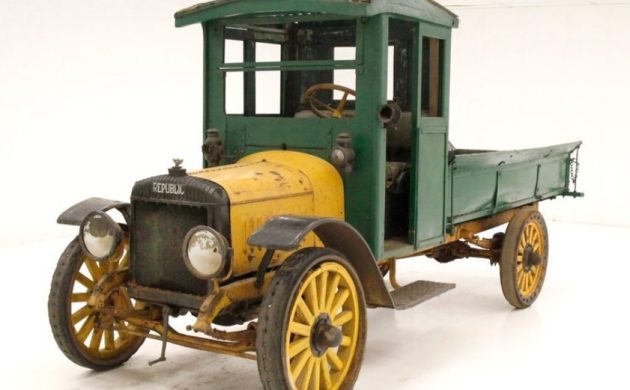
This truck is from the most prolific manufacturer you’ve never heard of: Republic Motor, with roots reaching back to 1913. Search the internet for “first truck made in the US”, and you might turn up Autocar, but more likely you will be inundated with mentions of Ford and its Model TT, produced in 1917 as a chassis or its Model T Roadster pickup – a complete vehicle – of 1925. But before anyone heaped coal into the back end of a Ford, some 40,000 Republic trucks were running around our rudimentary roads. These were serious haulers, ranging up to five tons. Here on eBay is this 1915 Republic truck with an asking price of $12,000. It’s located in Morgantown, Pennsylvania, and you’ll need a trailer to bring it home. It requires mechanical repair, but it’s a pretty simple affair. Once it runs, it won’t be as capable as my John Deere Gator, but it would make a quaint hauler working from one end of the farm to the other.
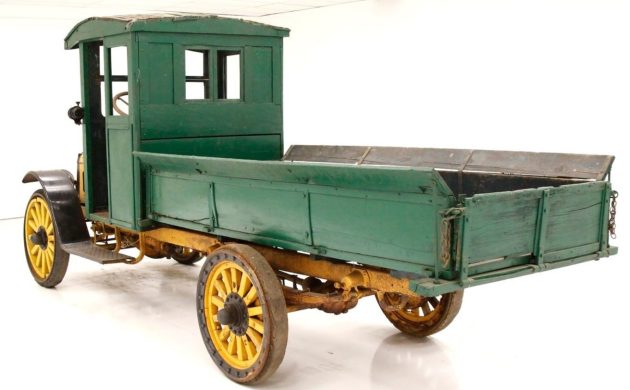
Republic was founded as a truck maker from the git-go, with the first of its kind rolling down a snowy driveway in 1911. Initially sold under the name Hercules, the trucks were later rebranded. WWI provided a substantial financial boost, such that at one point, Republic advertised itself as the largest truck manufacturer in the world, but management erroneously believed the new level of sales was permanent. It made acquisitions that strained its bank balance once the war ended, forcing it into receivership. It was acquired by American LaFrance in 1929, just in time for both companies to face the Great Depression. Republic sold about 70,000 trucks all over the world before its demise.
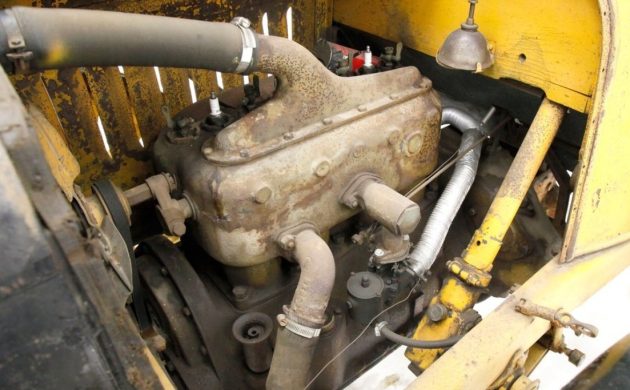
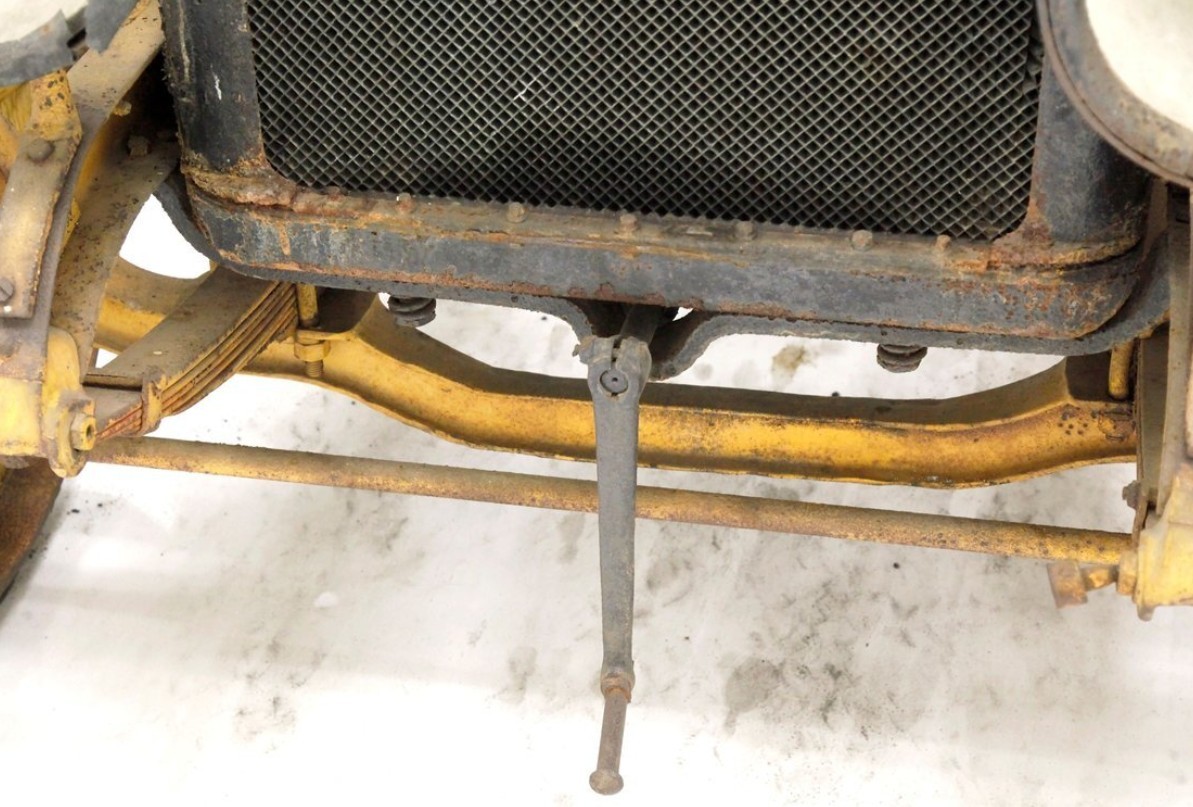
How many times have we seen Continental engines in early machinery? (I feel like Continental deserves a whole article.) This one is a 220 cu. in. four, paired with a tiny one-barrel and mated to a cranky three-speed crashbox. The starter is … you. Mechanical brakes operate on the rear wheels. Speaking of wheels, their wood spokes and rims have shrunk and are showing cracks and unsettling separations; the solid rubber “tires” need renewal as well (no date code on those, but I can tell they’re past their prime!)
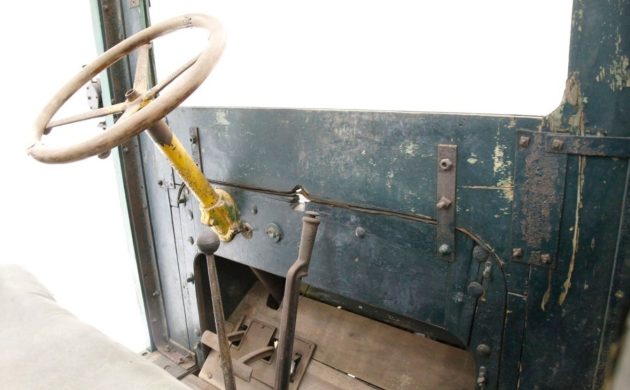
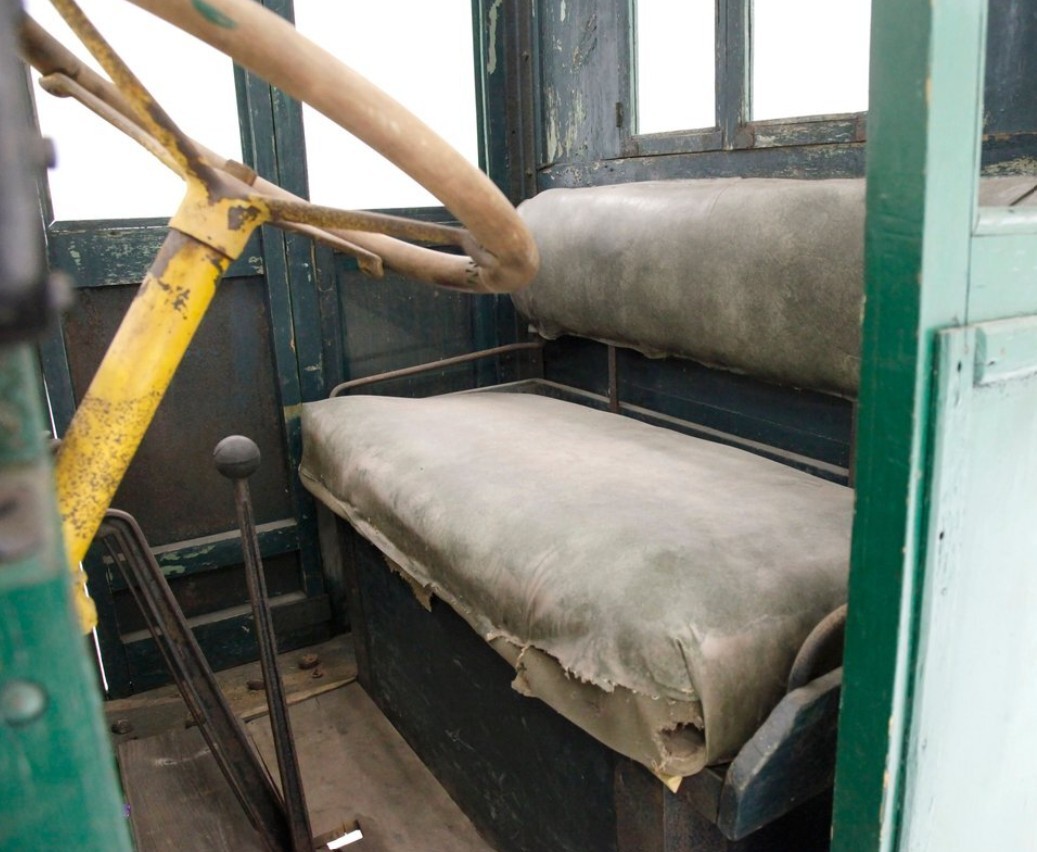
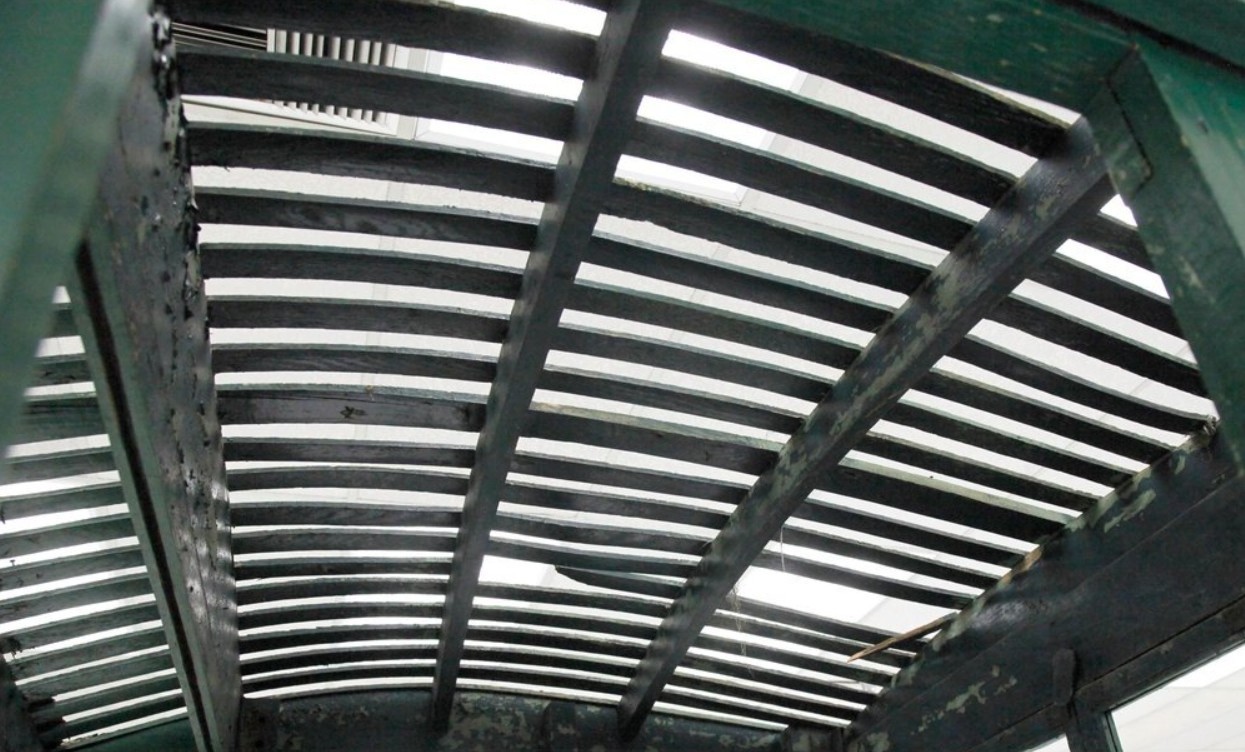
I love the “instrument panel” – that’s about as simple a gauge set as I’ve ever seen. But hey, we weren’t traveling much faster than a horse yet, so who cared. The rear windows resemble those in my garden shed. The remnant of an oil lamp hangs on the cowl. A leather bench seat, wood floorboards, and a gracefully curved roof round out the driver’s accommodations.
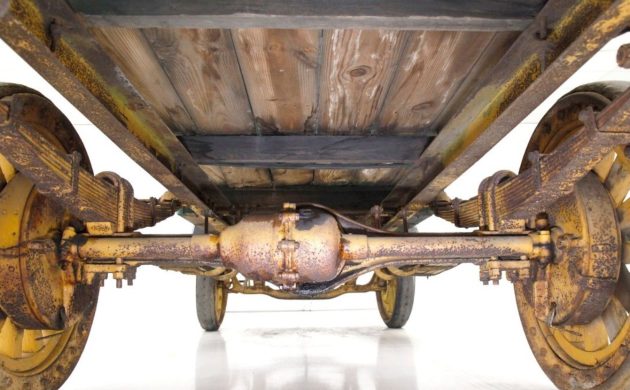
All of us are accustomed to waging war against rust, but what about dry rot? I spotted a bit in the body, though the bed looks fine. The underside is a reminder of just how simple a vehicle can be. While I suspect the seller will have to discount his price to tempt a buyer, I do hope someone finds the passion to get her running again. This truck is one stepping stone on the path of our history – the incarnation of our inventiveness, gumption, willpower, and the deep knowledge America was developing a century ago – and she deserves a good home.




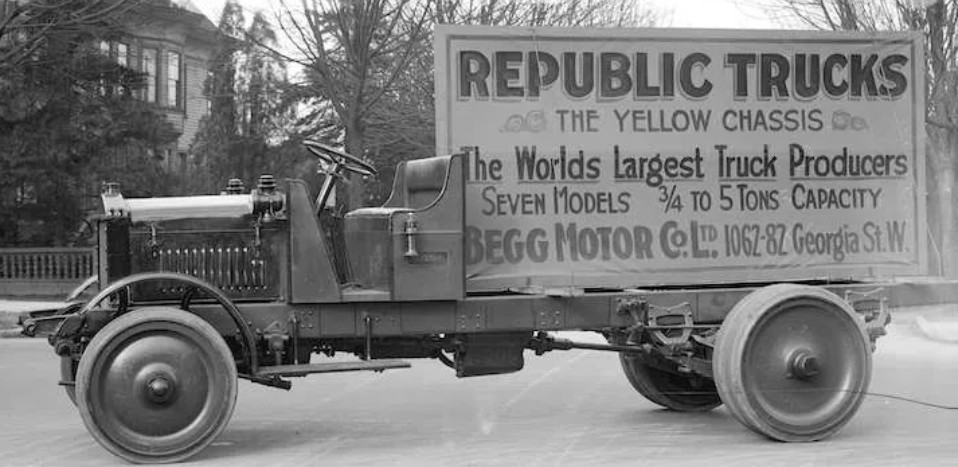

Oh, but I have heard of Republic. We are probably free because of Republic. The author only scratched the surface of Republic trucks. Influential in supplying the troops in Dubja Dubja 1 with the “Liberty” truck, a standardized military spec truck made by several companies. Oddly, the motor was a collaboration of 5 companies, Continental was among them. Perhaps you’ve heard of Ruggles, he was an important part of Republic, before starting his own company. I read, this truck, the 2 ton Model A, cost an incredible $1975 for just the chassis and seat. The Ford TT cost about $600, but not near the truck the Republic was. It had a patented internal rear drive setup, when others still used chains, and patents galore. The cab and box were added later by outside suppliers. Republic never made it out of the depression, bought by Am. LaFrance, for a couple years, eventually became part of Sterling. I have no idea what to do with it, static display for a sign maybe, but we owe a lot to these trucks, lest we forget,,,
Lest we forget, indeed. Thanks Howard A.
Remembrance Day up here tomorrow. November 11th.
Kind of odd but it seems that you’re about as likely to see a vintage Republic out west as you are a Mack of similar age. There was a local farmer in our region, bought a museum. With it came a sizeable boneyard. He had a couple of Republics similar to this model. Sadly, I don’t recall what happened to them but after the guy passed on his collection was auctioned off. I went to the sale but came back with nothing because there were some serious buyers. Anyways, I always thought of the Republic and its ribbed radiator tank. They were rid of them by ’27. I guess that’s called progress…
Geo, the example in your photo is glorious. Has the “yellow chassis”, the cab reminds me we were stilll driving horses pulling buggies. Love the stake sides.
Must be something about yellow frames, a White delivery truck about the same vintage sold elsewhere recently and that also had a yellow frame and suspension.
If the wood spokes are loose, just drive/tow her through a stream to make the wood swell…that’s what we do with our Model T’s here in Texas!
That’s how I fix a wobbly axe handle too – dunk it in my dogs’ water bucket.
Hopefully Steve’s Model T wheels don’t fly apart, and your axe head doesn’t fly off. 🤞🏻
No EFI, no computers, primer cups and a magneto. Nothing to go wrong, all you had to be was man enough to start, steer and stop!
Wood spoked wheels are of course exactly that, but, they are called “Artillery Wheels” because they were fitted to “Artillery Pieces”, (cannons). Cannons were invented shortly after gunpowder, therefore, hundreds of years before any motorized vehicles!
I see no water pump, so like the model T the cooling system appears to be thermo-syphon. That why flat belts and V-belts are known as fan belts. That’s all that was driven by this trucks engine.
On further inspection of the photos in the Ebay listing it appears the fan is driven off of a pulley attached to the drive also used for the magneto, running at cam speed rather than crank speed. Interesting.
Also, the ribbed top tank of the radiator is cast iron. Reminds me of a trip to a radiator shop with a radiator from our family’s 1970 Cougar, and an old timer working there referred to the top tank as the “top casting”, though of course ours was stamped from brass sheet.
And then there were the Packard’s, and here are 2 of 3 that my cousin owns. The white pneumatic tire truck is a 1920, 3 ton, and to the right is a 1914, 1.5 ton solid tire World War I Packard. Less than a hundred are known to exist in the world and he’s got 3, all of which started as partial rollers. In the summer of ’78 I graduated high school and also helped him dismantle the first one (the 1920) to begin the long arduous task of a restoration. Eventually Goodyear Tire Co. got wind of what he was doing, and they just happed to be in the early stages of restoring their own Packard truck, which was originally the “Wingfoot Express”, so named for the newly invented pneumatic tires for BIG trucks beginning in 1918. They needed an engine, my cousin needed 4 tires, of which none were available, which led to a mutual working agreement that included my cousin giving a spare engine to Goodyear in return for 4 first run reproductions using the original tooling, and their mechanic also rebuilt my cousin’s engine.
Packard was able to think outside the box. The New England Aviation Museum at BDL at one time had a Stinson “Detroiter” SM1-DX, NX-7654, with a Packard DR-980 9-cylinder nine-cylinder Diesel radial engine. It, interestingly, had a single valve per cylinder which did both exhaust and intake duties. There was a “Y” shaped manifold per cylinder facing both forward and rearward and fresh air rammed in from the front on the downstroke after the upstroke had pushed out the exhaust.
Now, THAT’s my kind of thinking!
Here I am in 1978 removing the oh-so-heavy engine from the 1920 Packard.
Hey Howard, you or Geo wanna drive this thing? To drive one of these today might be an epic event to be sure. No power steering, no synchros for the gearbox, just brute force and listening to the engine to know just when to shift gears and push
the clutch in and out. It must’ve
been something to behold to be sure. And now that I’ve said all that, I once had an old photo my
Grandma gave me that showed my Grandpa standing next to a
Republic truck like this one. The
Year
on the photo said 1922 and from what my Grandma told me, it was
the VERY FIRST truck in McLean
County where I’d grown up. My
Grandpa delivered cargo for a place car MY STORE, a giant department store in Peoria Illinois. In the beginning, he drove a large wagon pulled by a team of horses, but when the company switched to motorized
trucks for delivery, he got one–the first in the county which must’ve been really something to
make your deliveries in a matter of days instead of weeks. And like truck drivers today, he was gone from home quite a bit delivering goods to nearly all the towns between Peoria and Bloomington. Quite a feat for the time and I was riveted in place by
all the stories that Grandma would tell me as a kid. My Grandpa lived long enough to see
the roads improve to the point that his route now took hours
instead of days or weeks. He died during a massive scarlet fever epidemic in 1933 but his
stories lived on through my Grandma and now to me. And yeah, my girls get after me for telling all my stories, but I’m the
last of my family that can tell them today. And since I don’t have kids, I share them with all of you and anyone else who’ll listen.
And folks lemme tell Ya’, I’ve got a bunch of them!
Hi Ken. I wouldn’t be afraid to try to drive one of these. As far as navigating a straight-cut crashbox is concerned about the best way to do it would be to leave the clutch alone and “feel” your gears. For me, driving a crashbox such as a Warner T-9, the best way to drive them is to use the clutch for starting and stopping then feel your way through the gears.
On the ranch we had a Case tractor (730) that you could actually drive like a truck. And drive it like a truck we did. It actually drove very nicely up through the gears; a little tricky coming down but that was soon mastered. Dad eventually traded it off for a new one (which you could NOT drive like a truck). One of the former ranch hands quickly bought the 730 because he liked the way it drove…
Hi Ken, well, I’d be lying if I said I drove these kinds of trucks, but in all fairness, not a heck of a lot different than a certain R model Mack I cut my teeth on. The upside there was, just about every truck after the Mack was an improvement. For 1915, this was actually a rather modern truck, considering horse and buggy weren’t that far away. I read the top speed of these trucks was about 25 mph, and the “cushioning holes” in the tires did little. I heard of solid tires losing big chunks, and that would be what a day be about. Not unlike that grocery cart with the flat wheel I always seem to get.
Also, it wasn’t all men. The test driver for FWD Corp. was a woman. In 1918, Luella Bates became the 1st woman in the US to be issued a commercial drivers license.
Edgar Rice Burroughs was approached by Republic Motors, to write a promotional pamphlet for them in 1916. That pamphlet, telling the storyry of the Burroughs family, moving to LA, is one of the most sought-after of ERBs’ works!!
I saw this 4:30 this morning while getting ready for work. I’m seeing this now and am not at all surprised by all the responses. All the Federal stories and the Packard trucks shared here too are great. I’m with Geomech, don’t use the clutch to shift. Just slip shift it, you’ll get a feel for it. One thing about old trucks, everything is mechanical and you can just ” feel” everything working together. And Michelle phenomenal article and a Federal truck just moved up to the top of my bucket list of vehicles I want to drive. This NEEDS to be preserved. I wouldn’t personally go nuts restoring it. Just keep it looking like this. Fix what ails it mechanically and enjoy.
Nice original. I have 2 Republic trucks. Very overpriced for not running and bad rubber but still cool
Another restoration that needs to be refurbished.. Howard and Geo are right on the money as usual. As far as the wheels there are several PA Dutch Amish wood workers that can still build new ones..If listed in any of the antique truck publications I am sure it will be gone soon.
Thanks a lot, Michelle! Here I was, primed for a productive workday, and now my next hour will be spent heading down the Republic rabbit hole…
Apologies…. !