

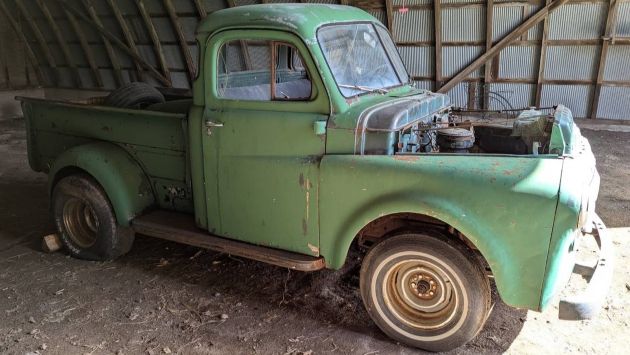
The resumption of automotive innovation among American automakers after World War II was quite sluggish, to say the least. Almost all post-war production cars were simply continuations of pre-war models, with pre-war styling (Studebaker and Kaiser were notable exceptions). It wasn’t until 1947 that the first all-new postwar pickups were introduced, with GM leading the charge with their “Advance Design” trucks, followed closely in 1948 by Ford’s F-series and Dodge’s “Job Rated” B-series pickups. The B-series shown here on Craigslist in Emmons, Minnesota, with an asking price of $9,200, is a 1949 example, largely unchanged from the 1948 variant that introduced the line. A special thanks to Barn Finder Barney for locating this one!
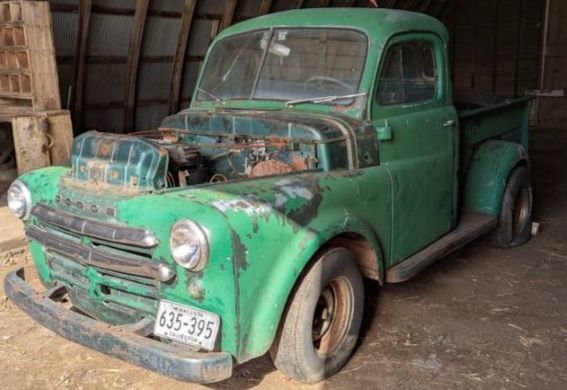
Though most American automakers produced trucks that varied vastly from their 1946/47 models, perhaps none went as far as Dodge with the B-series. 1948 Dodges featured a bed with sides measuring 5-1/2 inches taller than previous models, increasing cargo capacity by 40%. The cabs were widened, lengthened, and deepened, allowing up to three people to sit comfortably; the resulting squared-off interior design was often called the “pilot house” cab. The wheelbase was shortened by 8 inches, and the front axle moved farther back to increase stability. The final product is a striking, uniquely styled pickup that can handle anything you throw at it.
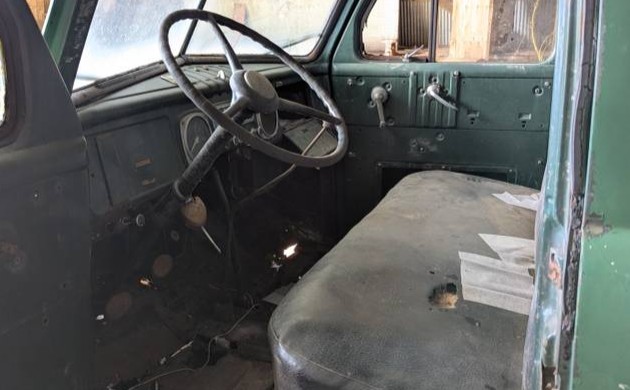
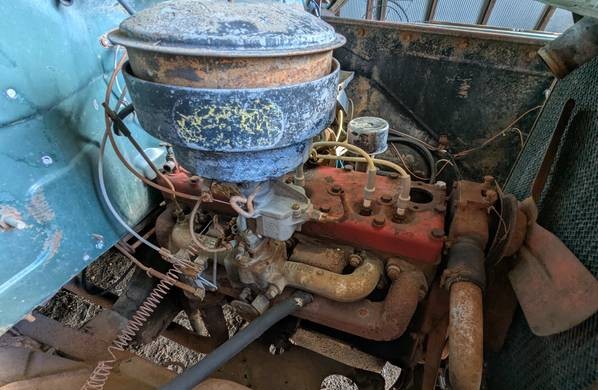
This particular B-series example is a B-1-B108, with the “108” referring to the 108-inch wheelbase that all their half-ton trucks shared. The 217.6 cubic inch flathead-six engine (rounded up to the “218” for promotional materials), used in Dodge pickups since 1937, produced around 95 horsepower when new and was coupled to a three-speed floor-shift manual transmission, both of which seem to be present and complete on this one (except for the thermostat housing on the engine, which does appear to be missing). Photos of the interior are sparse, but the interior on these trucks was sparse to begin with, so there really isn’t much to see; the pictures we do have show the interior as mostly complete, with some tears in the seat and the usual barn-related detritus, but it is in expected condition overall for a truck nearing 80 years of age. The seller notes one of the three chrome grille bars is missing, as well as the fuel tank; though not necessarily easy to find, these parts are out there to be found.
The underside of the truck is not shown, but you can see from the interior pictures that the floorboards have a typical amount of Midwest rot. In my experience with B-series Dodges, these trucks tend to rust in strange places, like the middle of the front fenders and along the beltline of the cab; these areas are in good shape, and the cab rockers and corners look solid as well. The hood is in the bed and looks to be all there (these trucks still had three-piece butterfly-type hoods). While this era of American pickup is immensely popular and that popularity continues to rise, Dodge is not generally the brand you think of when you think of 40s and 50s pickups. I think the $9,200 asking price for this one is a bit steep, given the truck’s condition; what do you think?

When I was a kid, there was a plethora of Dodge trucks in the border region. Lots of Pilothouse models but I have to say that the first version ticks all the boxes for me. It just seems that these look the best. Of course I wouldn’t kick any of these off my driveway.
The border region brought in some interesting situations. Being that the closest dealers for everything were just north of the border in Canada, compared to a 40 mile jaunt to Shelby, a lot of local farmers and general workers bought vehicles in Canada. With Dodge, it was American Dodge, Canadian Dodge and Fargo, which was a Canadian product. There wasn’t a lot of difference between them other than the corner windows weren’t available (according to my information) in Canada. But you could get into trouble in the engine bay.
Canadian trucks ran 25 inch engine blocks while the American versions had 23 inch blocks, until you got into the larger trucks with 230 and 250 CID. A lot of guys shot themselves in the foot ordering the wrong head gasket. It also made for some problems with dealer parts stock.
And then you had the American Dodge cars or the Canadian “Plodges,” which were Plymouths with Dodge badging. Growing up in that region, you learned from an early age but I remember some travelers that sometimes had to spend a couple more days at the local hotel because the dealer stocked or brought in the “wrong” parts…
Whoa, I can’t believe that bribe actually worked,,,our little secret,,thanks for the truck post. 9,9,9200, what, dollars? Maybe for Geos truck, people sure have twisted ideas about this stuff. Back in the late 80s, trucks like this inundated the countryside.Any farm at random, was guaranteed to have at least a couple. The guy that was a local dump curator, ( his barn looked exactly like an American Pickers stop), and also my kids bus driver, said he had a couple trucks he wanted to sell. 1st was a ’51 Ford F5 single axle dump truck( I drove home) and a pickup just like this. $100 for both. Never did get the Dodge running, although it surely could have. It should be noted, while Dodge originated the term “Pilot House”, many called the GM ones that too. And we all know what will happen here,,,