
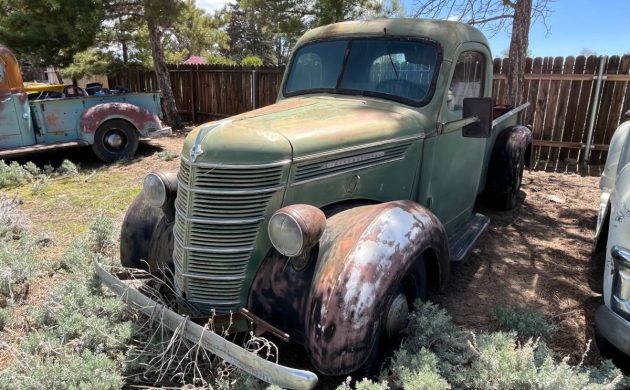
International Harvester is best known for its agricultural equipment and heavy-duty trucks, but its first truck – the Auto Wagon – was a precursor to a light-duty line that gained traction in the early 1930s. The company toiled in this niche for decades, but it was tough sledding: the Big Three had captured significant share and were set to grow faster, with laser-focused dealerships; IH dealers preferred selling the company’s most profitable products, which meant heavy trucks; and the company itself unwisely pursued a strategy of internal competition, pitting divisions against each other. Given all these headwinds, it’s a miracle production lasted as long as it did. Here on craigslist is a representative from one of International’s earliest lines of half-ton pickups – a 1937 D2. The seller is asking $7500 for this project; trailer it away from Reno, Nevada. Good eye, Nevadahalfrack – thanks for the tip!
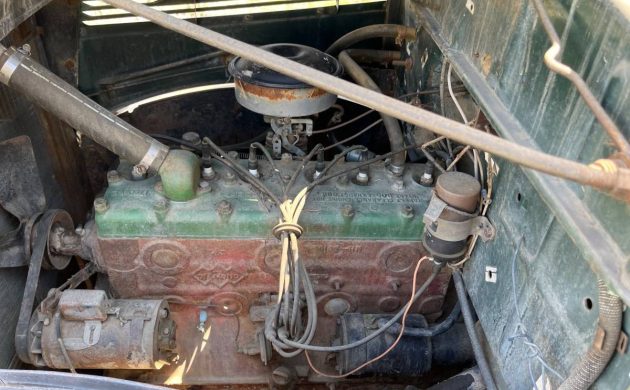
Here’s the famous Green Diamond flathead, this one displacing 213 cu. in. and good for about 78 hp – once it runs reliably. Helpfully, the seller notes that the engine does turn over. He also indicates, “It would take very little to get the truck back on the road again”, a sentence that always makes me wonder: if so, then why not put it in running order before selling it? If you guessed that the derivation of this engine was Willys, you are correct. In fact, International’s D1 was made by Willys-Overland. The standard gearbox was a floor-shift, three-speed manual, though for a few extra bucks, you could get a four-speed. International claimed a top speed in the 60-65 mph range, but these trucks were happiest running around 50.
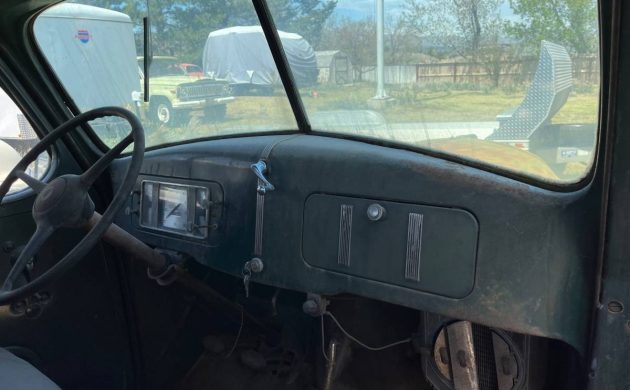
Trucks were already improving in the creature-comfort area. This cab was wider than the C-series and offered an improved greenhouse. But the ergonomics and equipment were simplicity itself, with few gauges, a bench seat, a crank-out windshield for ventilation, and rubber mats on the floors. That glovebox was considered a luxury. These were the days when standard equipment often didn’t include two sun visors.
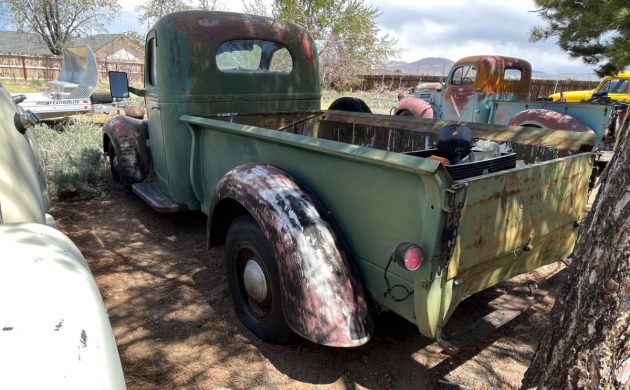
Styling cues are straight out of the Art Deco playbook, with a streamlined “V” grille and teardrop fenders. Early D2s came with just one tail light and no turn signals. This is the original paint, and judging by the photos, the tin worm hasn’t been too busy here: the cab corners are very clean. About 80,000 D2s were made up to 1940, but they’re a rare find today. How would you restore this example?




I’d be hard pressed not to make a mild resomod out of this old guy. Unique and usable and with a good paint job, good looking. After all that you’d be forever having folks ask you what it is.
Another knife-twister for me. Get it running and see where it takes you. The D-2 trucks were very classy trucks and sold reasonably well, even through a recession year like 1938.
Long wheelbased Binders of this vintage always looked a little thin in the middle. IH had the attitude that a person had to be able to stand on the ground so he could reach stuff in the bed without having to climb in. But that took a while before the realization that a continued running board greatly stabilized the rear fenders.
D and the later K-series had their rear fenders out there by themselves, where they were allowed to vibrate and crack, and eventually fall off, and get run over; a fate that happened to my personal D-2, and numerous D & K models.
One of the previous owners of my truck cut a nail barrel in two and made up replacement rear fenders for my truck. So far I’ve managed to gather up enough shards of rear fenders to complete one and 3/4 replacements.
That isn’t a Green Diamond engine under the hood. That engine is an “HD,” the immediate ancestor to the GRD. When IH contracted Willys to build pickups it took over engine design. The Willys Whippet engine had a smaller CID which IH opened up to 213. When the contract ended in ’33, IH took the engine and continued to develop it.
The difference outside is quite subtle. The HD has rounded corners on the head and it is fastened into place with studs and nuts (like this one has). Another difference is 18mm spark plugs. The GRD has a very sharp-cornered head and it is retained by capscrews. 18mm plugs were still used prewar, but all postwar had 14mm.
Inside the block, the bearings, pistons, valves and timing chain were all the same. Even the rods and the crankshaft were the same. The only difference was the HD used shims on the bearings while the GRD had the block and rods machined to a more precise diameter. Overhaul an HD engine and you’ll want to do the same–unless you really like to use shims…
I might add that IH discontinued the GRD as a truck engine at the end of the ’49 production year but continued to use it in combines and industrial equipment until 1954.
Parts for this can be a bit challenging but not impossible. I’ve put together a couple of transmission and rear end overhaul kits without too many problems. Engine parts can be difficult. Pistons will need to be made; bearings will need to be re-lined. I know some places that are willing to do that but don’t get into a big hurry; the end result is worth it.
If this truck was a little closer I’d sure be tempted…
I wanna be you when I grow up, so I know the internals of D2 engines! Thanks, Geo. Always appreciate the color you add.
Very interesting post! Thanks so much….really appreciate your expertise! I learn so much from this site…..
Given a piston or dimensions JE Pistons makes anything you need.
I’ll have to keep JE in mind as I haven’t heard of them before. Thanks for the info.
Remarkably good condition for what it is.
I own a 1940, last year of the D series. Mine is restored as original. This one deserves a faithful restoration. No truck other than a Diamond Reo gets as many people around it at a cars and coffee. This one even has the deluxe trim in the cab. It’s hard to see but I suspect it also has its lovely original 16″ artillery wheels which for no one makes reproductions.
Geomechs of course correct on speed. I keep mine to 50 MPH max. You could go faster installing a Gearvendors over-under, but then you better put in better front brakes, etc. Very rarely do people get annoyed following me on two lanes.
I thought the artillery wheels were 15″ Maybe they made both. I should have a set out in the wheel racks.
16 and17 inch. I have a few sets of both. Part of my STD list; refinish them, then put tires on them. It’s a 2 year process, curing the paint takes the longest.
6 lug GM.