
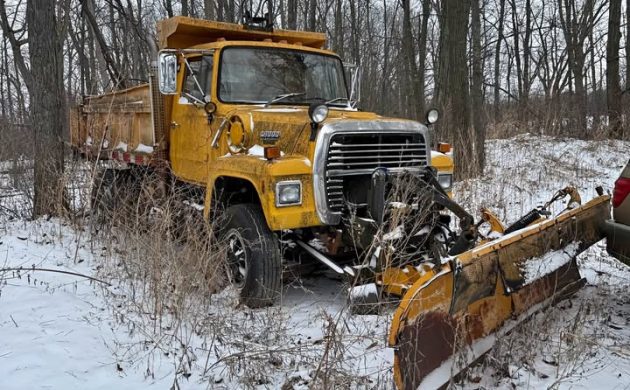
Old working trucks are among the most frequently discarded vehicles, in my opinion, typically because values drop to a point where it’s a difficult sell on the used market. Couple that with the sheer nuisance of relocating it and it becomes far easier to dump it in thee woods; heck, if you ever need parts off of it, it still has value sitting on the back 40. In the case of this 1988 Ford L8000 dump truck listed here on Facebook Marketplace for $3,000, there may be a fair amount of useful parts and components still tied up in it, and the truck itself may still be put back to work given the dependability of its 7.8L inline-six “Brazilian” diesel engine.
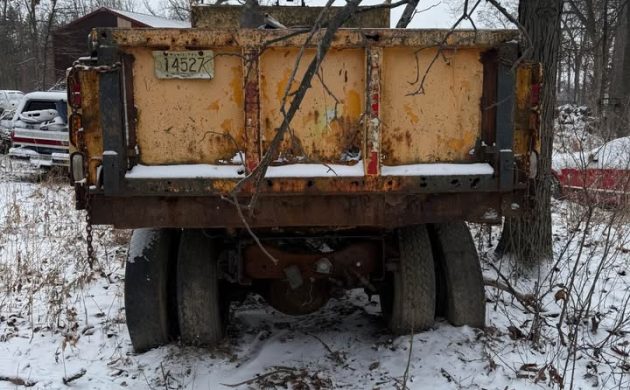
Now, it’s clear this truck has been put out to pasture for some time. But considering the value the plow mechanism has – and the likelihood of the drivetrain still being usable – this truck is likely far from done in terms of providing some measurable value to its next owner. The question is will the engine be used to fire this rig back up, or be pulled to keep a running, driving truck on the road? As durable as these motors are known to be, parts have been hard to come by for some time – so if this truck needs a fair amount of work in the form of replacement parts, it could be a headache.
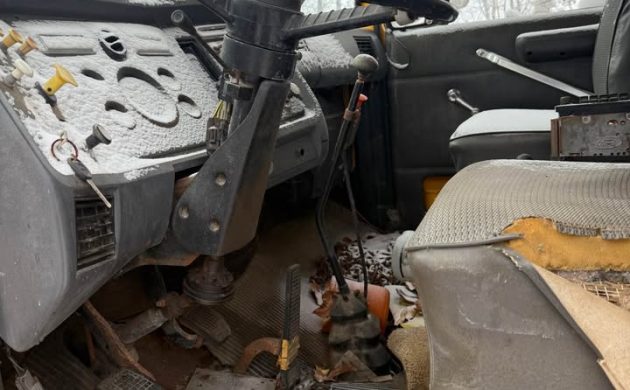
All that said, for someone who has successfully kept one on the road, the parts are certainly desirable. When you crawl around the web looking for more information, most of it comes back saying that you’re going to have to ship a replacement engine up from South America if the one in your current truck fails. The seller states that it ran well a year ago, but it hasn’t been fired up since. In addition, he mentions that the brakes are sticking and he blew out a brake line, which is likely why it was parked in the first place. As far as interior condition goes, I’m not sure there’s much to say other than it’s present.
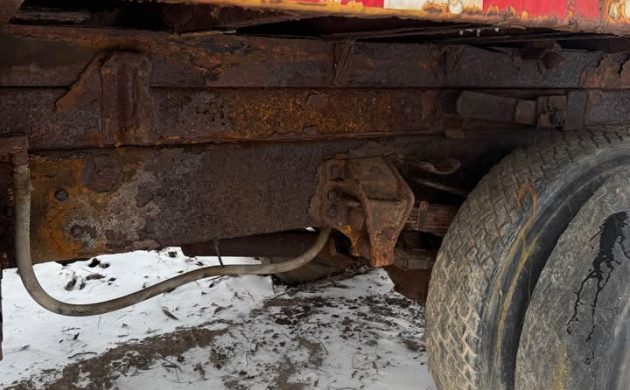
Scale on the frame doesn’t bother me too much, but for anyone who lives somewhere that rust is non-existent, this may scare you off. Fortunately, you can have this wire brushed off for the most part, which should alleviate some concerns. The Ford is located in Wisconsin and it’s parked in the snow, so I’m sure you can find some heavier corrorison without looking too hard; still, it’s not meant to be pretty, it’s meant to be usable. In the case of the desirable and rare Brazilian diesel I6, do you think the engine alone will help this forgotten Ford find a new home? Thanks to Barn Finds reader Lothar… of the Hill People for the find.



A Louisville!!! I don’t remember Barnfinds having one of these in the recent past. I’ve had a chance to drive a couple many years ago. I think both had a Caterpillar 3208 under the hood. I didn’t know about the Brazilian built 6. That dashboard brings back memories. Sadly there’s some people that will look at it strictly for scrap metal, maybe someone would want it for parts, but hopefully, maybe, someone will get this Louisville back on the road.
I enjoyed your write up Jeff!! Thank you
These were good trucks overall. The engines were based on what was originally designed and built in Dagenham, UK. Both the 6.6 and 7.8 were used in tractors and combines for many years so a lot of parts are still available.
Had a lot of these go through our shop. Emissions regulations got a bit stupid and if you tried to adhere to them they ran like a broken toilet. At least you didn’t have much of a mosquito problem. But you didn’t have any power either.
Fuel injection systems were supplied by Bosch. The 7.8 ran a P-3000 mostly but the last ones actually ran a P-7100 (similar to Dodge/Cummins from ‘94 to ‘98). Six years ago, about the time I retired, parts for the fuel systems were still fairly easy to come by. Last summer I stopped by to visit my former co-worker and he happened to have a P-7100 pump off a 7.8 all torn down. He told me that the main problem with parts was the cost, but then, so is everything else.
Good investment? They were well built but they’re also more than 25 years old. The biggest challenge you’ll find is maybe finding brake drums. Parts for the air system or the hydraulic system are reasonable to find, except for drums. But then, since the other makes of trucks use similar systems, parts for them can be a challenge.
Unlike Dave and Geo, I have no 1/1 experience with the Ford Louisville. But I do have 1/25 experience. As a kid, I built four variations starting with the AMT Ford LNT8000 kits (tandem axle dump truck, single axle tractor, single axle flatbed, tandem axle flatbed). I still have two of the models, but unfortunately they haven’t fared well during home moves and now pretty much look like the fifty-plus year old specimens that they are.
The Louisville, my favorite “big truck” of all time.
Finally, a Louisville, and from Wisconsin, no, what was the giveaway? I’m pickled tink a Louisville finally graces the pages, but jeez Louis(ville) a poorer example I don’t think you could have found. I drove a tandem like this for the asphalt company, a 3208, set of clubs( 5×4) that probably was just as useless as this motor. This was without question a local small town municipal rig, hauled a lot of salt, plowed a lot of streets, and the motor was adequate for that. Coming from the area, I’ve seen a LOT of trucks like this. That frame is toast, and you can see the layers gone by the spring hanger, I’ve seen frames like this crack more than once. As a plow truck, however, it doesn’t get any better than this. Couple big rocks in the back, for a long driveway, can’t go wrong. Those old “oil” engines will always start, I just wouldn’t go too far.
Little history on the Louisville Ford, if I may. Without question, Fords most popular HD truck in the construction arena. Either the company had Cornbinders, Macks or Fords. Construction of the L series ended in the late 90s, and decimated the city of that name. It employed most of the city who all now probably work in the parcel biz. I think only the Expedition is made there now, and how many of those do they sell? While official production numbers aren’t available, ( 1970-1997) it’s estimated Ford sold well over a million L series trucks in the 1st decade alone. The flagship would be the mighty LTL 9000, an awesome truck, and Ford sold the HD trucks biz to Freightliner( Volvo?) in ’98, and quietly exited the HD truck business. I can say from experience, the L series Ford was the best truck you could buy. I say a great find here.
Ford makes the Super Duty pickup line at the Louisville, Kentucky Truck Plant, as well as the Expedition and Lincoln Navigator. It’s quite an impressive place.
Hi SirR, reason I say “decimated”, in 2001 or 2002, on a trip from Wis. to FL., we stopped at a truck stop in Louisville for a bite to eat. The waitress was exceptionally friendly, like most folks from Kentucky, ( unlike the crabs in Wis., must be the weather) and while waiting for the food, we started talking. I said, being truck drivers, “Louisville huh, home of the trucks”? The smile ran away from her face, apparently, this was not long after the L series was stopped, she and many family members were out of a job, and she was working at the truck stop. We had similar stories from Milwaukeenosha, and Janesville. Takes a while, but eventually those cities reinvent themselves, and Louisville is the #1 hub for all packages going everywhere. The airport, the scene of that unfortunate crash a while back, handles an astonishing 3 HUNDRED, UPS planes a day alone!.
Ahh yes, the L series. I drove many a mile in various configurations, 24ft box with an open roof to haul junk tires in the 70s, straight body 9000 to haul oxygen and other industrial gases in the 80s and a homemade 600 rollback in the 90s. I changed out the running gear on the 600 to make it a 7000. Also put in an 1147 cat with a 5 and 2. I think the mileage on this example should be disregarded, as when you back up the odometer also backs up. I’m sure this one is past it’s prime and will be cut up or sold as an export.
Major league truck here. Never used a plow that big, just the one at the other end of the spectrum.
I have to go with Howard.. This is a totally wore out municipal truck. Probably the cab is as rusted out as the frame?? Depending on if it has juice or air brakes they whole system will have to gone thru. If the engine is not locked up it might(??) make a farmer or landscape company a useful vehicle. That plow is a lightweight used only for city streets or parking lots. The whole plow assembly possibly could be fitted to a 1 ton dually??? I think this truck will be either parted out or scrapped..
geomechs, correct me again if needed. Everything you said was what I remember. As a Ford store we became a, medium duty store when the LN6000? (cab over) came out. And these engines were introduced here in the states as a truck engine. And yes these these were New Holland engines before being used in trucks. Thanks for all the info, my brain needed a refresh!
Hi Wayne. The first 6 cylinder Ford engine I worked on was (I believe) a 268 Parent Bore. It was a power unit on a gravel conveyor. Ford definitely learned what not to do when it brought out the newer, larger engines. I first encountered the 401 (6.6) in a 9000 tractor. It had a Simms Minimec injection pump that ran its own oil reservoir in the cam box, which worked just fine as long as you serviced the cam box when you serviced the engine.
Ford adopted the American method of pressure feeding the cam box and allowing the oil to drop into the gearcase.
Now the LN6000 would’ve originally been powered by a Cat 1150/3208 but eventually had the 401 with a Bosch A-Series pump. Played with all of them for better or worse.
Ex-city truck bought to push snow, note the butterfly hood so you can check the oil, can’t flip the whole front end up with the plow on! Air brakes, thank God! This would have had Lucas wedge hydraulic brakes, crappyest setup ever! 5×2 good set up for a truck this size. If I had a need I’d give 3k.
It snows ❄️ in Brazil ?
The engine was produced in Brazil. The truck was produced in the U.S. The plow was installed for the original user.
They weren’t bad new, but municipal units were under spec’d and in many cases poorly operated. Stay away unless you want to just scrap it…
Bill, it wasn’t just municipal vehicles. I went down to Las Vegas to visit a public utility company to spec out 10 new C6500s for them. After all the body and equipment weights. I sat down with their “vehicle” manager. His first words after looking at my proposed specs were. “We don’t spec. these trucks this way. Change these load capacities down. He wanted me to change the spec to being overloaded just with the service body. (axle and tire ratings) Not to mention the required equipment and payload. I said “that is irresponsible what if you have a failure and cause an accident? Aren’t you afraid of a, lawsuit ?” His answer, “No, if we get sued and lose money, the public service commission will just give us more to raise the rates!” I wouldn’t spec their trucks that way and left. So, it’s not just municipalities who take the lowest bid. People are in charge who “know more” than the professional trying to getbthem the proper spec.
This is the kind of junk that should not be taking up valuable advertising space here. Barnfinds must be getting desperate to find new posts to publish lol.
That maybe true about the condition of the truck, but it brought in a lot of discussion.
I’m sorry and a bit hurt you feel that way, it’s as if you are giving us the middle finger. Perhaps you are one of the maybe 1% that actually likes Lambos and Corvettes, and that’s fine, but we “put up” with that nonsense, please don’t trash what we hold dear. One persons “junk” is clearly another persons gold, and if you had any memories at all about these trucks, like we do, I doubt you’d feel that way.
It’s not advertising.
We had a worn out Louisville daycab tractor at my 1st trucking job. Nobody ever drove it 😒 lol. We all refused. Mngt didn’t ever dare of applying discipline either.