
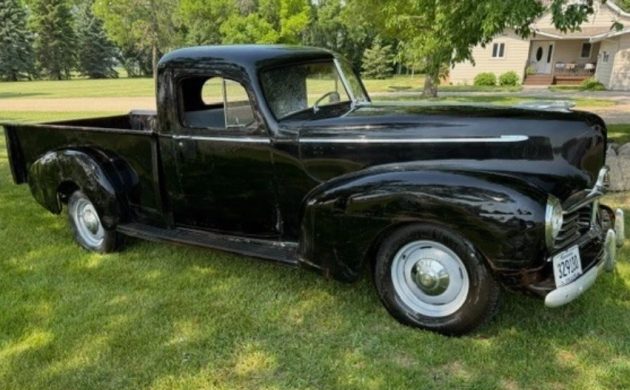
Like many auto manufacturers, Hudson’s first trucks were more of a pickup bed appended to a car. But the company began mass-producing purpose-built trucks in 1929, under a separate division called Dover. These were situated on the Essex car chassis. In the early 1930s, the Dover truck was renamed “Essex”, then swiftly shifted to “Terraplane”. In 1937, we had the Hudson-Terraplane, then finally, just Hudson – amounting to five nameplates in about ten years. The Big Boy was introduced in 1939 as a 3/4 ton on a 128″ wheelbase, but retaining the front-end sheet metal of Hudson’s business coupe. After the war, production resumed, but the Big Boy name was dropped. Here on eBay is a 1946 Hudson Super Six pickup, bid to $7200, reserve not met. A Chevy engine swap has kept this truck running and driving; it’s ready for the improvements a new owner can bring.
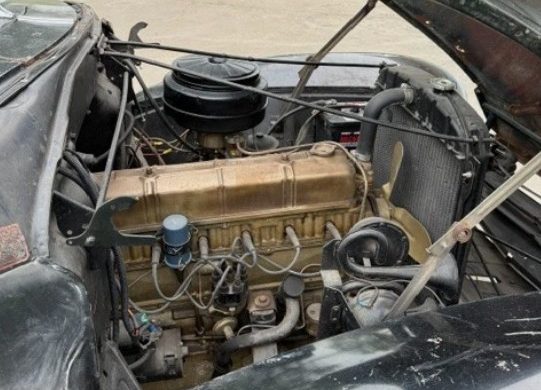
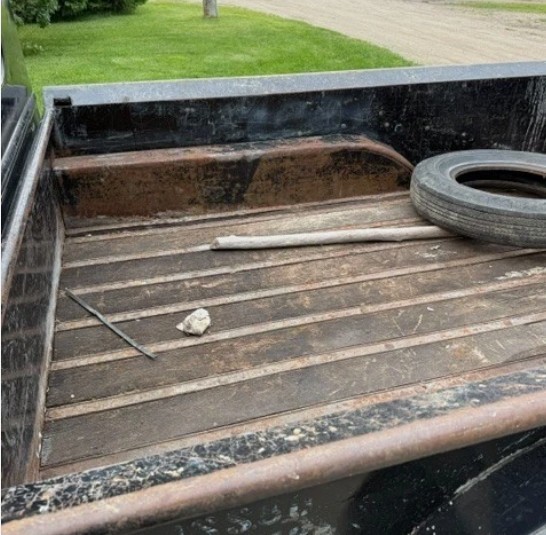
Hudson sent its Super Six pickups out the factory door with a 212 cu. in. flathead six-cylinder, good for 102 hp, and mated to a three-speed column-shift manual. This truck retains a similar transmission, but it’s now powered by a Chevy 230 cu. in. six. Independent front suspension put Hudson’s offering ahead of the competition, where solid axles were still the standard. A generously-sized bed – nearly 8′ and a bit rusty in today’s example – was another selling point.
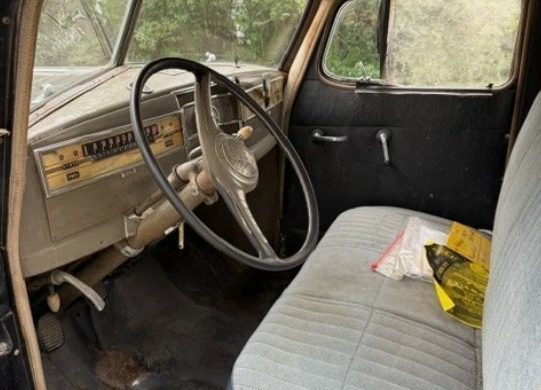
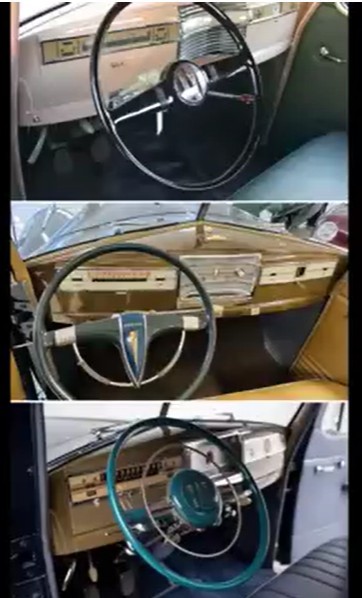
Inside, a bench seat and a feature-rich instrument panel greet the occupants. The Super Six pickup dash, along with its exterior, changed from ’41 to ’42 (when very few were made) and then again into the post-war period, generally becoming more elaborate as the years advanced. In fact, from ’41 to ’46, every steering wheel was different. A couple of the glass panes are cracked and delaminating, and the seller notes that the odometer is not working.
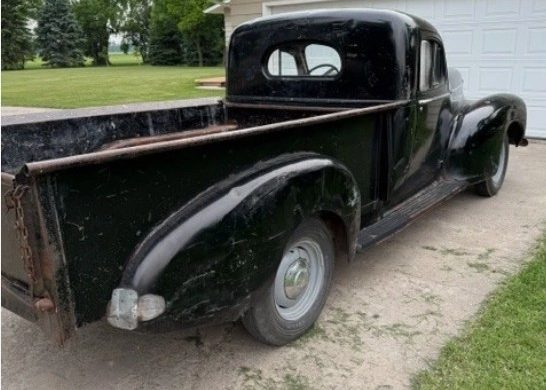
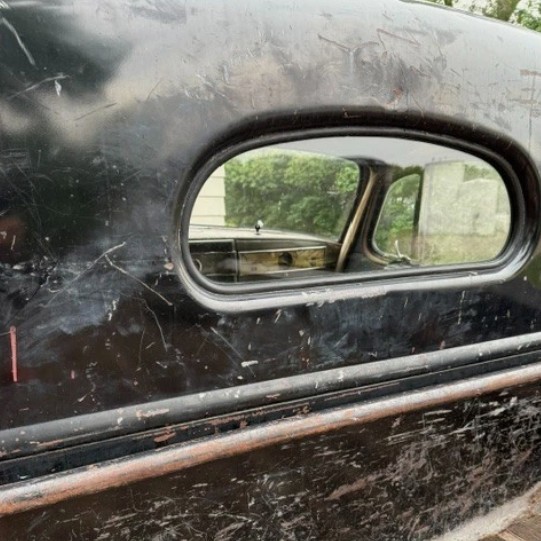
The body has collected several dents over the years, including up top by the rear of the cab. All the same, the styling lines are stunning: teardrop fenders and that rounded cab with its oval window set Hudson’s truck apart. Production numbers are vanishingly small, and finding a stock example today is tough. At the top end, this ’46 – restored to a fine standard – sold recently for $55k. And about a year ago, Mecum sold a ’47 for $34,100. But that leaves us with a question: use this truck as is with a few minor improvements, or restore it? What do you think?




Looks like a healthy preservation, something that will continue to serve for years to come. I question the choice of engine.
Sure, the old Hudson 212 is bound to be difficult to find parts for but not impossible. There’s still a few of them hanging around out west so a block or a crankshaft isn’t impossible.
Anyways, an old Chevy Babbitt-Pounder, to me, is not the best choice. If you’re going to use a Chevy six, at least find a later version.
Nonetheless, it’s highly unlikely that you’ll find another Hudson pickup at the show-n-shine…
I’m with the boss^^^, when I saw “Chevy transplant”, I was hoping for a SBC. Seems with this, they took a shower and put dirty underwear back on,( and don’t say turn them inside out either) didn’t gain much, in fact I say, they ruined a really rare vehicle. Apparently, a quick check shows a lot of parts for that 212 motor still available, and would have been a better way to go. The reason so few? The cost. I read these cost $1522, when a 1946 Ford was about $961, and only 2700 sold compared to almost 75,000 Fords. It was a market there was no market for, as later discovered when tried again with the El Ranchero[sic], it was a poor car and a poor truck. Naturally, I’d be skeptical buying something in “Crooks”ton,,
No doubt they should’ve kept the original engine if at all possible. That said, there’s nothing wrong with buying or selling in Crookston, MN. It’s a decent enough small MN town. Sure, there are some folks who aren’t the best but honestly, it’s generally safe. This seller just wants to get more money than he can locally. Frankly, I think the current bid price is about as high as most would go due to the engine swap and current state of the vehicle.
Hi 63, not to worry, I’m from Wisconsin, and there has always been this Wis/Minn. rivalry, think Fran Tarkenton/Bart Starr. I should talk about city names coming from the Badger. It’s all in good fun, we picked on Minnesotians as having it worse than Wisconsin, but to be clear, I did a lot of trucking in Minnesoty, and the people were great. My best friend lives in Minnesota.
I always thought that Hudson did a great job styling these. They’re beautiful. ( to me anyways) I’m with Howard and Geomechs above, its a shame they tossed the original 6. But as already stated, it looks solid and surely you’d be the only one at a show -n- shine or cars and coffee for sure. It’s a great find and a great write up too Michelle. Thanks.
That 216 is a very old swap and probably accounts for the majority of miles on this old beast. No other updates say it’s been sitting a very long time. That being said, if it runs and drives $7200 (current bid) is about right. I wouldn’t do anything but a very thorough inspection/service and drive it.
After going back and reading the full eBay ad, I’d say the dealer is helping out a regular customer with an estate sale and really knows little about the vehicle.
Wow, she’s a beauty. Especially, with its business coupe front end. Surely they didn’t just toss the original engine. A GM 235 6 would have been a better choice, but at least she’s running and driving. Id go thru the brakes clean her up and leave it a survivor,, driver.
Hudson’s have had beautiful trucks since the 1933 Essex. A 292 straight six would have fit and has more HP. Find that old engine and add a McCulloch Supercharger.
When I googled a 230 chevy engine it said it was made from 1963 to 1970 with a 140 to 155 hp. I was not familler with a 230 ci but it doesent sound like a bad swap, this enging could be sooped up to 200+ hp if desired. This engine definitenly does not have babbitt bearings and has a oil pump. All that being said I like this truck and with a few upgrades could be more cool than ity is.
I think the 230 was the “modern” replacement for the old 235.
I agree. This is not a newer style 230 Chevy engine. But a 216 derived “rabbit pounder” like geomechs
Said. I love Hudson trucks. Since this has already been modified, I would swap to a FI 300 Ford 6 with a 5 speed transmission. Upgrade the brakes and fix the body as time permits.
Another truck to be left AS IS!!! I do not agree with the engine swap>> Personally I would have gone with a MOPAR Flathead to keep it looking more authentic..
I saw one of these for sale a few years back. The engine had been swapped for an old Jaguar XLE motor. Go figure…but then I worked with a guy who put a 240Z engine in a Scout.
Agreed Brocky, I love those engines. I was a Delta mechanic for a lot of years & a bunch of our older stick-shift airport tugs had the Chrysler Industrial 6 coupled to a Clark straight-cut 3sp trans. Most still had military ID stampings under the layers of paint & from what little history I could find, one was even in service on an aircraft carrier in 1946. You’d be hard pressed to find a sweeter running engine, even compared to the later Ford 300s.
I admit to having an episode of eye sweat when they took them away for auction
After looking closer at the engine picture it could be a 216 or a 235 and not a newer 230ci. Maybe the sell is miss informed. Can anyone elce tell what engine it is?
The 216 used 2 top valve cover bolts. (See a above picture) As stated above, this is not a 230. The 230 replaced the 235 engine (which was not a bad engine) but the reason for the change was that the 230, (and the 194 and later the 250 and 292) were redesigned to be cheaper to build as they used small block Chevy parts. (Pistons, rocker arms, connecting rods, etc ) These were not bad engines by any stretch of the imagination. But if doing the original swap, the the 235 would have been a better choice back then. The 216 was a very durable engine, but it was not a “rev monster” by any description. But, they may have used what they had on hand at the moment. BUT IT IS A LIE TO CALL THE ENGINE IN THIS TRUCK A 230!
Chevy also had a 235 Babbitt-Pounder that came out in the late 30s and the 40s, into the 50s. It was used in the larger trucks and, after the introduction of the Powerglide automatic, was available in cars and light trucks so-equipped.
The engine is a 216 as evidenced by the 2 top nuts retaining the valve cover. The 235 used perimeter screws/bolts to retain the valve cover, as did the 230 class engines. (194, 230, 250 and 292) The later class engines used small block Chevy internals. Making them cheaper (as in economies of quantity) to build. The engine pictured is in fact a 216 that Chevy used for decades until the last one I believe was 1953.
By Jove…I was wondering…now I know….
Ah, so old, so soon. In 1966 I bought a ’39 MGSA (a full sized car, 4 passenger, 119″ wheelbase) with a ’46- ’49 Hudson Super 6 engine, with Twin H power (dual carbs). It had been brought to the US after WWII by a serviceman whose house was in 1966 was being bought by the adjacent university, and he was on his last legs, and the car had not been driven much since the mid-1950’s. MG built only 500 of these and so when the engine was toast the Hudson 6 fit (almost, the firewall had to be reconstructed and the MG radiator was no where big enough in the summer) and was the powerhouse of the early ’50’s for a 6 – long narrow engine compartment. I could find parts for it, replaced cracked exhaust manifold, gaskets, wet clutch oil, in the early ’70’s. Sold it for what I paid for it. $300. So a Hudson 6 replaced by a Chevy 6. Turns out, with the internet, about 10,000 of the 6’s MG used were made, after all, installed in the Wolseley cars of the 30’s in England, which was to the police of England at the time what a Crown Vic was here in the ’90s, so an engine, and/or parts, would have been available in the 1950’s after all. My all around mechanic buddy of the early ’70’s thought a Chrysler Slant 6 would be the logical replacement for the Hudson when the Hudson gave up but I gave up before the Hudson 6 did. (3 kids, mortgage, old house, two jobs, etc.)
1938 was the year the Hudson and Terraplane label’s were combined.
There was a guy local to our former Middle West farm that had a ’46 into which he had swapped a Twin H-Power engine. His was a regular driver and had a few nicks and dings, but was definitely a sharp 20-footer.
nothing to compare w/these once they’re restored right (the blue/white from the other channel is close/no cigar) something I’d never work again (nor daily). Cant say enuff abt how good they look. 1st sports ute (I know the T & the A had a lill bed on back, some early Oz utes)? This one certainly was stylin
I’m familiar with 1950s Chevy 6’s, engines 216 , 235 and in later in 1960s 250s, but Ive never heard of a 230. Maybe this was a typo or just one that I don’t remember.
That engine series started in 1962 with the Chevy II and the 194 size 6 cylinder. The 230 started as the base engine in the 1963 for the Biscayne, BelAire and Impala. (and I think it also as an option in the Chevy II that year) It was also the base engine for the C10 instead of the 235 in 1963. It’s a good strong engine series and GM/Chevrolet did a good job with the design. Especially since it was designed to be a Cheaper alternative to the tried and true 235.
One other note. Not only did the “new” 6 cylinder series use small block V8 parts. But it also used the small block engine bolt pattern. (As do the big block (396, 427, 454 engines) So, swapping engines was a piece of cake. In fact they even used the same motor mounts as the small block engines. (Just different mount brackets. ) The 216 and 235 had “their own” engine bolt pattern.