
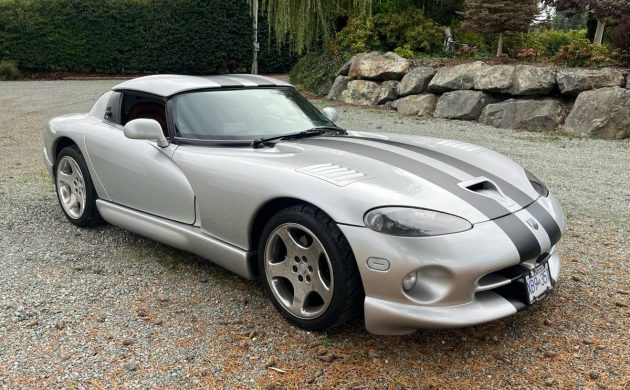
Bob Lutz loved driving his Cobra replica. Rumor has it that his enjoyment of the 1980s roadster inspired the Viper, albeit with an eye to bettering the Cobra’s performance. Fortunately, Lutz was working under Lee Iacocca at Chrysler: if you wanted to take an innovative approach to product, no better boss could be found. From Lutz’s idea to the Viper’s debut at Detroit’s 1989 North American International Auto Show took only about one year. Production required another few years, but in 1992, the Viper landed in showrooms – crude, rude, and fast. The car was only available as a roadster, and I mean that in the most rudimentary sense: side curtains, no outside door handles, a canvas top stretched from front to rear of the cockpit. The next generation did not bring much more civility, though a hard top became available. In 1996, a coupe was introduced. All the way along, horsepower was The Thing: it ranged from 400 to over 600 by the time production ceased in 2017. Here on craigslist is a 1999 Viper, available in Victoria, British Columbia, Canada, from a seller who prefers that you simply show up to see it rather than making any inquiries whatsoever. Priced at $53,000, the car has travelled 56k miles. Thanks to Curvette for the supercar tip!
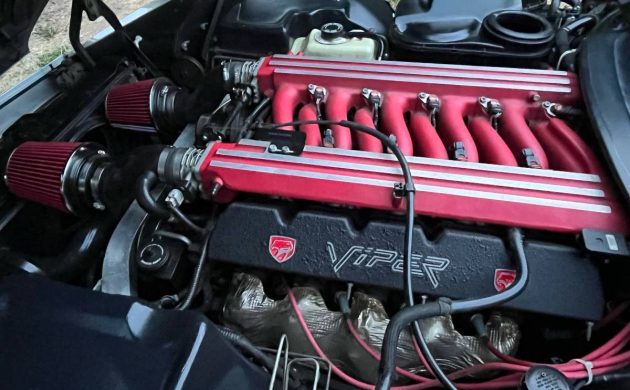
Aside from the iconoclastic styling and lack of civility, the Viper was born with a V10. Not many engineers leap at the chance to equip cars with V10s. For one thing, internal vibrations are endemic and must be combatted by counterbalance weights. And of course, gas mileage is atrocious. The Viper’s engine was derived from Chrysler’s Magnum V8, with help from Lamborghini, which had been purchased by Chrysler in 1987. It was not the most technologically advanced motor of the era, but it did manage 400 hp in its first iteration. By the time the coupe was introduced in 1996, output had increased to 450 hp. The transmission is a Borg Warner-sourced six-speed manual. This car has been tuned and fitted with new tires.
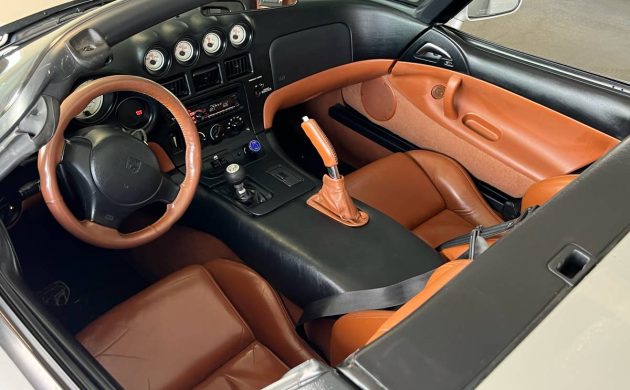
The finer things in life were seeping into the cabin by the time this car left the factory – namely, roll-up windows and air conditioning. External door handles and front-facing airbags were standard now. Unfortunately for American supercar fans, it was US insistence on side airbags (as well as the car’s low sales) that eventually killed the model: management elected to pull the plug on the Viper rather than redesign the body for safety features. Only 32,000 Vipers were sold from 1992 through 2017.
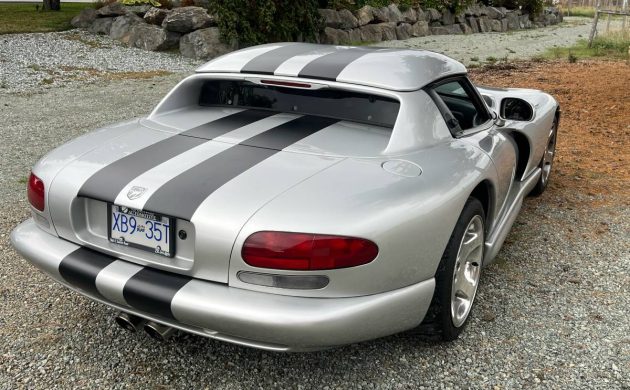
These are not touring cars, and most are not well-travelled. Any day of the week, a prospective owner can find a low-mileage example of a Dodge Viper. While niche-y performance versions will sell well into six figures, run-of-the-mill cars like this one have been wallowing around $50k for some time. The asking price is fair, but not a deal. If you wanted to own a Viper, how much would you pay?




Seems too pricey to me. Posted a month ago.
The car is advertised on Canadian Craigslist which means to me that the selling price would be in CDN dollars. That makes the price in USD $38400. If true I think it’s a pretty good deal. But I guess you’ll have to drive to Seattle or Vancouver and take the ferry to Vancouver island and knock on his door to ask him which currency his price is in. It seems there are a lot of people advertising cars for sale that they really don’t want to sell or they have it advertised to mollify their partner.
You are correct, Curvette. Anytime you see a car advertised on Craigslist in Canada it will always be in Canadian dollars unless specified USD… I live about 2.5 hours from where this car is, and would recommend a trip to Victoria anytime… we live in a beautiful province here!
I live in the Seattle area Mike and have been to Victoria and Vancouver many times and you are correct, it is a very beautiful province. We are currently planning a driving trip next year to Chateau Lake Louise to see more of Canada.
That’s awesome Curvette! When you’re in Lake Louise, you absolutely have to make the drive on the Columbia Icefields Parkway. It runs from Lake Louise to Jasper and is considered one of the most scenic and beautiful highways in the world. Trust me, I wouldn’t steer you wrong!
Also if this Viper was originally sold in Canada the odometer is calibrated in kilometers, not miles. If the odometer is showing 56,000 kilometers, than that would translate to 34,800 miles.
These are cool. And Michelle, you are correct when you say “These are not touring cars, and most are not well-travelled.” And the reason for that is the unique drivers position. The later ones were better than the early ones. But after an hour or more my back is screaming “get me out of this car!” At least in a Pantera you get another hour of fun before your back starts screaming. In the Pantera it is from “,spinal compression, on the Viper it is from being twisted sideways. Now admittedly, I do have a bad back. But bouncing around in a rally car for hours on end did not effect me the same way. The first Viper I drove was a Hennessy 550 version. Acceleration was mind blowing. (Teslas were not out yet) and the other 2 Vipers that I drove were very late models. At first I was disappointed because they “felt” slow. I was surprised when Iooked down to see 80 mph in second gear. With 4 more gears to go. With the different gearing the torque just takes over so that there is very little “sense of acceleration” they handle very well also. ( that mass of rubber better do something) A fun car for 60-90 minutes!