
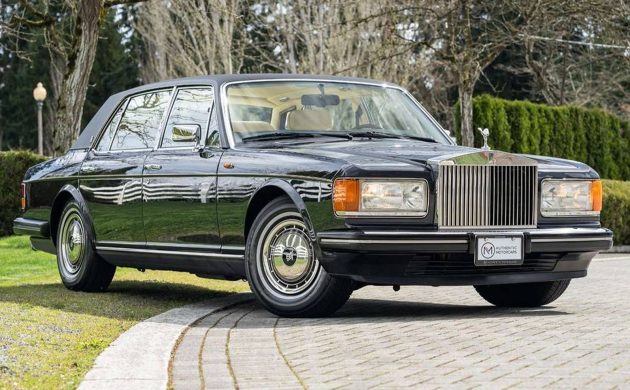
Among Rolls-Royce models of the 1990s, the Silver Spur III stands apart—not only for its rarity but also for its quiet transition into the final era of truly hand-built luxury cars. Only 465 were made worldwide, and just 94 were built for the 1995 model year. Of those, a mere 289 were left-hand drive. The example seen here, currently for sale here on craigslist in Redmond, Washington, is one of those rare few and has traveled just 33,657 miles since new.
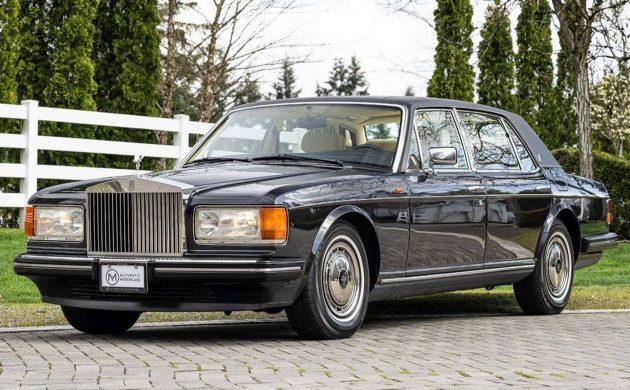
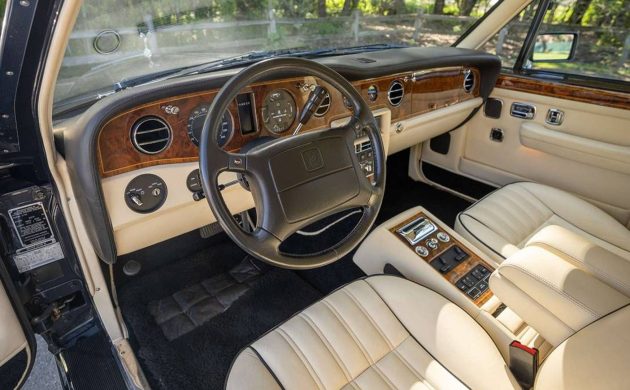
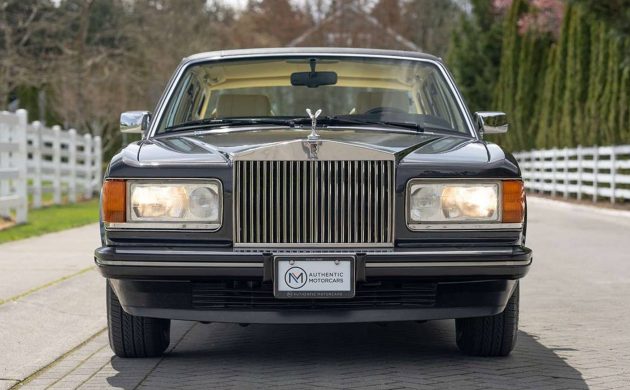
Finished in stately Royal Ebony Metallic with a matching Everflex roof and hand-painted magnolia pinstripes, this Spur III is a picture of classic elegance. Rolls-Royce purists will appreciate that the car is nearly entirely original, including its paint and soft Connolly Magnolia leather interior. The cabin is every bit as plush as you’d expect, complete with lambswool rugs, black Wilton carpets, and polished burl walnut wood trim throughout—plus fold-down picnic trays and a period-correct car phone. Even the factory AM/FM cassette deck, CD changer, and hard-wired battery tender are still with the car.
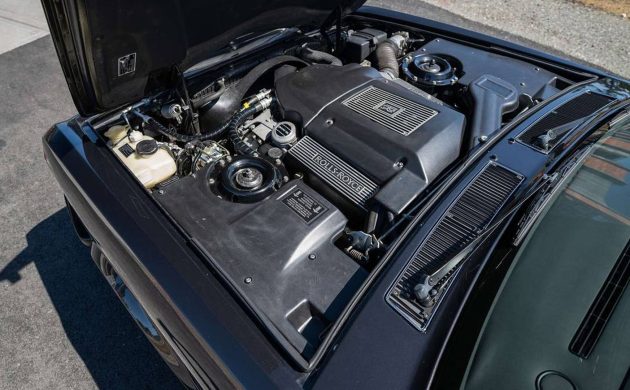
Mechanically, the Silver Spur III introduced several updates over its predecessor, including dual front airbags, improved suspension tuning, and distinctive European-spec H4 headlamps that replaced the earlier twin sealed beams. Power comes from the traditional 6.75-liter V8, producing a smooth 250 horsepower and 340 lb-ft of torque—plenty to move the nearly 5,500-pound sedan with surprising grace. This example has been routinely serviced and includes documentation of a rebuilt power steering rack in 2021 and a fresh oil change and detailing completed in March 2025.
This Spur was originally delivered new to Dr. Donald Rix of Vancouver, BC, in February 1995 and remained with him until 2007 when it was sold by Rolls-Royce Bellevue to its current owner, a Northwest collector. The car has always been garaged, never driven in inclement weather, and remains in exceptional condition inside and out. The leather is still soft, the paint shines like new, and the entire car presents as a time capsule of British craftsmanship.
Collector-grade examples of the Silver Spur III are becoming increasingly hard to find. Would you keep this one preserved as-is or start stretching its legs on long weekend drives?




Whenever I see these older cars, and read the horsepower/torque figures, I’m blown away at how much more power-per-displacement modern engines make. 250hp/340lb from a 6.75l V8? We can probably get that from an I4 with a turbo, now.
Would I want a turbocharged 4-cylinder motivating this huge beast? Probably not, I imagine this V8 lopes along quite nicely, at speed; there’s nothing frantic in the design. Pretty handsome car, understated and big. I don’t recall these being regarded as dependable, but Sir probably has a mechanic in his house staff, to deal with that.
My wife’s Mazda CX5 turbo: 250 hp 300 lb-ft from 2.5L turbo 4. So yes we can!
These cars have a very long stroke — ie they are undersquare engines — and they have a very low (8.0 to 1.0) compression ratio.
They don’t make a lot of horsepower, but they run very smoothly.
True, newer engines produce higher HP and torque with much less displacement, but there is a huge drawback with the new engines. They must run ant much higher RPMs to obtain similar results and that increases the wear index factor logarithmically. Consider that maintenance is consistently done on both engines, the old products will easily achieve one million miles while the new technology barely reaches one hundred thousand miles (excluding some Honda engines which seem to be exceptions).
It has a lot to do with the geometry if the rotating assembly. Things like Ferraris have an undersquare engine with large bores and short strokes. When I say large I mean relative to the stroke. They make a lot of horsepower and not a lot of torque and run rough.
A small bore and a long stroke makes a lot of torque, runs very smoothly but doesn’t make a lot of horsepower.
The huge horsepowers of some mercedes luxury barges are only really useful at very high speed. The electronics prevent you from applying all that horsepower at low speed, so you don’t keep spinning out.
For cruising along the beachfront or driving in a city, the smooth power delivery and effortless torque of a big displacement undersquare engine make some sense.
No name contradicts himself.
Apples to Oranges.
The Ford Ecoboost 2.3 4 cylinder makes 300+ HP. Great in a Mustang or Bronco, completely wrong for a car like this.
Enjoy that smooth V8 power, and 250 HP is plenty.
Agreed – I’ve driven a few of these mid-90s RRs, and they simply glide down the road with the smoothest of acceleration. I never felt a lack of power – this isn’t the type of car you need to stand on the accelerator of.
This automobile was built to glide everywhere and anywhere the owner wanted to go, and this model especially succeeded. It is difficult to find a similar ride in almost any auto on the American road today, yet, once experienced it is never forgotten.
I owned a Silver Spur for about 8 years, and enjoyed it. I do feel that these are just (expensive to maintain) older used cars, floating in between classics and modern cars. The “SZ” series (Silver Spirit/Silver Spur) was introduced back in 1980, so this is a fairly old design. RR “updated” the cars with Series II, and later Series III versions, but they all look the same to the unpracticed eye. Rare does not always mean desirable…. By 1995 many customers considered the SZ cars outdated, and sales were about half of what they were in 1991. There are lots of these cars for sale, most needing significant work. Most of those will cost far more to fix than they will ever be worth. This car is one of the nicest available, but a bit pricey for a SZ. Kinda like trying to sell a really nice C4 for C5 money.
Someone elsewhere made an excellent observation. He said these complicated luxury cars with systems and finishes that will require more maintenance than they are worth should more correctly be called “disposable” cars. They should be enjoyed for two or three years and then passed on. This may not be a sensible use of money, but it is definitely luxurious.
As a Rolls-Royce/Bentley afficiando of this time period as well – I agree with you on the asking price being a little high. I do know that by 1995, all of the bugs of the earlier cars had been worked out. Plus, they’d been using Bosch fuel injection for a while and were crusing along with the 4-speed transmission, as compared to the 3-speed that RR introduced this series with and kept through 1992. I was always told by RR mechanics that the best years of these cars were between 1993-1998 because of the technological improvements with the Bosch system and upgraded transmission. The reason that they get a reputation as being unreliable is that they just aren’t driven enough. Every RR mechanic told me you need to drive these cars. Every day – that’s what they’re designed for, and more than just 2 miles. If they get driven, like a normal car, every day, they’re really quite reliable. To add onto that, by 1995, the RR 6.75 an engine had been used by the brand for almost 40 years and was truly a reliable workhorse.
The next owner will have to settle for French’s yellow mustard since it’s used. They are big cars although I recently saw a new Mustang parked, behind Albers/Zionsville, IN (now a parts dealer), next to a Bentley or RR of this vintage…not quite so imposing anymore.
These big old Rolls and Bentleys don’t have much appeal to a user or a collector- probably akin the the 1920’s models that were available cheap in the 50’s.
As stated above, if you want one, use it until it needs uneconomical repairs, then move it on. It’s possible this car could be enjoyed for several years with very minimal running costs. But it’s gamble.
I know nothing about these cars but they are imposing and if you want the best one available this may be it. Seems like a lot of money.
I wouldn’t poupon this car.
In my opinion, (and I’m all about the total cost of ownership and lack of getting to be on the first name basis of your dealership service people.) And I’m a former BMW service manager! These cars are very much like current Rovers, Land Rover, Discovery, Jaguar, etc. And for that matter, BMWs also. Lease them for the length of the warranty and get out before the real cost of ownership slaps you in the face!
Hi Wayne – pershaps I’m reading into your comment incorrectly – these don’t have BMW or Jaguar engines in them (although for reference I have a 2015 Jaguar with over 70,000 miles, and the engine has been pretty much flawless – other than having to replace parts that wore out because they’re plastic). These have Rolls-Royce 6.75 liter engines that were designed and first used in the 1950s. By the time the mid-1990s rolled around, all of the problems that had plagued the earlier versions of this engine were corrected, and the engines were now using Bosch fuel injection systems which as you know are workhorses themselves. Every RR dealer & independent mechanic said these cars were extremely reliable – assuming their owners drove them regularly and beyond the 5 square miles of Beverly Hills where most of them were sold.
Not saying the engines are bad. BMW has some great ones. I’m speaking on general. The parts for the cars that I mentioned are astronomical in price, And those are the ones that you can purchase at the parts store. Go buy rear brake pads and rotors for your Land Rover and then compare the prices to say an Explorer. No real difference, but the price is stupid. Talk to a leasing company on a lease for one of these that includes maintenance. (Long term) and then compare to a similar SUV like a Denali. They know the difference. As I said, I’m all a out the total cost of ownership. And it ticks me off when a car company gouges for parts. (Take Toyota, their oxygen sensors are licensed by Bosch just like most automobile companies.) The average price for one from an American or non-screw ’em import company will be in the neighborhood of $80-$150 dollars. From Toyota its 3 to 4 times that. For a different connector. Really? And Honda is the same way.
Ok, I will get off my yelling box now.