
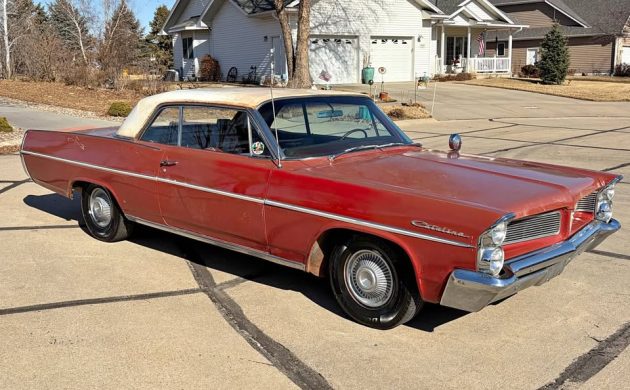
I’ve had this contention that, as the price of intermediate-sized muscle cars has reached stratospheric levels, a rising tide would benefit full-sizers such as this 1963 Pontiac Catalina accordingly. You know, a GM B-body car like a Catalina or an Impala isn’t much different, architecturally speaking, than the smaller A-body models such as the LeMans and the Chevelle. In some instances, the general appearance is even similar – the big difference is basically size. In reality, I’m not sure my hypothesis is sound, as these big cars seem to just bump around, price-wise, with some appreciation, but certainly not to the level their trimmer brethren have realized. Why is that? I dunno, but let’s give this Poncho from Arlington, Nebraska, the once-over and see if we can figure out why. You can find it here on Facebook Marketplace for $9,000. Thanks are due to NW Iowa Kevin for this tip!
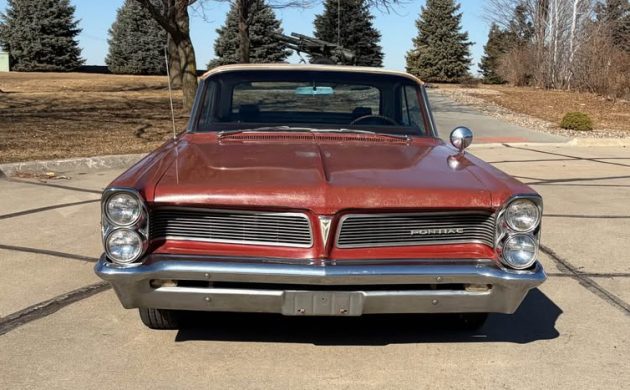
For comparison purposes, let’s compare this car’s dimensions, which are the same as a ’64 Catalina, to those of a newly redesigned ’64 LeMans/GTO A-body:
Model Length Width W/B Weight
Catalina 211.9″ 78.7″ 120.0″ 3,735 lb.
LeMans 203.0″ 73.3″ 115.0″ 3,126 lbs.
The dimensions don’t possess as great a difference as I initially expected, but the 500+ lb. weight delta is certainly noteworthy. I’d further offer that visually speaking, the Catalina looks a lot bigger than the LeMans/GTO, and that facet probably has a lot to do with preferences. Where the rubber meets the drag strip, however, is the weight-to-power ratio. Comparing the two, we find a ’64 GTO with its top engine option of 348 gross HP is carrying 8.98 lbs. per gross HP, while the Catalina is lugging around 10.1 lbs per gross HP with its top powerplant, a 421 CI, triple deuce-fed mill good for 370 gross HP – and there’s an important difference.
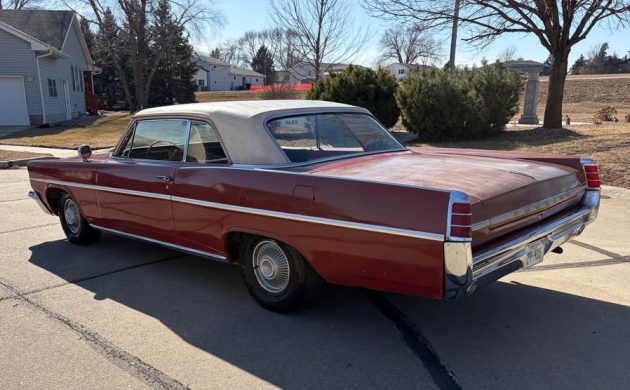
OK, so buyers weren’t springing for a Catalina in ’63 with a pass down the 1,320 necessarily on their mind, though some did, but numbers matter, and the Tin Indian moved 235K Cats in ’63, of which 61K were two-door hardtops such as our subject car. Besides the obvious, that being faded paint, the seller tells us, “Fairly solid and straight old car. Floors are great. Quarters and fenders have a little Bondo in them. Trunk has a couple holes around the body mounts, but is overall solid. Frame has a couple flaky spots, but is better than most of these cars.” Hmmm, don’t know about that flaky frame business or how it would be better than most other Catalinas. This one shows well enough, from twenty feet anyway, but if I were interested, I’d want to take a pretty detailed look topside and bottomside.
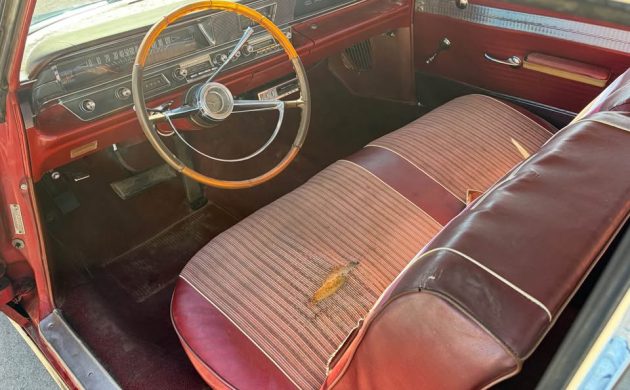
The interior’s striped fabric upholstery, a cheerful departure from today’s maudlin choices, has clearly seen better days. The seller adds, “interior is all original except drivers arm rest. Overall good condition. Seats need new foam, and drivers seat is ripped, but still very presentable.” The front seat will be an expensive challenge to reupholster as original, and that’s assuming that the fabric is still available. Beyond the obvious, the dash and instrument panel still present well – I always give Pontiacs of this era an extra star for their instrumentation and panel layout.
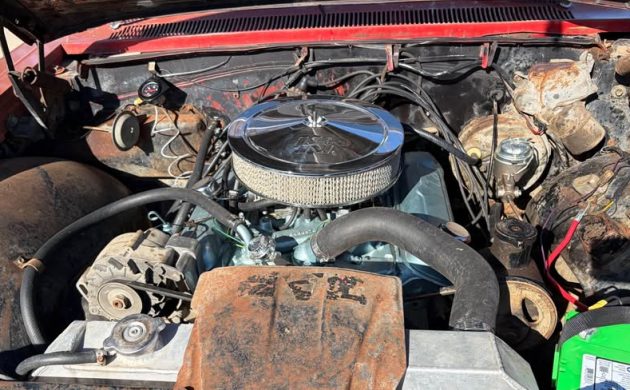
Behind the beak is a four-barrel carburetor-fed 389 CI V8 engine that should be good for 303 gross HP – assuming this engine was originally outfitted as such. I hedge on that point as the seller states, “Engine is regasketed with new oil pump, water pump, and timing set. Runs good but has blow by. Edelbrock 600 carb with electric choke. Aluminum radiator…” He further states that “it runs and drives good for an old car.” The transmission is listed as being an automatic, and Pontiac referred to it as a three-speed Hydramatic, and that makes me think it’s a Roto Hydramatic, also known as a “Slim Jim” – not one of GM’s finer units.
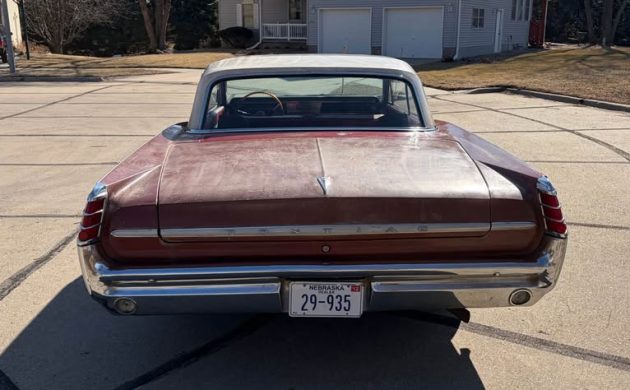
Well, there you have it. Nope, I guess a B-body model is not really a viable alternative to an A-body performance version – and thus the continuing price gap. Still, there’s big Pontiac quality here, especially in the cruising department, though I’m not sure this example is the one that I’d select. The listing is certainly detailed and straight-forward but that “flaky frame” business has caught my attention and not in a necessarily positive light. What’s your thought here, a worthy project or keep looking?


My dad bought a new ’63 Pontiac Catalina 4dr from Boas Pontiac in San Francisco when I was 7yrs old. It was a dark blue metallic. Dad partially traded a ’57 black Ford Fairlane 500 2 door bought used from S&C Ford, also in SF. Both dealerships long gone.
For $9000 , you think they could have bought a can of spray paint and paint the old piece of metal sitting over the radiator.
Dude’s selling a $600 car for $9k; it’s gotten ridiculous.
The asking price may be more than a stretch in its current condition, but this far from a $600 car and has been for at least a decade or two.
Steve R
1977 bought a 63 Catalina 4 door for $250. Had new tires, solid body. Hardly any rust. A real tank. It would plow thru the snow. The trunk was huge. Real descent work car. Awesome car.
Jim, I’ve got and love my ’63 Bonneville Safari 389 with Super Hydra-matic a/t & it shifts great! Optional Robo or Super, when I rebuilt it, they said they would NOT rebuild the Robo/Slim Jim. When I found this I was lucky it had the better Super trans. Ordered Starlight Black, Cameo white top, Red interior. Also has, 4bbl, p/s & p/b like most did, A/C, AM/FM, tilt wheel, electric gate window, & 8 lug wheels. It’ll be a gem when I’m finished restoration. Never seen another this color combo nationwide.
i can’t see anything on f/b. if there are frame issues then that could be a deal killer. looks to me it’s a dealer flipping it still has the dealer tag on it. it’s cool but not for 9k more like 3500.00
Pontiacs of this era were known for their rear frame rails falling prey to serious rust problems .