
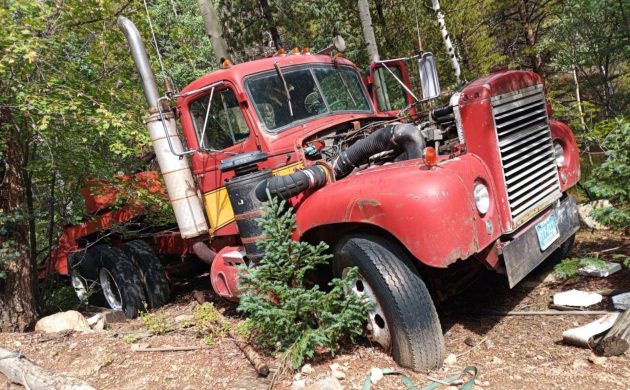
Sometimes a project comes along that isn’t just a vehicle—it’s a piece of working history. That’s the case with this vintage Mack truck and lowboy trailer, recently pulled from long-term storage and now available here on craigslist in the Denver, Colorado area. This heavy-duty classic has been sitting in the woods for more than 15 years, making it a true barn (or forest) find for anyone willing to take on a serious restoration challenge. Thanks for the tip Mike F.!
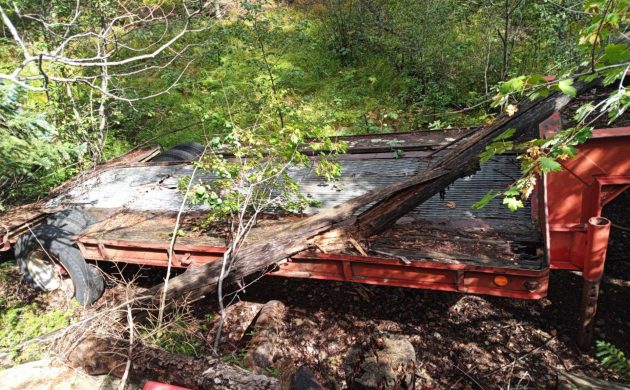
According to the seller, the truck is almost complete and is missing only its hood. That’s a huge plus considering how difficult sourcing original Mack parts can be for a project like this. The good news continues with the glass, which is said to all be intact and in good shape, a rarity for a rig that’s been left outside for so long.
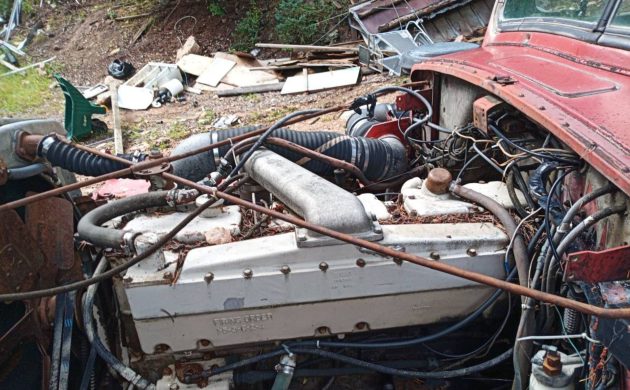
Under the hood (once you find one), the engine and transmission are still complete. The seller notes it hasn’t been started in over 15 years, but with some attention, it should run again. That likely means fresh fluids, fuel system work, and a careful inspection before turning it over, but it’s encouraging to know the drivetrain is still present and accounted for.
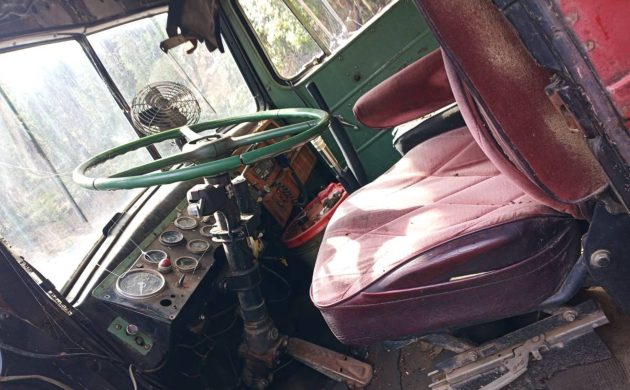
The interior is said to be complete as well, though it looks rough in the photos. Given the decades of neglect, a full refurbish will be needed, but having all the pieces still inside makes it easier for a determined restorer to bring it back without having to hunt for every knob, panel, or seat frame.
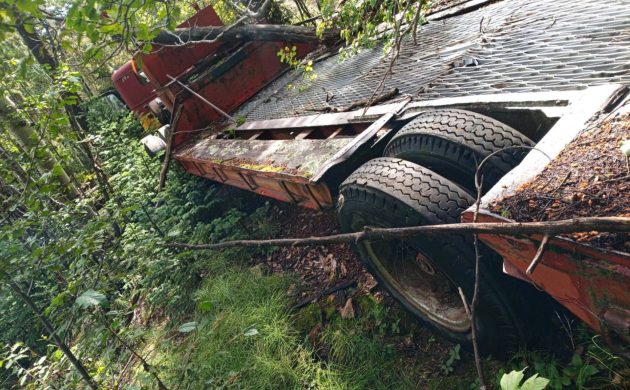
Adding to the package is the included lowboy trailer, which makes this deal especially interesting. Even if the truck takes some time to revive, the lowboy itself could be useful once refreshed, and together they represent a solid foundation for someone looking to restore a vintage heavy hauler setup.
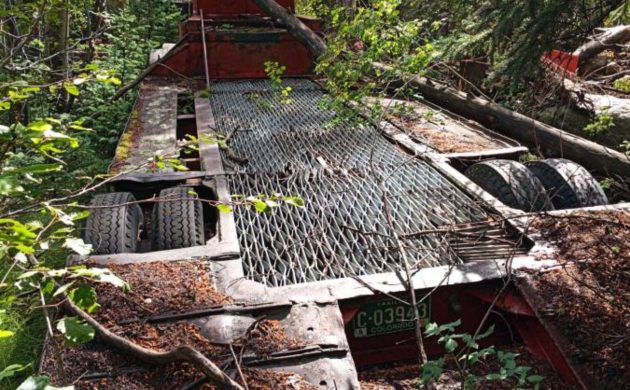
With its rugged build and classic Mack looks, this truck is the kind of project that could turn into a show-stopping piece of industrial history—or even go back to work hauling loads for fun.
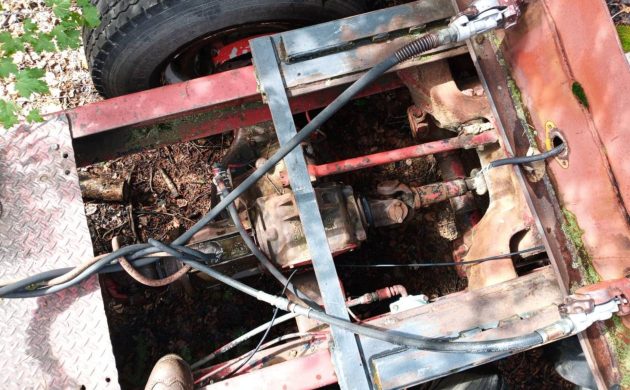
Would you bring this Mack back to working order, or would you restore it as a vintage showpiece?




I can hear the tap, tap, tap sound of furious keyboard compositions being created right now from here…
2 fast hands required to drive one of these Godzilla…especially when you reach for the “joey” 🦘
Tricky is an understatement, for a twin-stick. Maybe a 10sp, 15 or 20. Tried it once. Full respect to any drivers who ran with these setups. 👍🤝 Best to know where the truck likes to shift, want to be spot on with the revs. See the space between the rear axles.. I believe that was intended so each axle could carry a bit more load when getting weighed out.
Thanks for the article Elizabeth.
Totally with you Stan. Shifting the Main box and the Brownie Box both at the same time with your arm hooked around the steering wheel all while catching the next gear is a total art form. My Great Uncle drive a B Model twin stick Mack in the Jersey City area all throughout Hudson county. Not an easy job. Total respect here too.
Your Great Uncle earned every dollar Dave. I love Mack’s, despite their low roofs.
Mack makes their own motors, transmissions and axles. Their 500hp V8 is a favorite of mine.
Been there and done that. You needed to time your “double” shifts to avoid any curves in the road!
What’s a “joey”? A set of clubs surely kept you busy, and many times gears were skipped, but the “elbow through the steering wheel” was the only way. A far cry from the automatics of today.
Hi Howard…Joey was another name for the auxiliary box. As for the automatics of today… An argument could certainly be made that driving a manual rig, possibly, (and probably in my opinion), keeps your head up, and keeps you on your toes more than driving an autoloader.
Okay, thanks, a regional term perhaps, like Australia, and “Joey” has many different meanings around the world. Some called “Jo-dogs, an extra axle on tractors, a joey. We just called them “Brownies” or auxiliary and were already being phased out when I started in the 70s. Replaced by the RoadRanger, and I read it was Mack in 1987 that was the last 2 stick truck made. There’s merit in what you say about shifting. For those that may not know, ( and gives me something to do at 3am thanks to these beasts) the power band on a diesel is much narrower than a gas engine. a 350 was a BIG motor and most were in the 180-230 range. With power between 1300 and 2100 rpm, close ratios were needed to keep the motor “against the pin” so forward progress wasn’t impeded too badly, and shifting definitely kept you busy. Air shift helped some, and Mack had the “lazy mans shift” with a 5( or 6) speed, only because Mack motors could operate from 1200 to almost 2300, so a 5 speed( non-synchro) was all that was needed.
Automatics were needed for a changing world, and I read, 93% of all new semis are automatics. It greatly opens up the pool of drivers, we need so badly.
I’d love a demonstration from our golden generation as to how this was done. Hard to visualize it.
Since I have a twin stick DFD400 (cummins) I can say that it isn’t the upshift that gets you, it is the downshift! If it requires both transmissions to be shifted, I have to think about it long before it is needed. And really know where to put the second stick so it doesn’t slow too much and you miss the power band all together!! The shift pattern is nuts!
For sure, the guys that drove these were masters of the asphalt I can hardly get out our 2 mile dirt road.
There are a lot of good bones here and I hope it gets back on the road.
Sometimes ya gotta know where you can cheat and get away with it. Drove a rolloff trash truck with a 5×4 and on a long county contract run I’d hit a long grade loaded, 4th gear drop 3 on the aux. you could see the top and rather than have to shift both sticks I’d let it pull way down then shift the aux into lo-lo ( about 2 gear changes) that would take me over the top then just keep shifting up.
This would be a seriously unique ride to show up at a truck show with, but not at $18,000 BEFORE all the work required just to make it drivable and that’s if everything is in good enough condition to get it there. And too that’s if any of the needed replacements are still available.
But I’ll bet Howard, Dave (Driveinstile) and a few others BFers here can show us how to make this bad boy shift on down the road if you did get it roadworthy!
Best advice I can give is don’t use the clutch. What’s amazing, is I bet everything needed to get this old gal back on the road, safely, are all available, it’s just going to cost ya’. There was a surge of interest a while back, for owner operators to seek pre-emission trucks, to skirt the regs, but I think once they found out what it was actually like to drive these, it made the emission thing the lesser of 2 evils, ad sellers can’t give these away. This old gals working days are over, but I could see a light restoration, if the motor runs, and these old “oil engines” probably will and use it to take other toys that are not roadworthy, like tractors, and antique trucks to a show. As a private hauler, you get out of all the regs, and would be a hoot. I guarantee, heads would turn, you rolled in with this, and a couple toys on the trailer.
Howard, you’re right about not using the clutch. My first rig in the fire service was a ’60 B-model open cab pumper, 707 gas engine with a 5-speed. The fire service didn’t warm up to diesels until the 70’s. Clutch it to engage first to get out of the fire house, then bring the revs up to float, the shifts drop right in. It was a sweet old rig, replaced in ’75 by a LaFrance with 6V71 diesel and 5-speed Spicer. Syncro in all but first & needed the clutch. Rarely got as far as 5th in suburban driving. All autos now.
Question for you, Howard, the B75’s appear to have an L-model cab with B-model front sheet metal–is that correct?
BTW–some good twin stick shifting vids on Youtube.
Hi Tom, the site is unusually slow, perhaps overwhelmed by all the hot air, :), I believe so about the L model cab, although I’ve seen images of B75s with a B61 cab. Jim R. seems to have a pretty good handle on these. I think the signature feature of the B75 was the bigger grill. As HP increased, cooling was an issue, and needed bigger radiators. In fact, the Pete and KW needle nose had the same issue. The bosses always wanted you to use the clutch, because it wore the input shaft not using it, but the R model Mack I drove had such a stiff clutch, it took both feet at a stop light. Sorry boss. The less said about 2 cycle Detroits, the better, almost inevitable on a post like this, and could count on one finger how many Detroit powered Macks there were. Seems fire depts. used a lot of Detroits for some reason.
And Geomechs probably not only drove one, but worked on them 🔧 Nevada.
Hi Stan. In all honesty I never drove one of these, at least for any distance. They were around, and I worked on them.
Most of these that I came across were V-8 powered by Mack’s own line. Twin Stick transmissions as well. My miles on these were confined to test driving after some major work. I think you would have to drive one for at least 10K miles before you had that transmission mastered.
Quite a variety of trucks in the oil patch, with Mack and International probably adding up to half of them…
Well, well, wellity well, careful what you wish for, huh? Have a seat folks, if you have to go to the bathroom, go now,,,,okay I realize the site has many people to please, and it would be greedy for us to wish for this stuff all the time. While FB is inundated with trucks like this, there are actually very few websites that deal with old big rigs, so color me happy.
1st, and foremost, I’m no “maven” ( expert) on Macks, but tis’ no B61. I believe it’s a B75 with the square radiator and front windows, and the signature bulldog hood ornament ( 1 aXX looking at another) has gone missing, surely in some man cave by now. In any case, it would be chrome, not gold, indicating not Mack power. In this case, it’s a BC Cummins of unknown HP, I say a 290/350 was the most common, possibly added later, and the transmission setup, probably a 5×3, is more conducive to a Mack than a Cummins. I think this may have been a stick hauler from the PNW, they used long wb trucks and that tank behind the cab may be a water tank, that was used to cool the brakes, but for years, I bet, someone just dragged their machine around and didn’t go very far.
Got Colorado pricing, that’s for sure, I see stuff like this all the time on FB for peanuts, like couple grand tops. It’s nostalgic alright, but only to a hand full of people, that are disappearing on a regular basis, and not a lot of interest, except from the old timers like me that kvetch about these trucks, but we didn’t know any different. It’s not like some new driver in a rolling apartment has to ever drive this. This was trucking 101, no excuses and a Mack was the best,,,,for what it was designed to do. I visit a truckers site, just to see how low the industry has sunk, and the caliber of drivers, that still do a remarkable job, BTW, just have no connection to this truck, and you know, maybe just as well. Thank you ever so much for this blast from the past.
In a small side note, my 1st trucking job, late 70s, the company had all Macks, ( but changing to IH) and on the wall was a picture of a B model Mack, their 1st. The driver obviously loved the truck, and had painted on the shutters a bulldog sleeping with the shutters closed, and on the radiator, he painted a bulldog awake and growling with the shutters open. That’s the kind of drivers we had back then, and have come quite a long ways in that regard. But this was for a different time, and if you had a 1960 B75 Mack, you knew what you were doing. Wonderful post, the comments should be many, if still alive, that is., and sadly, I just don’t see much of a call for this stuff, unless gotten cheap. snif,,,you made an old gear jammers day, just thank G-d I don’t have to drive one anymore!( adjusting back brace) :) :) :)
Yer turn, by golly, and some new fangled “checking to see if I’m human” thing, sigh, never thought about that with B model Macks, and I miss it dearly.
We knew we could count on you, Howard! Thank you.
Good point on your part Dave-C’mon Geomechs step up to the plate and let ‘er rip!
Thank you for the compliment Nevadahalfrack. I oftentimes tell people…. I only get one good idea per week….. And that’s it…. I wrote that on a Tuesday, so please, no one look in my direction till next Monday!!!
🤖
I submitted this one with you pretty much in mind Howard, along with a couple of the other old trucker guys.
Thanks Mike, just a spoke in the wheel here, and it would be a bit selfish to expect these all the time. It’s a great feature of the site.
Well, looks like this old gal has been well covered already but I’ll add my 2 cents regardless. This is a B73 which made use of the L series cab (squared off as opposed to the well rounded B cabs). These were a little heavier than most Bs and mostly built for long hauls, as the long wheel base suggests. A Cummins engine would be standard equipment, but this engine is a later model with an aftercooler, probably a 350. Transmission most likely a TriPlex (15 speed) w/OD. The tank behind the cab is a hydraulic tank for a wet line (dump trailer). I can see a large dozer or skidder on the trailer. I have driven a few Bs back in the day and a few other 2 stick rigs and can still feel those shift points when running the same roads. I can see this beast shined up at a show with a period correct dozer on the lowboy but not for 18k, half maybe. Now we just need to hear from Geomech and Brocky. AND thanks for the big trucks, keep them coming!
Hey Jim, where’s my red shmata( rag), I’d like to cordially challenge you on the tank. I still think this was a log hauler and that was a water tank. It’s pure speculation, but that’s a pretty big tank for a hydraulic hoist. Most dump trucks I drove had much smaller tanks mounted lower, behind or part of a fuel tank. I don’t recall tractors pulling dump trailers being this long, except in California. The long wheelbase was needed on those giant stick loads, because the logs hang over both ends of the trailer. You’re right, it was used as a “wet line” tank later on, I see the big hoses, but I think it may have been a log hauler originally.
The hydraulic tank …”wet kit” they call it up here Howard.
So , if I understand correctly. ‘Long term storage’ is code for pulled out of the weeds.
No hood on the engine is not instilling confidence, especially when parts are a fortune. This whole thing reeks of huge money pit sort of dumpster fire.
Ha, ha, ha, ha ! The forth picture shows a small fan.
I remember it well. Blowing hot air on you. The cab would feel like a sauna. The good ole days. Back when men were men.
The newer Macks from the MaxiDyne era forward had the driver in mind. They have that air vent under the steering column, a.k.a. the scrotal relief valve, so you don’t need a spatula to get yourself off of the seat in the summer
ooo yes, the crotch vent. I remember that too.
Ablediver I like your sense of humor,
Thanks for the laugh 😂
The “flip-flop” truckers would probably self deport, if they had to wrestle this Mack over the highways.
Manly footwear required to drive manly trucks. Enough said.
Wow, a lot of Bulldog appreciation here. OK, for all you twin-stick aficionados, whether it be a duplex, tri-plex, or quad-box, they were all actually really easy once you got the shifting down-pat. And no, none of that two-hands-through-the steering wheel business, either. I learned on an U-Model with a Duplex in the 70’s. Pretty simple, 1st, Lo-Hi, 2nd, shift the main to 2nd, while just tapping the clutch, then, bring the aux. into neutral , rev to top of the shift range (usually 2100 rpm). then drop into Lo. Repeat the sequence in 2nd -3rd-4th-5th, just like 1st Lo-Hi. I learned that as an 18 y.o. .Four years later, I went to work for a freight company. All the company tractors, had 5spd’s. with 2spd rear ends. Being the new guy, on the first day, the terminal mgr. (TM) gave me my BOL’s ( don’t make me explain) and the keys to a new rental Mack. As I was walking out the door, I overheard the TM say “this oughta be good”. The Mack was a Duplex. I hooked up to my trailer, did my deliveries and pickups, and called it a day. The next day, the TM asked me if I had any problems with the Mack. “Naw”, I said “I learned on one of those”. Instant ‘street cred’. All that aside, hand / eye coordination, along with getting a feel for the shift range, any two-stick, despite its configuration, is a relatively simple process. I do have to say after having driven a ka-jillion diesel miles with lots of different transmissions everywhere from Bangor to Bozeman, to San Antonio to Santa Rosa and back. However, driving an automatic a few years ago was kind of an unusual experience, secondary to the lack of compression braking. Anyhow, if that old Bulldog’s engine isn’t seized, clutch / brakes frozen, anybody with a sense of basic diesel mechanics should be able to get it running on the first day. Ablediver out
A BIG Thank You to Howard, Jim, and Stan for already saying most of what I had to say!!! The difference between a B-73 and a B-75 was one had a Mack engine and the other a vendor engine like Cummins. This truck has a later Cummins and I only see one stick so I am assuming an Eaton Roadranger, or Spicer, transmission is attached to the newer engine?? The L model cab had a lot more room in it than the stock B model. This truck would be an excellent candidate to at least make roadworthy, or do a complete restoration, as a “toy hauler” although that single axle trailer, even behind a twin screw tractor, is too light for most loads. My advise to both the seller and Mack enthusiasts is go to the Big Mack Trucks website for both the sale and to get an idea of restoration costs and processes.
Hey Brocky, B73 had the Cummins while the B75 was all Mack. Go back to the CL ad pics and you’ll see both sticks. Driving 2 sticks isn’t a problem if you have the right person riding with you.
Years ago buddy Carl worked a farm with his family and was selling off excess stuff, sold a potato planter on the condition it be delivered. I was enlisted to help. Loaded on a barrowed trailer, we left early to beat traffic. Stopped for breakfast and coffee to go. We pulled back on the road behind a truck load of weekend worriers. Carl steering with his left coffee in his right while I shifted with my left coffee in my right. The fun part was watching the guys crowd to back of the troop carrier to see the truck that took 2 guys to drive!
That makes sense, Jim. So the 73 and 75 were virtually the same, with the only difference being the Cummins. Like I’ve mentioned elsewhere on this post, I saw the odd Cummins, which needed the usual stuff that was no different to a Paccar, or an International, or even a Hayes. It seemed like the majority of owners preferred the V-8 which was built like a tank, with the exception of the injection pump, which fell short of delivering what it was supposed to.
The V8s had a small distributor-type injection pump that resembled the M-100 on the 466 International. It was made by American Bosch as well, and it worked just fine for a short while. Unfortunately it was overworked and if you got 1,000 hours out of one you would’ve been highly advised to buy lots of lottery tickets.
The pump designation was PSM, which I understood the German way of explaining it to say that “P” stood for pump; “S” stood for Flange-mount. “M” stood for the proprietary customer: “Mack.” But us cynical reprobates decided that the M was much better suited to mean “Misery.”
Just as the R-models came out, Mack V8s were being fueled by big brawny Ambac inline (or V-shaped) injection pumps, which could drown the V8s from the inside, permanently robbing the addage, “Rolling Coal,” from the redneck vocabulary. Those “New-Improved” V8s brought a whole new meaning to the word, “torque.”
Hey Geo, those V8 Mack engines were tough to beat but at the time were only rated for 250hp, with the Cummins you could get the 335hp which is what you’d want for long distance hauling.
Well, daggone! I must have gotten censored. They went and put my entry through the Dept. of Jokes, and no one was laughing. Some of my best work too! Oh well, have to wait until lunchbreak to try again…
Have a good lunch!!!!!!! I always enjoy your posts, But this ole Mack is no joke!!! Just a big old truck to be enjoyed!!
Copy it next time Geo, to save you some trouble. Site has obviously added some changes, probably necessary, but things are slower for sure. Great comments from everyone. 👍
You guys have brought back a lot of memories, and I sure appreciate that. Makes me remember my days in a Mac B 81 10 wheeler, with a quad box. Yes the arm through the steering wheel brings back memories, and a vision of what you needed to do to drive these. One thing nobody mentioned was if you was to get both transmissions in neutral at the same time just pull over and stop, because you’re not going to get back in gear while rolling Along. Great memories when I started driving back in the late 60s, I drove for Sunoco pulling tankers. Just imagine pulling an t8000 gallon tanker with an international tractor, I don’t remember which series, and a 534 gas V8, with a 10 speed transmission. Talk about something with no guts! Guys, thanks for the memories!
Howard is right, it is no B-61! I drove a 1960? B-61 Thermodyne, and was teased mercilessly by the guys with newer rigs for driving the oldest cab ever made. I think it dated from the late 40s but in retrospect it was rather neat looking with all rounded corners. Love the BF conversations, keeps me young (sort of).
That looks like a 1957 B73(L model cab with B model fenders) The B61 had a raked back roof and wipers in the cowl.
Attention staff: the mob has spoken,,,thanks to all who contribute to posts like these, it a) shows where the actual interest of many viewers lie, and b) it’s not so grim, there’s a lot of “us” still kickin’. Will it ever be this simple again? Probably not, but the salvation there is, we lived it, and they can’t take that away from us.
I’m 10-10, and standing by,,,
I’ve always said, the bigger the truck the more the comments!
Everything has been pretty well said, but I’ll add my two cents…
I agree with the Cummins engine and aftercooler, as well as turbo’d. Perhaps horsepower into the 300’s.
It looks like a PTO on the floor by the drivers seat so I’m gonna guess the tank behind the cab is for hydraulic oil. It doesn’t look logger spec to me.
It’s a two stick truck but the sticks are very close together. I’m not a Mack man so maybe that’s how a duplex (?) looks.
Disc wheels on the steer and spokes on the drives and trailer.
As for driving two sticks it is really quite easy once you understand you are splitting each gear in the main box multiple (typically 3 or 4) times. Biggest problem I had with two sticks was late in the day making a lazy/sloppy shift from under to direct…and locking the box. It was a full stop and cheater bar ordeal to get going again. Arm through the steering wheel? Showboat.
I still remember the first time opening the cowl vent after having it closed for awhile. The amount of dust and dirt in the air was amazing.
Ok, I’m done.
During my short sojourn into the logging business I acquired a GMC truck with 6V53 Detroit. Had the 8 speed road ranger with the hi-lo selector. That screaming Jimmy had a great sound that would drown out a convoy of Ferarris.
BTW, the saying for loggers much like boaters was-
” The best 2 days of your life were when you bought your used logging truck and when you sold it.”
Hi gippy, those log haulers have baxxx that clank. I was watching a video of a driver, with a mombo load of sticks, coming down a grade, brakes a steamin’, and a left hand hairpin turn someone was filming them. To me, it looked like there was no way this driver was going to negotiate the turn. It took them several attempts, I swear the right steer tire was over the edge, but they made it. THAT was incredible, and not for me.
Thanks for posting this wonderful old Mack. And thanks for all the wonderful stories and comments. I’ve really enjoyed them. Howard, I got a deal for you-I know how much you like a good deal-If you buy this Mack and restore it, I will find and buy the hood for you. This deal is only good for Howard. Come on Howard, the truck is already in your state, you won’t find one any closer. Let me know if I need to start looking for the hood.
JoAnn
Oh thank you, JoAnn, but my gear grabbin’ days are over, except for the Jeep, and I kvetch about that. The hood is the least of the issues, couple mud flaps and tarp straps,,and it’s a big state. Tell you what, come on out, we’ll have some coffee and talk, no big whup. :)
BTW, JoAnn, if you still have your ears on, I thought I recognized that name. Thanks to Jim, he reminded me we were all comrades on the now defunct Old Motor. Had a lot of fun there, but didn’t end well for me, but it’s great to hear from you again. Say hi to the hubby, Rich(?), and keep the greasy side down, eh?