
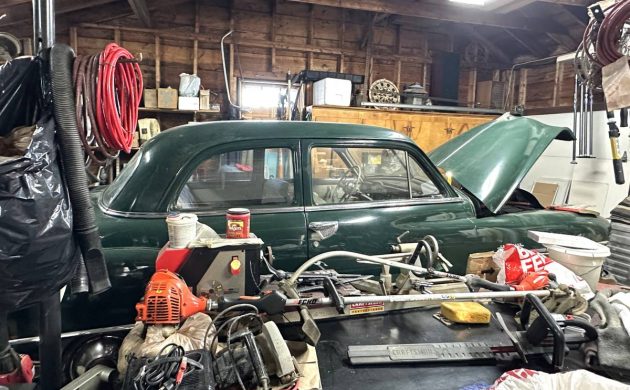
I know they’re not fast, sleek, or sexy, but I’ll always like these frumpy-looking Plymouths. In the 60’s, they made cheap, reliable first cars for teenagers, and in my family, Plymouth sedans of this era were driven by my uncles and young (sometimes very young) cousins around their river places to haul us and beach and fishing gear down to the beach and boat ramp. Here’s a barn find 1951 Plymouth Cranbrook Club Coupe that hasn’t been started since 1997, but is highly original (paint, interior, even the spare tire), looks solid, and would be a great candidate to make roadworthy again. Once that is done, it could be enjoyed as-is given its originality because as they say in Cliche Land, it’s only original once. It’s currently hibernating in a garage in Hingham, Massachusetts, and is for sale here on craigslist for an asking price of $6,900.
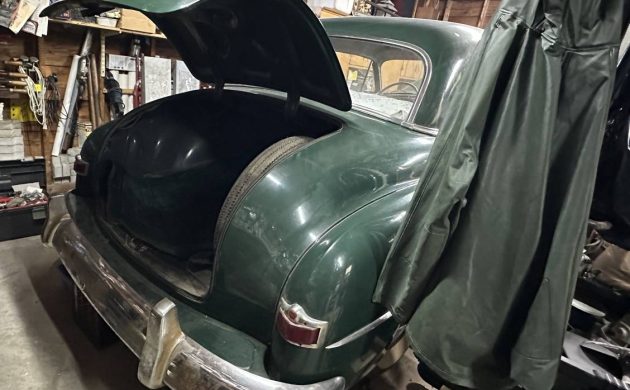
A guy named Jeff is selling it for the current owner and the Plymouth has a clean Massachusetts title in the owner’s name. It’s listed as a “barn find,” but no details are given. The current owner purchased it in 1997 with hopes of restoring it, but “life and recent health issues” are now forcing the owner to sell. It’s in a cluttered garage bay, so there are no side views of it and the rest of the photos are in the “details and closeup” category. The car’s factory Sherwood Green paint looks presentable to be 75 years old, the body looks solid, and I’m not seeing any rust issues. It’s hard to judge the condition of the chrome because of the dust and dirt but it looks okay. The trunk compartment is very clean and includes a trunk mat and the Plymouth’s original spare tire, and the undercarriage looks good as well.
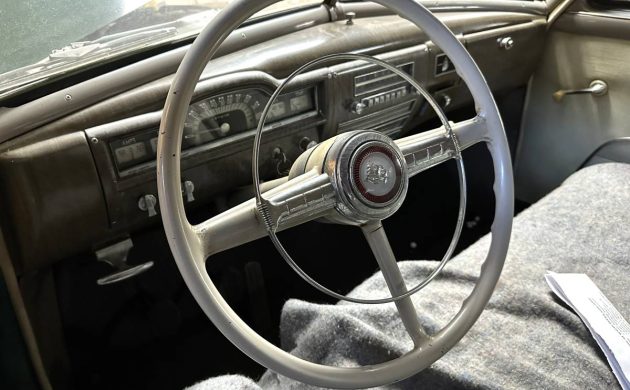
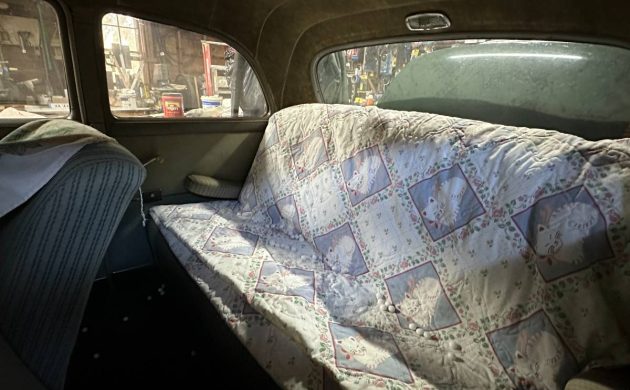
The Cranbrook was the top-of-the-line trim level and had a nice gray interior for a car in the low-price field in 1951. The roomy interiors were stylish, rugid, and if you fancy wearing a hat, you’ll have plenty of head space. The original front and back cloth seats are covered with a blanket and comforter, so you can’t see their current condition. The seller says they’re “in good condition with some minor tears and the headliner is in great condition.” The Plymouth has manual steering and the big gray steering wheel looks to be in good shape, and hydraulic brakes can be found front and rear.
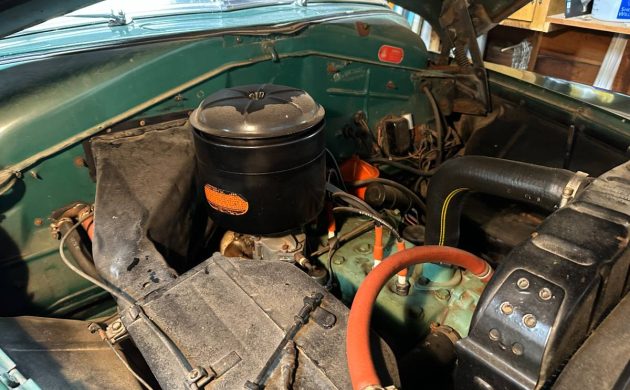
Under that Sherwood Green hood is the original 217-cubic-inch flathead six with a one-barrel carb that produced 97 horsepower. Mileage is stated at 55,000 and it’s paired with a 3-on-the-tree column shift manual transmission. The engine hasn’t been started since 1997 and the seller doesn’t say if it turns over or not. As with any car sitting on jacks for 29 years and not being started, it’ll most likely need the usual mechanical, fuel, and gas tank attention (in addition to brakes) to make Old Green roadworthy again. These Plymouths were known for being well built, sturdy, and dependable. Given its good bones and solid, original condition, this could be good project to take on. I really hope the next owner will make this old Plymouth roadworthy again and keep it as original as possible. What would you do with it?




If it turns over that’s a good place to start. Brakes and fuel system you can do yourself, change the fluids, 4 tires. Drive and have fun!
Listed here at $6900, Craigslist ad says $5900, if it turns over offer 5k. Cheap fun.
Over a month listed on Craigslist highlights the lack of interest. It may appear cheap, how many people are looking for an early-1950’s Plymouth project car? At least the seller is aware enough to start lowering the price, hopefully they will find the time to push it outside for better pictures.
Steve R
Look at the pictures on CL. This actually looks pretty good , If it turns over go for it. Even if it’s locked up, offer $2500. Gas tank and brakes , small V8 , A/T of your choice – easy, and back on road.
I want to like this car. I really do, but this car was not made for modern roads. And resto-modding it would just make me wonder why? It really is what it is, an entry level car for the budget minded buyer back in the fifties.
How is it not made for modern roads? If you’re talking about a Model T, then yes, maybe. I see some of the original VW bugs running around, 40hp, now those aren’t suitable for today’s roads.
They could handle the roads of seventy years ago! They should definitely handle today’s. Just a bit slower (perhaps) than some of the newer cars.
I purchased one of these in 1961 – a 1951 spiffy looking 2 door hardtop, black/yellow combination, and that little car and I rattled up and down the road from Springfield, MO, to Kansas City that summer of ’61, and at highway speeds of 70 mph, and sometimes, truth be told, faster. Did it all summer long every weekend with nary a problem. If it hadn’t gotten t-boned on Labor Day night by a red light runner, I might still have that little car today. It did everything I asked of it.
Personally, if I had the place to work on it, I’d love to get tgis running and driving, clean it up and have fun on the local 2 lane roads. Its hard to tell but it looks pretty solid.
And, once it’s up and running? You can wear your pork pie hat with ease!
Nothing wrong with a pork-pie hat say I, a living fossil!
K.T Keller built this beauty, just for you!
Any northern car of almost any vintage requires a rust assessment. ‘Frumpy’ is an apt description. ‘Boxy’ works too, and this is the essential ‘shoebox’ (misappropriated for the late 49-51 Fords).
These 1949-1954 Chrysler products ran virtually for EVER, and accepted a lot of abuse as they waxed older, changed hands for $50, and got into the 200,000 mile territory. The Plymouth won no beauty contests, but it had what you basically needed, and if you can get it running, it will work for most driving tasks even to-day. If it turns-over and is free of rust, I wouldn’t change a thing: I’d clean it up nice and spiffy, address any mechanical and upholstery issues, and drive it “as original was”, and let folks gawk at what cars were like when I was young and these were new. A 97-year-old man down the street has an all-original 1949 Pontiac (cracked driver’s side window and all), unrestored, which he drives (I won’t say “every day”, because he drives only when he needs to at this point). He bought the car, used, in 1961, and has driven it ever since.
Pop put 220K on a 54 Chrysler Windsor before a drunk parking garage attendant took it out (managed to smash all 4 planes of the car, front, back and sides….special talent I guess).
As a long time owner of a 1952 Plymouth Cambridge Club Coupe, I think I can offer a few comments about this vehicle. The CL ad is no longer active. So I can only assess this based on the information in Mr. Denny’s write up. For starters this is a very solid basis for the hobbyist on a budget who wants to acquire an early fifties vehicle to enjoy. I can almost guarantee that with a few weekends of TLC this Plymouth can be confidently driven wherever the new owner chooses. Parts for maintenance and most repairs are readily available. Club support is fairly extensive and fellow owners are both knowledgeable and willing to help. These cars are dependable and straightforward to work on. Some may consider the styling to be too conservative or perhaps even stodgy. To each their own but I get lots of thumbs up and positive comments whenever I take mine out for a cruise. She will move along quite nicely around town and on the two lanes. And as long as you stay in the right lane; the interstate highway can be managed at 60-65mph without issues. If this vehicle did indeed sell at or near the ask then the owner will be happy with their purchase.
Did any of these have overdrive?
Wayne, a Borg Warner overdrive was an option but first offered in 1952. I wish my ‘52 was so equipped.
The GOOD ones go QUICKLY!
Darn, the CL post said expired. I wanted to get a good look at it. I hope it did sell, and while this vintage is not my favorite, this is a project I would seriously consider. It has character, something that is sorely lacking in today’s world, and I can see a LOT of folks giving thumbs up when you are out cruising.
Very fun cars which have “aged out” to our population. Slow, clunky and one will not get in trouble with it. I have owned a few of these in previous years, yes I’m older, LOL, and enjoyed their simplicity and ease of servicing and repair. Their “achilles heel” were “soft” bottom ends, resulting in engine knock, but would survive if they weren’t driven hard, which was really hard to do anyway. Hopefully the seller found it a home and it will live on…. for now anyway….
When I was a kid I can think of two of these cars in my hometown that were identical twins to this car, right down to the green paint. One got traded and traded again, the third owner, a farm family I often stayed with, bought it as a second car and the girls drove the wheels off it. The other ended up getting stripped down and put into the local dirt track racing circuit; it’s fate was sealed the first season it ran.
That one was really sad as the car was in very good shape in the beginning. As the saying goes, ‘Good things never last.’
A sad story.
I dislike seeing anything abused, especially cars. Perhaps I’m still influenced, more than 50 years later, by a dressing-down from my car-dealer uncle. He gave me hell for driving a car, a ’50 Buick, hard and fast over uneven dirt terrain on the road to the junkyard. In so many words, he said I needed to learn to respect things, mine and others’, even when they’re without apparent value. My uncle wasn’t a deep thinker. Yet in this case, I think he was right: care and respect for people and property is a behavioral trait that sets us apart from savages.
Back in the day, Ron, the Plymouth was The family car for lots and lots of families, mine included. My uncle had a ’35 which he traded on a ’55 (a very frugal guy, my uncle). My dad had a ’36 and a ’40: the ’40 lasted through WWII, after which Mom and Dad decided to drive it from PA to CA to visit relatives. The crazy CA postwar car market paid Dad more for the ’40 in 1947 than he paid for the car new! Trouble was, you had to pay to get on a waiting list to (eventually) buy any new car…so no more Plymouths; Dad finally got a ’47 Hudson. BTW, all of the cars mentioned here were new two-doors…to keep the kids from opening a back door and falling out of the back seat… ;-)
My Dad’s first new car was a light grey ‘51 Plymouth Cranbrook. He picked it up at the factory to save money. The brakes went out before he got 100 miles. Had to wait until they towed the car back to the factory and fixed it. That was a harbinger of things to come. He absolutely hated that car. It took him 11 months to be able to trade it for a ‘49 Buick Special. I think I’ll pass.
I had a 51 Cranbrook as my first car back in 1965. I only paid $50.00 for it. It was like the Flintstones. You removed the aluminum plate from the floor and you could see the road below you. Got me to school and home cheap.
My compliments to the photographer. Or was that condolences…?
These were everywhere in my youth. A cheap reliable car. Of course we all wanted the new stuff (mid sixties) but these were obtainable without a rich daddy. The price needs to be very low to get this to move as the people who bought them new are dead, and so are most of us secondary buyers. Idealy a young gear lover can get it very cheap and restore and drive for the pure joy of seeing a 75 year old car come back to life. An, no, I would rather it rot then be mutilated as a rod. Have some respect for those who came before you.
That was fast. Somebody grabbed it already as the Craigs List has expired.
One of my relatives bought a Green four door 1941 Plymouth, new, just as the 1942s were coming out (a Special Deluxe, or whatever their top model was), and they were still driving it in 1979, when they were in their late nineties and had to give up driving because of near-deafness. The car was either sold or parted with in some fashion: I know not what happened to it after that. But it had scads of relatively trouble-free miles on it (except rhat the radio no longer worked).
We bought one from a neighbor in the mid 50’s, just like this one, even the same color, with only 17K on it. He had purchased it new when he retired. It was loaded with options: High output heater, radio, back-up lights, and turn signals. Good basic transportation! The biggest problem id that it was allergic to dampness. If a dog peed on the right rear tire, it wasn’t going to start!
I hadn’t thought of THAT! But now that you mention it, I knew of other highly reliable Chrysler cars of this general vintage that would not start, let’s say, if it were foggy and damp. You had to put a workman’s light under the hood for maybe a half-hour, just to dry things out: then she would start: no problem at all! A number of cars in this era still had a manual choke, and modern drivers might not be prepared for that. It is easy to operate, once you know how and are familiar with what to expect. All of this is part of the charm of driving as though this were 1950. We’ve forgotten these little routines since made unnecessary by newer convenient developments. The first time a modern driver hits the start button on a six-volt electrical system, he fears that his battery is nearing death… but she starts right up! We just are no longer accustomned to the slow cranking of a 6V starter. And unless we read the owner’s manual, we might not realise how many little fittings on that 75-year-old car need to be oiled and greased regularly, and in very specific amounts at particular mileage intervals. You don’t just drop into your nearest Valvoline or Jiffy Lube every 3,000 miles, pay the guy, and drive away. You need such things as spring-grease, and there are fittings for that. Many of these cars want straight 30W oil, or 10-W-40. Driving an old car is like tending to an 18-year-old dog: you have to understand its special needs that your 2017 Toyota doesn’t have. But then again, you don’t have to worry about that delightful “Check Engine” light that’s about to cost you $2,400 for a problem it takes a computer 41 minutes to locate, with sensors hidden in places that will cost you four shop-hours to get at!. With that old Plymouth, just open the bonnet, roll-up your sleeves, and address whatever it may be. Everything is straightforward under there, and you can reach any component of it from either up above or from rolling underneath. Yes, you have to change such things as points, rotor, condenser, and distributer cap far more frequently. And you have to re-gap your points every so often as they wear, or they will eventually fuse together and shut everything down. But, just as Johnny Cash sang, “Understand Your Man”, you become intimate understanding friends with your old car — and if you treat it right, it will treat you far better and more appreciatively than one of these impersonal “computer-geek” jelly-bean-bodied pieces of transportation with no personality, and not a level line on the body.
My Dad had one of these that had the damp issue also. He was a pretty good mechanic and he never figured his out.
I’d forgotten about the hand choke! Once you mastered the operation of them, they worked better, and were more reliable than the early automatic chokes of the era! The last hand chokes that were factory installed, that I know of, were on Ford’s 1970 Boss 302 & 429 Mustangs!
Actually, Chuck, my 84 RX7 has a hand choke.
Actually what we did to those old Mopars was change the starter from a 2-pole to a 4-pole, and they started much better. The industrial engines, such as the ones that powered combines, had the heavier starters; and they always worked.
We got a guy in our local car club who has a ’53 Plymouth and when we went on a day tour, he wouldn’t shut it off when we stopped for coffee. But after he switched to the heavier starter, his problems were gone…
I have to share that I am a bit surprised how Dodge/Plymouth/Chrysler sedan of 1950-54 have such high asking prices when in fine condition. I love “frumpy” sedans ….and the asking prices I see are often 12-16k on what I thought would be 6-8k at this point. Perhaps they trade in circles to which I am not part.