
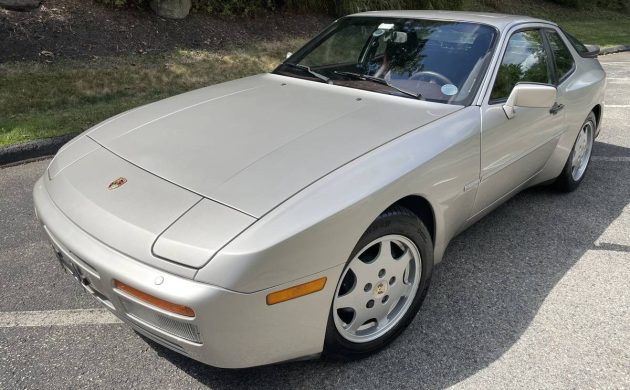
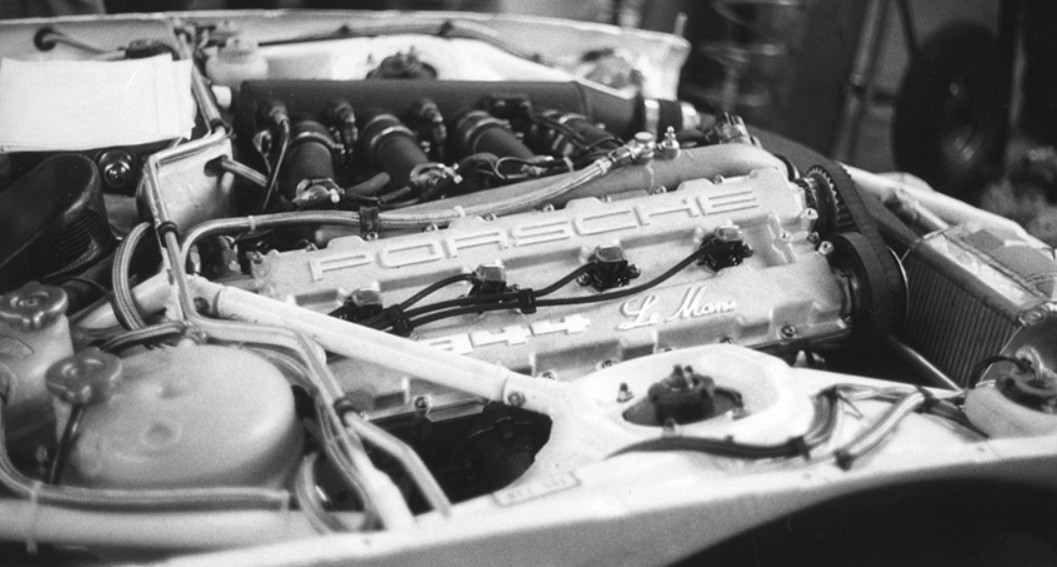
Unlike the 924, which began as a VW project and utilized a humble Audi engine, the 944’s roots were exotic. The car was designed around a race motor derived from the aluminum V8 Porsche designed for its 928. The new engine was essentially half that V8, augmented with harmonic balancers licensed from Mitsubishi, turbocharged, fuel injected, and sporting 16 valves. Its first use was in an altered 924 that Porsche entered in the 1981 Le Mans endurance race. The car was entered as a “924 GTP”. The engine bore the inscription “944 Le Mans”. Later, the car was known as the 944 GTR Le Mans. Early 944s dished up diluted performance relative to the Le Mans car, but by the time this example arrived, displacement was up to 3.0 liters (technically it was a 2.7 but a revised crank increased the stroke) and output breached 200 hp. Meanwhile, the body was more aggressively styled than the 924, with an extra sloped panel in the nose, prominent fender flares, and a larger spoiler. This low-mileage 1989 944 S2 is available here on craigslist for $17,800; it’s located in Westport, Connecticut. Mitchell G spotted this tidy Porsche for us – thanks!
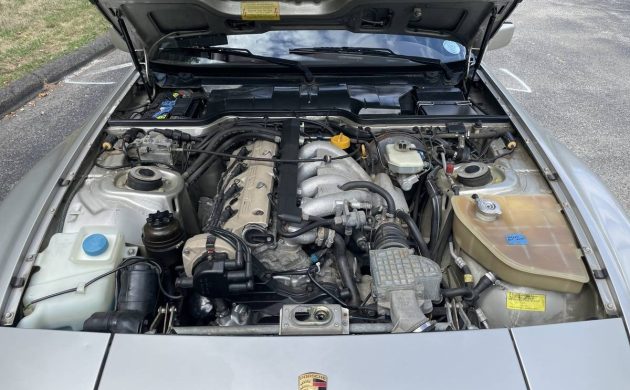
If you’re serious about performance, later 944s are the way to go (or you can rustle up a Euro-spec car). This S2 will deliver decent low-end torque for mannerly around-town driving – and a zero-to-sixty time of just over 6 seconds. The turbocharged cars, introduced in 1985, will outrun an S2 down the straight, but at the cost of turbo lag. Still, they’re very tractable at higher speeds. All of Porsche’s “transaxle” cars benefit from a near 50/50 weight distribution. No one complains about the gearbox – this one is a five-speed. The seller is the second owner, and the odometer reads just over 83k. The best news: a timing belt service was completed just 2000 miles ago. The car also rides on new tires.
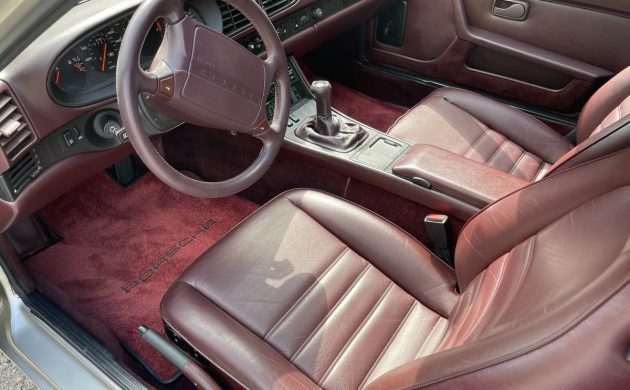
Other than the engine, here’s my favorite part of this car: the punch of an oxblood interior. The cabin is near-pristine. Even the shift boot is in great condition. I’m not usually a fan of logo’d mats, but these are great.
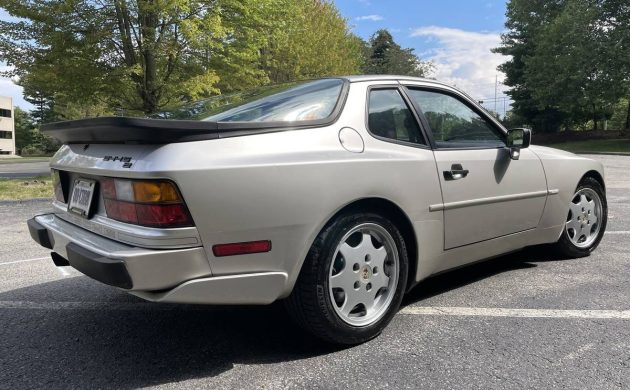
Anatole Lapine designed the 944. Its curves, gentle wedge shape, and defining rear hatch are shared with the 924, but the 944’s wider track, spoiler, and beefy fenders convey a seriousness missing from its older sibling. And of course, there’s no comparison performance-wise. These water-cooled cars are credited with saving Porsche during dark days, when bankruptcy was a possibility. Over 163,000 copies of the 944 were sold in ten years. Many didn’t survive, making this well-kept example a bit of a rarity. Scrutinize the seller’s maintenance records closely, however, as repair costs can be prodigious. If it’s mechanically up to par, this example is a near-bargain. Similar cars sell for over $20k.




Good write up Michelle. One point on the Audi engines in the 924: Our ’77 had the late ’78 European Special Edition engine in it and it was not slow. The S2 here is the ultimate in the line and as good a driver as you can get anywhere. Nice one here.
I owned a 88 944S and it was gutless. The 944S was Porsches first attempt at bridging the gap between the base 8 valve 2.5 and the turbo by adding the 16V cylinder head. Without variable valve timing Porsche calls it Variocam and intake runner tuning Varioram the 2.5 16V was no match for a relatively heavy car. It took only 3 months of ownership before I gave it the boot. The S2 models solved those issues for the most part.
Michelle you and I both love a red interior. Funny thing is I purchase based on the interior first followed by the exterior color.
Another excellent write-up Michelle. Just one technical comment for clarity. The balance technology licensed from Mitsubishi were balance shafts and are not harmonic balancers. The ones used on the 944 engine were designed to reduce the secondary vibrations characteristic of essentially all 4 cylinder engines. Those balance shafts are what makes 4 cylinder engines displacing more than 2.3 litres tolerable. Four cylinder engines smaller than that can be made acceptable with soft motor mounts.
Harmonic balancers are always fitted to the free end of the crankshaft (opposite the flywheel) and are more properly called torsional vibration dampers. At certain RPM’s cylinder firing frequency aligns with the natural frequency of the crankshaft and that will lead to failure of the crankshaft. Think of a fine crystal wine glass that can ring when flicked with your finger and then that ringing can be stopped by grabbing the glass above the stem. Supposedly the great Italian opera signer Caruso could shatter a wine glass with his powerful voice when he hit and held the same note that aligned with the natural frequency of the wine glass. That would not have been possible if that glass were held in one’s hand by the bowl of the glass.
Good information. We don’t run balancers on our small 948 and 1275 race engines because of the extra weight and high rpms, 9,500 on the 948 and 8,500 on the 1275. Only thing in front is the disc for the crank sensor but the 6 lb flywheel and 5 1/2 lb aluminum clutch balanced with the crank all contribute to a smooth engine. Porsche had a large 4 cylinder to contend with and it took them a long time to get it right.
With such a light flywheel you have greatly reduced or eliminated the need for a tortional vibration damper. Few 4 cylinder engines have them.
Wow. I did not know that.
Thanks for the correction z1rider, and thanks to you, too, Bob. I just took apart a 948 in preparation for a rebuild and was investigating the whole raft of harmonic balancers that are available, so for the first time in my life, this is actually on my mind. Your information couldn’t have come at a better time.
My little engine is for “practice”, certainly not racing or such, in fact I don’t really have a destination for it yet. I do own a Turner with a 948, so I guess it can be an alternate if I ever was foolish enough to remove that perfectly well-behaving unit for this new one…. but mostly I just want to get used to building engines. There’s six of them under my bench – five BMCs and one 170 cu in Ford – it’s time they taught me a thing or two instead of just taking up space.
For a street engine the balancer should be used but slightly lighter ones are available. Same with clutches and flywheels. balance them with the crankshaft. Suggest picking the flywheel and clutch and then have them balanced together. Moss Motors has a good lighter weight flywheel, stock balancer pulley and other items you will need. Mini Mania is good for clutches and other goodies you might want. Moss Motors.com and Mini Mania.com.
I feel this write up has a couple of wrong statements . The 924 was always a Porsche design but was supposed to be a joint venture with VW , where VW canceled the VW built engine. Porsche then built their own and named the car subsequently porsche 944. I owned a 87 Porsche 944s and I enjoyed driving it a lot. Not super fast but reliable.
As a side note: did anyone else notice the mismatched paint on several body panels ? I wonder if the car was in an accident , or why some panels had been resprayed but not others .
I saw that, but I can’t tell if it’s just the light, or what. Silver can be notoriously difficult to photograph.
not a porsche follower but this would B it (is it) if so. The 928 even more so. “Conventional’ for me w/the changes as compared to history). Affordable – Y follow if not even dream-able (not an eye catcher for me either). Even like the body style best.
Never knew the Mitsu connection, thnx.