

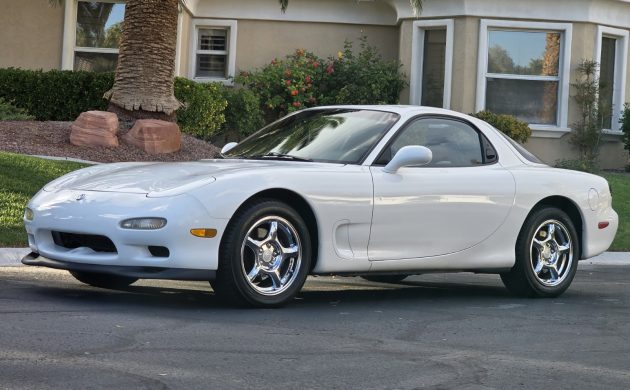
I’ve had the privilege of driving a few desirable classics, but there are still many on my Bucket List. One is the Third Generation RX-7. Mazda played hardball with these cars, equipping the wonderfully smooth Wankel rotary with a pair of sequential turbochargers. Suddenly, the RX-7 had teeth and was a genuinely fast sports car. This 1994 example should take that concept further, thanks to some tasty mechanical upgrades. It presents nicely for its age and is ready for action when the new owner hands over their cash. The seller has listed this marvelous Mazda here on eBay in North Las Vegas, Nevada. Bidding has raced to $30,100 in a No Reserve auction.
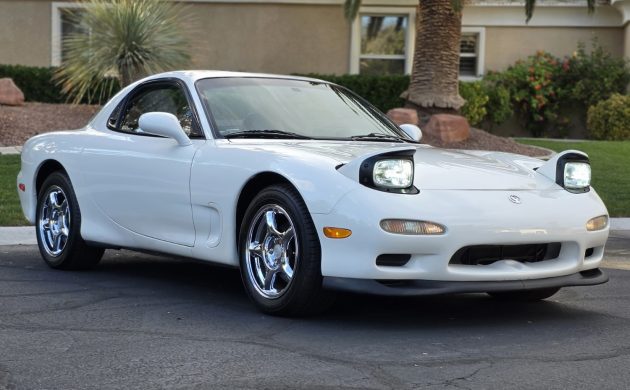
Mazda introduced its Third Generation RX-7 range in 1991, with the latest offering riding on a longer wheelbase. The styling was radically different from its predecessor, with improved aerodynamic efficiency. Our featured RX-7 emerged in 1994, ordered by its first owner in Code PT White, which was a new shade for that model year. The seller confirms that the paint is original, with no history of cosmetic repairs or restoration. Therefore, it’s not surprising to find a few minor chips and marks in the close-up shots. That said, it holds a nice shine, and with no dings or dents, the appearance is comfortably acceptable for a driver-grade classic. I can’t spot any rust or other nasty surprises in the underside shots, and I wouldn’t expect any if the car has spent its life in its current location. The plastic has done an admirable job of withstanding the harsh Nevada sun, and the chrome wheels are spotless.
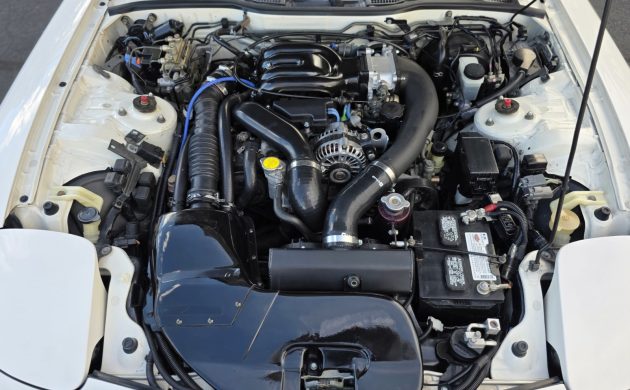
Mazda is the only company to enjoy long-term success with the Wankel rotary motor. This powerplant, and its initial lack of reliability, pushed the already struggling NSU over the edge when its groundbreaking Ro 80 chewed through engines, costing the company a fortune in warranty replacements. However, Mazda persisted, developing an effective solution to the common issue of failed apex seals, and proved its ability with Le Mans 24-hour success utilizing rotary-powered race cars. This RX-7 demonstrates Mazda’s desire to push boundaries and seek performance gains. Its 13B rotary has a nominal capacity of 1,308cc, but it is a giant-killer. The company employed an excellent sequential twin-turbocharger system that pushed power and torque to a factory-quoted 255hp and 217 ft/lbs. The system let one turbo operate from engine start-up, but as engine speed increased, the second engaged a “pre-spin” system to deliver full boost when it came “on song.” It eliminated turbo lag, further emphasizing the car’s smoothness. It allowed the Wankel to propel the RX-7 to a factory-claimed top speed of 155mph. This car may deliver more to the rear wheels via a five-speed manual transmission, as the seller fitted replacement turbochargers from BNR Turbos and an intercooler from Mazda specialists Tri-Point Engineering in Canoga Park, California. The seller has always maintained this RX-7 properly, suggesting it is ready to head towards the horizon with the winning bidder behind the wheel.
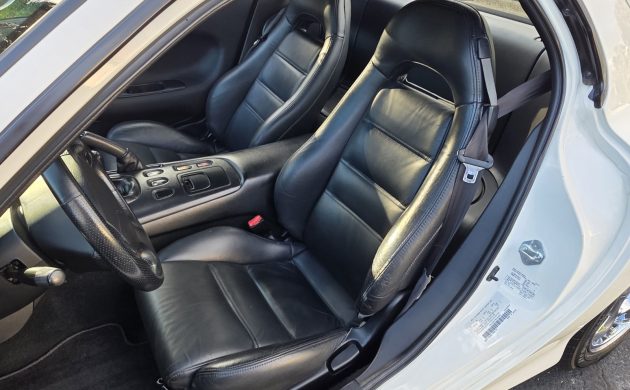
This Mazda’s interior continues the positive vibes. Trimmed in Black leather and Charcoal plastic, its condition supports the seller’s claim that this classic has covered a mere 64,000 miles. The leather on the driver’s seat outer edge is particularly noteworthy, with only minor wear that should disappear if treated with a high-quality conditioner. The plastic hasn’t deteriorated, and the carpet is wear-free. It should also be extremely comfortable, equipped with air conditioning, power windows, power locks, power mirrors, and a tilt wheel. I think the stereo is upgraded and includes a CD player.
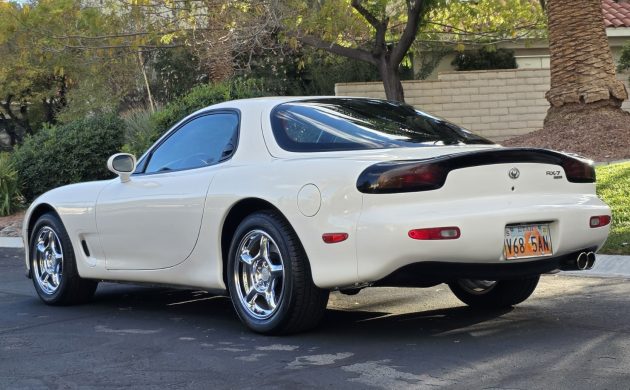
If you’ve never driven a rotary-powered Mazda, you’ve missed out on one of motoring’s great pleasures. I slipped behind the wheel of an early RX-7 years ago, and it is hard to describe the experience in automotive terms. You don’t receive a brutal “shove in the back” when you drop the clutch, but the closest feeling I can equate it to is rolling down the runway in a passenger jet as it reaches take-off. You aren’t aware of massive acceleration, just a smooth, linear speed increase. The seller’s upgrades to this 1994 example should accentuate that feeling, helping to explain why it has generated considerable interest since hitting the market. With No Reserve in play, this RX-7 is days away from finding a new home. Are you tempted to make it yours?

This car has truly been pampered. It looks new! I still remember the early RX100, around 1971. The car was about the size of the then current Corolla and it definitely had beans for such a little car. It also sucked gas. 20 mpg was the norm on a good day. And yes they had reliability problems. And still do. If you get 100k out of the latest 13B you’re doing well. At least they don’t break along the way like they used to. Whoever buys this car should use it as the occasional Sunday driver if they plan to keep it long term.