
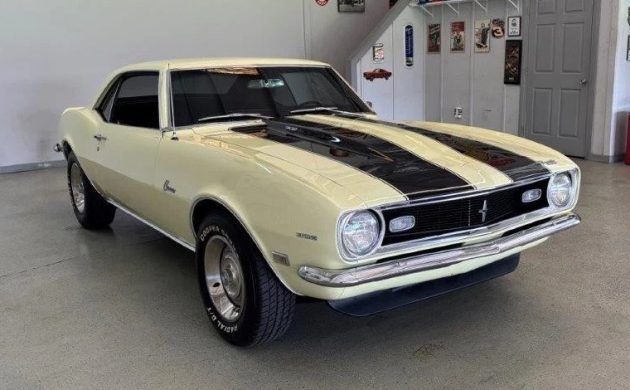
I sometimes wonder whether the automotive industry will once again see the likes of this 1968 Chevrolet Camaro Z/28. There will almost certainly be high-performance models in the future, but will manufacturers ever produce vehicles designed specifically to achieve motorsport success? That is the story behind Ford’s Mustang Boss 302 and the Camaro Z/28, with both companies adopting a “win on Sunday, sell on Monday” marketing strategy. This 1968 Camaro Z/28 is an exceptionally tidy vehicle that retains its numbers-matching drivetrain. Somebody has performed minor updates that could be easily reversed if the buyer prefers authenticity. I must say a big thank you to Barn Finder Curvette for spotting the Z/28 listed here on eBay in Loganville, Georgia. The seller set their BIN at $74,900 with the option to make an offer.
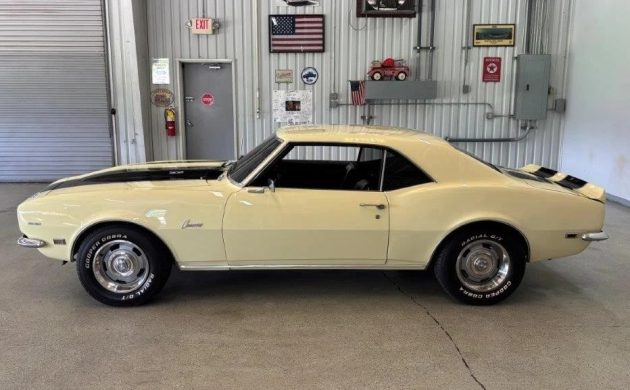
The Trans Am Series was probably at its peak in the late 1960s, with many manufacturers directly involved in factory racing efforts. Those companies also supported privateers, but the primary aim was to improve showroom sales. Ford recognized the benefits and produced the Boss 302 Mustang. Chevrolet joined the party in 1967 with the Z/28 version of its new Camaro. The Z/28 was one of its best-kept secrets, and only 602 of these classics left the line during the first year. However, the cat was out of the bag, and sales rocketed to an impressive 7,199 vehicles in 1968. This Camaro is one of those cars, ordered by its original owner in subtle Butternut Yellow with Black stripes. The seller doesn’t mention restoration, but the lack of panel and paint imperfections suggests the car may have been refreshed. Its beauty is more than skin-deep, because the underside shots confirm that this classic is rust-free. The Camaro retains the correct spoilers that were an integral part of the Z/28 package, while the trim and tinted glass are excellent.
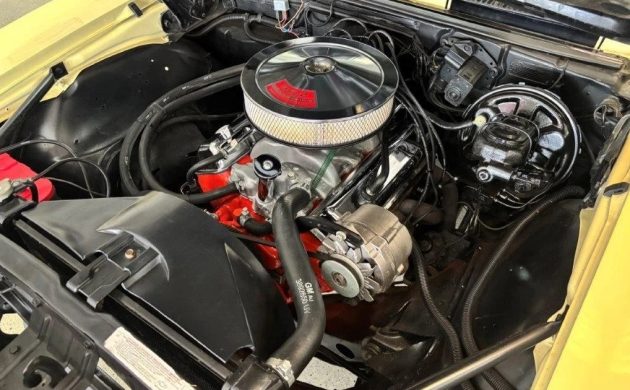
Chevrolet targeted the under-5.0-liter Trans Am category when developing the Z/28 package. The car’s 302ci V8 squeaks under the limit, but only just. These engines don’t shine on the dragstrip, because the 290hp and 290 ft/lbs of torque both peak above 4,500rpm. However, for circuit racing, these engines were ideal. This car retains its numbers-matching V8, four-speed Muncie transmission, and 12-bolt Posi rear end. It sports aftermarket headers, but there appear to be no other mechanical upgrades. The seller includes the original Owner’s Manual and invoices dating back to 1984. They confirm that this classic is ready to hit the road with its new owner behind the wheel.
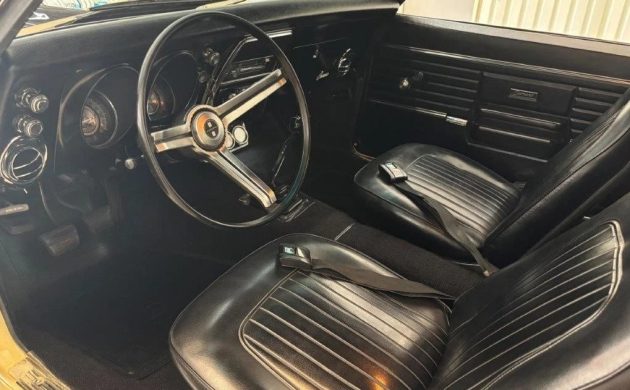
Chevrolet’s competition focus with the Z/28 is evident in its interior. Those seeking the luxury of such features as air conditioning need look elsewhere, while this car isn’t forced to cope with the additional weight of a console. “Bare-bones” is the phrase that springs to mind, although the seller added a retro-style stereo and underdash gauges that could easily be removed. The Black vinyl trim is excellent, as is the carpet. The dash and pad are spotless, and there are no signs of wheel cracking.
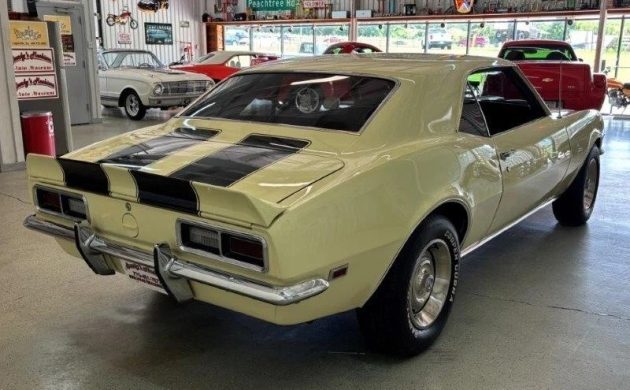
The reality is that, as most motorsport categories adopt a “control” format for vehicle specifications, the need for homologation specials will almost entirely disappear. It has happened to NASCAR, although there will always be exceptions. This 1968 Camaro Z/28 emerged at a time when manufacturers recognized the marketing benefits of racing cars that buyers could purchase off the showroom floor. Its presentation is impressive, and reversing the few apparent changes would allow the Camaro to recapture its factory form. Is that the path that you would follow if this gem found its way into your garage?


Ford, Chevrolet and Chrysler all made race only cars until 2023, these purpose built to run in Stock and Super Stock NHRA classes.
This car has some modifications you wouldn’t expect on a high dollar restoration. Rubber fuel line from the fuel pump to carb, addition of the cowl induction hood, as for the aftermarket gauges if expect something vintage looking like Stewart-Warner Greenline gauges which are available new.
This is a nice car, but there are enough questions for potential buyers to really do their homework and verify every major component and the quality of workmanship.
Steve R
I agree, it’s a nice car but there are things about it that cause me a little concern. Besides the assorted modifications visible, the rattle can black appearance of the firewall “restoration” worries me about the overall quality of the restoration, as does things the door match mechanism painted body color. Also, I’m always bothered by ads claiming “matching numbers” with no pictures of those numbers provided. Unlike 67 and 69 Z/28’s, 68’s are much easier to clown with nothing on the trim tag to identify them as a real Z/28.
To the author, Ford came into the Trans Am series in 1966 with 289 powered Mustangs. Chevrolet entered in 67 with the Z/28 designed for the series, Ford didn’t counter with the Boss 302 until 69. While the Z/28 wasn’t intended for drag racing, it’s high 14 second quarter mile times were within a half second of the SS396/375 Camaro and quicker than the SS350. Slicks and open headers put the Z/28 into the 13 second range and many Z/28’s dominated their NHRA classes. Finally, the spoilers were never an “integral” part of the Z/28 package but instead were always a stand alone option on the 67-69 Z’s.
I agree with Steve R. When asking high price you should have vintage gauges after market. The exhaust should be factory chamber exhaust system stock exhaust. manifolds. I heard how a 302 sounds with this exhaust system. It sounds wicked.. the bodywork is beautiful for what we could see in the pictures.The interior is beautiful and I would like to know if that trans is a Muncie 21 or 22.. As far as I know in this car should be rock crusher. I wish the new owner good luck. 🐻🇺🇸
To the best of my knowledge, only 69 Z/28’s came with the chambered exhaust, and then it was only for the first three or four months of production. Owners of 69 Z/28’s and SS 396 Camaro’s and Chevelle’s with chambered exhaust were being ticketed for excessive so Chevrolet replaced it with regular pipes and mufflers starting in November 68.
The standard trans in the Z/28 was the close ratio M-21. The M-22 was optional with the Z/28 and the Camaro SS396/375, but since less than 1300 68 Camaro’s were ordered with the M-22, most 68 Z/28’s came with the M-21.
that is 1 shotty looking exhaust for 75k. i guess every Camaro owner feels their cars are worth north of 50k. this is not in my opinion a 75k car. bit too sloppy
Looks like 40-45K IF you can verify ALL the numbers, right down to the heads and stroke. If all that’s right, it’ll require partial disassembly and thousands in parts and services to get it to top dollar. Let’s face it, other than paint and soft interior parts, this is pretty much a #3 car, and I bet it only looks worse in person.
Most clean 67-69 Camaros are worth more than most people think as long as they are correct. This has the wrong hood and a few other problems. My first Camaro was restored in 1997 to almost perfection. Being a 67 Z28 it was worth more than this one but it sold for $170K at Mecum almost 2 years ago.
I bought a brand new 1969 Z-28 in late 1969. After I put a couple thousand miles on it , I took it our local Lyons dragstrip on a Wednesday night “run what you brung” night. Ran a 13.8. not bad for stock street car.
Can anyone explain the mufflers?
Not worth what he’s asking for a partial restoration. Wrong hood, center caps and other things. BTW the author has it wrong the Z28 could be a fast 1/4 mile car in the right hands. My 67 Z28 ran high 13’s in stock configuration and Jerry MacNeisch runs a 67 Z28 in D/Stock and runs mid 10’s at 126 mph.
Not buying it, no tach, I’ve never seen a 68 without a tach
I have read somewhere that during the 69 model year the spoilers were optional at the beginning. Then became standard with price increases. Price increases happened several times on the Z-28 option during the model year. I think the Z could have come with either a M20 or a M21 transmission depending on what gear ratio was selected. Both trans were a mandatory option, around $200. The M22 was around a $400 option, not many came with it. 3.73 was standard, postraction was recommended and a option. To get 4.10 and up ratios, pos was mandatory. I have heard several stories about the chambered exhaust option, NC8. It was only offered in 69. I had a April built car that came with it, per dealer invoice. The assembly manual says it was discontinued on 6-13-69.
The M-20 was not available on the Z/28 in 67 and 68, but did become available for 69 on the Z/28. As far as the chambered exhaust, there was a Chevrolet TSB issued in November 68 informing dealers that the chambered exhaust would no longer be standard on Z/28’s or L-78 Camaro’s and Chevelle’s. I may be wrong on this, but it was my understanding the chambered exhaust remained an option for a while, but only in certain states where car exhaust was as strictly regulated. I’m pretty sure the TSB covering the chambered exhaust is available on the Camaro Research Groups website.
The BarnFinds knowledge base is excellent!