
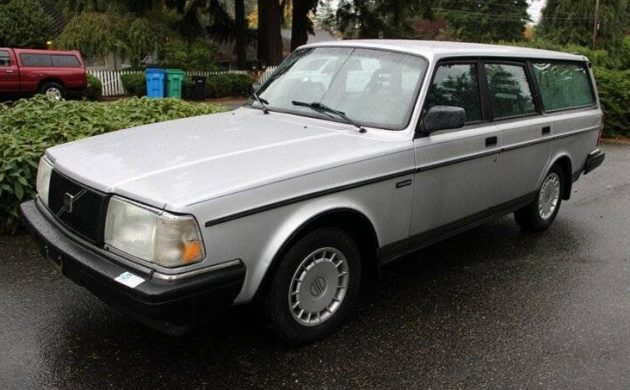
The Volvo 240 is known as being one of the most reliable and over-built vintage cars you can buy. When new, it was celebrated for its outstanding safety record, a reputation that remains intact today. The 240 enjoys a cult-like following, along with health spare parts supply and plenty of like-minded enthusiasts willing to help you out if you’re caught in a jam. The Volv0 240 shown here on craigslist is a 1992 model wagon equipped with the desirable manual transmission. It looks like it was a local trade-in at a used car lot that primarily sells late-model entry-level vehicles. The selling dealer is asking $8,995.
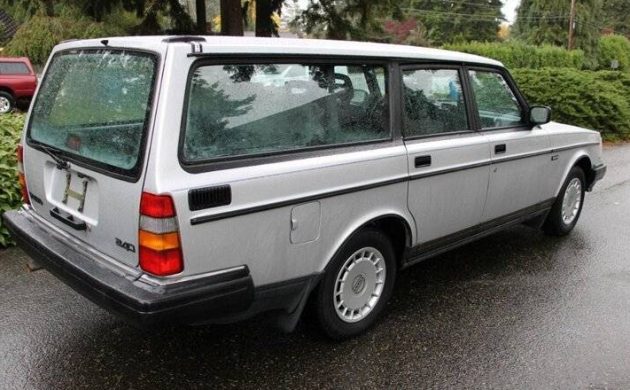
With 154,159 miles, this 240 is barely broken in, and since it’s located in the Pacific Northwest, it remains in very tidy condition despite almost certainly being someone’s daily driver up until recently. The 240 is not rare, with literally millions of examples produced across the lifetime of the 200-series family, but that number gets a bit tighter when you start looking for a 240 in truly decent condition and one with an elusive manual transmission. While plenty of Volvos are equipped with a stick, the 1990s saw drivers start to abandon three pedals in droves, which makes it more challenging than you might expect to find a three-pedal variant. Check out the rockers and wheel arches on this wagon – not a sign of rust anywhere.
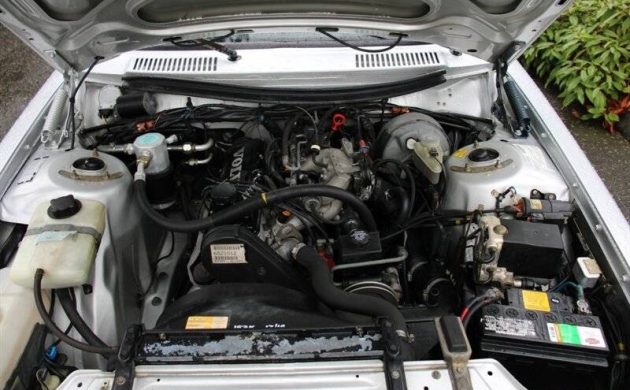
The Volvo 240 is powered by the venerable B230F engine. This is as utilitarian as it comes, right up there with Toyota’s 20R engine series. They do not sound good, and there’s very little you can do to make them fast. However, you also cannot kill it. This is an engine that will easily outlive the car that’s built around it, you, me, and large swatches of the Periodic Table. It’s a near-bulletproof drivetrain and the selling dealer notes that this one benefits from a recent timing belt replacement. Otherwise, plan to some basic fluid changes and spark plugs to keep this engine happy. The engine bay is surprisingly spotless for a vehicle with over 150,000 miles on the clock.
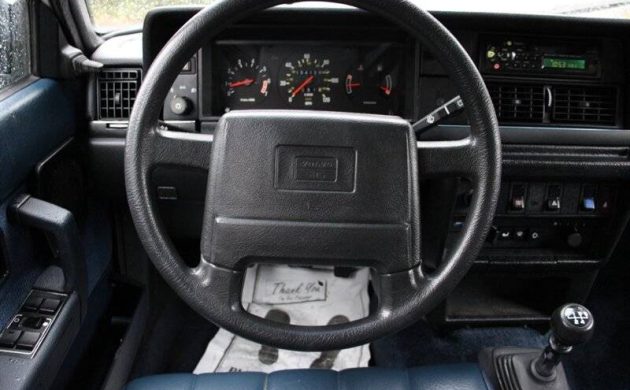
Performance-wise, the 240 made around 114 horsepower and 136 lb-ft of torque. No rocket ship but it will still get out of its own way, even today – which is why you still see the 240 in active use in places like the PNW. This car is a later production model which helps avoid the crumbling wiring harness issue some of the middle- and late-80s models were known for, and it also adds a driver’s side airbag. For a dealer, I actually think the asking price is quite reasonable, and given it’s located near Seattle, I can’t help but wonder if the selling dealer has simply priced it like any other late-model daily driver, which would demonstrate just how durable these 240s are.




My wife and I own a 1989 240 DL it is in great condition and I bought it at an auction for 900 dollars I get comments on average twice a week People saying it’s cool some ask to buy it I hear alot of my dad had one or they had one in college A lot of times the younger people ask What is it
Yes, it’s a very nice looking Brick, but the price seems a bit eye watering for this car doesn’t it? Would also be helpful to have some better quality pictures too. There are no shots of wheel wells or undercarriage and only low res pix of the rest of the car, which looks nice but not $9K nice.
Pretty good value. 4 speed w/ overdrive was rare in the later years.
I’m pretty sure it’s a regular 5 speed, not a 4 speed with overdrive like older models had. Either way, a stick in a Volvo makes for a much more enjoyable driving experience.
I called the seller who seems to have cars regularly on this site and was told the car was already sold to an out of state seller. Seems they are using Barn Finds a good way to sell classic cars they get. This is the second car I’ve contacted them about and cars get sold the day Barn Finds lists them.
I’m actively looking for a 140/240 series car. I’m kind of flexible, in that I want a two door (142/242 S or E) with an overdrive, or a wagon with O/D. There are lots of really nice examples, like this one, with 100 – 150 K miles, no rust, well maintained in the $8-12 K range.
Or,,, projects for 3-5K. This is a great example of the top range, and considering what I’m seeing, shouldn’t last long at that price. GLWS.
Great, strong cars. Maintenance requires: oil and filter change, (NO FRAM) spark plugs, flame trap, and an occasional water pump and timing belt and tires. Average brake pad change if driven properly about every 75,-80,000 miles. Many cases of extreme bad accidents with no bodily harm inside. I had a, customer who bought a Volvo wagon when their daughter was born because of the safety aspect. The car lasted until the daughter got it for college use. While in college she slid off the road and the car tumbled down the side of the mountain. Rolling several times. The daughter only had a cut on her arm from the broken side glass. When buying the car when she was born, they never had an idea that the car would save her life 20 years later! I had a 265 wagon. (V6 issue) that I bought used when my daughter was born. I knew that the engine was tired. (The V6 back then was a terrible engine and cut the vehicle value in half) I had a heart attack at just the price of the timming set. So I installed a 5.0 Ford and AOD transmission. It was a virtual bolt in. The only problem until I installed a rear differential from a turbo car was differential life. I later sold the car to a Volvo freak friend of mine that had to have the car. He has recently passed away and the car is still sitting on his property which is held by his son. Who knows, maybe I will get it back some day. It sure surprised BMW and Volvo turbo owners when I dusted them off.
Like it but at that price, would want to be actually buying it from the original owner and hearing details on everything that it has been through and some verification of the mileage.
One of my favorite things to find in the boneyards was one of these Volvo wagons if they had the 3rd row seat. I could buy them for $20 or $30 and I don’t believe I ever had one sell for less than $200. I must’ve sold a dozen or so of them. An added bonus was they folded flat and were easy to ship.
I bought a 1979 242 coupe brand new in spring of 1979. I bought it to avail myself of Volvo’s legendary reliability and long life. It was a disaster. There was always something wrong with the car, usually having to do with its cooling system. Another friend had bought the Volvo P1800 sports car new, and had it towed 26 times. She laughed at me when I bought mine and I told her I thought hers was just a fluke. What are the odds? Two people in a fairly large social circle bought new Volvos and they were two flukes. That car went through a series of $200 (in 1979 dollars) repairs that consistently left me standing beside the road. (propaganda of the era: “Nine out of ten Volvos sold during the last eleven years are still on the road.” Actually, they were beside the road.)
Man, if it wasn’t for bad luck you wouldn’t have any luck! A very untypical experience. I have seen a couple of that vintage have fuel pump issues. (2 pumps, 1 in the tank and one external) I was convinced they were wiring issues between the relay and pumps. I finally had the tech run a stand alone harness and it solved the issue on the one car. But never got the chance to play with the second car.