
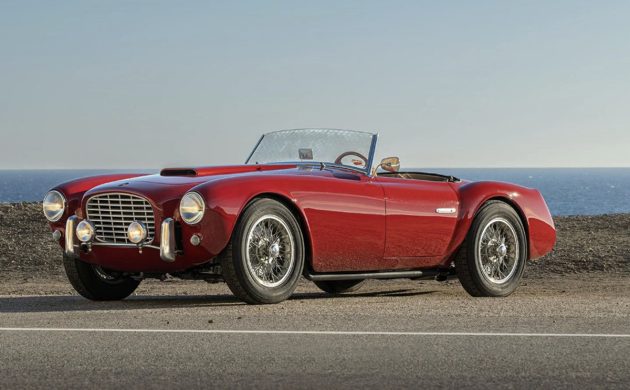
Can I get a deal because this coachbuilder isn’t … Zagato? or Vignale? or Pinanfarina? Probably not! Though he isn’t a household name, Rocco Motto’s creations are every bit as desirable as his more famous peers. Motto founded his bespoke carrozzeria in 1932 at the age of 28. Orphaned during WWI, Motto had apprenticed with metalworkers from the time he was a child, rising rapidly to head the coachbuilding division at Martelleria Maggiora in Turin. Like his former employer, Motto’s new shop crafted elegant bodies for small manufacturers such as Ermini, Bandini, and Cisitalia – first in steel and then, after WWII, in aluminum. As his fame grew, Motto attracted more elaborate commissions from the likes of Ghia, Porsche, and Lancia. This 1953 Siata 208S spider is one of 53 produced. With its lines penned by Michelotti, thirty-three of these were built by Motto’s shop. Broad Arrow is representing this rolling work of art at its Amelia Island auction on March 6th; the estimate is $1.1 million to $1.4 million. Before you keel over at the hefty price tag, note that it’s far less than the sales price of this similar example, which sold for $2.04 million last year. Read on for why we’re looking at a potential bargain on this exotic roadster, and thanks to Araknid78 for sending along yet another spectacular tip!

With the Amelia auction still a couple of months away, Broad Arrow’s description remains cursory. But not many specialty cars can remain on the down-low any longer. We noted Broad Arrow’s description of this car’s engine as “period correct” – which begs the question, why not numbers-matching? Hunting around surfaced this listing, which reveals that chassis BS 520 was raced starting in 1957 by Motor Imports of Honolulu, Hawaii, and thereafter with other owners who aimed for speed, not originality. In white livery and with an Oldsmobile V8 in place of its 2.0-liter, Fiat Otto Vu, chassis BS 520 managed a few wins and collected several plaques. Later, a Chicagoan painted the car red and installed a Ford V8. The current owner commissioned a full restoration, obtaining the “period correct” motor. From the factory, a four-speed Fiat-derived gearbox was standard, but since many Siatas went off to the races, a five-speed competition gearbox was also available. This one is from Alfa Romeo.

Decked with twin Webers, output was about 110 hp, but for competition, the car could be equipped with a hotter cam and triple Webers, achieving 140 hp. The car weighs about 2500 lbs: this is another “quick, not fast” sports car, but if it sat in my garage, I wouldn’t care one whit what its zero-to-sixty time is. Braking is handled by finned aluminum drums at each corner.
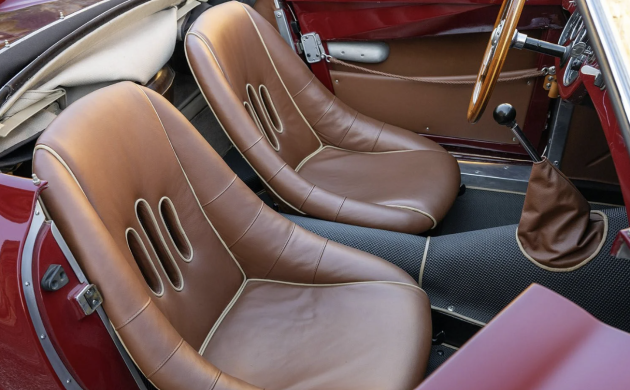
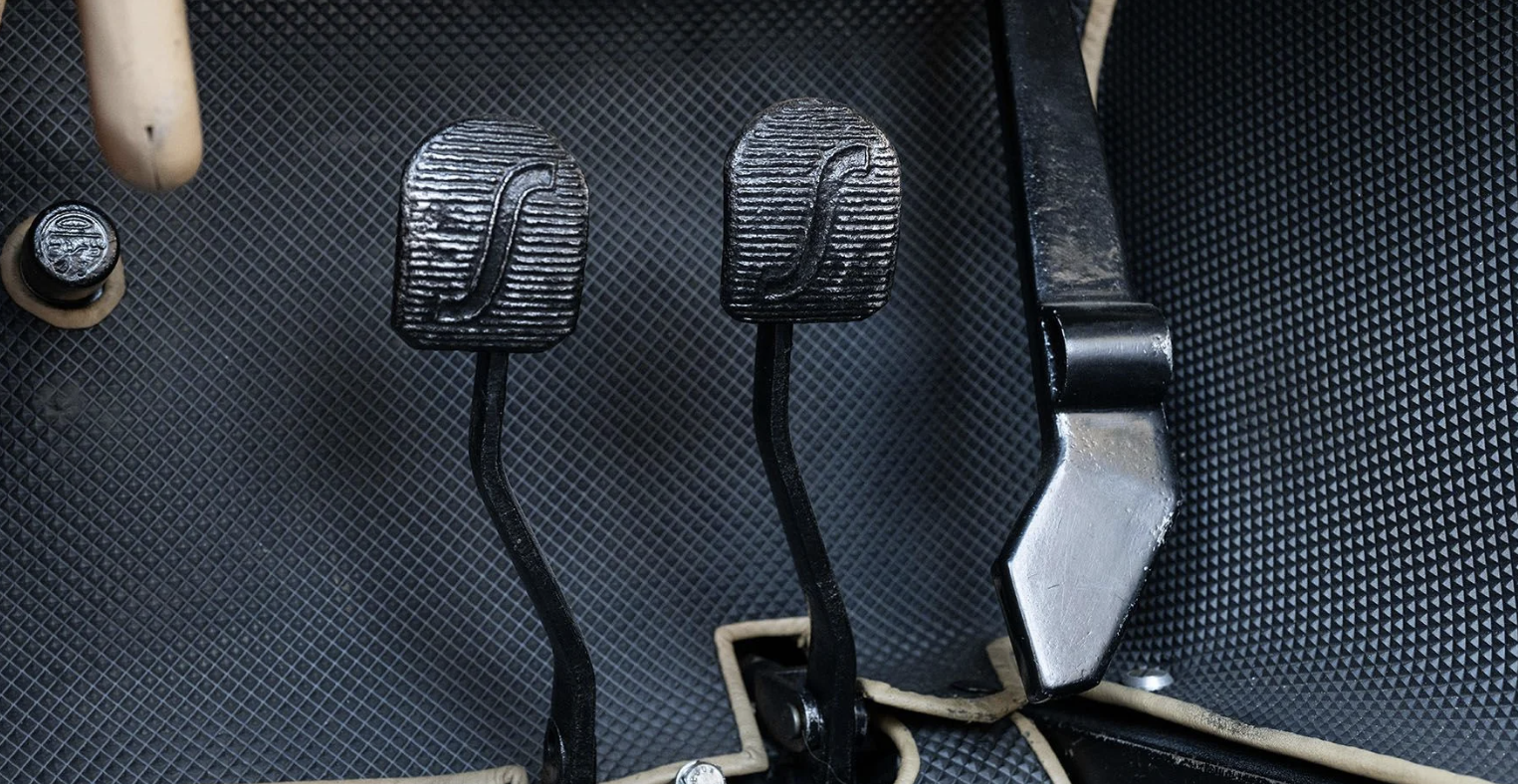
The fixed-back front seats were refurbished in tobacco leather; the top frame, wood-rimmed steering wheel, and side curtains were rebuilt. A black convertible top grants a modicum of shelter during storms. Big Jaeger gauges feed information to the driver. Even its pedals are proportionate and well-designed.
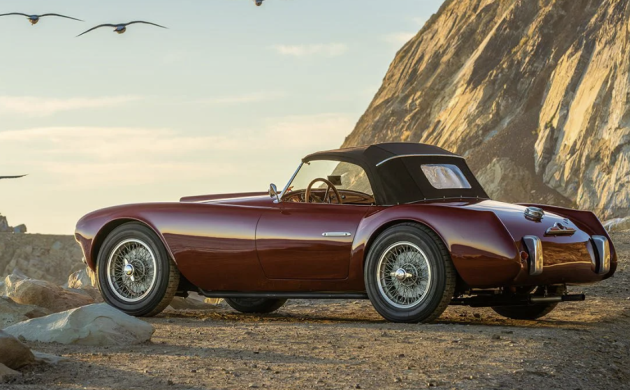
This view, showing the tidy rear fenders fashioned into fins, Monza-style gas cap, long stretch forward to the reverse-slant nose, and slightly oversized wire wheels is a reminder that creature comforts and practicality are not on the roster here. It’s a purposeful machine with racing on its mind. Today, this Siata would be greeted eagerly at nearly every event you care to enter, despite its non-matching engine. In fact, its new owner might strike a bargain on a car that’s worthy of most garages.




Another great write-up, Michelle!
Growing up in Southern California in the 1950s and ’60s, I was lucky enough to see a couple of these Siatas, plus the Fiats they were derived from. Beautiful little cars, no matter who hammered out the bodies.
Leaving the price aside — I have to, because there’s no way I could come up with that much coin — it would be a hard choice between this and the Lusso previously featured. Both are exquisite.
If this sat in my garage, it wouldn’t sit. Italian sports cars belong on the road!
This Siata definitely fits in the description as exotic. Even that engine is a work of art. I really enjoyed your write up Michelle, and you mentioning the history of its racing roots, its kind of hard to believe That a Rocket V8 from the good Dr. Olds was under this elegant hood. Yet after all that history of racing to be restored so beautifully to this condition must have been some huge undertaking. I’m sure for that price this beauty will get to reside in a climate controlled garage, and hopefully be enjoyed on a beautiful day on a twisty back road. And Michelle, I think you can definitely add one of these to my “List”, towards the top too!!!
At first glance I saw an AC Ace which debuted in 1953 also. Penned by John Tojeiro and influenced by the Ferrari barchette. What a sharp looking car. Interesting exhaust manifolds, never seen exhaust outlets point upward. What engine is that?
It’s the Fiat OttoVu (8V) engine. A 2.0lt all aluminium pushrod motor with only three main bearings. It loves to rev and the upward flowing exhaust ports are part of that, unfortunately the three main crank doesn’t like being reved without some subtle but significant changes.
That’s the 8V FIAT 2.0 l. engine designed around 1950 by the genius Dante Giacosa. As mentioned, not too many were built (114?) and many wound up in scrap heaps ’cause Yank Iron with lots more grunt would fit there.
The “King of Cool” Steve McQueen owned and drove the hell out of a ’53 Siata 208S Spyder. It is said that he liked to call it “his little Ferrari”.
This 8V was the perfect choice to fill the engine bay as so many have “lost” their original to small block Fords etc..
These are the best looking barchettas IMHO , and this one is perfection.
I wonder where Steve McQueen’s is?
The the last I’ve seen is it sold for $946k on Sotheby’s in 2011 but I don’t know who bought it or where it’s at now. https://rmsothebys.com/auctions/mo11/lots/r109-1953-siata-208s-spyder/
The seats do not adjust in some Siata’s and thus you must be the right size to fit the car. I know because I cast 1″ thick pedal rubber pedal pads that extended the beautiful cast steel pedals towards the driver for a customer in the San Diego area. There is a beautifully cast steel “S” in brake and clutch pedal facings for shoe traction. My pads had that cast face in the back of the rubber for perfect fit and echoed that “S” and background ribs perfectly on visible side. Must have been a tough installation though–because that foot-well tunnel is not too big! HA!
Stunning little cars, with a weight more in the 1700-1800lb range they’re quite enthusiastic performers. With surprisingly good parts availability these days they’re not as difficult to live with as they once were, but rare enough to ensure entry to pretty much any event on the planet – only 33 of the spider, 53 would be the total for 8V powered Siata’s in total
The badge bar and driving lights distract from the otherwise beautiful shape of the car. Even the seats, door handles, hood scoop, and windshield are perfectly sculpted. For me, this car is far more distinctive than any Ferrari.
Excellent write-up as usual, Michelle. Thanks for the acknowledgement.
Sweet auto!
Yes, I was thinking AC Bristol looking at the front end. Not a bad thing, as I really like the look. Very cool car. Hard to believe that it is a sister to the Siata Spring we saw here a few days ago.
Beauty.