
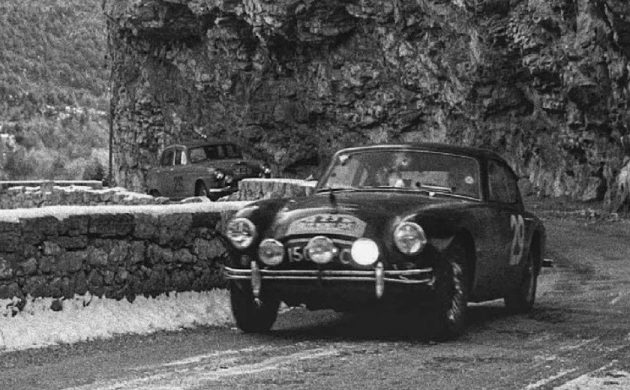
Maybe if you had a rare and beautiful car that had raced in the Tour de France and at Monte Carlo, you wouldn’t let it sit damaged and undriven in a storage unit for decades? Proving that barns, garages, fields, and woods still harbor spectacular cars with spectacular histories, this 1957 AC Aceca with Ruddspeed features and a full résumé of race history was recently unearthed by Charlie Gray of Brooklands Cars Ltd, a restorer and broker of vintage cars in England. Well, technically, he wasn’t responsible for finding it, exactly: he received a call from the family of an elderly gentleman who was moving to a care center. The property had to be cleared, and here it was, along with two Bristols. We can only imagine how Mr Gray felt – knowing a thing or two about ACs as he does – when the car’s registration number (150 DPC) rang that bell that said “race car”. AC assigned “DPC” to its factory cars, many of which were put on tracks around the world. This special Aceca is now offered for sale, POA, which translates to “we might tell you the price if you prove you are deadly serious.”
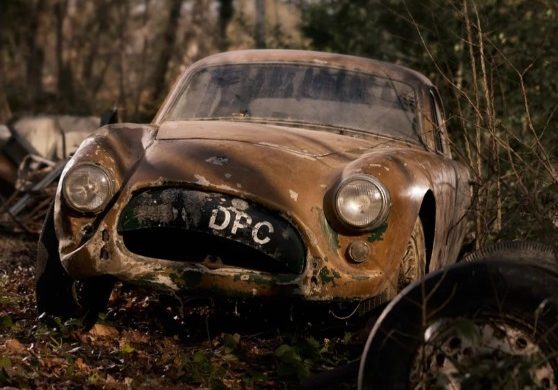
Oh, one more thing regarding price: the car is offered only to buyers who will commit to a full restoration via the AC Heritage arm of Brooklands. And it’s going to need it, because it was parked after a tangle with a Ford Ten in 1969, with no effort to repair the damage. By then, it had collected a cursory gold repaint, obscuring the factory Deep Chrome. Other than transport from the elderly owner’s lock-up, the car has barely moved and certainly not under its own power since then.
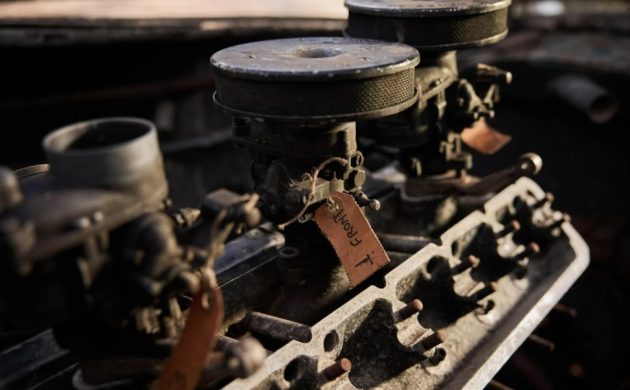
Speaking of power, when you go to buy an Aceca, get one with a Bristol engine, please. AC originally equipped its Ace and Aceca with its own engine – a two-liter six dressed with three SUs, good for about 85 hp. Nice, but it took ten seconds to attain 60 mph. The free-revving Bristol engine was developed from a prewar BMW design. Displacing a few ccs less than AC’s own six, it still produced 125 hp in factory tune, but was capable of much more. The Bristol motor’s unique valvetrain has one cam in the block acting on twelve pushrods arranged vertically on the intake side, and six horizontally on the exhaust side. Though this engine is the car’s original block, it’s been open to the elements for all this time and will need careful renovation. The car’s history includes at least some preparation by Ken Rudd of Ruddspeed: it retains twin fuel filters, a hand-painted cowl still emblazoned with “DPO”, and a period cut-off switch.
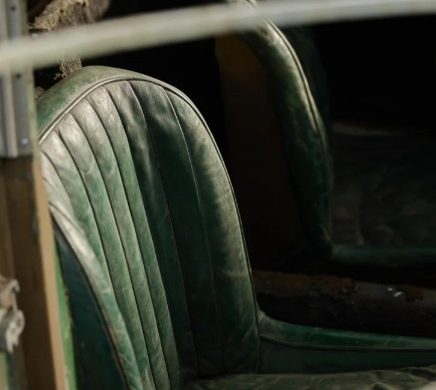
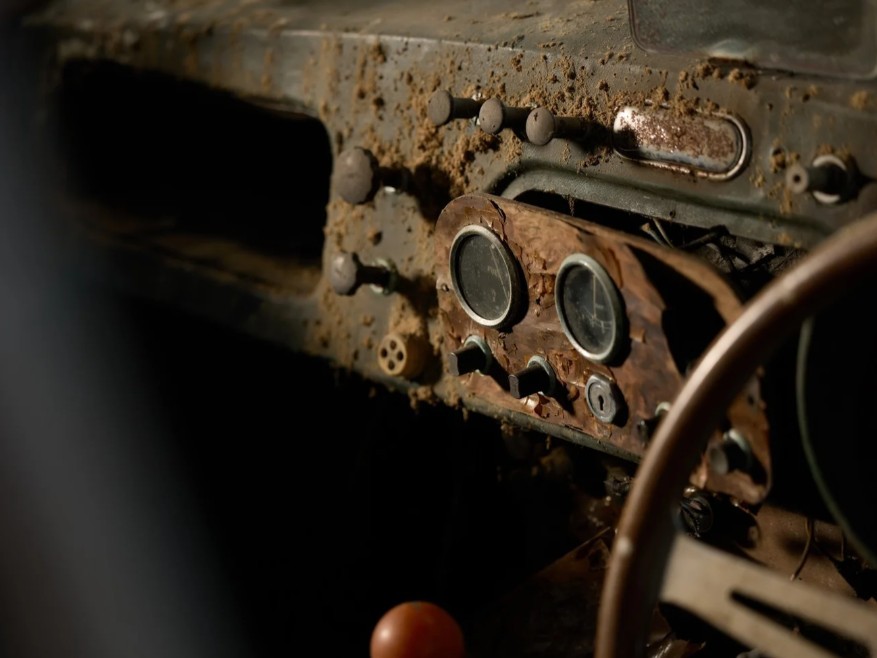
The seats, still clothed in their original green leather, are weirdly well-preserved, but the instrument panel is a mess! Once the cabin is restored, the owner will enjoy the synergy between its ergonomics and the car’s engaging performance. The Bristol engine growls – a distinct note unlike your typical British engine – and the car is quick in each of its four gears. Braking is no problem, with discs in front starting in ’57. Independent suspension is another ingredient contributing to the Aceca’s race success.
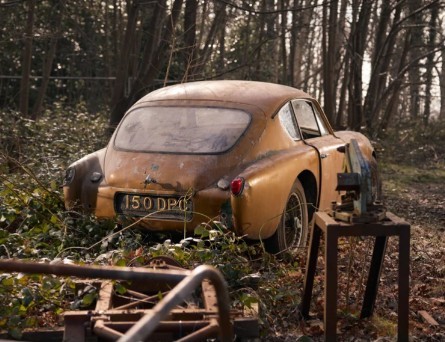
About that race provenance: this car placed 14th overall at the 1957 Tour de France and sixth in class at the 1958 Monte Carlo Rally. It raced the Tulip Rally, as well as Pau and Full Sutton. Only 328 AC Acecas were made, and precious few can boast this provenance. This car’s new owner will own a very special example indeed.




So, in other words, it’s not the estate selling it, it’s Brooklands, and will only sell it if they do the restoration. Maybe they are the best at it but kiss my a$$. If you’re not going to sell it just because you don’t get the restoration, then restore it and sell it. Otherwise, it’s just another garage wreck. My brother had an Ace and restored it in CA and it was beautiful. Just my opinion, of course.
$$$$$$$$$. I just keep hearing that cash register sound. Absolutely a incredible find! AC Acecas are elusive rare finds to begin with but this is over the top. Its just mind blowing that a car like this can stay hidden for so long. Good luck to the next owner, they will need it. On a side note, I would rather have an AC Ace or Acecas over a AC Cobra.
I agree! I, too would rather have an AC Ace over a Cobra. The problem today would be than when someone (unknowledgeable) would look at it, they would say, “Nice Cobra!”
Splendid writeup, Michelle. What a find!
A pinnacle European barn find Michelle and terrific research on your part as always.
A fascinating piece of obscure automotive history surfaces again, hopefully to be seen at Goodwood some time in the near future.
pretty close to the gullwing or bevHills car club business models. All have a variation on that theme – how to wrench (get it?) every penny oudda customer.
As any who knows I’d say: 1. the style is perfect (windshield rake, short aero deck, longer hood, FB/lift back. 2. I skip sales or dont pay for provenance (ephemera, coins, stamps, cars or anything else). So a triple pass here to a great looking design. May (if curiosity builds) try to research the motor/other mechanicals).
Another excellent writeup, Michelle!
If anything, you’ve understated the Aceca’s beauty. I remember seeing a couple in California many, many years ago, and wishing Carroll Shelby had Cobra-ized such a refined and well-executed design as an addition to the roadsters.
I do suspect Mr Gray knows full well how much a full restoration will add to the Aceca’s price, and it won’t be pocket change. Pretty sure if he thought it would not be more than a buyer would pay, he would have undertaken it and sold the car on afterwards.
I don’t remember when Ken Rudd was doing Ruddspeed conversions on Bristol engines, but I suspect it was after 1957. He also did six-cylinder English Ford and Austin-Healey modifications, which added considerable power.
I wish I had the dosh to bid, though.
I´m also a bit surprised that Rudd worked on Bristol engines, only associating him with Ford-engined ACs. Maybe Rudd was the supplying dealer in this case?
Some AC people would say the Ford is the best combination in any case, being more modern and lighter than the Bristol engine, giving more power for lower maintenance costs.
Agree that the Aceca is a beautiful car, one of those which looks better today than ever it did in the 60s.
It’s yours to own – ONLY if you do what we want you do to with it….Hopefully some millionaire with money to lose will win it and restore it.
Apparently Mr. Gray isn’t smitten enough to purchase it.
So which engine is this, the BMW-derived six or the Rudd-headed Brit? This guy is fishing with great bait, hoping to catch a sucker.
The Bristol engine is, to all intents and purposes, a copy of the prewar BMW inline-six that was built by the Bristol Aircraft Company.
IIRC, all Acecas had the Bristol engine, though AC roadsters were fitted with English Ford sixes when the Bristol engine went out of production.
All Acecas in ’53-55 came with the AC engine. In’56 the Bristol powerplant became an option…and as of 1961 a handful (I believe six) Acecas were fitted with the 2.6 Dagenham Ford six by Ken Rudd, optionally.
I cannot justify anyone leaving such a rare race car uncovered and especially unprotected underneath. After some damage i had left my X1/9 covered but on bare ground in wet and cold Northern Greece for a few years but later on it was obvious that the proximity of the wet ground underneath did some damage despite personally applying a layer of expensive antirust agent when brand new. Attention required. Very good research Michelle.
Has anyone asked you to justify it?
None of us know the story of the car’s owner, or what life dealt him.
No one has asked me to justify its sorry state nor that i need anyone to ask me. It’s democracy and i entitled in my own opinion especially when i see the PHOTO OF THE CAR and the writer clearly stating that “after a tangle with a Ford Ten in 1969 No EFFORT TO REPAIR THE DAMAGE, except cursory GOLD REPAINT (lines 17,18,19, 20).
Nothing about justification or the lack of it thereof, just a vintage cars owner feeling sad about this neglected relic of important races.
It’s not about justification, it’s about Democracy and the right of having an opinion after seeing the photo and the fact, as per the author, that there was “no effort to repair the damage” but instead it “collected a cursory gold repaint”. As a vintage cars owner, gearhead and ex-racer many years back, i was saddened by the car’s state.
(It seems that my 1st similar answer an hour ago didn’t made the cut, never mind whatever)
I agree with Rick in the opening post.
They don’t want to sell it outright, because somebody might not restore it after buying and it may sit somewhere (not that sitting 56 years isn’t already significant), continuing to rot.
Were I interested in this type of vehicle, I would want to know the price before I bought it, and I would want to know what I am in for as far as restoration goes. By telling me who will do the restoration and how it will be achieved whilst giving carte blanche to the restorer gives me the impression that both the purchase and restoration will be unreasonably high.
I can’t imagine anyone who would buy a vehicle under these conditions. If they truly want to restore it, they should do so and then sell it POA if they like. If it is as valuable as they indicate with their evasive and restrictive sales strategy, surely someone would be interested in their finished product. However, it sounds to me like Brooklands isn’t convinced, hence the strong arm tactic. In this case, it is better to be the seller than the buyer.
A good write-up on an interesting vehicle nonetheless.
The reason they are doing it on someone else’s nickel is because they would be seriously under water even getting the work for wholesale and in addition to tying up a big chunk of money they would be at a loss at the end of the day.. This way they can make money flipping the car as well as doing the resto on a blank check. It’s likely going to be a labor of love for someone who has money to burn and wants something unique.
Telling Brooklands Cars how to run their business is hilarious. This company, for all intents and puposes IS AC Cars today, they are the UK “Go To” company for classic 50s and 60s AC sports car restoration. It would be the obvious place to restore this car but in any case, Brooklands Cars owns the vehicle and can sell on its own terms.
There is a price, it is POA. All you have to do is ask…… which should also lead on to a discussion on the cost of restoration.
In terms of restoration costs, the best you will get for any restoration of this scope at any level – Triumph Spitfire to Bugatti Ventoux – is a quote which will always be less than the final cost. This Aceca is obviously a historically important car with provenance which will gain access to the Tour de France and other top events. That also has value to someone wealthy enough to inhabit that world.
So this car will be a sensible proposition to a commited AC collector with deep pockets who wants a no questions car with quasi works restoration.
For orientation, Brooklands Cars are also offering a lovely Aceca-Bristol in fine driving condition for 110,000 GBP. Compare that with an ACE or early Cobra and the value of the Aceca is clear to see but I´d expect the Tour de France car to cost at least 3 times that price.
Thank you, Martin. It’s nice to have someone knowledgeable to balance out the armchair experts.
And great writeup, Michelle.
Thanks! And thanks to Martin, too. AC Heritage/Brooklands is fortunate to own the car, and judging from the portfolio of restorations the company has completed, are the “go-to” experts in this field. The car will find a buyer, and any of us will be fortunate if we are ever able to lay eyes on the result.
What a car. Did not know these coupes existed. For the vast majority of us we are left to dream land to wonder what will happen with it. Someone with bottomless pockets will take it for sure.
Hopefully we will get see the restored piece in the future.
Just for reference this lovely car was somewhat recently restored in the UK for £315,000. Now seeing what it sold for I’m guessing if they were to give you the featured car, you’re likely to be upside down when finished. That said, who cares? life’s short :) https://rmsothebys.com/auctions/ch25/lots/r0015-1957-ac-acecabristol/
Interesting, James. Arguing against myself maybe, but the auction company describes the restoration costs as ‘staggering”. I agree 100%. The company quoted for the restoration turns out to be an expert rolling road supplier for historic racing cars, but makes no claim to being a restoration company. Strange, and maybe a good reason to have Brooklands Cars restore your classic AC!
Agreed. If Brookland is willing to make a fair profit on both the car and restoration then someone will gladly step up I’m sure. Cars with this type of history don’t come up often unrestored. BTW, seems strange that the seats would be green, if my research is correct that deep chrome was a blue hue… maybe why the seats look better than the rest of the interior.