
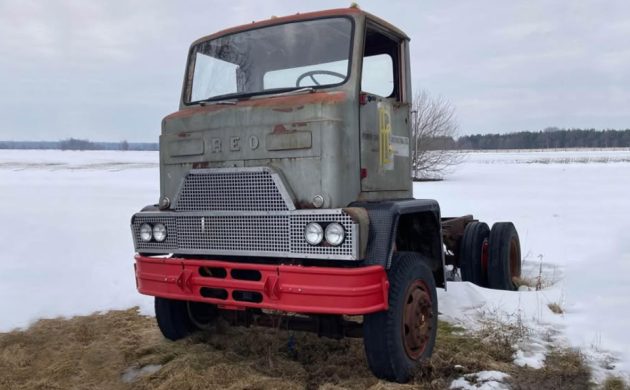
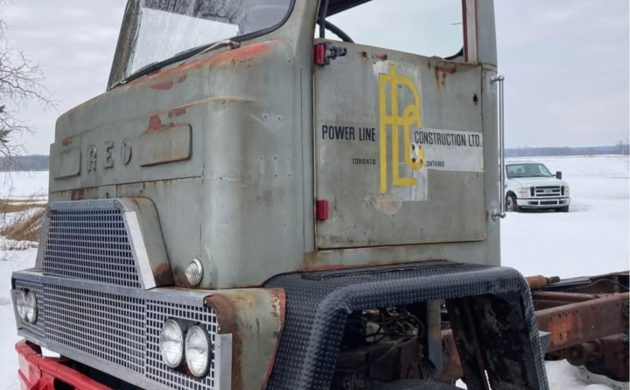
Heavy trucks from the early 1960s don’t surface often, and when they do, most have lived hard working lives that leave them rough, incomplete, or heavily modified. This 1961 REO Cab Over, currently listed on Facebook Marketplace in Dunrobin, Ontario, stands out simply because it still exists—and because it appears to retain many of the components that make trucks like this increasingly difficult to find. Thanks for the tip, TomV!
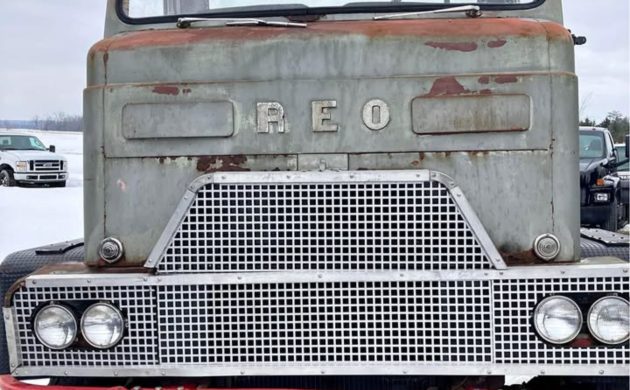
REO was already fading from the commercial truck market by the early 1960s, which makes surviving examples especially uncommon today. Cab-over-engine designs were built for function first, maximizing cargo space while keeping overall length down. As a result, many were worked relentlessly, scrapped, or repurposed when newer equipment came along. That reality makes this truck’s survival noteworthy.
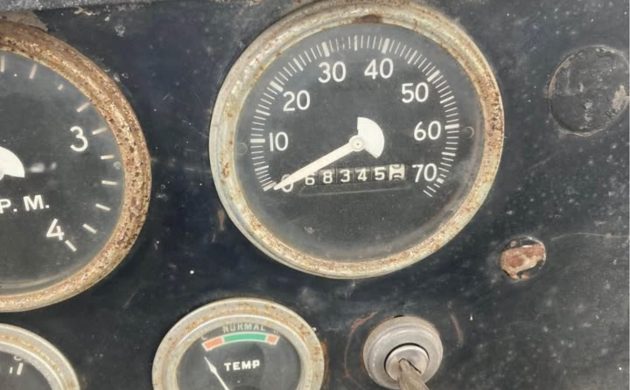
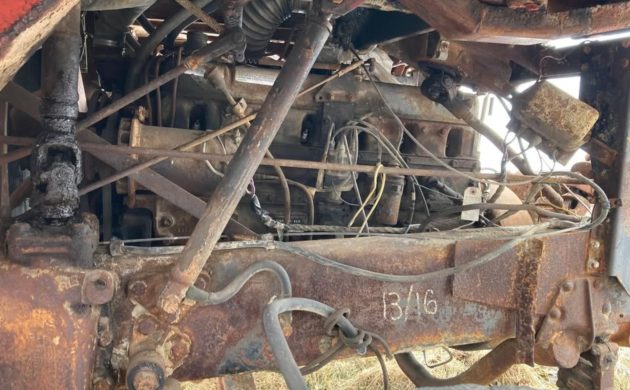
According to the seller, the cab is described as extremely solid, an important detail for anyone familiar with restoring or preserving vintage COEs. The truck retains its original inline six-cylinder engine, along with the original transmission and rear end, suggesting this is still largely a complete drivetrain package rather than a stripped shell. The presence of the original 12-volt splitter is another detail that will catch the attention of serious truck enthusiasts, as those components are not easy to replace once they’re gone.
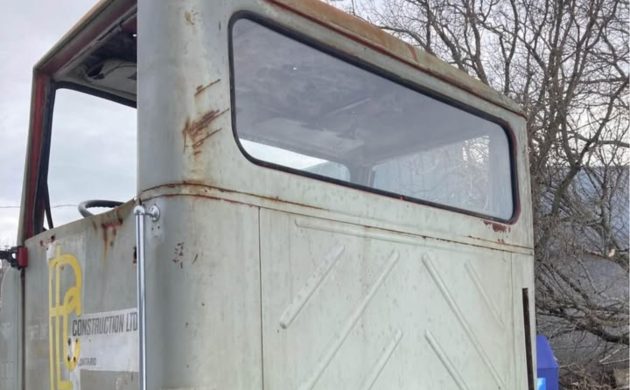
Glass is another area where many vintage trucks fall short, but this REO is said to include front and rear glass as well as the quarter glass, removing a major hurdle for a future restoration or preservation effort. While no claims are made about current running condition, completeness alone places this truck ahead of many projects that come to market.
Ownership paperwork is reportedly in hand, which is a major plus, particularly for a commercial vehicle of this age. Older trucks can sometimes come with registration complications, so clear ownership adds real value and peace of mind for the next caretaker.
At an asking price of CA$6,500, this REO seems aimed squarely at enthusiasts who understand what they’re looking at. It’s not being positioned as a finished truck or a quick flip, but rather as a rare foundation—one that could be restored, preserved as an industrial artifact, or thoughtfully repurposed depending on the buyer’s vision.
Cab-over trucks like this represent a very specific chapter in North American transportation history, when efficiency and durability mattered more than comfort or style. Seeing one survive in this condition is increasingly rare. The real question is whether the next owner chooses to return it to the road or simply preserve it as a rolling piece of heavy-truck history.


Ransom Eli Oldsmobile
*Olds
The “-mobile” was the marque, not the man.
Actually it was Ransom Eli Olds. Oldsmobile was the car company he founded.
First off, I just want to say what a fantastic fine Tom V. And Elizabeth thank you for writing it up, great job, and I appreciate all yout research too. This was most certainly not a cabover you’d see every day. And quite frankly, I don’t remember ever seeing one of these. To me at least this Cabover REO looks very solid, and has a lot of what I’m sure would be hard to find bits and pieces. It would be great to see this old workhorse restored. Thank you again for writing this one up. It was a treat!!!
Over the years I’ve seen a lot of COE trucks but REO is one I have yet to see up close and personal. Saw quite a few conventional units, especially the late 40s/early 50s versions. By the time I was outgrowing crayons the venerable REO was being taken over by other builders.
Not sure what powers this truck but I’ll guess it to be a Continental 22R (501 CID) or an R6572 (572 CID). I know that International used an R6602 (602 CID) in its larger gas-powered post war trucks, and it looked similar to this one. Never been in a Continental engine larger than 331 CID myself, and that was a flathead six that was an enlarged version of the F226.
This would be a challenging restoration without question. But it could still be possible. You would need to be dedicated to the cause plus have a good machine shop at your disposal. I knew such a man but unfortunately he met with an untimely demise at the London-Brighton Car Rally back in ’19.
It’s so sad that good things and good people never last…
Geo, first off, I truly am sorry for the loss of your friend. It hinestky does seem like the Good Guys ( and girls) we lose too quickly many times.
And secondly, I’m no expert here by any means, but I’m going to say that if a gentleman like Geomechs hasn’t seen one of these up close and personal…… This is indeed one rare truck!!! Lol. I always enjoy learning from you Geo. ( Seriously, you NEED to write a book lol)
-Dave
Were you responsible for his death?!
No, elchinero, I had nothing to do with it; he was there and I was here. Ron (his name) and his wife were motoring around in his 1903 Knox when they misread their map and wound up on the motorway. They were looking for the exit when a big truck hit them from behind.
The driver of the truck was found completely responsible as he was texting at the same time…
REO made their own engines, so it is possible that the engine is REO’s own.
That’s interesting. And it isn’t the first time I heard that. Myself, the trucks I worked on were conventionals and mostly older than this. I did get called out to sort out electrical systems and a frozen air system…
geo, I’m not on Facebook, what’s the transmission options in these neat trucks ?
I’m going to slant towards a Spicer 5000 series. Maybe a 6000. Sometimes hard to tell, especially in a COE…
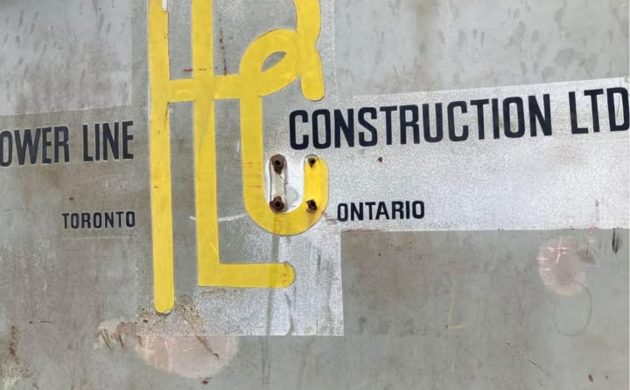
Okay, Howard, welcome aboard, you’ll be taking the cabover, take some tools with you,,:0,,Howard, where are you going? ( sound of Jeep tires squealing on gravel) No lie, I’ve driven not much better, just not too far. Models are confusing, but this is either a DC403 or a DC703, and both featured the Gold Comet in-line 6, “Tilt-cab” and a replacement for the V63 single headlight cabover that featured a gas V8. This truck was the beginning of the Diamond REO era, and while both White products, Diamond T and REO remained separate makes until 1967. I’m not entirely sure what is meant by “12V splitter”, the 2 speed axle? In the early 60s, there was a device that switched the 12V tractor to 6V trailers, as many 6Vs were still around. That was called a “splitter” I think. Believe it or not, REO was a very popular trucks. Not so much for the cabover, as REO had a more off road following. I never saw a REO cabovers like this either. Even more rare, is a FWD cabover that looked like a big window air conditioner. Not entirely sure what this truck was used for, being a utility company, rest assured, it didn’t go far either. I doubt it was a road tractor, and more likely a straight job as an equipment hauler. It’s a neat find, got a snowballs chance in Hades for any sale, might be useful as a sign holder,,,,great find.
Looks like a 2-speed axle to me
Don’t know about a 12V splitter either. It makes me think of our B-61 Mack (also 1961) that came to us with a ‘series/ parallel’ switch. It used the two 12V batteries in series for a 24V shot to the starter, then reverted to 12V in parallel for running everything else after the truck started???
When I read about a 12V splitter, I thought about a Series/Parallel switch. I used to see a lot of them on diesel units but not very often on a gaspot, although they were used in the larger applications…
I wouldn’t want to see this rig coming up fast in my rearview mirror on a lonely stretch of highway.
Stephen King should write a short story about this truck.
East of Omaha?
WOW! Got to admit I’ve never seen a REO coe of this vintage. Best I can tell it’s a DF400 powered by a Gold Comet 331, 331 cubes, 160hp, backed by a 6000 series Spicer transmission and an Eaton 2sp. Unusual, I think, to run a relatively small gas engine in a truck this size when there was a 440cube 220hp V8 and diesel options. Doesn’t look like it would take much but a lot of scrubbing to get her back in shape. I like it! Wonder what they used it for? It’s not a tractor.
The 331 engines that I worked on were flatheads. I won’t argue that there might have been an OHV version out there in later years (like the early 60s); I just never had anything to do with one. For this I tend to think that it was at least the 501, which was used alongside the IH RD501. Need to see some numbers…
I can only tell you what my Motors Manual and Gold Comet sales brochure for that series engine tell me. What you’re probably thinking about is the Continental 6-371/6-427 flatheads.
You’ve got more information that I have on that, Jim. For the engines I worked on my customers supplied the manuals/specs. I always wanted to get them and duplicate them but sadly they passed on before I had that chance. The information obviously got turfed. Frustrating…
Found a picture on Curbside Classics from years ago of a 1952 Reo F22 that says it has a 331 OHV, and the pictures match.
Well, I stand corrected.
After looking at the photos again, it appears I made a mistake that no one caught (not that they would know what they were looking for), so I’ll fix that. (auto-correct?) That’s not an Eaton rear but a Timken(Rockwell) 2sp, double- reduction rearend. I also see the driveshaft lying on the frame.
Okay, I hope this works,,,it seems the large trucks are always these dilapidated forgotten hulks, and viewers wondering if that is the best representation and sunk to new lows, while we see pristine Lambos, Vettes and such,, well, I hope you print my latest tip, and Ms. Rand, I’m looking your way ( Machinery Pete ad), a 1984 Peterbilt 359. Now,,,,there were all kinds of nicer Petes, but I figured since the name is BARNFINDS, and not “The Truck Paper”, I figured a farmers Pete IN A BARN, would be appropo.
Staff: I’m not one to beg, but please write that Pete up, so folks can see what real class was like in 1984. I’m 10-10, on the side,,
cool looking truck. great yard art
My knowledge of heavy trucks is limited to a National boom truck licensed @ 30K and how far you can push it over the tipping limits. Mostly crane operating.
I’m always impressed by you BFers and your superior insight into all vehicles.
I really enjoy seeing these heavy trucks and equipment that come across here.
Thanks Elizabeth and TomV…keep em comin!
Just a,very different cool old truck. Most likely, (since it was a, utility company) originally a flat/stake bed body. And since it’s gas and not diesel, as Howard said not for long hauls. Just for running supplies back and forth. Now me saying this is not earth shaking as I’m not a big truck guy. But I have never seen one of these before. My opinion of the” Style” is that it’s very utilitarian/industrial looking.
I used to drive old rigs like this in the 70s. Business owner was CHEAP and skinned fleas for shoe leather. On rig was a COE Mack 1961 or so. It had a split axel ( 2 speed) that was stick driven. The bosses son drove an Int. gravel haller that activated a Spicer 2 speed using a switch on the shifter. Worked so much better than 2 sticks in the Mac!
The REO Gold Comet engine came in several sizes, Used in REO trucks from the early 50’s thru the late 70’s by REO, Diamond T(from 1959) , and Diamond REO. REO designed and built this cab in the middle 50’s and White Motor dropped it in the early 60’s as by then White had the Diamond T 931 cab to use as their COE as well as the White 5000 series (similar to the REO) and the 7400’s. Here is a picture taken in2013 of the one Roger Gerhart owns and is shown in one of his sheds in Lititiz PA. I think he has had it at the ATCA National show in Macungie a few times?
Hey Brocky, the Gold Comet engine series offered three 6 cylinders a 255, 292 and the 331 which was rated at 160hp, these also an LP option. There was also the Gold Comet 220 V8, 220hp from 440cubes.
Here is an early 60′ REO cab over that replaced the one in this topic which is actually a Diamond T 931 badged as a REO during the time White Motor was building both on the same assembly line in Flint Mich.
Hi Brocky, we sure are cut out of the same piece of tarp, as mentioned, UPS used Diamond REO cabovers in the 70s, very similar to what you pictured. It was right when I started trucking, and remember them well. They were some of the only trucks that UPS retained the DR logo, as was the practice of UPS to remove all trucks names. Many of the drivers refused to give them up, and remember UPS yards with the “all-new Astros and Macks”, and a lone Diamond Reo. I’d guess the truck you show, may have been a “surplus” UPS truck, as UPS were the only ones I remember with fog lights and that sander by the rear axle. While they may have gotten the truck used, that wagon, a 40ft(?) Kentucky, was pretty new, and I’d say that pic was taken in the early 70s and not sure UPS ever had a sleeper, they were great trucks.
“the same piece of tarp”, rough around the edges and flapping in the breeze? (sorry Howard, I just couldn’t resist! HA!)
Howard, those rear axle sanders were fairly common on New England single axle tractors from the 60’s. I worked for a freight company based in NH and had a 68 ‘GMC single that had them (they never worked anyway). We would have air-shift rear axles vs. the electric shift because they weren’t prone to corrosion. Since we didn’t have air-driers on those old beasts, on near zero winter days, you had to use a propane torch on the fittings to somewhat thaw any ice in the fittings. The only thing better was to be lying on your back using a road flare to thaw out trailer brakes. Something the auto trans., flip-flop crew won’t have the opportunity to experience. Too bad…..
That is a great image Brocky!! Love it!!! And that Reo has a sleeper too.
UPS ran REO’s out of the Shrewsbury, MA break-bulk terminal in the early 1980’s. They drove those things into the earth after countless re-builds. It was hard to get real close to them, because the dudes driving the “feeders” rarely stopped.
Having done business with UPS in the past. (selling them replacement parts for their delivery cars. what they called the trucks that do the local delivery) NOBODY in the vehicle fleets pinches pennies more than UPS. The average life of a delivery car is close to 30 years. However, they never hesitate to spend money on repairs. It’s ALWAYS cheaper to repair. And that’s their internal moto. So Ablediver, you are so correct!
Wayne, thanks for the agreement. When the “feeder” drivers would literally run into Dunkin’ Donuts, us guys sitting at the counter would bust their chops about their ‘clocks’ (tachographs) catching them ! As far as me being “so correct”, call my house, you’ll get a different opinion (LOL)
We called tachographs “Stool Pigeons.” I had a fair number of drivers ask if there was any way to disable them. I said, “Other than ripping them out and driving over them, not much.”
I rarely drove a truck with a tachograph, most I had were speedographs,kind of the precursor to the modern ELDs of today. They had a paper disc inside recording the time and movement, and had to be turned in everyday with your paperwork. Many “discussions” resulted from those. We called them the “tattle tale”( and worse) and aside from a good zeitz, not much could be done to cheat them. I knew of stories told around the lunch counter, some guys said they would drill a small hole in the face @55 and insert a pin restricting the movement beyond 55, and hammer down. However, most trucks I drove didn’t go over 55 anyway, so no big deal. I knew a guy that drove for Cornflakes( CF) a cabover FL, 250 Cummins, 7 speed, an air pressure gauge, a speedograph, and a red light for coolant/oil press,,that was it.
The cracker box cab a few manufactures made them it looks close to the old Dodge with cracker box cab
Howard I am NOT disagreeing with you. This picture of the Avon Sole REO came from Jeff Lakazcychak, The moderator of the “What Am I??” section of the Just Old Trucks website. I believe this picture, and the truck, was taken in the very early 60’s and it is a REO. From 1960, when White closed the Chicago Diamond T plant, to May 1, 1967 White Motor built REOs, Diamond Ts, White 2000s, and special order heavy duty Whites all on the same assembly line in the REO plant in Flint Mich. There could be 3 identical trucks come down the line and go out the door as 3 different brands!!! May 1, 1967 is when White Motor combined REO and Diamond T and created the Name Diamond REO. The Diamond REO’s that UPS had (with NO sleepers) were built after this date, and YES UPS had a lot of them.. I remember seeing them in Ohio well into the late 90’s.
Ablediver, the same in my house. Thank God, I’m on the downward slope of completing our new house. It’s been a long 3.5 years! You move slow when you are over 70 years old.
The Dodge L-1000 COE built later looked close to the REO