
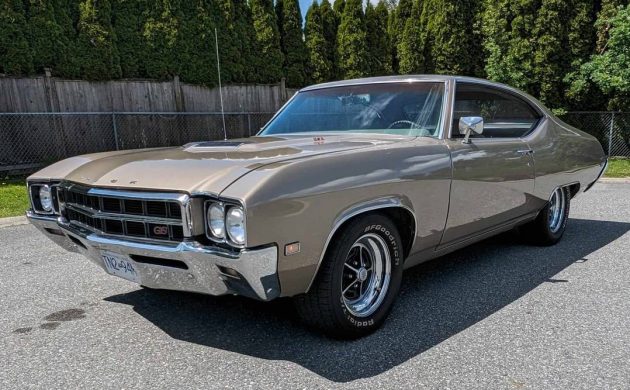
Rarity claims are not new to us at Barn Finds, with some easier to confirm than others. That brings us to this 1969 Buick GS 350. The seller claims that it is 1-of-70 produced with this paint and trim combination, and although I have found no information supporting the claim, I have also been unable to dismiss it. Its condition is excellent for a classic of this vintage, and I must say a big thank you to Barn Finder T.J. for spotting the Buick listed here on Craigslist in Mission, British Columbia, Canada. The seller set their price at US$28,995.
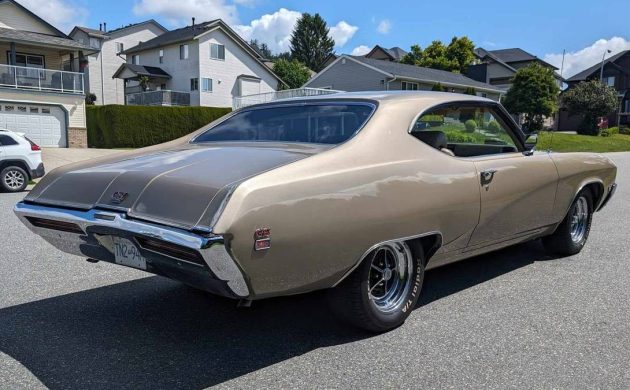
Buick unveiled the GS 350 for the 1968 model year, with this second-year example leaving the line in 1969. Its Champagne Mist Metallic paint shade represents the first piece of the puzzle that makes it a supposedly rare beast. The seller confirms that the vehicle received a repaint in its original shade in 2010. The lack of cosmetic imperfections suggests that it has been treated with respect, as there is no indication that this classic has been abused. Chips and scratches appear non-existent, and the panels are as straight as an arrow. Rust isn’t a problem, with this car’s cause helped by the fact that it spent most of its life in California. The trim and glass look flawless, the Rally wheels sparkle as beautifully as the paint, and the functional Ram Air hood forces plenty of cold air into this Buick’s V8.
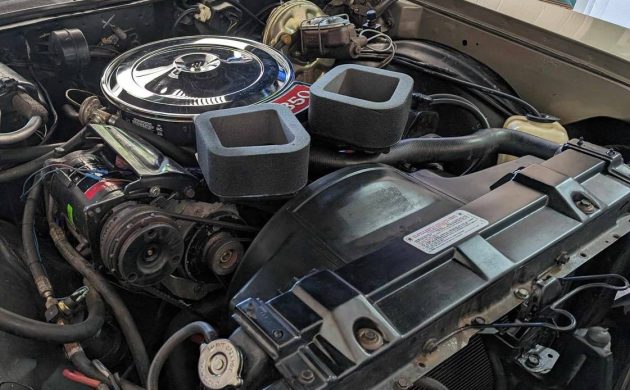
As the model designation suggests, this Buick is powered by a 350ci V8. The Dealer Specification Sheet quotes power and torque figures of 280hp and 375 ft/lbs for this motor, which feeds to a 10-bolt rear end via a three-speed Hydramatic transmission. Those seeking an effortless driving experience will welcome the first owner’s decision to order this GS with power assistance for the steering and the front disc brakes. It is fair to say that while this Buick would have played second fiddle to hardcore muscle cars in 1969, its performance would have satisfied all but the most hardened enthusiast. The seller confirms that this GS 350 is numbers-matching, a crucial consideration when evaluating its future investment potential. It is disappointing that the seller supplies no information regarding how this classic runs and drives. However, they provide a link to this YouTube video. It includes a pretty comprehensive walkaround with the V8 rumbling in the background. Most readers who check the video will agree that the motor sounds as smooth as silk.
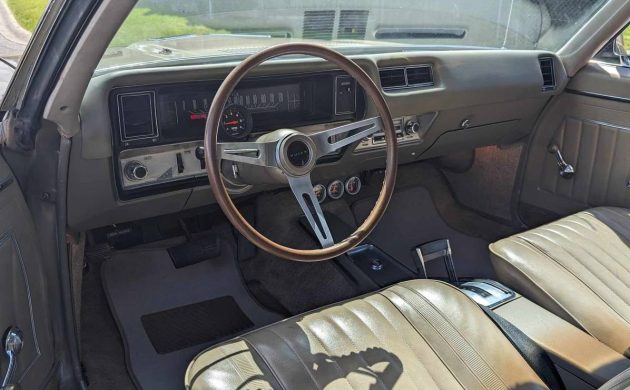
The interior images supply the second piece of the puzzle surrounding the seller’s rarity claim. Trimmed in Buckskin vinyl, they state that only seventy of these classics left the factory with that trim accompanying Champagne Mist Metallic exterior paint. I spent considerable time researching that claim for validity, but haven’t found a definitive answer. However, those with plenty of time on their hands might have better luck than I. The interior presents well for a classic of this vintage. The vinyl on the front seats is slightly stretched, although there are no rips or tears. The pad hasn’t succumbed to the Californian sun, and the plastic is excellent. The seller upgraded the factory radio to receive AM and FM, adding a column-mounted tachometer and additional underdash gauges as the only modifications. However, with air conditioning, bucket seats, a console, a sports wheel, and a rear defogger, life aboard this Buick should be pretty pleasant.
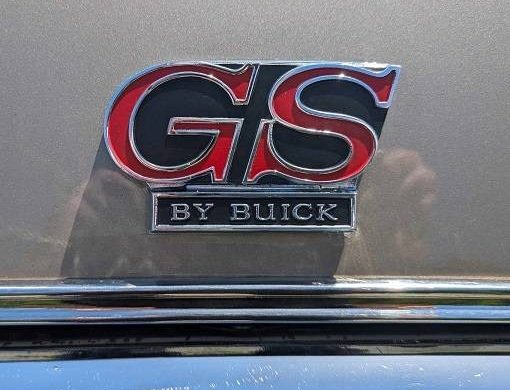
The Buick GS 350 found its place in the market in 1969, with 4,933 buyers splashing their cash to take one home. That figure almost doubled in 1970, with the GS 350 remaining a reasonable seller until production ended in 1975. This 1969 example appears to be a gem, and if potential buyers can confirm its rarity claim beyond a doubt, its value will likely increase in the future. Hmm, rare, plenty of power, and an appreciating asset? I can’t think of one negative in that scenario. Can you?




Nope.. nothing negative here. Beautiful Buick and GM knew how to make and style there cars. I remember being a teenager and sitting in the passenger seat the person i knew then, just planted the go pedal and saw those tires just smoke up!! Can’t remember if it was a 350 or 400….I saw the video the seller has. That engine sounds sweet. I can picture myself sitting behind the wheel and having a Grand time!! The older I get i really appreciate all vehicles back in the sixties and early seventies. 60s had style and sounded great. The 70 was losing a lot of it after 74. I hope the next owner will really appreciate what he or she has…. BUICK GS!!! 🐻🇺🇸
Have always loved these cars and this looks like a great deal.
Someone save this car from BC before it rusts!
These bring back memories. I bought a base model ’68 somewhere in the early 80’s with a blown 350. Found a totaled Pontiac GP with a low mileage 400 4 barrel and turbo 400. Got GTO motor mounts and slotted that thing right in there. Dang, we had some fun with that car. This one looks beautiful, but not in the cards for me right now.
Back in the late 1980’s, I bought a 69 Skylark convertible from a fellow BCA member pretty dirt cheap (somewhere around $500 IIRC). It was a real rust-bucket, but I knew that, and he told me exactly that beforehand. I had 2 questions for him. Can I drive it daily? Does the top go up and down? When the answer to both was yes, my answer was SOLD! Had a lot of fun with that car that summer – get out of work, and down goes the top. That fall, I “treated” it to a quicky “body work” (meaning patch in a couple of pieces of steel and lots of bondo), and a cheap paint job. Sold it for about twice what I paid for it, plus the cost of the “body work”. Did the same thing my friend did – told him it was a rust bucket and cheap body work. It looked good (way better than when I bought it), and he didn’t care. I can imagine how great it would be to drive this GS, even if the top doesn’t go down.
looks great. these colors really work and appear to be nicely done. 68/69 are you love them or you don’t. had a 68 400 sucker would really run. i would find some factory Buick mats for it.
My best friend/college roommate bought almost this exact car in 1972 to take to college, except it was emerald green with a black vinyl top and interior. I was driving a 240Z, but it seems every time we went somewhere, we took the GS. It was roomy, comfortable, fast and fun. Gas mileage was not great, though, and gas prices were going up fast back then. He eventually traded it in for a 1974 Opel Manta. This looks like a really nice example. If it were green, I’m sure my friend would be seriously interested. Good examples of these models in any color are hard to find.
Listing actually says $38500 or “may trade”. It’s sure a beauty, checks all the boxes for a driveable classic.
I’m figuring that is Canadian Dollars. If I were to buy this I would pay the 38.5K in Canadian, which is $27,395 U.S. right now. Nice 1.5K discount.
There is a ski mountain in Vermont named Jay Peak. They would take Canadian Dollars at the same value as U.S., so we used to stop at a local bank on the way there and convert into Canadian. Back then, it meant a 33% discount on ski passes. Nowadays, they have changed it to having proof of Canadian citizenship before they accept the money.
100 % no negatives, well there is one! I don’t have the money.
Absolutely beautiful GS. Rare or not, its a great color combination. If theresanythinh wrong with it, I’m not seeing it in the photos. Really nice. Thanks Adam, great write up.
Great looking car that you don’t see to much…..
I drove one of these (1968 model GS 350) after driving a GS 400 in 1970. Why would anyone want to buy a new Grand Sport with a 350? The 400 (401?) was a fire-breather. As a Skylark, it is a beautiful car. As a GS, it is a nice preview of 1973, when muscle cars couldn’t get out of their own way. I ended up buying a Cutlass convertible with a 350 4bbl. It was a wonderful car, but I didn’t delude myself into thinking it was a 4-4-2 (even if GM had riveted a 4-4-2 onto the side of the car like they did in the mid Seventies). That 350 engine was a spunky, reliable, engine but it was not fast. Later, I bought a 1974 Buick LeSabre Luxus convertible. It had a 350 4bbl and could not pull the fluff off a dandelion. But it ran forever – admittedly at about eight miles to the gallon. My 1974 Gran Prix had a 400 4bbl big block and would chirp the tires going into second gear with an automatic. It also got about nineteen miles to the gallon – better than my three Cutlass 350 convertibles which got about thirteen.
Maybe because the insurance rate on the 350 was a lot lower? But I’m not sure if that was a big concern in ’69 as it became later on.
Maybe it was a lot cheaper than the 400?
Very perceptive. I think insurance cost was the exact reason for that. My annoyance at that GS designation is that it seemed quite misleading, if you weren’t a car guy and thought you were actually buying a Grand Sport, a designation which meant something as applied to Buick Rivieras and Wildcats. GTOs, 4-4-2s, and Chevelle SS 396s didn’t have watered down versions. They had differing carburetion and sources for air, but If you bought a low-end 1968 GTO, you got enough horsepower to impress even the most jaded twelve-year-old.
As a semi-sentient being in 1968 (I was 21) I recall this pretty well. The horsepower/muscle car fight for ascendancy had resulted in a tremendous payout of claims for insuring such improvident vehicles. Most of the drivers of these screamers were young and stupid, as was I. They drove like they were unkillable. They weren’t.
In 1969, I priced out a new Mustang Mach I with a 428 Cobrajet Ram-air engine and a four-speed manual transmission. If memory serves (it often doesn’t) this car, out of the showroom, did an astonishing 13.3 quarter mile at 108 miles per hour. Car Life magazine, a low-budget understudy to MotorTrend, proclaimed that car to be the fastest production car in the world in the quarter mile. I don’t know if that was true, but it certainly inspired me to want one very badly.
I went over the build sheet with the salesman and it priced out at just over $4,400 – roughly the price of an expertly negotiated entry-level Cadillac (and a third of the price of a lower middle class house in a decent neighborhood) at the time. That was discouraging, in and of itself, since I was about to become a teacher and Cadillacs were not a common sight on school parking lots.
For an idiot my age (under 25 was a magic cutoff), minimal car insurance on that track-melting muscle car was over $1,200 per year. A Quick look at the math of it and you can see that four years of insurance premiums would buy the car outright – including tax, tag and title.
When I amassed enough wealth (partially from having got shed of a wife whom I married in a flash of brilliance at age 20) to make payments on a new car, I chose an Olds Cutlass convertible with a 350 and a four-barrel. Even then, the first insurance company I went to refused to insure the car, calling it a sports car because it was a convertible. Insurance companies were as easily frightened as a herd of gazelles on the African veld in 1969.
Interestingly, girls were a lot more impressed by a beautiful Oldsmobile convertible than a Mustang coupe that rode like a buckboard but could shred its tires in one blaze of jackassery. This was a surprise to me, for reasons I will never be able to fathom. It certainly worked in my favor and I just pretended like I knew it all along, and that’s why I made my wise decision.
Even then, insurance rates, for anyone under 25, were a cause for missed meals.