
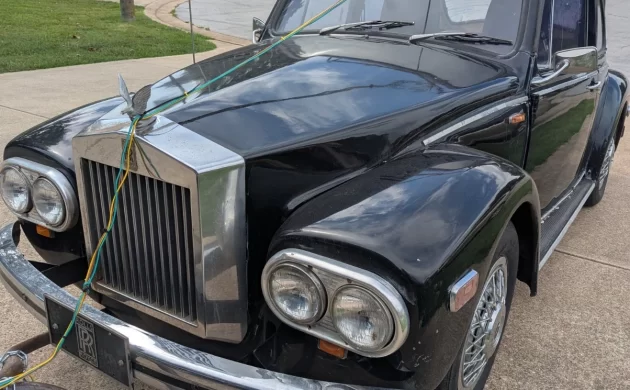
Looking back at modified automobiles offers you a sense of where culture and cars were colliding at the time. When Volkswagen Beetle owners began adding a Rolls-Royce front end to their German economy cars, it was clearly a means of having a little fun. We weren’t taking ourselves so seriously when it came to the have’s and have nots. If you were cruising in a Beetle, a Bentley was likely out of the question budget-wise, but you could give your homely commuter car a taste of the good life with a nose job. This 1969 Volkswagen Beetle listed here on eBay for $9,500 or best offer is a curious artifact from the past, and one that still draws a smile.
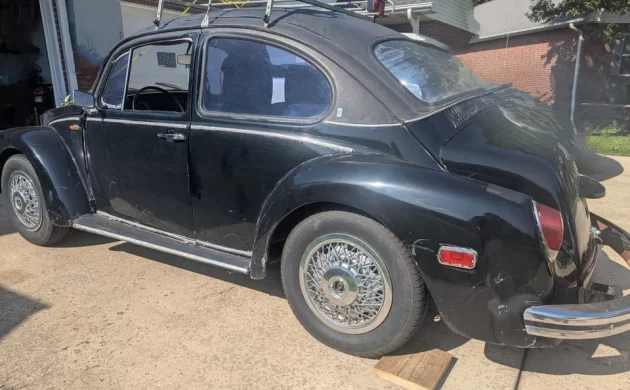
The Rolls-Wagen is also a terrific example of how this country has always been somewhat obsessed with looking like money even when you don’t really have it. We still see it to this day, with clothing likes meant to mimic high-end Italian brands, wheels that are supposed to enhance the “bling” factor of your humble ride, and big screen TVs to watch programming that looks the same on a 20-inch as it does on a 42. The Mini-Rolls is taking the rich aesthetic to a new level, however, especially when you consider how much money was spent to simply look rich, even when the one-percenters were likely snickering at this Beetle when it drove by.
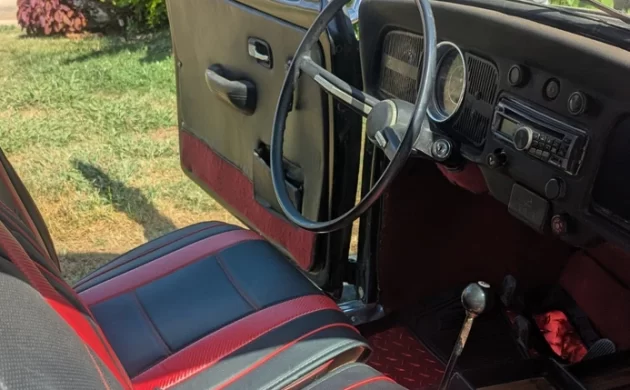
It wasn’t necessarily perceived this way when the concept was first introduced. The New York Times even wrote an article about the Rolls-Wagen in the 70s when the concept first began to gain traction. The article pointed out that for under $300, owners could have their humble Bug converted to a mini-Rolls, with one of the companies specializing in the conversion based in Brooklyn. At the time, the reporter didn’t make it seem like it was an attempt to appear wealthy, but more another example of how Beetle owners loved to customize their rides, starting with the flower-power era, migrating to the “Cal-look”, and now even a Rolls-Royce in miniature form. For what it’s worth, this Beetle appears to have a nicely upgraded interior with custom two-tone leather seats.
The seller notes that he bought the car off of the previous owner’s farm, where it did run and drive around the barn yard. It has a large tow bar on the front, which typically means it was pulled behind an RV. There has to be someone out there that remembers seeing this thing behind a Winnebago! The seller notes that it does have a few rust spots, including beneath the landau-style roof. It’s worth noting that the Rolls-Royce modifications are quite extensive, going all the way back to the trunk lid and wire-style hubcaps. When it was built, I’m guessing this whole job cost more than $250, but who knows – in Oklahoma in the middle 70s, $300 may have gotten you the whole-body treatment! Do you think these Rolls-Wagens are charming or an abomination?


I remember parts kits for these conversions being sold in the J.C. Whitney catalog, back in the day. RR style front ends, Continental style rear decklids, you name it.
Same here. I remember the JC Whitney catalog having these. I also remember the ’40 Ford coupe ones too. I actually liked them back then.
Reminds me of the Cheech and Chong movie Up in Smoke!
I was thinking the exact same thing! 👍
LOL, I was going to say the same thing!
They actually stole a real Grille in that one
Obviously these were meant as a gag, like those T-shirts that have a tuxedo on them. Ironically, somebody who could afford the equivalent of $2000 in today’s money on a sight gag for a Beetle was probably well above the median income.
These kits always looked like they may have had functional benefits, like extra trunk space or clearance for forced induction.
Between the general late 30s shape, the cuteness, and the fact that there were almost too many of them by the late 60s, you can see why people started personalizing them.
Man, you can barely tell the difference between this and a real RR.
I remember when these were common.
I feel old.
There was a ’40 Ford kit available also.
Do you remember the MG-TD replicas they sold to fit the Beetle chassis? For some reason, as a kid, I thought that would be cool. Glad that Dad poo-pooed the idea.
The great thing about the Beetle is that it wasn’t a unibody, so you could pop the body off pretty quickly and make it an MG, a Bugatti, a Porsche Speedster, a dune buggy, a Brubaker Box, a Bradley GT…and thousands did!
About 35 years ago, my wife wanted me to go look at a Morgan that was for sale. The “Morgan” was an MGTD Replica on a VW chassis.
I wrenched on a 1970 with that ’40 Ford Wunderbug kit on it. Looked great.
Since the rear fender’s bashed, I’d consider putting original fenders & decklid on it. The fun’s all in the front, anyway.
The ’40 Ford kit looked good, I thought!
I remember them but I never saw one as extensively customized as this. All I ever saw was the RR grille on the hood.
For this price, there are people unloading real Rolls’, desperate to get out from under the need to pay $1000 just to enter the repair shop’s property.
So maybe this is a deal?
VW parts are still pretty cheap and available, and you can do most work in the driveway, so yeah, that’s a fair case to make.
I have heard the Queen was niot amused.
Haha….nice!
The 40s Ford look are not only a tribute but a superb a real classic if carried through with fine detailing. Wish I had one. It’s sad here in Lincolnshire two barns are full of Beetles robbed of just their engines.
Something I’ve come to wonder about: could that nose be meant as a ’40 Lincoln instead? We all remember the Continental engine cover, and the Ford and Lincoln were similar.
Better call Vera or Father Brown.
The drivers seat upholstery is damaged in one picture but not the other….how is that possible?
Two different surfaces. The damage is on the actual seat upholstery, and then on top of that there’s a newer pad with the fat red stripes that only covers the bottom and back seating surfaces.
People seem to forget, the Beetle was a major sales success. They were everywhere, and the aftermarket saw how easy it was to modify that car. Manufacturing speed parts, then flaired fenders. Then unbolt the body and using this fairly new and cheap material fiberglass, building on, off road vehicles out of the durable little car. It was a crazy time.
I’m 58, I haven’t forgotten. And I used to get JC Whitney catalogs! One whole page of the general catalog was VW long blocks, and they had a separate book just for VWs. When I was a teenager, a guy in my apartment complex had a Speedster on a Beetle chassis–which, of course, wasn’t much of a stretch.
Ridiculouse – and destroying the ingeniouse design of the beetle.
As generaly with stuff like for example wire-style hubcaps – pretending to be something it is not – fakeness – I don’t like that.
As the most-produced car in history, letting a few have individuality isn’t the end of the world. And the design wasn’t that ingenious: almost anyone building a rear-engined car in the late ’30s would have come up with something a lot like this.
what a joke!
Was alcohol involved in designing & marketing this?
It needs one of those big revolving keys on the back to
make it complete.
No.
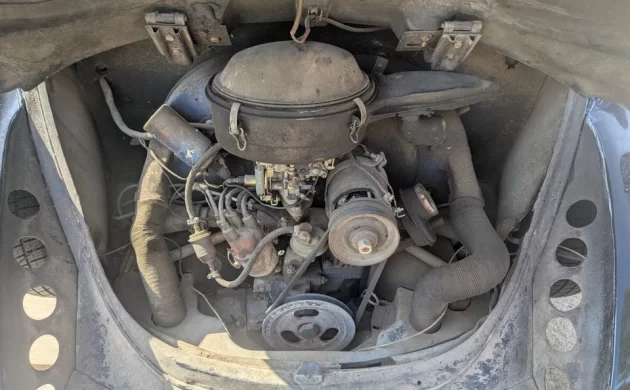
VWs were great little cars for what they were, certainly plentiful, but both ubiquitous and anonymous. And, as pointed-out, an easy invitation to modify and personalise. I think this Volks-Rolls is cute — one if the best realisations on this kit that I have seen, and well-preserved. But why did they not clean-up that humble engine bay?.
Today you can buy a real 70’s Rolls for the same price as this VW
How the mighty have fallen.
You don’t have to look very hard to find a 90s to early 2000s Bentley at this price, yeah. And if you don’t do just a little research you’ll end up upside down in repair bills. And then the maintenance bills start
Ïmmediately “Cheech and Ching Up in smoke” pops up for me seeing Rolls Royce and Beetle together :D
This conversion was silly back in the day. I’m shocked that any survive. There was one in my hometown that a college kid had and I had snickers every time it went by. I think the word oxymoron best describes this conversion.
Hitler didn’t design diddley squat! He mandated a people’s car and Ferdinand Porsche put together a design team to rip off Hans Ledwinka, Tatra’s chief engineer. Saying Hitler designed the KdF-Wagen is like saying Teddy Roosevelt designed the Panama Canal, or FDR designed the atom bomb.
Came here to say that, but you did it better…
Also worth mentioning that Hitler was in power for five years before the first KdF-Wagen was introduced to the German people. By then he had already re-militarized, taken back the Rhineland, put thousands of people in concentration camps, and was in the process of taking the Sudetenland and Austria and inspiring Kristallnacht, so a cheap little car that almost no one would end up owning was less than a drop in the bucket of Hitler’s relationship with his constituents.
I saw a documentary on Hitler and it said he designed the bug to help gain popularity and as he gained power he took control of another car company to build war machines. If that was wrong then I apologize for the misinformation on this one but it’s not the first time I’d heard that, it was also mentioned on a documentary about Stallin. Maybe I need to quit watching this crap on tv lol.
Things get simplified when you have an hour on the History Channel to fill. Both dictators wanted cars to help keep their people pacified, and Hitler had the benefit of a country with a lot of great engineers. The Soviets did a lot of copying, and after the war they packed up whole German factories and brought them home, too. But both Hitler and Stalin were too busy with crimes against humanity to get involved with the literal nuts and bolts of building cars.
Theres a lot more to the story about the VW, yes it was the peoples car and Hitler told his engineers to produce “a peoples car” very simple and utilitarian no radiator, the original used the same fenders front and back and the same panel for the hood and engine cover with a roll top roof to save metal, the dash only had a fuel gauge, etc.
However Hitler told the masses to put $5 a month into a booklet that was like a payment plan and after so many months they would get a car. At the last minute when they were to get cars , Hitler invaded Poland (I believe ) and his war effort put everything on hold and he literally stole the money for the war effort.
It’s funny that it only had a fuel gauge, because after the war, it took years to bring the gauge back. Yes the prototypes were recognizable but primitive.
Most everything on TV is crap.
I am the one guy who is actually considering buying it just to restore it back to a beetle and then make that kit fit something else
With all due respect, Troy, why go to that trouble, when there are plenty of unmodified WV beetles out there? But there were a limited number of these Volks-Rolls kits made, and fewer still this nicely finished. If you read my posts on this site, you see that I do not generally like modified cars: I don’t. But there is a difference between taking a surviving classic car, throwing mag wheels, oversized pipes, fuzzy dice, tufted bucket seats with a centre-console and racing steering wheel onto a family sedan or station wagon, putting-in a 5-speed floor-shifted manual transmission into a car which came equipped with a column-shift automatic, lowering the suspension, and replacing the powerplant with something monstrous rated at 475 horses, completely adulterating a vehicle originally and simply intended for everyday street use — as opposed to saving something that was done close to when the car in question was new, from a specific kit intended for that purpose. Part of the attraction, 40 and more years ago, for modifying a VW with a silly body-kit such as this, was to have something which was not just like every other one on the road. I am reminded of Levittown (whether the one on Long Island or the one near Philadelphia). Right after World War II, Mr. Levitt obtained sizeable tracts of land, one convenient to New York City, and the other close to Philadelphia (back when you still could find affordable land in those locations), and he mass-produced dozens of cute little identical tract homes along a winding maze of new pleasant little streets, setting a pattern for a highly affordable form of suburbia (cf., “Silhouettes” by the Rays and/or “Charlie, the Midnight Marauder” by the Limeliters). A young G.I., freshly home from the War, could buy one of these $6,000 houses, bring his wife, and have everything he needed to raise a family, within easy reach of all that these greater metropolitan areas had to offer. Because these houses were practical and identical, they could be built in the manner of an assembly-line, greatly cutting the cost.
But the essential problem with Levittown was the same as that for the VW: people prefer to be distinct from each other. Go back to either Levittown to-day, and no two houses look the same now. Not only are the trees tall and planted in individually-chosen spots, and fenced-in in-ground swimming-pools added in many cases; but the houses themselves have been re-modelled and modified and added-to, according to whatever pleased their owners as time went on, in most cases changed quite dramatically. The result are beautiful suburban neighbourhoods with ever-flowering variety and individuality — and a great many of us can’t afford to buy homes there now (smile). But their original design fit a particular need for convenient affordable housing in the American world of the 1946-1949 postwar boom. In that same time, Americans were willing to buy countless new cars in the style of 1942 — at least until there no longer was a shortage of new cars — then the makers had to change things to entice us into dealers’ showrooms. The Volkswagen also filled a need for a practical and economical second car in the 1950s newly-affluent economy. We loved them for how “cute” they were, and the money they saved us. But by 1965 or so, we were rather SICK of them, frankly. We still appreciated all that they did for us, and that the parts keeping our 1954 Beetle alive were the same as those used in newer ones. But we eventually took-out our frustrations over the sameness, by making kits for building comical little road freak-shows out of some of them. The car was still the same — but now it turned heads in dis-belief: it was a curiosity-seeker and conversation-starter. These kits were a labour of love in a narrow span of time, and only but so many have survived: they deserve to be saved and preserved as they are, not torn apart to restore a car such as this back to what it was from the VW factory.
Willingboro NJ, the third Levittown.
What else would it fit but another Beetle? And then why not leave the other Beetle stock, and this one as found?
Hitler already had the idea while he was in prison for insurrection back in the middle 1920-s. He was an absolute car nut. He commissioned Porsche to design a low priced, simple vehicle for the masses in the early years of his reign. Alongside of that, h ulting in a myriad of bikes from 38cc bicylemotors to 1 liter 2-strokes, 750cc 4 stroke boxers, award winning side car designs, massive bicycle productions, tremendous earth moving machinery, locomobiles, 3-wheeled delivery trucks, heavy duty long distance trucks galore, not to forget the Autobahn, a road network which inspired Eisenhower to built the American interstate system. I am not mentioning the
airship development (cut short via sabotage) and every technical thing anyone cares to mention. To claim that Porsche created an engineering team to ¨rip off¨Ledwinka is noot only incorrect, it is obviously maliciously dishonest. Porsche designed the iincredible Auto Union V16 race cars and was a persnal friend and college mate of Ledwinkas.
Well, I am maliciously dishonest more often than not…I recognize that Porsche was a very talented engineer, obviously, but with everyone concerned long dead, it’s fun to stir things up. And having designed the Auto Union Silver Arrows has nothing to do with whether the KdF-Wagen was his original design or not. I had a boss years ago whose biggest business rival was his own father; they were both crooked as hell. The dad’s motto was, “If you can’t screw your friends, who can you screw?” I know of at least one time that got him sentenced to probation.
About 15 years ago I was at a classic British motorcycle shop and they had a Beetle with the ‘40 Ford kit for sale.
No. The KdF idea was in the works for years. Heck, it can be traced back to the Hanomag 2/10 of 1925. Porsche, Tatra, Zundapp and I’m sure a couple others were working on the idea in the 1930s, and the prototypes from the different companies looked amazingly alike.
The H series Mercedes were similar too.
Confirms the old addage ”You can put lipstick on a pig, but it’s still a pig”.
Way back in the 70’s, we had quite a few of these, as well as the 40 Ford ones, cruising around our area. We always referred to the RR ones as the Rolls-Volks. They were so different at the time, that we all thought they were pretty cool. No one took them seriously–just something fun to do to the everyday Beetle.