

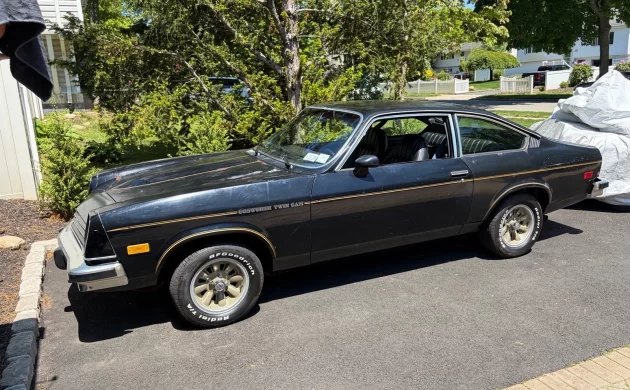
Some people buy one cool car in life, sell it too soon, and talk about it forever. Such was the case with a friend of mine and his mid-1970s Cosworth Vega, like the one shown here on ebay. If you are similar, and this happens to be your dream car, then grab up some money and hit the “bid” button right now. The car has sat at its opening number, just $500, for a few days. There are three days left to go as I write this. Note that the reserve has not been met. If you find the magic number, prepare to get to Commack, NY, to roll your prize away.
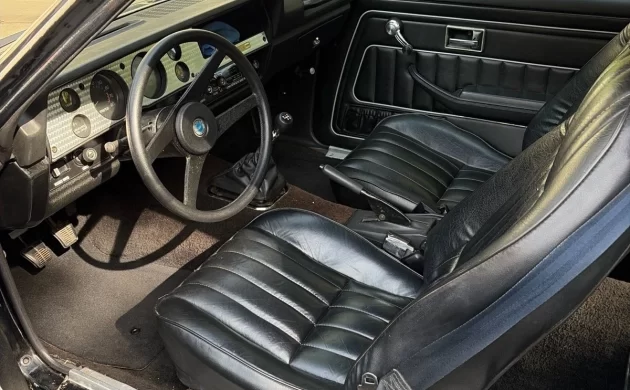
What will you be getting? A sporting little coupe that retains all of its original features. It does have 101,000 miles on the odometer, and the seller is realistic, saying that this is not a restored show car, but a drive-and-fix classic with upside for the right buyer. If you don’t mind kind of perished paint and rust at the bottoms of the doors, this could be a project worthy of parking in your garage while you fix it up. Before doing that, however, you might line up an information session with someone who understands the fuel injection system used to deliver the dead dinosaurs to the intake air, because the car, the seller says using varied descriptions, runs rich.
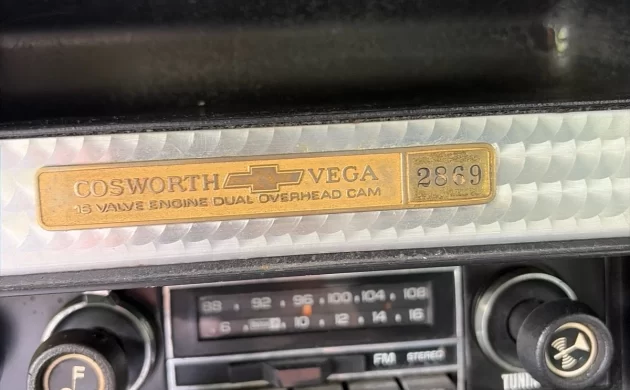
The Cosworth Vega is a classic turned out by Chevrolet after being dreamed up by John DeLorean. It was offered for only two model years, 1975 and 1976 and sold around 3500 units. Each one came serialized, the sequence number being engraved on a plaque which is affixed above the radio. The idea was that the car could compete with the best sporting offerings from the European manufacturers, like the BMW 2002 and the Alfa Romeo GTV. That never quite happened, though a niche following has existed for the Cosworth Vega from the get-go until now. The Vega itself, some will remember (and perhaps wish they hadn’t), was a compact car that came in a number of body styles. This Cosworth edition always reminded me of a miniaturized 1969-70 Mustang Sportsroof (fastback), its looks definitely recommending it.
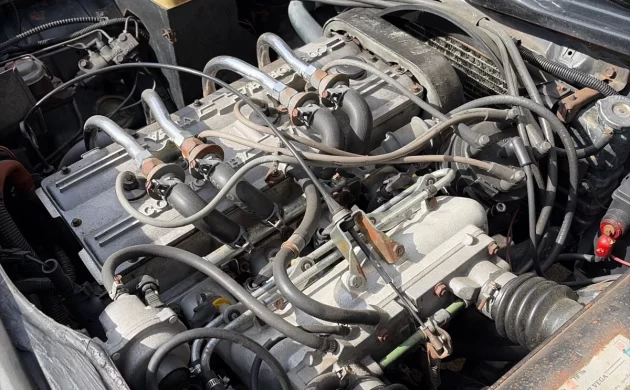
How did these get along? Like the mini-GT car that they were. Using a 2.0-liter 4-cylinder that might gratify the modern collector when he or she reads the dash plaque, which boasts that the car has a “16 valve engine dual overhead cam.” To know that the top end was designed by Formula 1 supplier Cosworth adds to the provenance. Those engines, by the way, were hand-assembled. So if this is your thing, and you can find a way to make this make economic sense, then maybe this tatty around the edges mini-GT car is for you.

Yes these are cool, one bid now. I just think the demand for these are not strong.
Supply exceeds demand. There’s actually quite a few of these still out there. Probably 95% of the Vegas still on the road are Cosworths.
With all the rust, I’d say $500 is about where it should sell. Love to see what’s UNDER that torn up carpet. Guessing more rust. A great many Vegas turned into Flintstone cars
Good thing this has the Cosworth engine. At least that part of this tin can is the only thing somewhat reliable. “It should have had a 350” you say? GM knew if they used that small block, above 80 mph the Vega’s body panels would start flying off.
Many engine switches which used any V-8 suffered body twist resulting in a large spiral windshield crack because the car needed a half sub-frame which Vega drag cars always installed. I put a 215ci Buick V-8 in mine which at stoplights out ran Corvettes because the Buick weighed less than the original Vega 4cyl which had head problems. At 60mph it was barely off idle and got better mileage than the 4. Best car I ever owned. Was totaled by an illegal without insurance who broadsided me at a 4-way stop intersection.
That 215 aluminum V8 was great engine, so long as you never let it overheat, LOL! If it overheated, the block might warp, then it was game over! Yet another example of GM’s bean counters pulling the plug before all of the bugs were worked out! Yet another example of the list of GM engines and cars that GM cancelled because they weren’t selling, thanks to teething problems that should have been fixed long before the cars went on sale! The engine list includes that 215 V8, the DeLorean OHC six, and the LL8 Vortec 4.2L straight six that went into some late 1990’s Chevy Trailblazers, Saab 9-7X’s and GMC Jimmy’s. The car list includes the Corvair, the GM 1961-63 Y-Bodies, the Fiero and the Pontiac Solstice/Saturn Sky/Opel GT triplets. If the Engineers had been allowed to fix the problems, GM would have been much better positioned to prosper in the gas shortages of the 1970’s. Yet another example of being “penny wise and pound foolish” from the bean counters at GM!
Someone once observed that GM is a finance company that happens to make cars, rather than a car company that offers in-house financing to its customers! That was certainly true when the GM Assistance Corporation (GMAC) was making more money on the interest on car loans than GM did actually selling the cars back in the 1980’s! Roger B. Smith, GM’s CEO at the time, certainly thought more like a banker than the head of a car company, that’s for sure!
Hard to believe a Vega in New York that’s still in one piece. You would think that most of it would have returned to Mother Earth by now.
neat but i don’t think it will meet reserve. needs a lot all around. of work. being from NY you can bet there is rust somewhere
Once a Vega, always a Vega.
It’s time to take that motor out and put it in something else. Probably the best option and tribute to the cosworth; it would certainly be fun on an engine stand
Good to see the high IQ bunch is still alive and well…
Find a Vega put west and “rebuild” a Cosworth Vega. How about a Kamback Cosworth?
Get minds think alike, LOL! I’ve thought of doing something similar with a Pinto wagon, dropping an Ecoboost 2.3L four into a Pinto! 300 hp & 300lb.-ft. of torque! Whee!
Maybe do something about the gas tank!
The wagons never had that problem.
How about a convertible cosworth?
Find a solid notchback body and go to town. Remember not to skimp on the extra structural bracing and to weld it in before cutting off the roof.
Vegas with that this dash and body shape looked like a mini me to the Camaro. Too bad they had all the rust issues and engine problems. I almost bought a new one the first year they came out but decided against it. Waited a couple years till my insurance came down and bought a new z28.
John
New, they didn’t sell because GM never delivered the promised 140 hp and with a list price of $5,000, they cost within $500 of the list price of a new Corvette, and several hundred dollars more than a loaded Z28 or TransAm. People said, wait, five grand for a VEGA? No thanks! Now they are collectible, and can be had for reasonable money, even though GM built less than 3500 examples, because, after all, it’s still a Vega! This was GM’s first all-aluminum, 16-valve engine, equipped with Electronic Fuel Injection (EFI), so it is collectible for that reason, as a sign of what was soon to come! This one is admittedly rough, but worth saving. We’ll see how the auction goes, but I might take a shot, if it can be gotten for short money. The EFI was often swapped out for carburetors, because no one, not even GM techs, knew how to work on it! If getting parts for the stock EFI setup are a problem, you might be able to swap in a TBI setup from Borla, which uses Throttle-Body Injection (TBI) system made to resemble a set of Weber DC0E carbs, a popular upgrade for these back in the day!
Chevy advertised it as “One Vega for the price of two”
Sort of an “In you face!” ad, LOL! The implication being that those “in the know” would understand. Sadly for GM, no, they didn’t understand.
My 1972 Kammback with the 4cyl went belly up real quick because it had an aluminum block and steel head which tended to warp causing head gasket leakage and scored cylinder walls, said the car magazines. I put an aluminum Buick V-8 in mine and it was the best car I ever owned, outran Corvettes, barely off idle at 60mph, better mileage than the 4. Best car I ever owned. Totaled by a non-English speaker without insurance who blew through a stop sign and broadsided me, almost killed me.
Cosworth or not, vega’s are junk.
Does Vega own something?
I grew up through the Vega era. The Cosworth was a nice try about putting forth a good sports car. Unfortunately, I agree with you…. it’s still a Vega and junk at that! Today, it probably has more appeal due to its rarity and ‘so-called’ potential. Plus, today you won’t be driving it everyday having to deal with the subpar construction. GM built absolute garbage in the 70’s because the company was run first by the ‘bean counters’. No wonder the import market took a foothold here because they offered quality…. not just a car that was ‘made in America’!
A local dealer near me had a very nice, low mileage Cosworth Vega for sale a couple years ago. They were trying their hardest to get somewhere around 10 grand for it, with no takers. It finally disappeared from their lot, but I would be surprised if they got more than $5000 for it.
These cars are the perfect example of how rare doesn’t always mean valuable.
Strange because I sold my 76 Cosworth 5 years ago for $10K and see them going for more if they are clean. Mine had 43K miles on it and a rare orange one instead of black.
And you all miss the point. Forget rare. Forget that it didn’t make the 140 hp it was supposed to make. It was 1975. It was 2.0L. It was 16 valves. It was DOHC. It was EFI. It was sequential FI. It handles better than most cars of its era. Did you ever drive one? Some people here really don’t appreciate automotive technology or the risks that need to be taken to make something work long term. Shame. Seriously, BF should just stop showing these here, as literally every last one shown seems to bring out the shortsighted en mass.
I’m among the few who like Cosworth Vegas! There. I’ve said it! Yes, they were overpriced when new, but they were the very definition of being “ahead of their time”. Now, such technology is commonplace, but in 1975, this kind of tech was only seen on Formula One race cars that cost six figures to build! Using Bosch injectors with Bendix sensors and a Bendix analog control unit, they were using “state of the art” tech developed by the pioneers of Electronic Fuel Injection (EFI), Bendix and Bosch. Bendix developed the original mechanical fuel injection system for the 327 V8 in the Corvette. Bosch would develop an EFI system for the VW Super Beetle in 1975. I give GM and Ed Cole an “A” for effort, even if the effort fell short. Being the first is always hard! Others would follow the same path later, and make improvements, but we should always recognize the ones who took the risks to be the first!
I appreciate your comment, Robert.
The Bosch D-Jet system actually goes back to 1967 for the 1968 model year and first appeared on the VW Model 3 (Squreback and fastback). Yes, this was the system that Bendix modeled the Cosworth’s EFI system, with some improvements. The D-jet uses points for a speed sensor, while the Bendix system used a second magnetic pickup in the distributor. Another improvement was the Bendix system (as implemented on the Cosworth), was that it was a fully sequential timed system, while the Bosch system was semi-sequential, firing 2 injectors at once.
As for “falling short”, I would ask to what metric? Yes, it was down to 110 HP in 1975 from its 140 goal, but that was almost entirely because it required a catalytic converter that year. The car was originally supposed to come out as a 1973 model in Q4 of 1972, but with the rapidly changing emissions regulations year to year in the 1970s, they were playing catch up to keep it certified and that didn’t happen until March, 1975. Literally removing the catalytic converter on these and opening up the induction system will allow these engines to make 170HP all day long.
Compare to a BMW 2002 the same year. They were 100HP. The Cosworth even in the de-tuned state it was sold as, still compared better than other GT cars of the day it was being run against, including Alpha Romeo GTV, Saab 99, Lancia, etc.
It was expensive to make. The engines were hand built in a clean room lab, balanced, used forged everything and had state of the art technology almost no one else had. Pretty much all DOHC engines that did exist at the time were 2 valve engines, not 4. The only 4 valve engine that existed was a Triumph Dolomite Sprint, and that was carbureted and was a single overhead cam design.
These engines were also RACED in Formula 2 (2 liter limit) from 1970-1973 and were dominant at the F2 level.
This car didn’t fall short. It suffered from the existing reputational problems the Vega had by 1975 (and were almost entirely fixed by that year), even though its design had no such issues. The new CEO at the time, Pete Estes, whom of which replaced Ed Cole was not an engineering leader and was a bean counter. He hated the Vega and cut the Cosworth production short, as his goal was to phase out the Vega entirely the following year, even though by then that car was near perfect.
There are way too much mis and dis-information on these pages lately. Enough. People either care about this hobby enough to be honest, or just shut up please.
Thank you, both, for shedding light on a misunderstood car born in turbulent times.
Your discretion of the 1975 Corvette,is very similar to my old 1974 BMW 2002,tii, however the BMW 4 cylinder averaged 25 miles per gallon, and only cost $5200, today a well kept version is worth over $25,000. Not bad for a car that was used as a daily driver year around (yes it snows in WV.
Hi Robert, I owned a Cosworth, 1975. The dealership got two cars in that year. One went into storage and the other one went into test driving mode. They were both with the dealership two years later. I found out that they had really lowered their asking price. The car that was sitting outside for two years in the Iowa weather they wanted $4000.00 for. I had a little bird tell me that the one in the warehouse was the same price. I bought it and it was a great running car, the little bird that had talked to me owned a BMW 2002. When we raced each other they performed the same, he got upset because of what he paid for the BMW against what I paid for the Cosworth! I would probably still own mine if it hadn’t been destroyed in an accident! Thanks for listening sir.
All good comments Jason! I like Vegas also. Although I had a bitter taste in my mouth because of the Pontiac Astra. I worked at a Pontiac store when they came out and remembering the whole line if them an not a single one started when it got cold. Luckily for me, I was in the parts department and didn’t have to shovel off all the snow before dragging each one in to get it warmed up enough to start. The Cosworth Vega, Corvair and the Fiero all ended up being great cars. Once they got all the bugs out. Only to be shelved and abandoned by GM as soon as that was accomplished. If GM would have spent more time developing/testing before releasing product to the masses. They might actually release better longer living (as in model longevity) vehicles and be cheaper to produce. Other than having to quickly bring out a new model to replace the failing one. (Think VW Beetle, Porsche 911, etc.) The GM bean counters have too much power. The engineers/car guys should have a heavier weighted power/control. Think John DeLorean, Lee Iaccoca.
True. The list of GM cars that went to market before they were done is a long and sad list. The Fiero is the one that really hurts for me, as I was shopping for my first new car at the time, and was waiting for the “P-Car’s” release with almost breathless anticipation, only to be bitterly disappointed at launch. The Toyota “Mister Two” was superior in every way, except price! Dealer gouging kept the MR2 out of my driveway, with markups of $3k, $4k or sometimes, even $5k above list price! By the time GM had finally gotten the Fiero right, sales were in the basement and GM pulled the plug! Which was a shame, because GM needs an entry-level sports car for those of us who cannot afford the Corvette’s supercar six-figure price tag!
Robert Atkinson, Jr, and GMAC Commercial is a joke!. They will bend over backwards for a Chevy dealers. But as soon as a,GMC dealers has some very exciting things happening they find an excuse to pull the rug out from under them. I had several deals all set for hundreds of conquest deals over Ford. And they just folded. I finally was able to to a 400 vehicle lease deal using GMC vans and Primus Financial. (A Ford Motor Credit subsidiary) And another 2200 unit deal that GMAC just wouldn’t talk about using an excuse that proved to be non-existent. I have nothing Good to say about GMAC commercial. I had good dealings with “regular GMAC. But when I was getting many nationwide deals done with commercial trucks. GMAC Commercial stepped in to stop it. If I had been a Chevy dealer. I would have been a hero. But bring a GMC dealers, I was a thorn in their side.
This would have been the exact same time that AMC was looking for a new engine for their Pacer. Lightweight and fairly reliable. I wonder if they ever contacted GM about this?
I never thought of it…. Wow! A Cosworth Pacer!! Interesting idea through hindsight!! A fishbowl with a twin cam……….
I don’t know, but both the Pacer and the Vega’s successors, the Chevy Monza and its corporate sisters, the Buick Skyhawk, Olds Firenza and Pontiac Sunbird, were supposed to get GM’s stillborn Wankel. AMC had made a deal to buy some Wankel engines from GM. When the Wankel was canceled, both companies scrambled to adapt existing engines to fit. AMC went with its old reliable, the straight six from the Jeep, while GM used a variety of engines, including the Vega four, Buick’s V6’s and the smallest V8 they had in the parts bin, a 265 V8 that later became a 350 as the ever tightening emissions rules strangled power output in the late seventies. The V8 had issues, because it was a very tight fit. You had to jack up the engine to change the two (2) rearmost spark plugs on the V8, at least until GM issued a recall with a kit. The kit was a pair of rubber plugs, to cover the hole you had to drill in each front wheel well, so you could get a socket wrench onto the back spark plug on each side of the engine! You still had to put the car on a lift or jack stands, though, as you had to take the front tires off to get to the holes!
As a former owner of both a 2002 and an Alfa GTV, the Cosworth Vega was always an interesting and attractive alternative. Except that is was a Vega.
I get that GM was trying to compete. Lord knows, they were getting their back side handed to them in this category. I suppose It was a worthy but fatally flawed attempt from the get go.
The Opal GT was already gone. That would have been the better platform for this for an enthusiast buyer.
The buyers were stuck with a Vega platform and body, and a black one at that for the first year.
Had they added some meatier tires and some decent body mods to really make it stand out as a boy-racer, it may have been able to overcome some of that. But that would have added even more cost.
Could I thrash on a Cos-Vega like I used to thrash my GTV? Not likely. That’s hard to duplicate with just some suspension do-dads. The Alfa was Italian, and you knew it all the time.
Did a Vega have the durability and solid bones of a 2002? They were superb vehicles. Highly unlikely, and the BMW buyer could upgrade to a tii.
I agree that it’s unfortunate, and misunderstood, but no amount of verbal wrangling will change these cars into something but a Vega.
Again, the Cosworth Vega’s biggest problems were the price premium you paid to get one, combined with the Vega’s tarnished reputation. If that engine had been dropped into the Vega’s successor, the Chevy Monza and its corporate sisters, things might have turned out differently, but alas, such is life. The one other area where the Cosworth Vega fell short was the solid rear axle, as it was inferior to the fully Independent Rear Suspension (IRS) used on some of its contemporaries, such as the BMW 2002. It was by no means unique, however, as many so-called sports cars of the era, such as the MGB, Opel GT, Alfa-Romeo Spyder Veloce, Triumph TR7/8 and the Fiat 850 Spyder, all used solid rear axles at the time, as a cost saving move.
many years ago I worked at a major Chicago area alignment shop, Vegas would come in for an alignment, we would turn them away because the construction of the vehicle was garbage, the front unibody was very weak, the crossmember would sag, the camber would go negative, there was no way to get the car align able, about the only thing you could do is toe and go and we didn’t do that kind of shoddy work, they were piles of junk from the beginning.
I ran Goodyear stores in the Chicago area. The Chicago area streets were terrible. My tire guys got to the point of being able to identify what street the car had been traveling down by the severity of the bend in the wheels. And used to have bets on who was correct. (the house took a 25% cut on the bets as the counter people had to verify with the customer) Consequently the alignments were out also. These were the days before offset ball-joints and so our approach was to use a 10′ bar to bend the car back into spec. However, we only charged the customer for a “toe & go” alignment AND had the customer
sign the invoice stating “temporary repairs made so that the car can be driven to a dealer for trade-in” We stressed that the “temporary repair was just that” and that situation was going to happen again. Some of the early Chevettes were worse. Add to the fact that most of the Chevettes also had broken rear coil springs. Chicago area streets are some of worst I have ever seen. (particularly during that time in history) And I have driven all over the US. The poor quality cars never stood a chance on those streets!
My good friend and co worker bought one in 1980 .The engine seized up on his way home going up a narrow 2 lane mountain road! What a nightmare almost killed him. After a rebuild it did it again! Bye bye Vega off to it’s new home at pick-a-part.
Yes, the stock Vegas were awful, but the Cosworth version only lated two (2) model years, 1975 & ’76, so clearly his was one of the stock versions that gave the Vega it’s well-deserved reputation for poor quality!
The only ones that were awful were the plain ones. Add a GT package and 4 speed they were nice nimble little cars. I have owned 12 total with 3 of them Cosworth’s and the others all GT’s. The only one that was bad was a 74 GT automatic and I bought it as a winter beater. The Cosworth’s were in their glory at speed and high rpm’s. Spinning up to 7000+ between shifts was a blast.
GM will never allow any car they sell to out perform or take sales away from their flagship. The Corvette.
And Chevy dealers cry like babies when another GM dealer has something that they don’t. You should have heard the crying when GMC got the Denali! You would have thought that they just lost an arm! 6 months later Chevy got the LTZ. Many of cool GM car was neutered so that the Corvette speed or acceleration wasn’t surpassed. A retired GM engineer once told me that when they revised the rear suspension on the ’65 Corvair there was a twin turbo flat 6 engine in R&D that had gone through enough dyno time to warrant an in car testing. When a “planner” found out the horsepower that they were getting on the dyno. He had the engine crushed so that the Corvette wouldn’t be “compromised “. Everyone in engineering already knew the ’65 Corvair would out handle the Corvette. And there was actually a little thought as to have a Corvette brand that included the really fast Corvair. But that idea was killed almost as fast as the idea was born. Just think what would have happened to competition with the 911 in 1965 with a twin turbo Corvair. Fun to think about. Naturally in true GM planning. By the time the Corvair was close to perfect GM axed the car.
I always found GM’s “protection” of the Corvette as a way of defending mediocrity. If they simply allowed for an open market of ideas within the company, the Corvette itself would be even a better car, let alone what having many “better” cars would do for the company. Very shortsighted. Unfortunately (and I say this a GM guy), very GM…Always after the quick quarterly buck, even at the expense of long-term success. They had great engineering and design efforts, but always seemed to acquiesce to the bean counters come dividend payout time.
I just bought a ’66 Corvair Corsa 140, btw. Will be selling the Cossie and the Monte shortly. Need to make some room, and after several years of owning two classics, I have decided one is enough.
Vega, tough case to follow. They were very weak in the structural sense. Iron oxide is the disease that made a weak car even weaker. We used to joke about how the doors would end up binding in their frames and having to realign them by shimming them in the right position with wood shingles then welding the hinges to the door fames,
It’s a tin can. That was and is the primary issue here. Short of a roll cage, there’s no fixing it.
There’s nothing “super” about this.
Ended at $2700, Reserve Not Met.
18 bids.
I sold mine #3087 3 years ago for $9,000 and that was cheap. Low miles (43k) all original paint and interior. New tires, shocks and stainless exhaust.
Just curious, why did you sell it?
Sold due to family problems and wish I still had it. Just bought a V8 Vega to play with now LOL.