
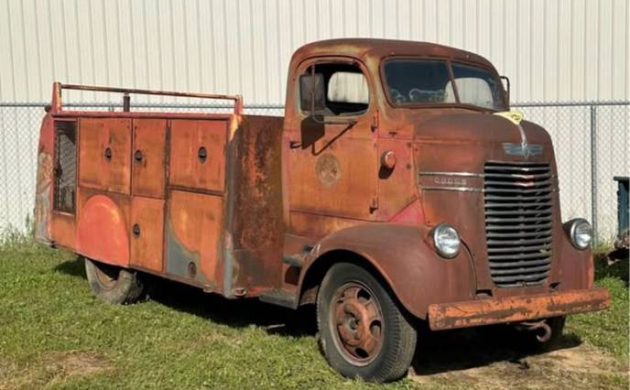
Dodge began its run of “Job-Rated” trucks in 1939, but though the advertising nomenclature was prosaic, the trucks were anything but. The “Art Deco” movement had evolved, and the new streamline moderne style was all the rage: Americans bought streamlined toasters, streamlined lamps and radios, and strolled through streamlined buildings. Auto designers followed suit, sculpting sheet metal to match the trend. The new Dodge trucks looked fancy and worked hard. Buyers could choose from over 1800 permutations of body styles, equipment, weight ratings, and accessories. Engine options were more of a constant, with three or four six-cylinder motors ranging from 85 to 104 hp available. Here on craigslist is a 1941 Dodge cabover dressed for duty as a fire truck; the seller is asking $10,000, and the truck is located in Sagle, Idaho. We have Jack M. to thank for this tip!
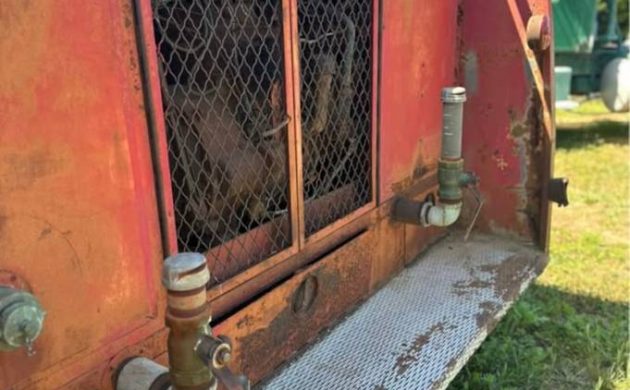
Delivered new to Fontana, California, this Dodge is said to be completely original, from its paint to its wheels to its drivetrain. The flathead six-cylinder turns over but hasn’t run in a few years. The truck rolls and steers “easily” – as much as a heavy-duty truck can. Vintage cabovers of any ilk are tough to find these days, with those labeled Dodge particularly rare. What fare is available is usually rebuilt to modern specifications, like this example, where the six-cylinder has been replaced with a Chevy small block V8 backed by a four-speed automatic transmission. Or for a flashier option, try this green ’41.
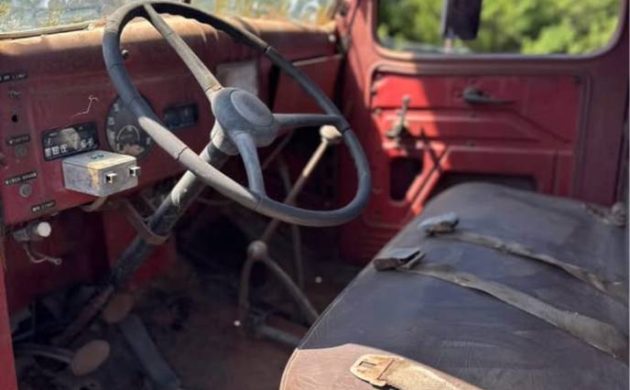
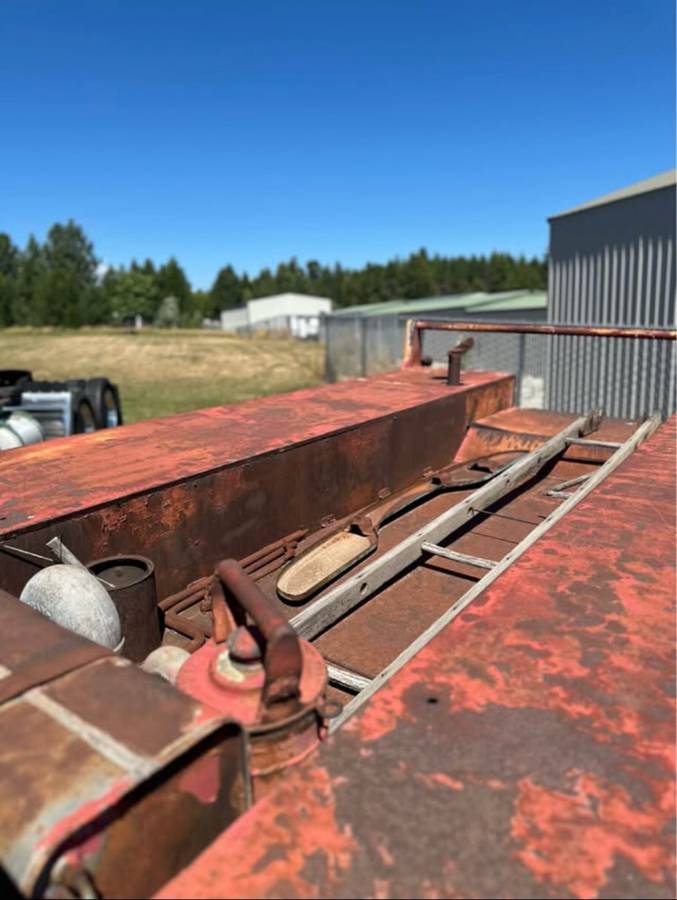
While exteriors were as stylish as supermodels, interiors were still sparse. It took another decade for truck makers to consider the comfort of the operator, though on the safety side of the ledger a previous owner installed seat belts. Bits of firefighting paraphernalia remain. This truck’s day job makes its systems more complicated; bringing the entire apparatus to working order might be substantially challenging, or the new owner could go the resto-mod route.
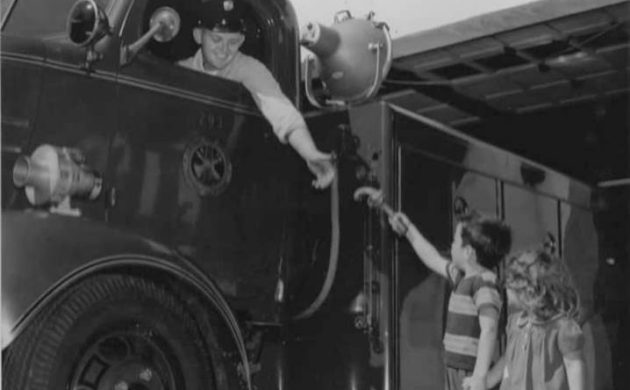
This vintage photo gives a sense of scale – these cabovers are big ‘uns. Values are tough to define, since original versions of pre-war Dodge cabovers almost never come up for sale, let alone in fire truck trim. My sense is the price is aggressive, but perhaps someone has a vision for this old guy that justifies its acquisition. What do you think of this artifact from the streamliner era?



Another old truck? YEE-HAW( firing pistols in the air) I was saddened that someone, a member no less, trashed our beloved Louisville, and called it junk, they did, I assume they feel the same about this. Luckily the author( and the site) is smart enough to post another, reducing despair considerable
Can’t add much to her great post, I’m not so sure it was streamline so much, cabovers got a quick reputation for tight turning and perfect for a fire dept. So many cool things, that unit on the dash, the turn signals( Diamond T had those), and the sight tube for how much water left, and seat belts? Clearly for a rollover, I’d be curious what powered the pump?
Cabovers of this era are indeed rare, I saw’r this one ( a Chevy) at a storage place near me, but they generally led a rough life, discarded after the war for one of those new “diesels” coming in, and a fire truck is about the only way you’ll find one.
It’s cool the seller included pics of when it was new, I’d say late 1940, and fire departments are usually very proud of their history. Shame Fontana Fire Dept. doesn’t want to restore it, as a tribute to all those guys in the 2nd CL picture when it was new, all said “anchors aweigh” a few short months later. With that, I’d cosmetically restore it, and put it on display.
Several regulars disparage vehicles that are not auction show darlings. They just do it using terms like “less desirable” and “limited appeal” instead of calling them garbage directly. More people should learn to just not click on things they don’t like.
Exactly, I very rarely look at anything newer than 1980. Check out what interest you and leave the rest for people that are interested in it.
A site like this ?? About cars no less ….AND you want nothing but sunshine and donuts ??!! Get outta here !!
The pump was likely powered by a PTO. That’s how modern pumpers work.
I’m with Howard. Please keep them coming. One thing that we don’t get to see a lot of is a known history. And seeing those photos of this Dodge when it was new is a real treat. I know if you could get that old Flathead 6 running, it may not keep up with modern traffic, but still, it would be nice to see it restored to original, especially given its history. I’m wondering if this truck has a Brownie Box in it? There is a second shifter poking out from the rear of the cab. It looks very complete and solid too. I sure hope someone can restore it. Thank you Jack M. For spotting this gem, and of course Michelle for writing it up. I really enjoyed this one. ( Well…… I enjoy all of them……) -Dave
Dave, you and Howard nailed again. inasmuch as we all very much like and appreciate the cars, stuff like this truck, old dozers and similar type iron seem to always draw a litany of responses.
This is a great old truck project. It’s not as sexy as a hook and ladder truck of that era but it does stand as a broader canvas for purposed variations. Really hope whoever takes this on makes it whole quickly then shows it off somewhere that we get to see it!
As a retired firefighter (31 Years) in a major city, I have never had any interest in owning a fire truck. It is just a tool that I have no practical use for. However, this art deco fire truck is just too cool. I am sure if I owned it, I would find something to do with it!
Hi Joe, I know we’ve had our disagreements, but I can understand what you mean. Many think of the “glory” of operating the largest vehicle allowed on our highways a big deal, and it was, but the truck itself was more of a tool to make a living, and falsely glamorized by Hollywood, just wasn’t so. I’m actually a bit surprised you say that about lack of interest. Generally, I’ve found firefighters do indeed have a keen interest in their past, why, in our little town, a bunch of retired firefighters got together, with donations, and restored our 1918 Kissel that was the city’s 1st motorized fire engine. I look at this site as a history lesson, and we need people like you to add what you might not think is important, to the discussion, and I’m sure you have plenty of stories. We’d love to hear them, or it will be lost forever.
Joe- I’m also a retired career Firefighter/Paramedic, 28 years full-time. I’ve owned two vintage fire apparatus, a 1941 Chevy with a Pirsch body and a 1950 Ford with a Firefighter body. I also was the “curator” of my departments 1924 Ahrens-Fox. Been into hot rods and customs for over 45 years. Old fire apparatus has a small but dedicated following. This truck will find a new home.
Interesting piece of history. Got a lot of questions, does the short shifter operate the transfer case that shifts from ground drive to pump drive or is that another engine/pump at the rear of the truck? The operators panel is usually close to the pump and in this case at the rear of the truck. Unusual discharge setup at the rear but that may be a retro fit. Nice old rig that needs to live on.
A two-speed axle was available on these. I’ve always thought the short shifter coming from under the seat was to shift the axle, but I dunno! Howard? Geo? They’d know.
It well could be for a 2sp rear, but most pumper fire trucks the pump is run from the truck engine through 4th gear in this case or direct gear with the drive shaft running to a transfer case that is either in the ground drive position or pump position. There’s not much info in the text and the pictures, even in the Craigs list ad don’t show much.That’s why I asked if there was another engine/pump at the rear of the truck.
This vintage of a truck would likely use a 2-speed that shifted manually. I did see some vacuum-shift (even some electric shift) models on the larger trucks. I find myself searching for replacement diaphrams for customers. To determine what kind of unit this truck has I would need to have a look at the pumpkin…
I believe I see an engine in the back, I can see an oil fill tube, and there is an exhaust stack sticking up on the rear passenger side. You can see this better in the Craig list pictures. Also a green Peterbilt in picture. The controls are on the driver side rear panel. Not much left to the ladder. I can’t follow the plumbing either. There appears to be a square gas tank up in the front of the bed.
Hi JoAnn, I’m so glad you joined the discussion, featuring old trucks digs up all the old stalwarts, :)
Okay, couple things, you are right, I do think indeed that is an auxiliary motor in the back. I see a starter housing, the fuel tank and the controls and stack, possibly an in-line 4 running the pump. I agree, that ladder has seen better days.
Far as the lever under the seat, I found a FB post, and that is indeed a 2 speed rear axle. I’ll post a pic separately, but I never knew they had a mechanical 2 speed, but here’s the proof. Thanks, see, isn’t this fun!!!
https://p15-d24.com/topic/61104-2-speed-axle-shifter/
Howard, Ford ran a lever shift 2sp through the 30s and early 40s
Hi Howard, good pictures you found. Can’t image the vacuum setup being any good, just think how quick the vacuum wipes worked. By the time the rear differential got enough vacuum to shift you would lose so much momentum, you would have to downshift twice to make up for it. It is a nice truck, hope somebody saves it. I am also wondering about that gauge on the front of the body behind the driver’s door. Looks like a clear tube with a faucet top and bottom. Could it be a water gauge? You know me, I like to study everything in the picture. Nice bantering with you Howard.
JoAnn- The tube on the truck body behind the driver’s door is a sight tube for the booster tank. The valve above it is likely a fill valve for the tank. I’m a retired career Firefighter/Paramedic, 28 years in the fire service and former curator of my departments 1924 Ahrens-Fox fire engine. I’ve been around vintage fire apparatus for a long time. Owned a few old fire engines myself.
Mike’s 57, Thanks for the sight tube info and for being a Firefighter. Could we interest you in restoring a 1941 Dodge Cabover? I’m sure you could do her proud. I was looking at it and saying to myself, “That’s going to take a lot of red paint.”
Joann- Thanks for the kind words. Actually, I did have a 1941 Dodge COE!!! It was (still is) on a Chevy P30 chassis with a 454/400 drive train and a Hodges 18’ ramp bed truck. Can’t figure out how to load pictures here. Very cool truck! It now resides in Jackson, MI. I definitely wouldn’t mind owning this one!
I’m not entirely sure how the mechanical 2 speed would work, with the rear suspension traveling up and down, you’d think the lever would too. A good jolt would shift the axle unintentionally. By far, the most common 2 speed was the electric. Vacuum was used, but like you say, it was sluggish. I think I even remember a long cable operated 2 speed too. I doubt this was used as a split shifter, and probably like an O/D for road use. Funny, but not “ha-ha” funny, I’ve driven many underpowered trucks, where road speed dropped off fast, and you had to skip a gear downshifting. Many say those were the “good ol’ days”, but ask them today and they will say, THESE are the good old days. There was nothing good about adjusting a set of points by matchbook in the pouring rain. :)
Mike’s57, I would love to see a picture of your truck as I’m sure others would as well. Below where you post a comments it says you must be a member to add images. Only realized this after my husband tried to post something.
Jeepers Creepers ,I no that as a 41 Chevy steel looks mean .
I think the last time this pumped any water was probably a year after water was invented. Still, I’d be curious to know if the pumping mechanism still worked.
What a great write up…with great comments to boot .
Excellent write up, Michelle! Next time I hope I’m in a place where I can properly respond to something like this instead of navigating my way through MSP International Airport, including getting my steel-laden left ankle through TSA.
The joys of travel and the heartbreak of saying goodbye to some wonderful grandchildren. That’s one of the few joys of getting old.
Anyways, this truck. A very uncommon encounter out west in the Chinook Belt. A bunch of us were hiking the West Butte of the Sweetgrass Hills when we came across a Dodge COE with a gravel box, parked near a ramshackle cabin in Pratt’s Canyon.
It seemed to be in good shape, like it was actually parked. Of course the gearhead in me required an in depth inspection.
First time I ever saw a COE of that vintage that wasn’t a Ford or GM. I was a little surprised to see an updraft carburetor but then, were are you going to put a downdraft?
I talked to my dad about it when I got home and he told me that my Uncle Woody, who happened to be the local Plymouth-Chrysler-Dodge truck dealer in the region might have been the one who sold it. I heard conflicting stories about how many trucks Uncle Woody managed to latch onto during the war but Dad told me that more than one COE made it to Woody’s place.
I took a pic of the truck but considering that it was 1970 and I was a smart-assed 17 year old, plus it was an Intermatic 110 camera, good pics weren’t easy to come by. Too bad as well because when I went back about 4 years later the truck was gone…
I owned one like this converted to a car hauler with a Hodges ramp bed. It runs a 454/400. Very cool truck, now resides in Jackson, MI.
Michelle, Thank you for another antique truck write up. Keep the trucks coming!!!This truck is above entry level so how far a person restores it will depend on their checkbook and abilities. This truck deserves to be restored to a showable condition. It definitely should be placed well above the Yard Art someone mentioned. My first thought on the big second lever was also a transfer case pump drive, But since I agree that is a pony motor pump in the rear, It must be a 2 speed. I have driven vacuum 2 speeds and they were NOT very dependable. Yes, there were manual shifted 2 speed rears, I rode many hours in the county’s late 40’s 260 Brockway dump trucks with them.
Howard I am sorry that I upset you with my comment about the Louisville, But the frame looked shot thus it becoming a parts truck???
Howard, thanks for your comments, I know we have disagreed occasionally, but I believe it was fun and healthy, because I think we both respect each other. Also I think you understand why I don’t want a firetruck. I had one for over 30 years and it was just a tool, yet a very expensive one and a very necessary one. Now that I am sliding into my mid-eighties, I am becoming more understanding of other things, than just vintage Hot Rods. I see all sorts of vehicles I want now, but still not so much a fire truck, but an art deco cab over could be way cool!
Thanks Joe, oh, you know guys, take a couple swings at each other, then buying each other a beer. ( A boy named Sue) It’s true, we can’t twist bolts off like we used to, but if anything is going to get us through the aches and pains of that today, its telling how we got there. I was 71 the other day, no no, don’t say it, I’m good without any accolades, Dick Van Dyke, who was 100 the other day, said, it’s almost a curse seeing everybody go before you. I had a lot of trucking friends now gone, that could add a tale or 2. I’m sure you can too. Peace brother, and thank you for your service as a fire fighter. It, like trucking, goes unnoticed until you need them.
I have a 1949 Tonka cab over toy dump truck that looks very similar to this Dodge.
Thanks Howard, I am going to be 83 this spring and I am not happy about it. But, it sure beats the alternative. I certainly can’t do what I used too, but I am learning to compromise. Not having 6 cars only 2. Not in the shop 8 hours a day, about 3 or 4 and that’s not all working. And the big thing is paying people who know what they’re doing, and probably saving money because I would probably end up saving time, not having to re do it twice.
One thing we can do is agree to disagree!
Howard, the mechanical shift 2 speed rear was a rod from the lever in the cab to the lever on the rear. Since it was hinged on both ends it flexed with the rear movement. And there was not much of that in heavy truck suspension.. You also left out that there were also many air actuated 2 speed rears. I drove many Brockways with them.
Joann, I think you should lift off the throttle when shifting the 2 speed. Vacuum goes up when you lift.
Looking to learn about vacuum brakes on trailers in the 40s. Have a Diamond T with large vacuum tanks and a hand valve on the steering column.
Rallye, You are right on the throttle lift to shift a vacuum 2 speed. Almost slam shifting it. When splitting it with the main tranny, you sometimes had to wait until after the clutch was out on the main then force it into low range.
What year and size (model number) Diamond T do you have??? I have never seen a trailer with vacuum brakes, or know much about them. I do know they had very large brake chamber diaphragms in an effort to apply the brakes. I have always pulled and worked on trailers with air brakes.