
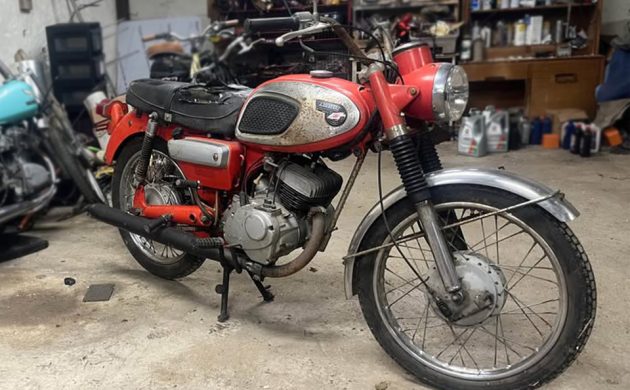
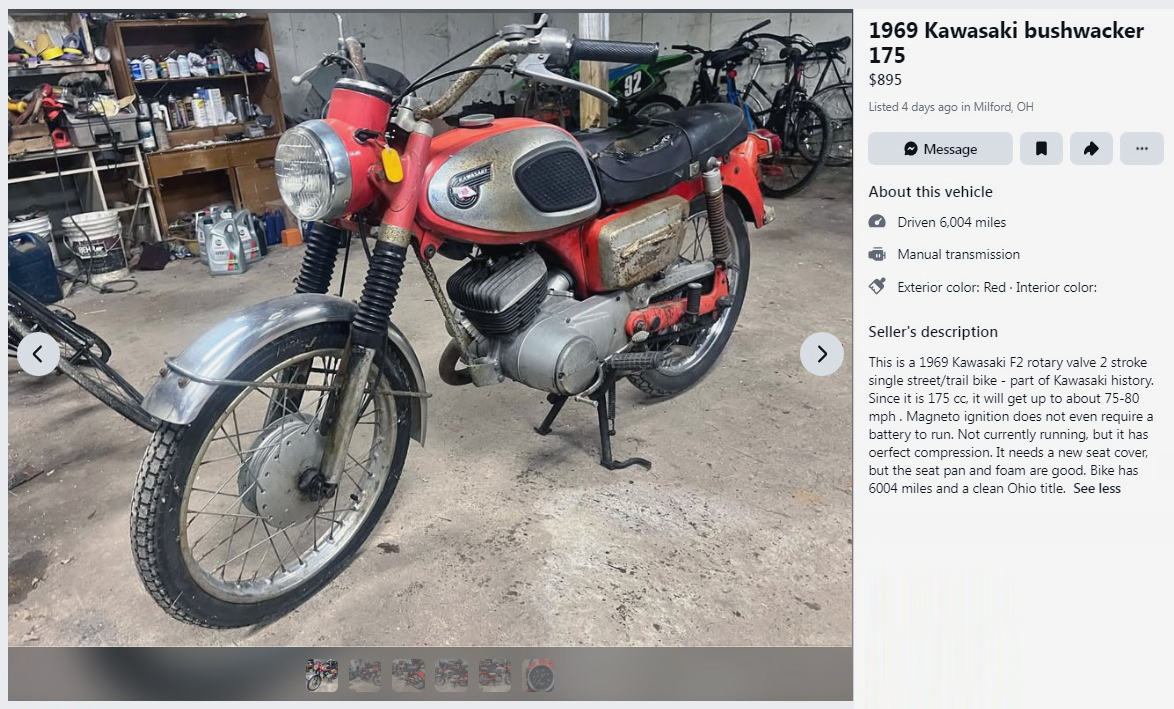
The seller has this bike listed as a Bushwacker, but the Bushwacker is an on/off-road version of Kawasaki’s 175, with beefed-up handlebars, an upswept exhaust, and more off-road features. This is clearly a street bike. This 1969 Kawasaki 175 F2 can be found listed here on Facebook Marketplace in Milford, Ohio, and they’re asking $895. Here is the original listing, and thanks to Pnuts for the tip!
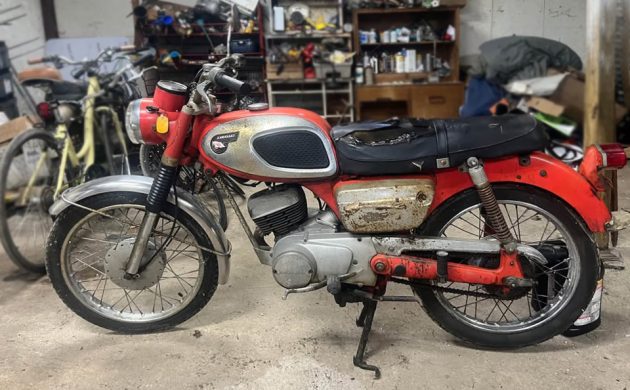
Disclaimer: The seller does say this is an F2, but they have Bushwacker in the title, and that name was reserved for a different model. The street bike didn’t get a cool name. Made between 1966 and 1969, Kawasaki’s 175 F2 came after the (yes) Kawasaki F1. There was a related trail model, the F2TR, made for 1966 and 1967, and that would be fantatsic to own. I really like on/off bikes with raised exhaust pipes and details like that. Not that there’s anything wrong with street bikes. The F3 was the Bushwacker that the seller mentions, but this isn’t one of those models.
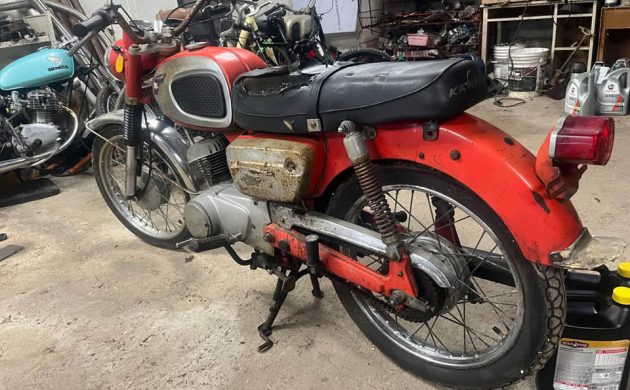
You can see the rough condition of this bike, and it won’t be cheap to drop it off at a restoration shop – if you can even find one anymore, a lot of them went away in recent years. A person could probably restore this one in their garage or shop in a few weeks, other than the chrome work. That’s typically the most expensive part of any restoration these days, sadly. Chrome shops are even harder to find than restoration shops, it seems like. The F-series was made until the end of 1975, and then the KE-series took over for the 1976 model year.
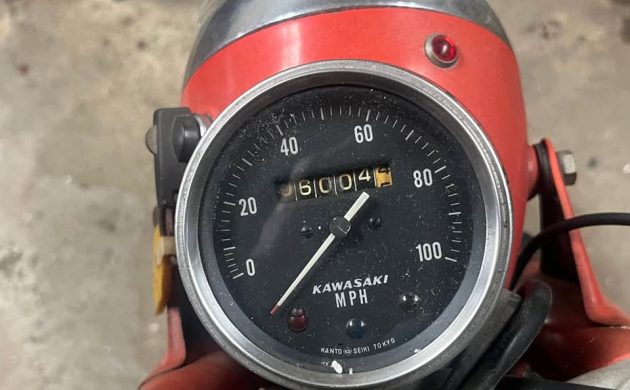
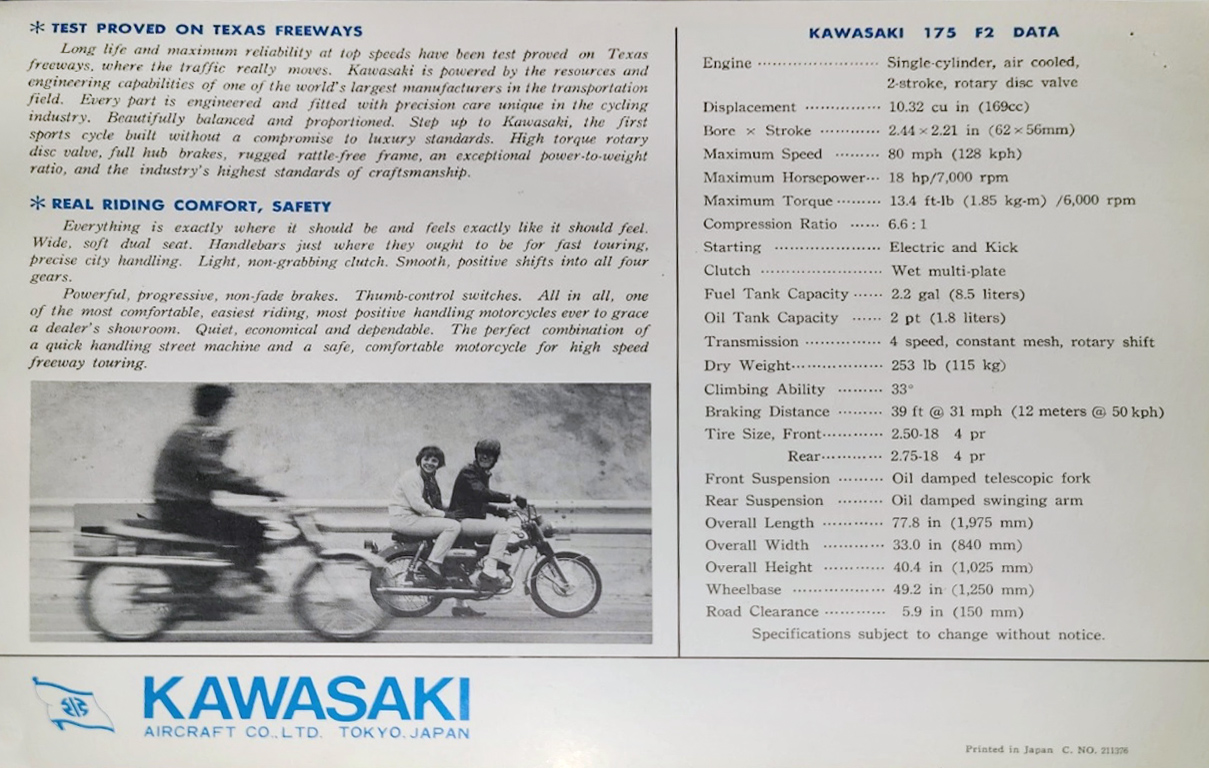
Someone rode this motorcycle a lot, with just over 6,000 miles showing on the odometer. It’s a single-cylinder, so that’s a lot of buzzy miles to have put on. Maybe they used it to commute to work in the city, which would be perfect, other than the 99.99997% of texting drivers around you not paying attention to anything other than trying to type LOL or watch cat videos. A brochure says the F2 175 was “test proved” for speed and longevity on Texas Freeways, so maybe it’s better than I imagined it would be at highway speeds.
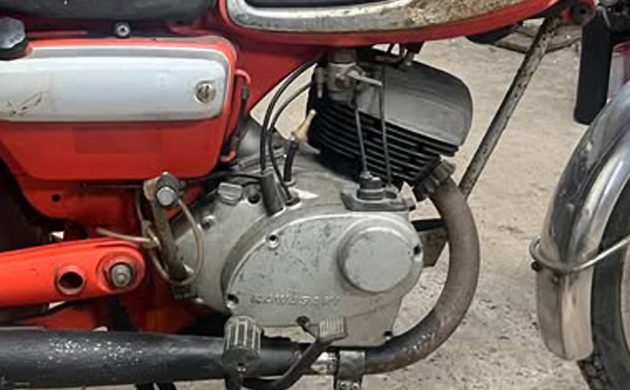
The engine is Kawasaki’s 169-cc two-stroke, rotary-valve single-cylinder with 18 horsepower and 14 lb-ft of torque, and it has Kawasaki’s SuperLube oil-injection system. Power is sent through a four-speed manual transmission and chain to the rear wheel, and it has a belt and suspenders (kick start and electric start). The seller says it doesn’t run but has good compression. Hagerty is at $1,700 for a #4 fair-condition example and $3,700 for a #2 excellent bike, so there isn’t much room, as far as restoration costs go, to stay under that number. Would any of you ride a single-cylinder Kawasaki on Texas freeways?


Get it running.
Fix the seat, clean it up.
Ride the tar out of it!
It’d be the fastest “ring-ding” in many a neighborhood, undoubtedly.
Oh, and probably new tires would be a good idea..
I like your thinking, young man.
😁
And thank you for the compliment, Scotty, tho definitely NOT the case.😆
Interesting that out west, the term, “Bushwacker” applies to more than a motorcycle. Truthfully, the only 175 Kamakazis that I saw were ‘Bushwhackers,’ or the newer Enduros. The latter was a good attempt but I thought that an electric start (which the Enduro had) was overkill. Just the same, they did the job they were designed to do. There were a couple of 125s in our region that were based on this design.
A restoration project like this could be a lot of fun although if a Honda Superhawk came into the shop this would be put on hold. Hope someone takes this and gives it the full treatment…
Or a ‘67 Black Bomber?
https://www.sanmarcosmotorcycles.com/motorcycles/1967-honda-cb450-black-bomber?srsltid=AfmBOopi7FJOCcepGEWlN8AYgabwK4KxMMGXK-MVg9GsqNiUmsv9mHME
I remember when the CB450 made its debut. Never liked the gas tank but the engine was always a work of art. I found it interesting that I never saw an engine before or since that used torsion bars for valve springs. Lots of new ideas over the years…
Geo, you most likely knew this, but apparently, Kawasaki was one of the only ones that used the same generator for the lights and to charge the battery, to also function as the starter on the early bikes, the F1, F2, and F3 series.
Actually, the Suzuki 150, circa, 1965, had the same starting/charging system. My brother had one back before the Vikings invented Meade. I was fascinated by the silent starting mechanism.
Ha! I may have to borrow that phrase sometime, that’s as good as it gets.
Kickstand, and center-stand.
It’s hard to beat that combo, too!
Crankshaft seals, always a potential problem. Expensive and labor intensive. Ride on Texas highways? I’m scared to drive on them and I live in Texas! No way this size bike will be able to sustain Texas highways’ speed limit. Then there’s those damn 18 wheelers blowing you off the road. Bike this size best for in town riding.
Ha, I agree, Azzurra! I’m there two or three times a year at least, and come to think of it, I have a trip to Midland coming up, aaaaaaagain. I’ve also noticed super rough road surfaces in the western part of the great state of Texas, maybe to keep them from wearing down from all the truck traffic? It’s like driving on pebbles. Maybe in 1969 things were different there and everywhere in regard to driving, or I should say, drivers.
If you are going to be in Midland, don’t miss the Petroleum Museum. It also houses the Chapparal museum. All but one of Jim Hall’s cars are there. It’s a must see. Right off I-20.
Wow. At 80 mph (MINIMUM!) on I-10 near Kerrvile …
That brochure is from 1969.
You know what’s amazing and not covered? How this bike could possibly have anything in common with what was just around the corner for Kawasaki. I read, in 1969, a collaboration of engineers created the H1 triples, and instantly changed the game. To go from this to a rocket triple was unheard of, yet, the biggest news was yet to come. A man named Gyoichi “Ben” Inamura, began designing a 750 4 cylinder 4 stroke in 1967, but Honda beat them to the punch in ’69. So, in 1972, they upped Honda with the Z1, and never looked back at these humble smokey, ring ding, beginnings. Sound familiar?
Freeway? Nah, most, if not all of these, owners put a bigger schprocket on the back, and trashed these in the dirt. They actually made better dirt bikes than road bikes.
I’ve restored more than a few 70s and 80s Japanese enduros. I’ve learned to stay away from bikes with missing parts, especially Zooks. A one-month restoration can drag to a year over little stuff like a tail-light lens or an air box. The kicker is that it’s hard to find projects that AREN’T missing parts.
The implication that this would make a good freeway bike must have something to do with the suicide rate in Texas. I used to ride a 4 stroke 175 (Honda flavored) in Interstate 10 in Texas 60 years ago but the first time I blew a tire ended that nonsense.
The only way I’d consider driving this on any highway would be if it was equipped with a cell phone jamming device which would disable the adult pacifiers within a 100m radius…just sayin’. I’ll go back to my padded room now.
Actually – Jessie – a Air Force riding buddy of my dad had a 175 Bushwacker and rode with my dad Suzuki 120 Cat with me on my little Yamaha 60 press frame. Jessie was heck on that and finally moved up to a Bighorn 350.