
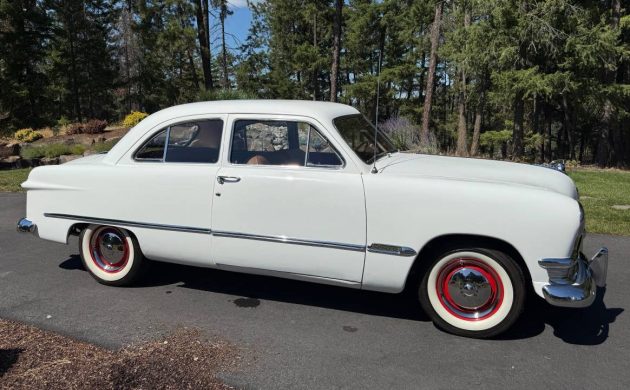
This 1950 Ford Custom Deluxe Tudor Sedan has been in regular use since its restoration years ago. Naturally, it has accumulated a few minor cosmetic imperfections, but its overall condition guarantees that it can still turn heads. It has no apparent needs, while the seller’s price makes it an affordable option for those seeking a turnkey classic. I must say a big thank you to Barn Finder Spokane Jeff for spotting the Ford listed here on Craigslist in Coeur d’Alene, Idaho. The seller set their price at $10,500 and won’t consider trades.
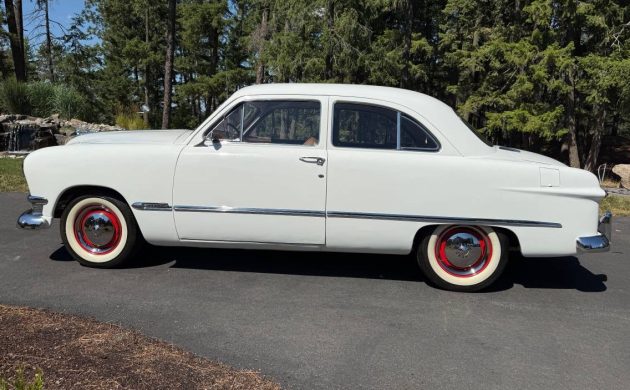
American passenger car manufacturers spent the early years following World War II producing lightly modified versions of their pre-war offerings. The initial focus was on restoring build numbers as they worked behind the scenes to develop new models. Ford hit the ground running in 1949 with a new offering that became affectionately known as the shoebox. Its styling was unlike anything that had appeared previously, and it proved an immediate hit with buyers. The company performed minor cosmetic upgrades in 1950, which is when this Custom Deluxe Tudor was produced. The seller confirms that it has seen action since undergoing a restoration years ago. That means that close inspection reveals minor cosmetic imperfections. However, the White paint shines beautifully, the panels are as straight as an arrow, and this beauty is rust-free. The trim and glass look excellent, and the Red wheels provide a striking and classy contrast.

Powering this Ford is the company’s 226ci flathead six-cylinder engine. The company’s Sales Literature for 1950 utilizes glorious color drawings that accentuate the car’s appearance and features, confirming that this engine should develop 95hp and 180 ft/lbs of torque. The seller indicates that this car features a three-speed manual transmission with optional overdrive, enhancing its open-road cruising capabilities. They describe the Tudor as a fun car to drive, suggesting that it is a turnkey proposition with no mechanical maladies. Adding to the appeal is the parts collection that comes with the deal. This includes a spare engine and a range of additional parts that should allow this Ford to continue plying our roads for many decades to come.
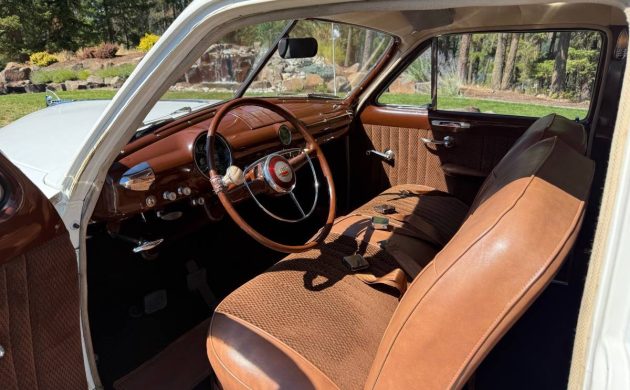
One aspect of this Ford that has survived exceptionally well since the restoration is its interior. Trimmed in Brown featuring cloth and vinyl on the seats, there is no evidence of wear or abuse. The painted surfaces look exceptional, and the wheel is free from cracks. This interior features what Ford dubbed its “Magic Air” heater, a clock, and a pushbutton radio.
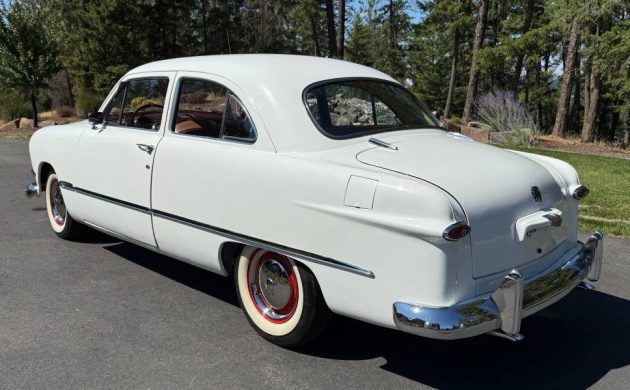
This 1950 Ford Custom Deluxe Tudor Sedan is a wonderful classic that is in excellent condition. It has no apparent needs, and the additional parts should allow it to continue to ply our roads for many years to come. The seller’s price is realistic and offers accessibility for those enthusiasts considering a first classic purchase. It has only been on the market for a few days, but I won’t be surprised if it finds a new home fairly quickly. Are you tempted to make it yours?




Oops!! Two door sedan, NOT a coupe. Big difference in desirability but this one’s so nice it’ll sell in a second. Priced to GO also.
Thank you so much for the feedback, OpaJim. Sometimes I miss the obvious when it is right in front of me! You’re absolutely right, because this is a Tudor Sedan, not a Coupe. I’ve amended the article, and I hope that you continue to enjoy them.
Nice car. Both rockers are not straight so checking them both for covered rust might be worthwhile. The cars were the best designed units ever put out for the American market in my mind.
BobHess-
I saw the same thing you did concerning the rocker boxes. Upon closer inspection of the pix, I think that they’re straight but that the photographer failed to fully close the doors so they cast those shadows. Take a gander at the left rear quarter shot with the door fully closed. We can only hope …
I think the doors weren’t fully latched, hence the shadow on both rocker boxes. In the right side view you can also see that the trim doesn’t align. The left rear quarter shot doesn’t show any anomaly.
The wide whites, trim rings and red wheels really set the whole thing off nicely.
A beautiful restoration indeed! I certainly can’t fault what I see, but had a question. I would have to consult my reference material at home, but I’m not sure Ford utilized an actual WHITE paint for it’s cars in 1950. I’ve seen very light gray by various automakers in those years, but not white. If I’m wrong, I stand corrected. I just never saw a `49-`51 shoebox Ford in this shade, that was said to be original.
That’s a great observation, Will Fox. I have the Ford Color Chart for that model year, and you’re right: That shade isn’t on it. I appreciate your feedback on that, and I hope that you continue enjoying our work.
Having been a teenager in 1950, I can assure you that where I grew up (Bergen County, NJ) the only WHITE vehicles were ambulances.
As for the “styling was unlike anything that had appeared previously” bit. I direct your attention to both the ’48 Crosley and the ’48 Kaiser/Frazer.
‘Nuff said.
Oh, and my recollection is that the dashboards were silver, not brown, nice as it is.
Didn’t run into another ’48 Crosley the whole time I owned the car.
A word of caution, white painted vehicles hide many body sins
WORD!
I never understood why these relatively sleek looking cars were called ‘shoeboxes’. A 1950 Plymouth station wagon or Chevrolet wagon of the same year, definitely shoebox-like, but not the Ford sedans, coupes, and convertibles.
My dad had a 1950 Ford Custom
4 door V-8
I would describe the color as Bone or Off- White.
I never really liked the body style. (lack of style?) But, they are starting to grow on me. It looks like a solid driver at a reasonable price.
My dad had a blue’50 with skirts in my much younger days and I loved that 2dr sd n Ford!
Be still, my heart!
I like it. But, I would have to find a flathead V8 to replace the 6.
Nice ride! 6 cylinders, 3 speed with overdrive would be my preferred driveline components. The six claimed 5 fewer horsepower than the V8, but in real-world comparisons had a slightly better torque curve (more low end, “off-the-line” performance) and gave away nearly nothing at the high end of the scale. Beyond being the equal of the 8 in performance in almost all ways, it was not prone to overheating as was the 8, ran more smoothly under most conditions (any straight six is inherently a well balanced engine,) and was easier to work on, also. I drove a ’51 Victoria V8 and a couple of 6’s, and I’ll take a 6 any day of the week, despite what old Henry believed! (There’s a reason nearly every large truck Diesel engine in use in this country is a straight six, as well!)
My brother had a ’51 flathead V8 convertible back in the late ’50’s. Lots of fun in that car. He did a lot of work on that car. Had finned Offenhauser heads and even had a blower on it for awhile.
Only question I have, since I don’t remember myself, is why, this being a 6 cylinder motor, it would have dual exhaust? Other than that, this is a really nice car.
Ed, the split exhaust might gain little in performance, but the owner likely wanted it for the sound and cool factor. I didn’t notice that til you mentioned, which made me go back to the ad site for more very good photos, though none underneath. The color appears to be a very light grey which may well be correct.
Hey, we have a bumper crop of Ford vehicles here today, so more for me, seven, I think. Is that a record?
For many straight 6’s of that era, dual outlet split manifolds were available, both for the sound, but mostly for reduced back pressure in the exhaust system. Combined with a dual carburetor intake, some of these old engines were quite hot performers. Stock car racers back then weren’t all V8 powered; straight 6 and 8 cylinder engines were very competitive!
Lovely looking car. My favourite cars have always been the 1949-50 Ford. If only more pics were posted of this car.
More good ones on the ad site to check out.