
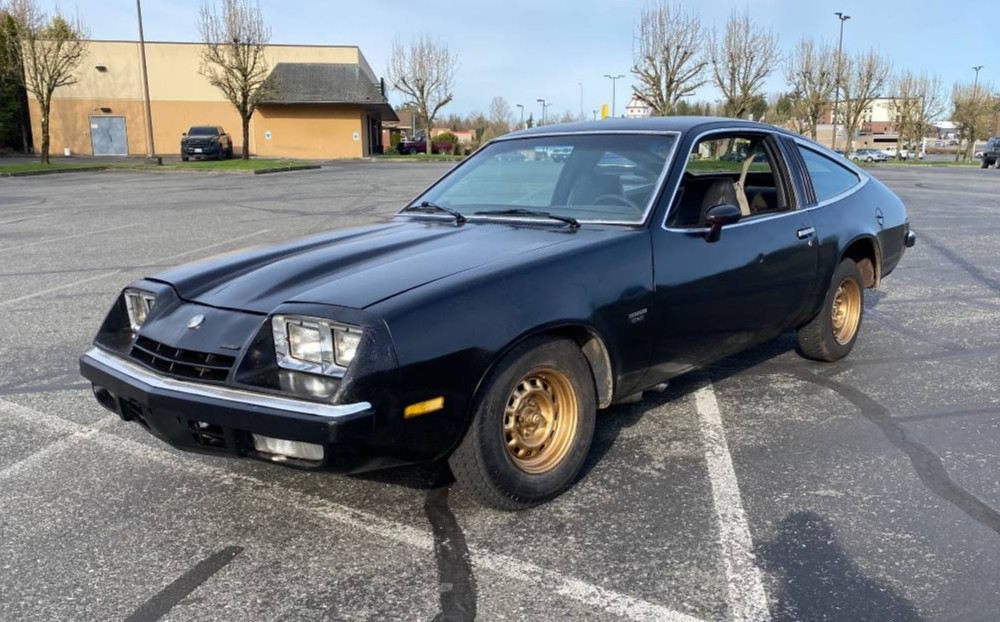
Chevrolet introduced the Vega-based Monza in 1975 to largely compete against the subcompact Ford Mustang II. Unlike the Vega, which remained in production through 1977, the Monza could be ordered with a small-block V8 engine. The seller’s first-year Monza is a 2+2, another way of saying it’s a hatchback (a coupe was also offered). This one is set up to outperform its original configuration, but needs a host of body and interior work. Located in Lynden, Washington, this little hot rod is available here on craigslist for $2,900. Thanks for the cheap wheels tip, Barn Finder “Scott.”
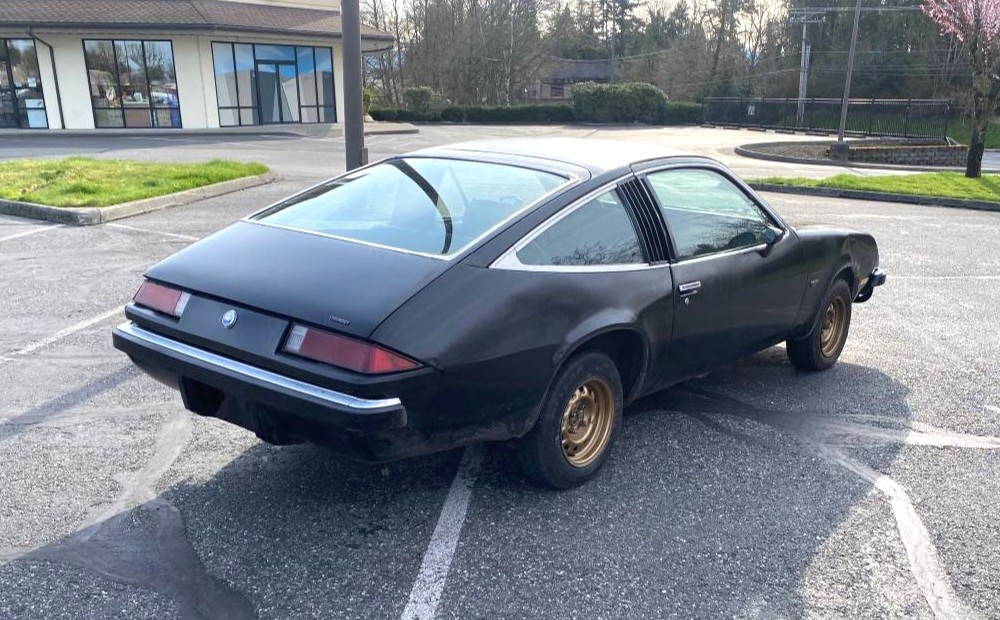
The Monza spawned derivatives from all the other GM car divisions except Cadillac. And was in production through 1980 until a front-wheel drive replacement came along. I owned a 1980 Pontiac Sunbird in this same body style, and its best feature was its “Iron Duke” I-4, which the Monza did not use in ’75 (it had the Vega I-4 as standard). GM’s John DeLorean dubbed the 2+2 as the “Italian Vega” due to styling similarities with the Ferrari 365 GTC/4. More than 731,500 Monzas were built overall, with 136,200 in 1975 alone (42% were 2+2s).
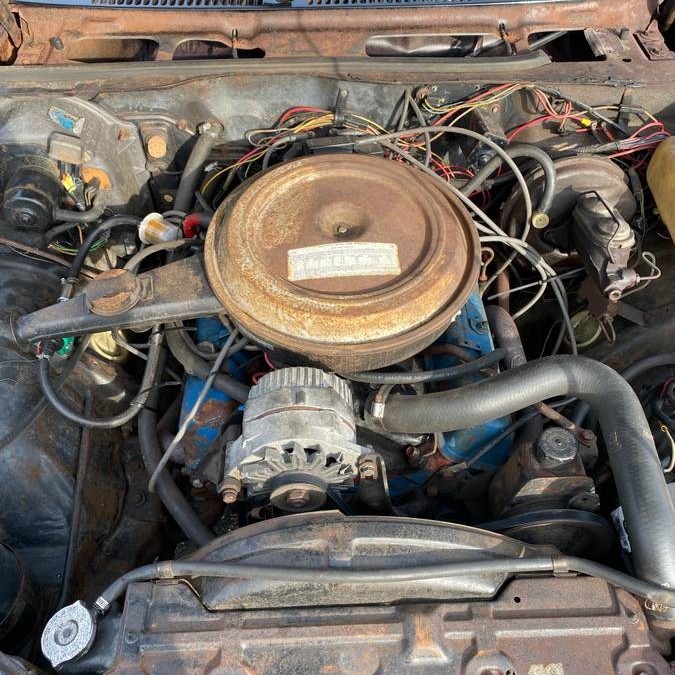
We’re told this Monza was a V8 car from the factory, so it probably had Chevy’s then-new 262 cubic inch V8 under the hood. That has been jettisoned in favor of a 350 out of a 1974 Nova. We don’t know how many miles are on that motor, but the vehicle itself clocks in at a well-used 123,000, and the Chevy has an automatic transmission (TH-350?). From the list of mechanical add-ons this car has received, we assume it has plenty of gumption. Those goodies include headers, a Flowmaster exhaust, possible tweaks in the rear end, and even a push-button starter switch.
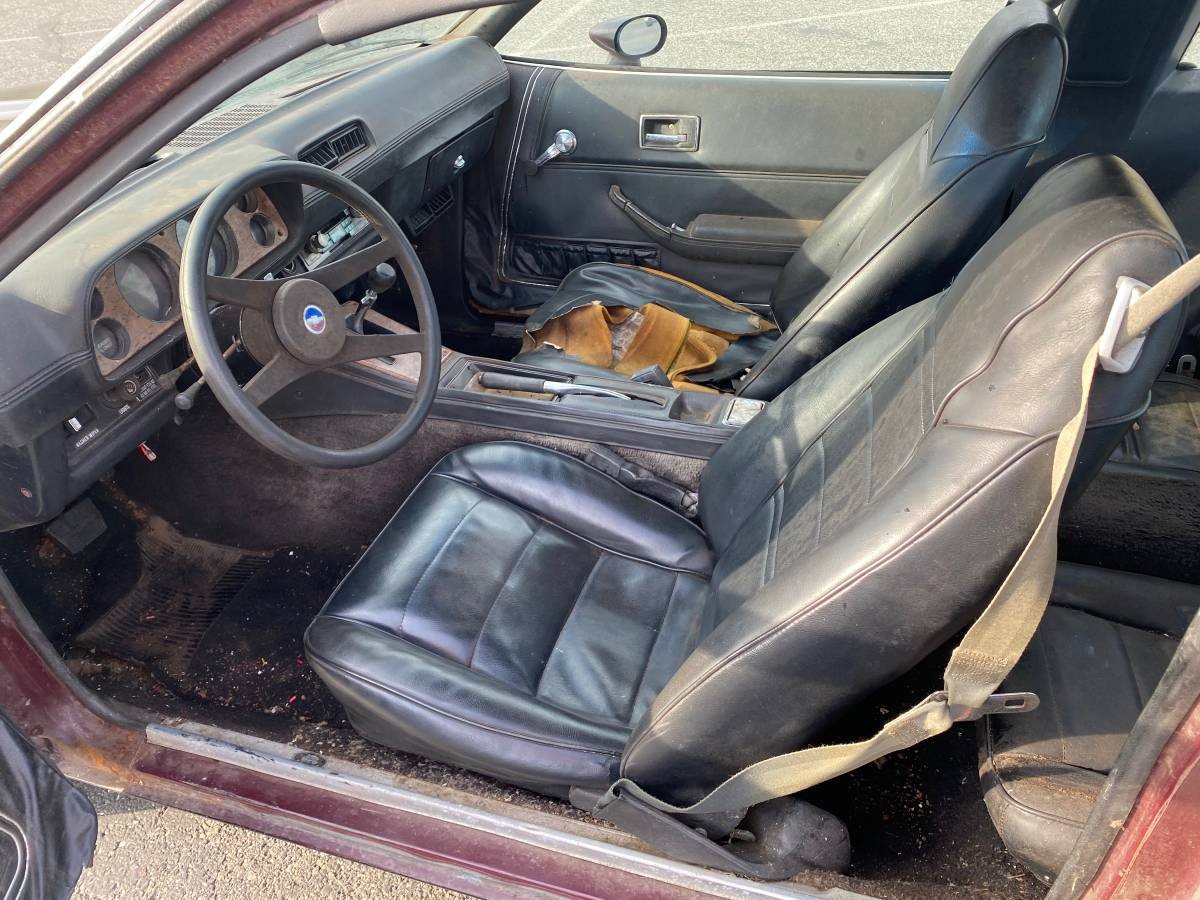
The problem areas lie with the body (rusted out rear quarter panel) and a rattle-can paint job (satin black covering the original burgundy). The interior needs loads of help (upholstery, carpeting, headliner). But we’re told it runs well. Maybe your best bet is to drive it as-is until it won’t go anymore, as all the cosmetic needs probably outweigh its future resale value.




Gaaaakkk, on a BFs roll, it seems. My ex-wife had a rather new ’77 Monza V8 ( a Vega on steroids) when I met her late 70s. It was, to her, a step up from her Vega, that my late ex-MIL inherited, and she loved it. The Monza was a poor car, and the V8 made things worse. Power to pass? Boy howdy, but poor in every other way. Her brother, who raced a ’65 Chevy at Hales Corners, had a profound influence on the V8. She didn’t know her rear from 3rd base, but the V8 was a much better motor than the 4 ever was. We drove that car all over creation, it lasted quite a while, thanks to the V8, but was pretty rusty by the end. For the record, the 305 was from the factory, the 262 phased out in ’76, I think. The 305 had a design change and no longer was the motor that had to be lifted( 262) to change plugs, but was still not an easy job. Kind of a fun car, very similar to the V8 Mustang ll, and inherently front heavy, and winter, FORGETABOUTIT. The V6 was better for this car, not available from Chevy, and the V8 was a much better choice for the extra $287 bucks. Clearly, not many survived. Quite a find.
The ’75 Monza did indeed use the 262 (at least, according to my data, which could be wrong), making 110 HP (net), and if you lived in California, your V8 Monza came with a 350 cu in (5.7 liter) V8 making 125 HP (net). Note that the ’75/76 Cosworth Vega also made 110 HP (net), but with much less torque.
I remember had to drill holes in fender wells to change two back spark plugs
First one I’ve seen in quite a while!
Automotive trivia. Restoring a Jaguar XJ6C a long time ago, I discovered that the immersed fuel pumps cost $129 from the dealer, but if you went to the Chevy dealer parts counter and asked for a Monza V8 fuel pump, it was $80, and if you went to the local autoparts store, it was around $29. Lay them out side-by-side, they were identical, and all 3 had AC Delco molded in the plastic end.
I am pretty sure this car is on youtube as a “will it run”. Right area of the country, anyway.
Back in the day, I bought a twin to the ‘75 Monza 2 + 2 new. Burgundy with black interior, no air, which made it a warm traveler. I had a sunroof installed which really helped with airflow when open, but on sunny days gave one the “living in a greenhouse” effect. The 262 was a peppy motor for it, the spark plug issue could be solved without lifting the motor, but it took time, patience, and a couple of knuckle socket attachments.
GM built Vegas and Monzas as throw away cars. Mine had around 80,000 on it when I realized the whole front end needed to be rebuilt. I was married and ended up trading it for an ‘80 Ford Fairmont wagon which had more room and ac, but even with the wood grain vinyl, wasn’t as sporty as the Monza.
I always liked this one….
The only nice Pontiac J2000, ever.
Steve R
Yeah, I realized after my edit time ran out it wasn’t a Monza. My bad.
Me too!!
I had a 77 Spyder with the 305 c.i. motor. It was my first car that I drove and I loved it. After about a month of owning it I pulled the 305 & added a 500 h.p.350 and then I really loved it. I raced the wheels of it then sold it and upgraded to a 68 Camaro 396 4- speed car. I sure do miss that car.
I had a 77 Spyder with the 305 c.i. motor. It was my first car that I drove and I loved it. After about a month of owning it I pulled the 305 & added a 500 h.p.350 and then I really loved it. I raced the wheels of it then sold it and upgraded to a 68 Camaro 396 4- speed car. I sure do miss that car.
I had a near new 77 Monza Mirage back in the day. At least memory says it was a 77? 305 with automatic. Drove it year-round in MN as my everyday car and I can tell you not a good winter car. I did really like it and if the right one showed up today I think a Mirage would be a real head turner and fun to own again.
The notchback coupe came later, it was designed to compete with the Mustang II Ghia. These were aimed more at the Mustang II fastbacks and since the Mustang II could eventually be ordered with the 302 V8, GM followed suit with the 262 and later, up to a 350 was offered direct from the factory. Like the Mustang II, the base engine was a four-cylinder. The Ford used the 2.3L four from the Pinto, these came with either the “Iron Duke” 2.5L four or the Vega four-cylinder. The middle engine choice for the Mustang was the 2.8L “Cologne” V6, the GM products got a pair of Buick V6’s, either the 196 or the more popular 231 V6.
https://en.wikipedia.org/wiki/General_Motors_H_platform_(RWD)
This is another car that I remember being EVERYWHERE including the Buick and Olds and Pontiac versions too. ( The Buick version was very popular it seemed in my town). My Grandpa had a ’79 two door wagon. Silver with a red interior and the Buick 3.8 V6. It wasn’t a rocket ship but was I’m sure much better than the 4. What I remembered was the car actually handled very well for what it was. I passed my drivers test in the 80’s in that car. But just like Howard brought out, rust overtook it.
I test drove a notch back monza with the V8 and a 4 speed. At least I think it was a 4 speed. This was in the early 80’s. I think they wanted 2500 for it and I had no intention of buying it, I just wanted to drive it. I was not impressed at all with the way it ran. My brothers 76 4 cylinder 4 speed ran better than that one
1st US car w/rectangular headlites
Those were everywhere when I was approaching my teen years. I always thought of the 2+2 as: “When I grow up, I’m gonna be a Camaro.” Same for the Sunbird. It was gonna grow up to be a Firebird.
& also the early Vegas.
My father had a 1976 Buick Skyhawk version of the Monza. 3.8 v6 automatic. Searingly hot all black vinyl interior.
When he got a 1982 Supra in 1984 the Skyhawk became his winter car and my sister mostly drove it the rest of the year.
It took a lot of abuse. The Panhard rod broke or rusted off the body mount 2 or 3 times. When it wasn’t attached the rear tires would rub on the inner fenders every time it changed direction. In the winter a 100 lb concrete block sat in the back ( cut from the basement wall of the neighbour’s house when he added an egress window. IIRC eventually the whole rear suspension was closed to rusted off, and then it was happily sideswiped by a FedEx truck. The edge of it’s rear bumper split the old Skyhawk from end to end like a tin of sardines. Totalled.
Might have been better if it had simpler LEAF springs in back like the Pinto, Maverick, etc.