
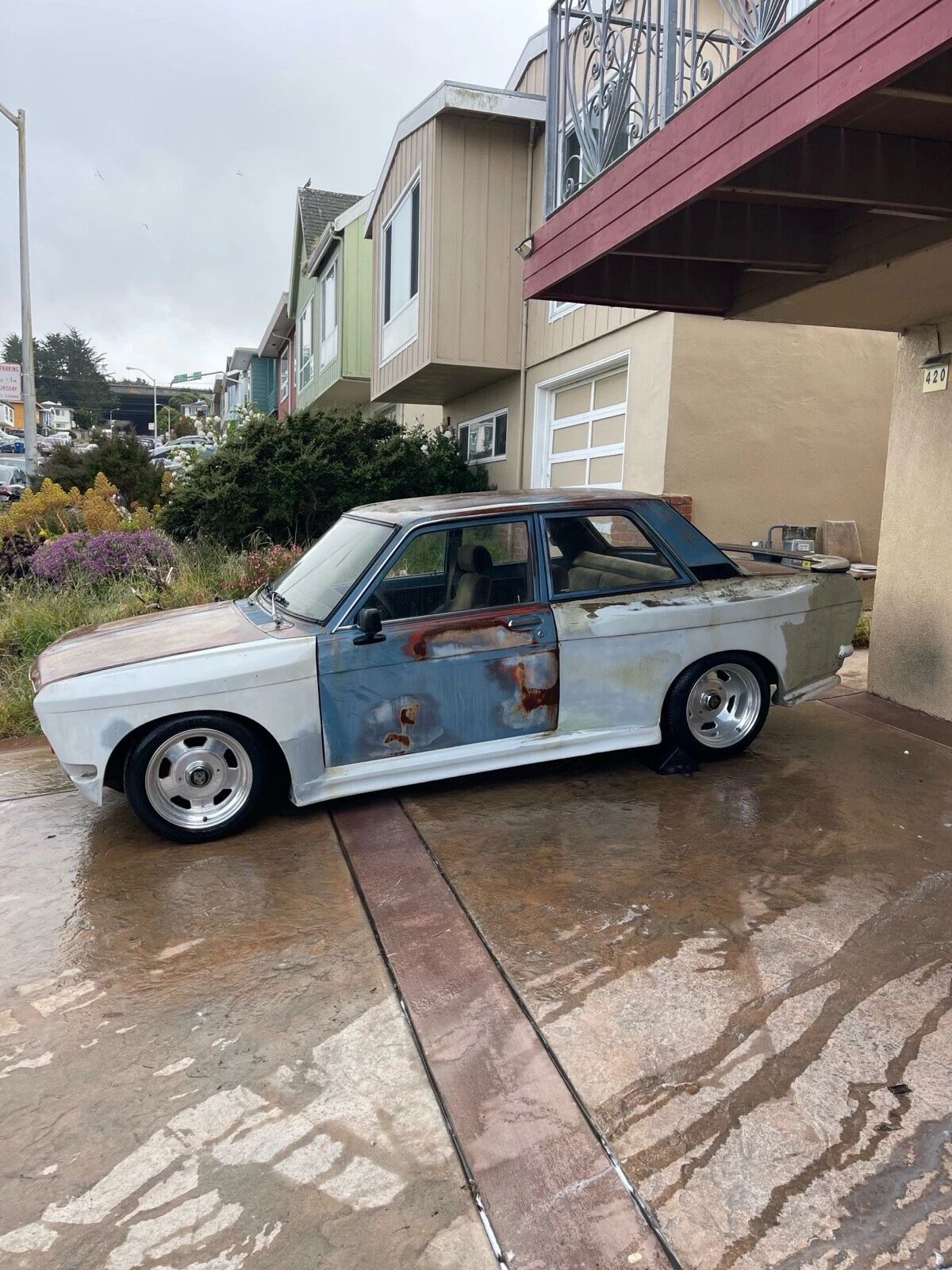
Do you have a car that falls decidedly outside of your usual preferences for a project and somehow keeps hanging on, lingering at the edge of your perspective? That’s the Datsun 510 for me. I really have no desire to go outside my traditional habit of buying 90s/2000s fuel-injected German cars and trucks, but the 510 is one of those vehicles that stops me in my tracks when I see one, likely because it is one of the few cars to ever threaten the granddaddy of sports sedans, the BMW 2002. This one listed here on eBay appears to be a stalled widebody conversion with some other modifications performed.
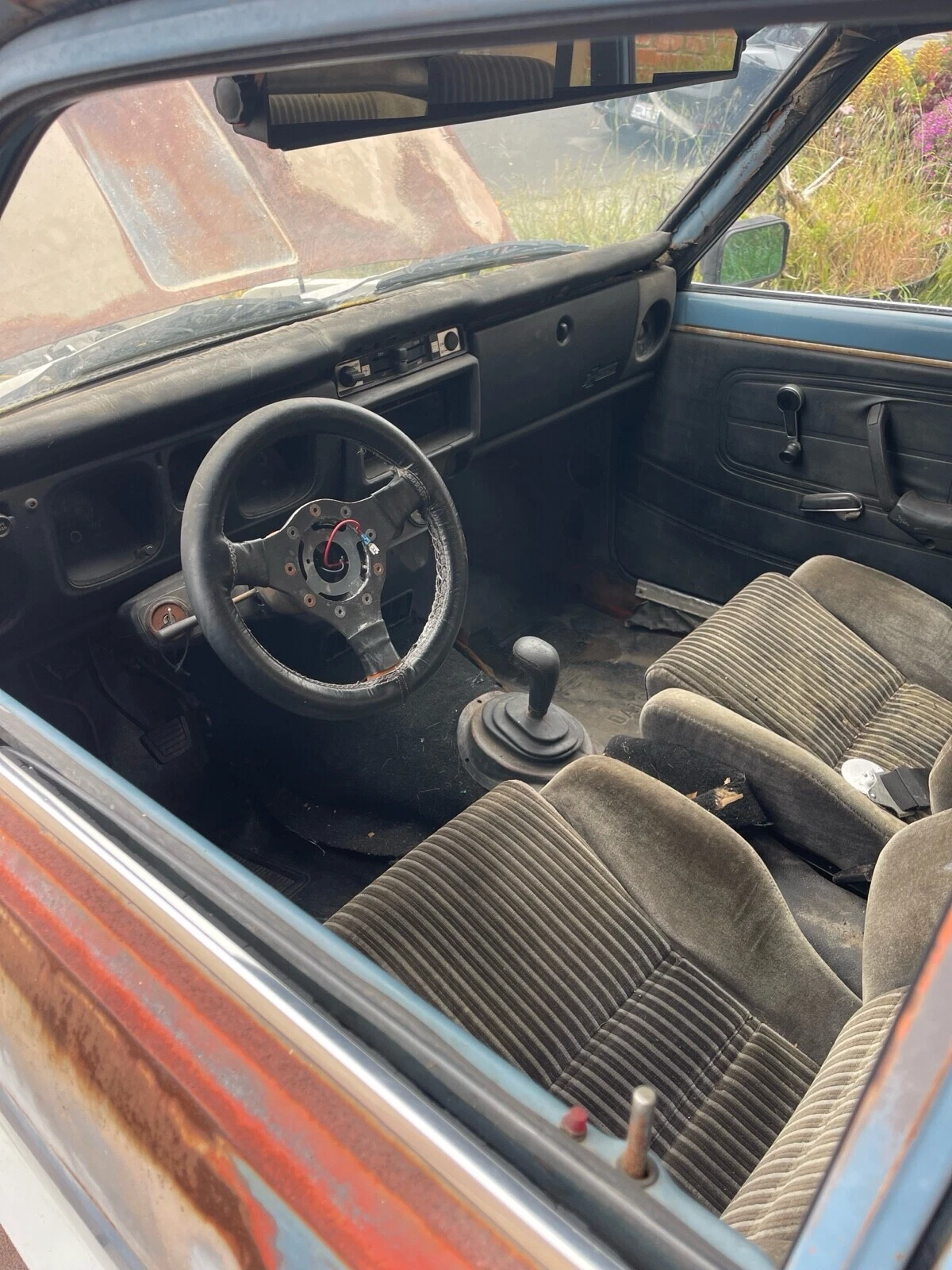
Now, there’s one car in particular that I have in my sights and would love to someday make my own, and that’s a modified Datsun 510 residing in the Toad Hall car museum collection on Cape Cod. I’ve visited this car every few years and have spoken to the owner about it; this is the reason when I see a 510, I still think about owning one someday. The 510 is one of those rare models where you can appreciate it in stock form but also as a modified vehicle, and the market rarely punishes a seller for choosing to tastefully enhance his ride. The 510 still enjoys a deep aftermarket supply of body parts and performance modifications, and this one appears to benefit from both – but those seats are likely from an 80s-era Honda or Toyota product.
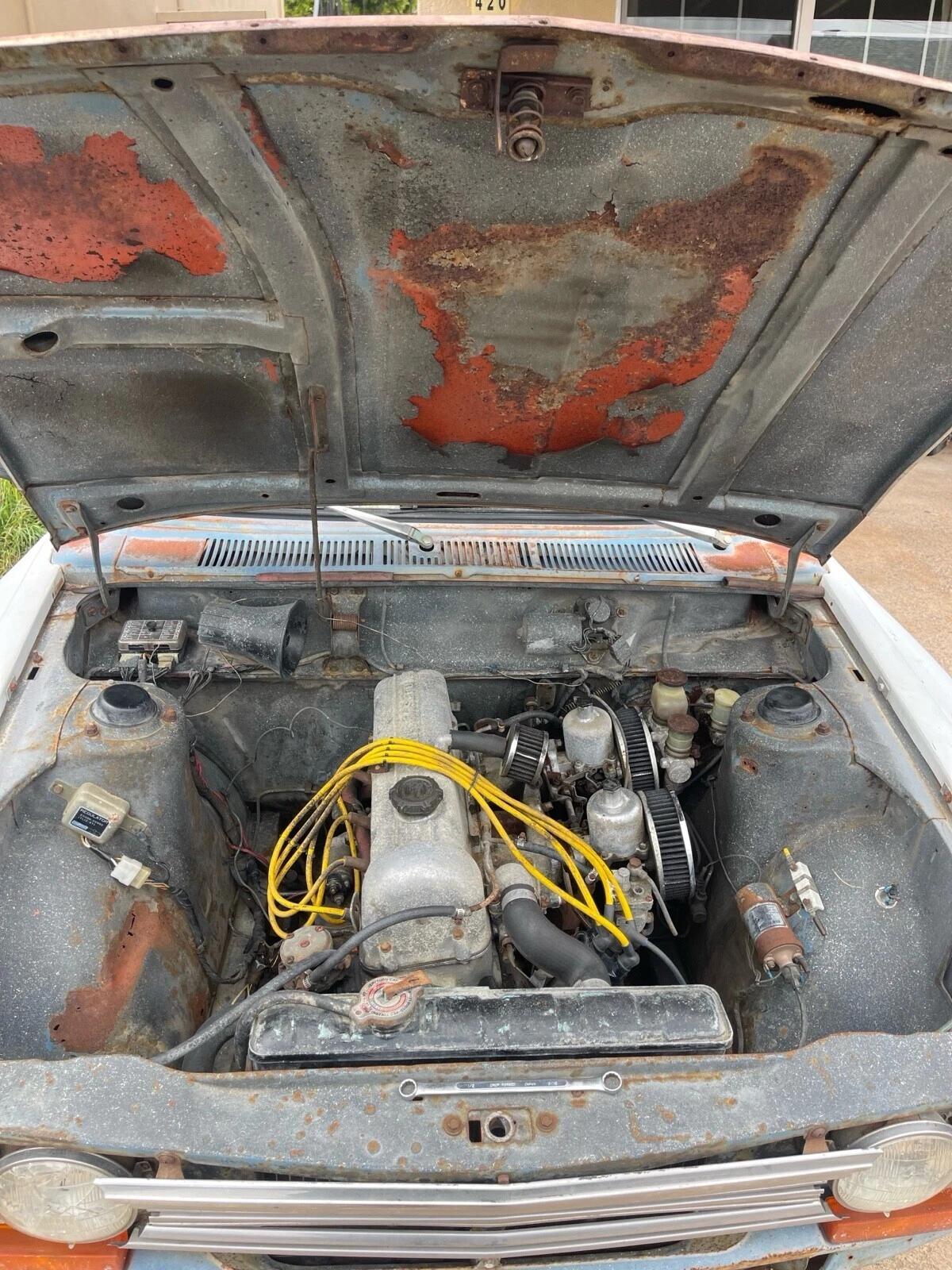
The L16 engine that came standard in the 510 wasn’t particularly exotic, but it did make 96 horsepower – which, for a Japanese car in the 1960s that wasn’t a high-performance build or a luxury model, was more than respectable. I’m going outside of my lane in guessing carb setup, but I want to say this is a twin SU carburetor arrangement, which is fairly common when you have a 510 and want to ditch the stock air cleaner assembly. The seller claims it runs but doesn’t offer much else in the way of background; the plug wires are clearly more recent and aftermarket.
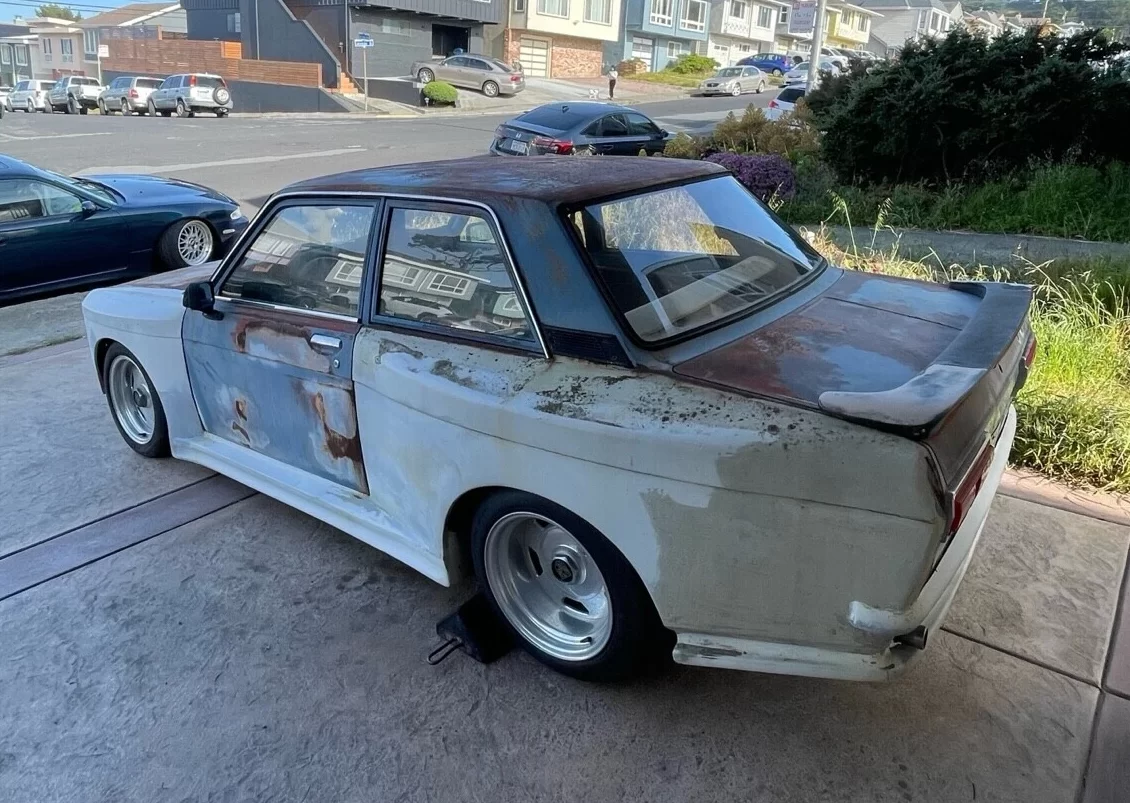
The seller also seems a bit clueless about the widebody conversion, though it absolutely has one. The listing notes that the fender enhancements are fiberglass and not steel, so the level of quality baked into this kit is anyone’s guess. The wheels are certainly expensive and likely a custom offset to match the wider arches, but again, we have more questions than we do answers when trying to assess the quality of the work done and why it stopped. Still, there’s no denying the curb appeal of a 510 and its contributions to the sports sedan market, so hopefully this one comes back to life as a modified example finished to a decent level of quality.




Between the owner not knowing much about the car and it being a “stalled” project, one would need to look at this car closely before making any cash outlay.
This looks like it’s been sitting for a long time. Daly City is one of the few places in the Bay Area where rust is a concern, luckily, if there are problems they are relatively easy to spot because they rust from the top down due to the proximity to the ocean and constant fog.
The 2dr 510’s have been sought after since the mid-70’s, most that still exist have been modified, most better than this. Unless a potential buyer was searching for one with this style of body modification I’d keep looking for one closer to my plans rather than pay a premium for work I was going to redo.
Steve R
The bodywork is based on the IMSA race cars of the ’70s and ’80s that Peter Brock designed and raced. We raced one in SCCA events in the late ’90s and it was a fast and fun car to drive. The kits to make wide bodies are still available though the SCCA cars are not allowed in most of the classes they run in.
Although not wildly popular, I like the look of these cars. Where can I find a body kit?
Was looking for one in the late 90s found a few but most were rust buckets. So instead I found an 83 corolla bought it for $100 cleaned the living s_ _t out of it and put the 20R and five speed out of my probably 500,000 mile 76 RUSTY celica. Still have it currently building a BAD ASS 22r for it. I still would love to have one of these but would like to buy one somewhat done for a decent price 🤣🤣 but way to many projects and no time or money 😪
like the body more oem and mods ‘sleeper’. I see both the wagon and sedan in local competition. Great ‘smooth’ looks & (’67/73 build) asa pre ‘80s “square lines” world evolution of the auto design art.
Probably Japanese made SU clones, most likely Hitachi- that is what my friend had on his ’67 1600 cc Fairlady.
I have always liked these. But thought a 2 door wagon version would be the coolest thing ever. But grafting a wagon back end on would make a fuel tank issue. (The reason that the wagon is not and independent rear suspension version) I actually looked carefully into doing that conversion when a family member had a rust free 2 door. 510s in any version are great cars, any without major rust need to be saved, in my opinion. You would need a complete (Most likely) rusted out 510 to use as a parts car to take on this project of love.
It might wind up as a race car for VSCCA races like the last one.
The US versions of the L16 engine were shipped here with the 2 bbl vacuum operated secondary Hitachi Carb. Japanese domestic versions had the SSS dual SU carbs that would not pass US emissions restrictions. Those engines had higher compression and a different cam profile. Can’t tell from the outside if this is just a carb conversion or the entire engine swapped in from the Japanese domestic market as those engines were imported to the US. Nonetheless, the Hatchi equipped 1971 L16 would deliver 96HP or almost 1 HP per Cubic inch which was considered a real performance standard only a few years earlier with the Corvette. These engines were very durable and much better than the Toyota 18RC of a similar time, in terms of valve and timing chain life. Plan on a head gasket change at over 100K miles as they started leaking coolant into the combustion chambers. You need to make a special tool from a wooden paint brush to jam between the timing chain both sides to keep the tensioner plunger spring from pushing the tension out of the housing. If that happens, you need to pull the front cover to fix it.
For a clutch, use the 2000 roadster pressure plate which had a higher spring pressure and lasted longer than the stock unit.
My family owned a 521 truck, a 510 sedan, an 810 sedan which had the L24 fuel injected engine, and several 620 trucks. I had to change the head gaskets on the first 3 at just over 100K miles. The 620 Trucks were sold or traded before that milestone.
My 521 Truck ultimately ended up with an L18, a set of headers, a webber 2 bbl carb, electronic ignition, a 200SX 5 speed, 510 sedan bucket seats, Shelby aluminum rims with 60 series Good Year Eagle tires and was fast, fun, simple and easy to work on with great parts support. Best of success to the lucky winner.