
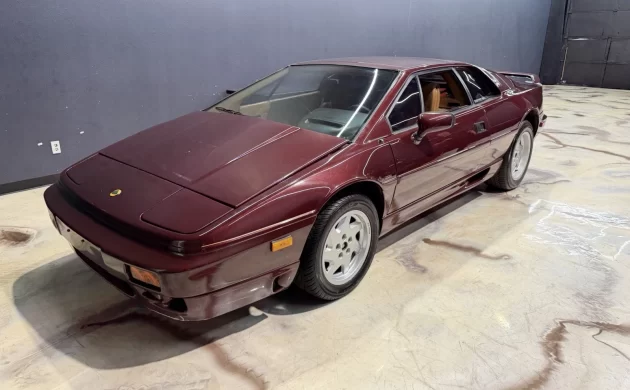
The Lotus Esprit is still out there, folks, and despite its relatively low price of entry for a real-deal period supercar, owners are always willing to invest heavily in their upkeep. As someone who obsesses over receipts and documentation, it’s incredible to me how often we see listings like this one here on eBay for a 1989 Lotus Esprit SE, which is listed for right around $30,000 and just recently enjoyed a $10,000 service. Owners seem to lavish these cars with attention despite the fact they reliably sell for under $40,000 when their peers from the same era are regularly pulling significantly more than that. Is the Lotus Esprit underappreciated, or are the heady maintenance bills a sign of why they’re still affordable?
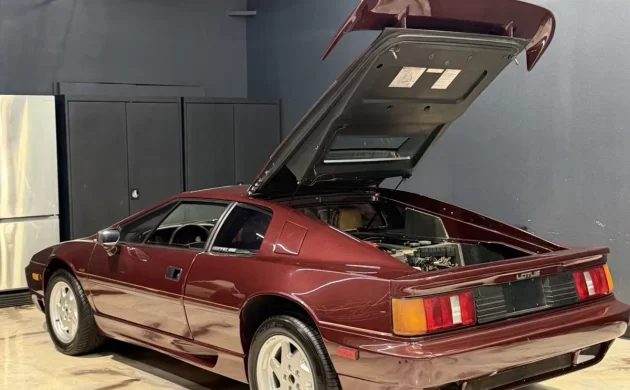
There’s likely no correct answer to that question. Old sports cars require a fair deal of upkeep, no matter the marque. Engine-out servicing is not uncommon whether it is a Ferrari 308 or a Porsche 911. The Lotus may have the same requirements, but it doesn’t have the same price tag. The question is, does that lower cost of entry make the stubbornly high maintenance costs worth it? When it was new, magazine editors reported blistering acceleration for a car with under 300 horsepower, thanks to its low curb weight. No joke, the Esprit was faster to 60 than both the Lamborghini Countach and the Ferrari Testarossa when new – that’s some impressive performance chops considering the value of each car in the present market.
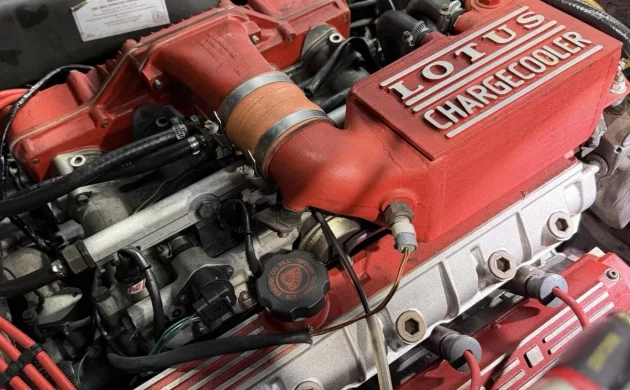
The SE trim unlocked a variety of upgrades, most significantly performance-wise. The induction system was revised, exhaust back pressure was reduced, and the fuel injection was re-programmed. This gave drivers of SE examples a 36 horsepower increase over the base model. Other tweaks include the air-to-liquid intercooler which likely gave it the biggest gains in terms of all-out performance. Taking heat out of the engine bay and transferring it to a heat exchanger is the easiest way to explain it, and all the various cooling components, including the A/C compressor and oil coolers, are part of a massive radiator assembly in the nose of the car. I’m sure the Lotus engineers ensured maximum weight balance was achieved with this system up front and the engine mounted mid-ship.
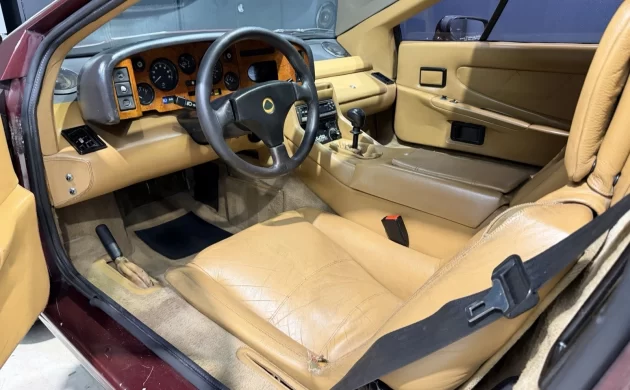
Since the Esprit was a hand-built car, build quality varied greatly from vehicle to vehicle. This is part of the Lotus experience, where you inevitably found various mechanical components and body panels needing adjustment. The interior of this Esprit looks quite tidy for a driver, and while there are flaws, none of it will be too difficult to repair. The Lotus team saw the contemporary 911 Turbo as its primary opponent, which should tell you something about its performance capabilities and what a bargain it is today. With $10,000 in engine-out service done, you’re in a good position to enjoy this Lotus for some time before the next repair bill hits.



I have always wanted one of these, i did have a Europa, but the problem is i am over 6 feet tall with big feet. Looks like a good deal.
Something I learned from “The Grand Tour”:
(L)ots (O)f (T)rouble (U)sually (S)erious
Having never owned a Lotus, I cannot comment on the veracity of the above.
That line has been done to death,& seems to come up
with every Lotus featured.And unmless you’ve owned a
British car & had a lot of problems with the electrical systems,
please stop with the bad LUCAS comments.
I had an Elan & understood that it wasn’t the same as
a period Impala or Galaxie.
For this kind of money, you can find something faster and much more reliable, and you won’t have to pull the flippin’ engine to do general maintenance.
I agree! If it had a Porsche engene it would be a bargin.
You don’t buy cars like this because it’s going to offer the most reliable and best bang for the buck. If you want to do that just buy a corvette. But then you wont have a car that james bond drove.
Bond didn’t have to fix it.
As an owner of an ’88 Esprit for over 35yrs. It’s been low maintenance. The timing belt (Gates T188 $80) has been changed several times and the water pump has been rebuilt, two regularly sourced Bosh fuel pumps. That’s it. Engine is out in an hr. Even Hovie’s Garage was surprised to see that happen on a V8 Esprit.
I had one too. Turbo SE. It was very reliable. Two clutches, a couple of timing belts…my 997 cost $9300 recently for an engine out, brakes all around and one tire.
I’d imagine, and I’m probably not the only one who thinks the value of these Esprit’s will always fall short of other comparable models because its basically a fiberglass hard to work on kit car with a measly 4 cylinder engine. You could bolt four turbos on it and it still wouldn’t help.
I think even the later cars values are dragged down because the bloodline traces back to a 4 cylinder. I think they’re really cool cars but I couldn’t afford even a VW based kit car so who cares what I think. Some days it’s better that no one cares what I think, LOL!
Beautiful car in a beautiful color that I have not seen before. I enjoy building my cars and then driving them. The idea of having it sidelined for major maintenance/repairs and having someone else doing it. Rubs me the wrong way. Not to mention the cost.
As a lifelong car lover , my first drive in a convertible car , confirmed my love for open air driving so , this car has never been on my list to have but they are really nice to look at , their reputations are not great but with all cars , the aftermarket has solved most issues , buyer will be proud to drive it !