
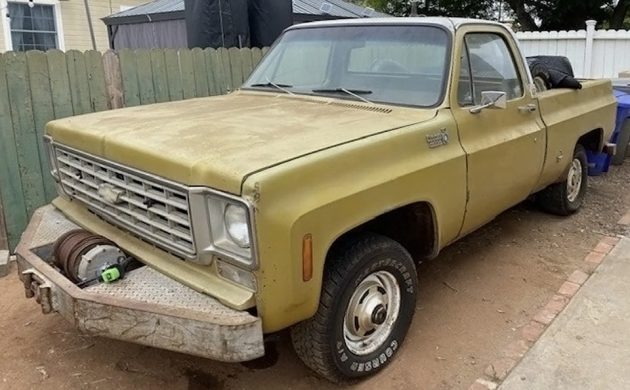
Yuba Gold is a great color for this 1976 Chevrolet K10 4×4 Short Bed pickup. The winch and big front bumper throw me off a bit. I did not expect to see that, especially on a short-bed truck. This one was made in California and appears to still be there, listed here on eBay in beautiful San Diego, California, where I should have moved after high school. The seller is asking $8,500 or best offer.
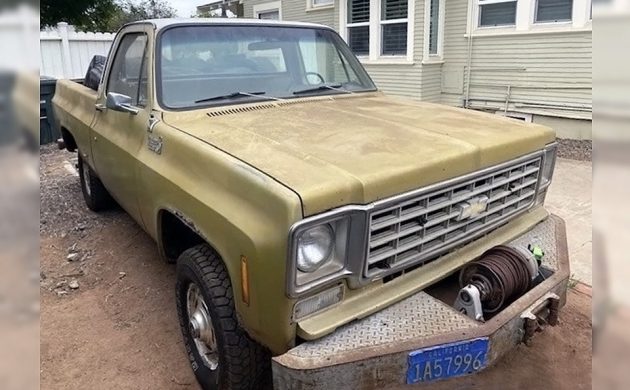
I don’t think of short bed pickups as being workhorses, so that giant winch and front bumper seem somewhat unusual. I love it, though, I would not change that to a regular small front bumper myself. I think I would leave everything as it looks now, other than cleaning it and trying to polish it up as much as possible without ruining the original paint. I’d even leave the rust over the right front wheel well.
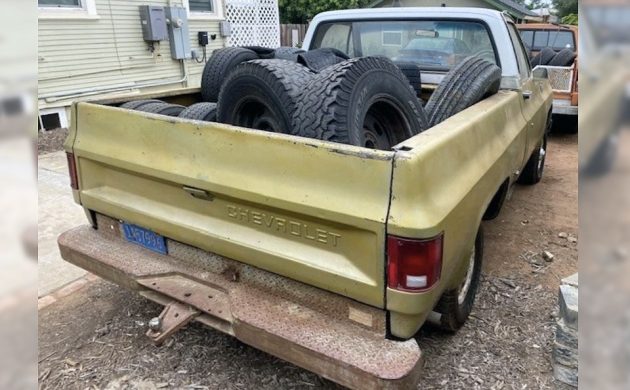
The third-generation Chevy C/K series was made from 1972 for the 1973 model year until 1991 here, and the seller says this one is a short bed, which would have had a 6.5-foot bed and a 117.5-inch wheelbase, up 2.5 inches from the previous generation trucks. It sure looks like a short bed to me, but so did the one Elizabeth recently wrote about, and there’s a comment about it not being a short bed.
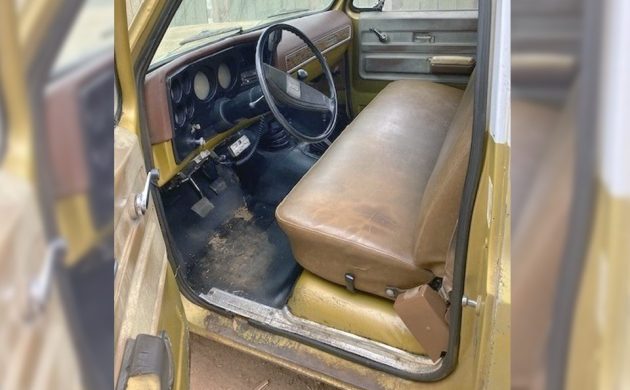
This truck is anything but perfect, but it looks like it would all clean up pretty well. I believe the vinyl seat cover has been added as the original would have had some detail to it, not just a big slab (piece) of vinyl. It looks perfect, though, and even more perfect is the fact that this truck has a 4-speed manual! A 4×4 short bed with a 350 V8 and 4-speed? Yes, please.
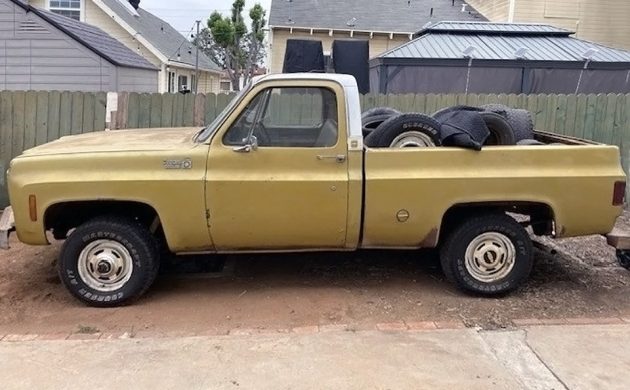
The driver’s door appears to have been repainted at some point, but I would probably still leave it. I would love to see what this truck would look like after cleaning and detailing the heck out of it. Sadly, the seller didn’t bother to pop the hood to show us the 350-cu.in. V8 (according to the VIN), and it would have had about 165 horsepower and 250 lb-ft of torque, sending power through the 4-speed manual and 2-speed transfer case to all four wheels as needed. They say it runs, drives, and stops, so that’s good, right? Hagerty is at $6,600 for a #4 fair-condition truck, which is about where I’d put this one, but I’m no expert by any means. Unless we’re talking about Andy Griffith trivia. How much would you pay for this K10 4×4?


Cool truck Scotty. A short bed with a 350 and a 4 speed and 4WD. Yes all day long!!! I agree with you about the paint and possible body work. The tailgate is actually a newer one. The Chevrolet lettering was centered and typically painted if memory serves me correctly from all my Dads Chevy pickups from when I was a kid. I’m wondering if all the tires in the bed acts as ballast, I’m wondering if you stand on the brakes with that huge front bumper and winch if it would do a front wheel stand ( just kidding). I won’t comment on a price, I’m way out of touch in that department. This is a great truck Scotty glad to see it written up here, I enjoyed it.
Popular set up for a long time w sportsman. Shortbed 1/2 ton 4wd w stick. A bit smaller size is beneficial for off roading and getting into the lakes 🐟 🎣 for hunting 🦌 and fishing. That’s a serious front bumper setup, definitely an extra leaf spring reqd… are these leafs up front ? Not that familiar w Chev trucks. Thanks for the article SG.
Good truck for the shape it’s in. I am a little surprised to see a Southern California truck with rustouts.
1976 was a good year for 4x4s. We sold a pile of them, even Shortboxes. I remember ’74 and ’75, they offered the NP 203 (full-time) transfer case only. The General must have gotten enough complaints that it allowed the 205 with free-running front hubs again. I did not like the 203 back then; I hated it behind a manual and if you had an automatic, there wasn’t enough substance in the transmission case to support the weight of the transfer case. We had a lot of them fail, right above the rear mount. It wasn’t until ’78 before the designers finally got some adequate brace rods that eliminated that problem.
These trucks were good to work on and ultra reliable. I can easily say that they were the best that GM had to offer for a long time. You just light them and ride them.
I would want to see everything underneath because I’m not fussy about the rust. Like I said: California? Was it parked on the beach?
I had to laugh at your comment regarding it taking several years for the manufacturer to correct the failing transmission cases. In my years as a service manager for emergency vehicles, I can’t remember how many times we had to correct OEM manufacturing or design errors in our shop. Trying to get manufacturers to pay warranty claims (often, for some really stupid self-inflicted problems) was always a battle. One who is no longer in business kicked back a claim that involved tracing an inoperative light- the problem was a damaged harness buried in the body. They refused to pay for the troubleshooting time, so I resubmitted the claim with no troubleshooting time, but four hours to change a light bulb. They paid it. Another time, we had a new apparatus, built by the same company, that the windshield wipers would make one cycle when starting the vehicle. We figured out that it was an undersized engine to chassis ground cable, causing the engine to hunt for any available ground paths while starting. They happily paid us this time, as their service manager admitted to me that they had thirty new apparatus in their service department that all had the same problem. There was a time when four wheel disc brakes were popular on fire apparatus. After doing a full brake job on a 30,000 pound truck (rotors, pads, etc) the truck would start to roll when parked on a steep hill, where it always held before. Even though we ordered OEM replacement parts, it turned out that, in the interim, Rockwell had reformulated the pad material to remove asbestos (without notification) reducing their coefficient of friction and reducing their holding capacity as a parking brake. The solution was modifying the fuel tank at the rear of the chassis to fit the largest brake chambers available to the rear axle to increase “clamping” pressure. A constant one was, after contacting a manufacturer concerning an obvious warranty issue, I can’t remember how many times I was told, “That’s surprising- we haven’t heard of that before. However, we do have an update kit available that will correct that problem.” Okay… This was basically my daily routine, with Monday being the worst, dealing with the pile of fire trucks that broke over the weekend that needed to be repaired by noon (in the opinion of my clients). Now retired, I sometimes actually miss it, but then I wake up. 😉
I am not a service manager but my manager at the dealership I work at has had to deal with fighting for warranty claims to be paid for for weird problems on these newer Jeeps. Thats why a very good detailed story on a warranty repair is al ways good.
@ Mark
I had a really skilled mechanic who worked for me who was equally unskilled at paperwork. On one apparently unenjoyable job, he turned in his time sheet for the day with “fix truck” describing the repair work performed. I went to him and asked for more detail. I got back “fix f______’ truck”. I thanked him for the additional information and made up the tale of woe from there. Whenever I had to justify a large repair bill (often $10K+), I had to sit down and write a very detailed explanation of charges and repairs. The bigger the bill, the bigger the story, as I used to say.
Oh, enough said about me and square body GMs,,,now, if it be A-G trivia the author is after,,, in the early 1960 episode “The new Housekeeper”, where Aunt Bee makes her 1st appearance, Andy brings her home in what kind of vehicle?
Unsurprisingly, it has already sold, the seller accepted an offer.
Steve R
I’m restoring a k10 it had a inline six and we swapped it for a four hundred, that puppy is going to have so much power