
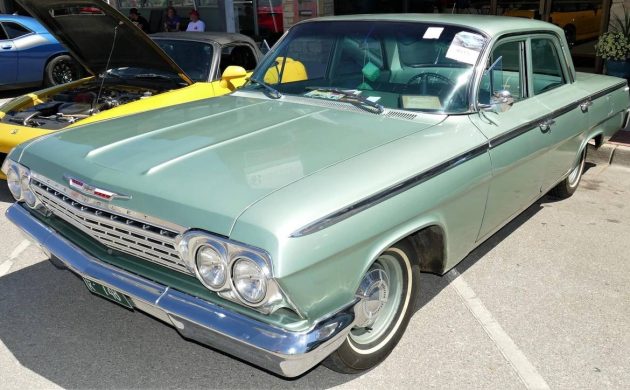
If you wanted a new, low-frills, full-size car in 1962, the Chevrolet Bel Air was hard to beat. It was a step up from the fleet-quality Biscayne, but not as well equipped as the top-of-the-line Impala. The seller’s car is as basic as they come, with a list of paid options that could be counted on one hand. Although it’s a 4-door sedan, it looks brand new, with just 30,000 miles on its odometer. Located in Topeka, Kansas, this survivor-quality Chevy is available here on craigslist for $26,000. Also, it’s a tip brought to us by Jack M.
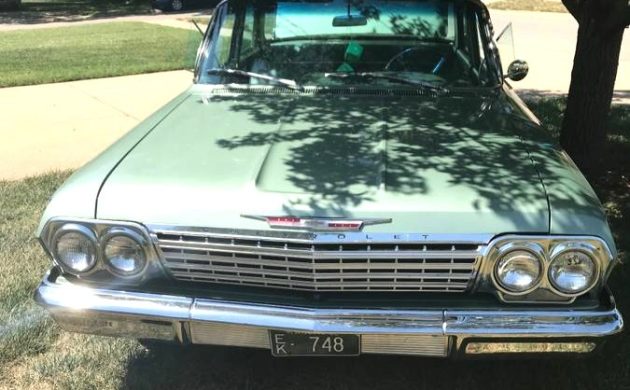
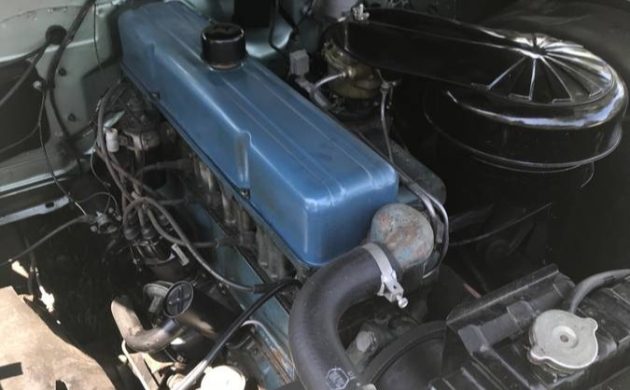
This Bel Air is a simple means of transportation. Starting with a 235 cubic-inch inline-6 that only delivered 135 horsepower (a far cry from the monster 409 V8 you could order). The transmission is the venerable 3-speed manual with the shifter on the column, of course. From the copy of the MRSP provided by the seller, the extras are “permanent” anti-freeze (that was really a thing?), an oil bath air cleaner, overdrive added to the 3-speed, and tinted window glass. All of this cost you an additional 100 bucks, raising the total ante of the purchase to a whopping $2,766. About 10% of the seller’s asking price in 2025.
As the story goes, everything you see should be original (except consumables, naturally). The machine’s first owner was a little old lady (no, not from Pasadena) in Kansas who drove it only to church and the store (really?). When she finally parted company with the Chevy, it lived in a museum for many years. Along the way, the Bel Air has turned up at shows and collected a few awards (not pictured).
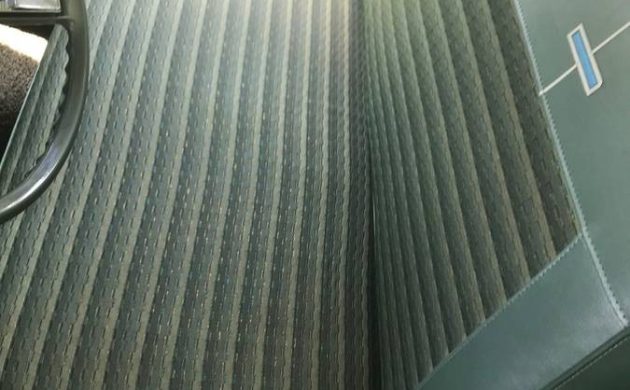
We suspect this Chevy is still sporting its factory Surf Green paint. The interior colors are coordinated to match. If there are any flaws with this car, we don’t know what they would be. Nor is any mention made of any servicing that is needed to take it out on the highways and byways. Given the basic features and four doors, is this sedan priced correctly to sell?




Wow. This is litterally a brand new ’62 Chevy. This is what was very common back then. Most were used up and eventually parted out for their more ” popular” 2 door and convertibles. I’m very impressed with this condition, and hope its new caretaker keeps it this nice.
My baloney has a 1st name,,,ah the old lady schtick, newsflash, grandma didn’t row through the column gears, or knew what overdrive really was, much less a hefty priced option to boot. None of the “bubbies” I knew anyway, and we knew a lot. No, this was her frugal Harolds car, ordered it, rarely drove it, and more than likely passed away, and the car sat. Didn’t even get a heater, not many women I knew would go for that. I bet “Doris” never even had her license.
RE: “permanent anti freeze”. Years ago, late 50s, early 60s, cars were still being cooled by water. Anti freeze was pricey, and most in warmer climates, just used water, hence that geyser of rusty brown water upon overheating. The term “permanent” came about because you could use it year round, permanently. I remember old timers saying, “you’re leaking permanent”.
Can’t resist, the stick is killing the sale. An automatic, this car wouldn’t make it a day. The stick is going to have to take the right person, and they just checked out yesterday,,,you’ll see, I was right.
I think your spot on here. Put it back in a museum, though, car museums in general are failing as Boomers bite the dust. Ideally, someone whose dad owned one would get it and love it, but it is 10X the price for that to happen. probably get bought for ten grand by some overly rich guy to put into a huge collection. At least, it won’t get put outside to rust, that is something.
For me the stick on the column would prompt me to buy it, but I’m old enough to have driven a bunch of them. No heater! That would be a deal breaker for me living in the Adirondacks. That and the price is what would hold me back, yes it’s really nice and as close to perfect as you can get but for the money there are much nicer and fun vintage cars and trucks to be had.
First car I ever drove was just like this, my older brother’s blue one. I be-bopped all over Denver rowing that three speeder…loved it. I spent a lot of time in SW Kansas (probably passed by this very car, it’s from Spearville) as a kid in the sixties and this car is equipped just the way I remember many folks, including relatives near Garden City and Dodge City would buy. That would include the overdrive, to cruise longer distances across the prairie at fair velocity. And the column stick wasn’t an issue with the farmers wives, I mean…they drove tractors at times.
Many of these cars still survived into the eighties in some areas of the plains states. After being handed down as a ride for the school kids, they would be relegated to “field car” status, basic utility transport. My teenage brother and cousins would run around at night in field cars hunting coyotes and varmints. Old Chevy’s and Ford’s…basic and tough.
By the way, this car has a heater, they were standard on all the full size sleds, including the Bel Air and even the “lowly” Biscayne. Way to cold in winter down there to not at least want a heater.
I have a 59 Chevy two door sedan with synchromesh and a 59 Buick Convertible also with three on the tree. Hopefully I got a long time before I check out.
It’s a great looking car, but how much of a market is there for a 1962 full sized 4 door Chevy with an asking price of $26,000? If you drive it you hurt value, the 6 cylinder and column shift don’t make for the greatest driving experience. Sure, it will draw a lot of eyes at its first few coffee and cars, but so will a lot of other well preserved 4 doors and other cars without a strong following from the 1960’s through 1980’s that you can get for a fraction of the price. This car lives squarely in the segment of the hobby, where price matters, enthusiasts drive prices, there probably aren’t a lot of enthusiasts who have a car like this at the top of their list.
Steve R
For the love of God, someone responsible please buy it and keep it from being “modified” with hydraulic suspension or some similar mularkey
Alot will give this a thumbs up, but at that price, opening their wallet is a different story, for the reasons Steve stated.
You are right, often vocal proponents are hard to find when it’s time for action.
Steve R
Plenty of people will shell out 26 large for a vanilla Chevy in this shape, but with an automatic. Sure, they’ll be getting an actually brand new Trax, but they’ll number in the tens of thousands.
If there’s a butt for this seat, at this price, the clutch pedal won’t put them off.
GM greens with their green tinted windows are so satisfying to look at.
So many colors both inside and out. Having a match in blue, green or turquoise was quite common. Glad DRV noted the tinted glass which was still a poor man’s climate control. I like it for everything it is but wonder how much it would serve me in today’s traffic.
People are still loving the straight 6 and 3 on the tree setup.
https://youtu.be/RwQrJfqVM6U?si=sXFI4_HfSkr6fLoo
Please whoever gets this beautiful car, do not drop in an LS engine or Tremec and a useless Blue Tooth whatever you folks listen to today. I love it as is. Back in the day, granny could drive a stick. Today, most kids can’t even put air in a tire. You could maintain this with a Craftsman SAE starter tool kit. No dumb check engine light or TPMS sensor glowing in your face.
My mother drove a 63 bel air wagon with a six and three on the tree for over eight years in the late 60s until we got our first new car in 73. With us five kids aboard,EVERY BODY knew how to drive a stick back then. Autos were a luxury
My granny drove a 3 on the tree. And there was a time when she was in a hurry that the right rear tire made black marks on the pavement and even squeaked the same tire after shifting into second gear. She grew up in Tennessee (even went to the same high school as Dolly Parton although many years ahead of her) and I always thought that she might have run moonshine in her younger days. (I actually saw some her brother made) She was quite the character.
This was the last year for the “Blue Flame” 235 CI 6 cylinder engine. And the last year for the crankcase vetilation/draft tube.
The next year (1963) saw the introduction of the 230 CI engine which used many if the engine parts from the 283/327 engines of the time. Please correct me if I screw this up as I am getting old. But the pistons, rocker arms, and I believe connecting rods were all small block V8 parts. (Part of the reason for making a slightly smaller size engine than the 235.) The 1963 model was the first year of 50 state pollution control device known as the PCV valve. Which was actually a good thing for engine longevity. Making engine sludge a less likely by product. And just for you young wipper snappers out there. The next item to improve engine life. Although it was a by product of other pollution control devices. Was lead free gasoline. Which not only improved engine life. It has had a very positive effect our individual lives. (Read about lead poisoning testing where there was only one laboratory in north America where actually real testing for lead related toxins could be performed. Because all the other labs were lead contaminated! Our clothing, hair, the ground, our food, everything was lead contaminated )
Don’t label me a tree hugger. Because I’m not. And I’m not a fan of many of the “pollution control devices” because I believe that they go overboard and adversely effect engine performance. (Particularly fuel economy and sometimes engine life on some engine designs.) BUT, PRIMARILY fuel injection and computer controls, (primarily exhaust O2 sensors) have been a very positive addition/requirement to our internal combustion engines.
This was the last year for the “Blue Flame” 235 CI 6 cylinder engine. And the last year for the crankcase vetilation/draft tube.
The next year (1963) saw the introduction of the 230 CI engine which used many if the engine parts from the 283/327 engines of the time. Please correct me if I screw this up as I am getting old. But the pistons, rocker arms, and I believe connecting rods were all small block V8 parts. (Part of the reason for making a slightly smaller size engine than the 235.) The 1963 model was the first year of 50 state pollution control device known as the PCV valve. Which was actually a good thing for engine longevity. Making engine sludge a less likely by product. And just for you young wipper snappers out there. The next item to improve engine life. Although it was a by product of other pollution control devices. Was lead free gasoline. Which not only improved engine life. It has had a very positive effect our individual lives. (Read about lead poisoning testing where there was only one laboratory in north America where actually real testing for lead related toxins could be performed. Because all the other labs were lead contaminated! Our clothing, hair, the ground, our food, everything was lead contaminated )
Don’t label me a tree hugger. Because I’m not. And I’m not a fan of many of the “pollution control devices” because I believe that they go overboard and adversely effect engine performance. (Particularly fuel economy and sometimes engine life on some engine designs.) BUT, PRIMARILY fuel injection and computer controls, (primarily exhaust O2 sensors) have been a very positive addition/requirement to our internal combustion engines.
So this car and the others of the same model year were the last of the breed before government intervention into our hobby/passion. In many cases (in my opinion) this has not been a good thing. And many times has created more expense due to “unnecessary” heavy park bench bumpers, unnecessary emission control devices, etc. But in some cases ( mostly byproducts of government regulations) there has been some good. Fuel injection along with computer controlled O2 sensors create more efficient vehicles AND can “set the table ” for all kinds of ADD ON horsepower. So at the time (1962) we didn’t really comprehend that it was an end of an era. It was a small stop and jump into 1963. But history shows us now, that was just the beginning of our current status quo.