

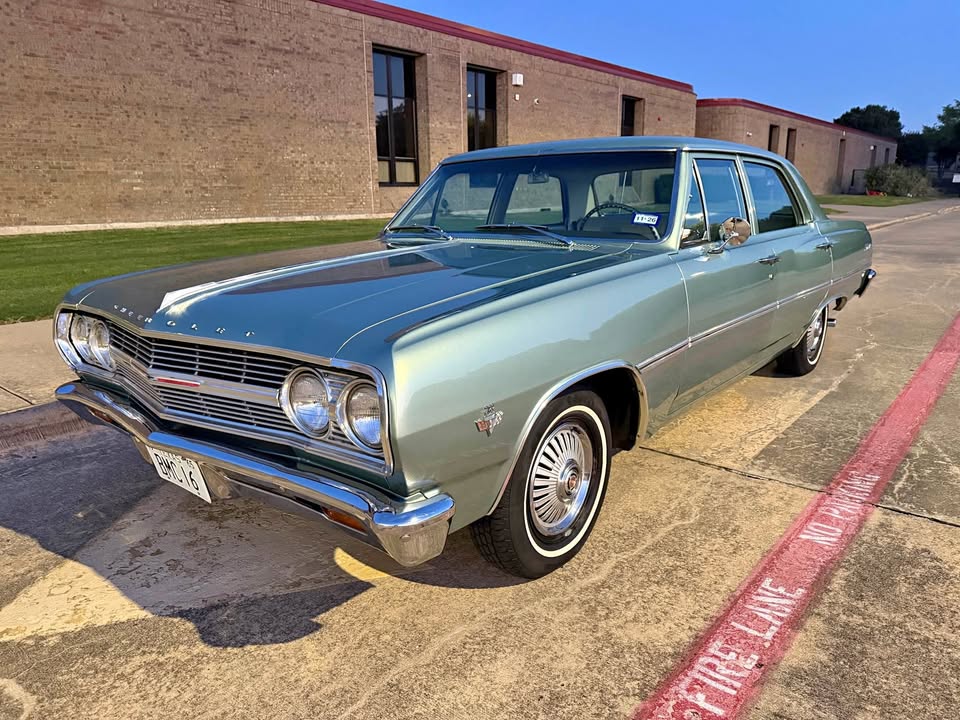
I know what many of you are thinking—what a shame that this 1965 Chevrolet Malibu is a sedan. That may take the bloom from the rose for some readers, but many prospective car collectors have grown up with nothing but four-door sedans and SUVs; therefore, I see this car as an opportunity for a younger collector to get into a very nice older car without being concerned with the stigma that’s often attached to cars with four doors. Or, it could be an opportunity for someone who likes low-mileage, mostly original cars to pick up something that’s popular but a little off the beaten path. Either way, it’s a beauty, and Barn Finder T.J. spotted it here on Marketplace in Allen, Texas, with an asking price of $13,900. That’s stout for a sedan, but this one might be worth it.
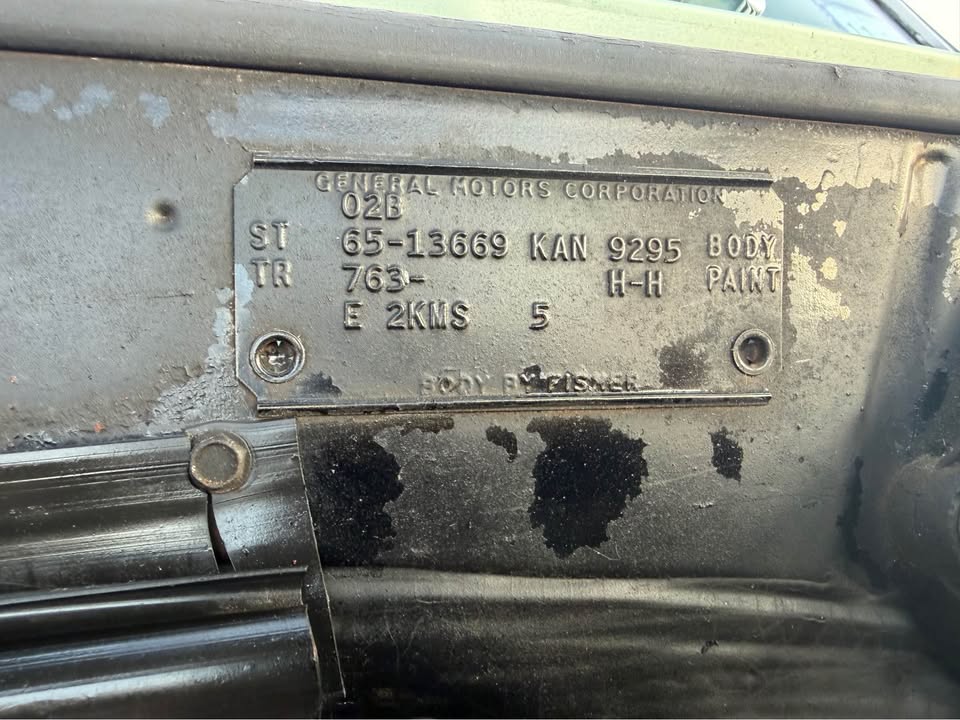
The seller has posted a Fisher Body Tag for us to decode, so let’s see what we can find out.
- 02B: The body was built the second week of February 1965.
- 65-13669: 1965 Malibu four-door sedan
- KAN: Kansas City, Missouri, assembly plant
- 9295: Fisher Body Unit Number
- 763: Light Fawn Cloth/Vinyl
- H-H: Willow Green exterior paint (upper and lower)
- E: Tinted Glass
- K: Air conditioning
- M: Powerglide Automatic
- S: Rear antenna
These options are not exhaustive; Fisher Body simply needed to know what options would affect them in the building of the car’s body from the firewall back.
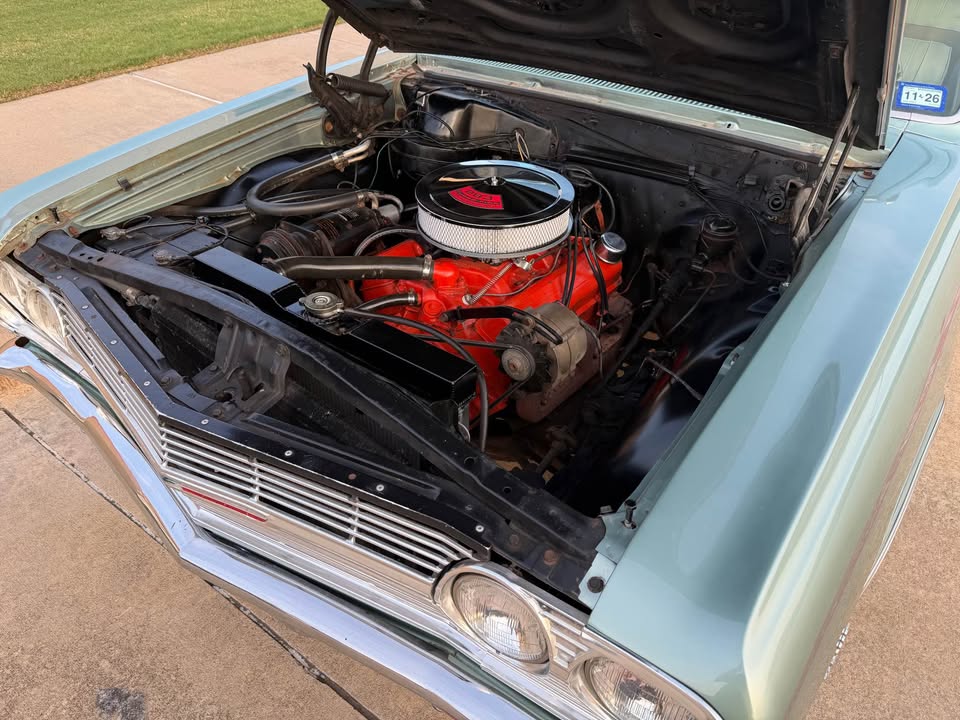
The engine is worthy of discussion. The seller says that it’s a 283 four-barrel, and that could mean one of two things: 1. Someone put a four-barrel carburetor and manifold on a garden-variety 195-horsepower 283, or 2. It’s a 220-horsepower 283 four-barrel with factory dual exhaust, an option introduced mid-year as the “L77.” The AMA documents for the 1965 Chevelle were updated in February 1965, so that’s a possibility on this February-built car. On the other hand, the pictures seem to show a single-exhaust system. Either way, the Malibu has an aluminum radiator, electric fans, and HEI distributor, but the factory air conditioning does not work.
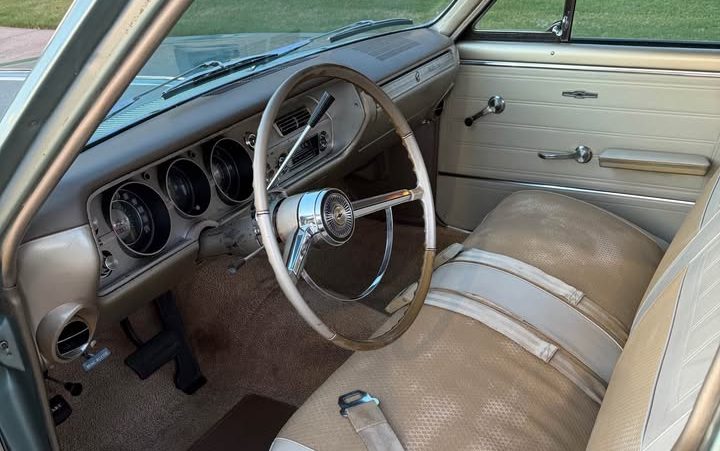
Aside from the carpeting, the fawn interior is original, and includes a set of underdash gauges for keeping track of the 283.
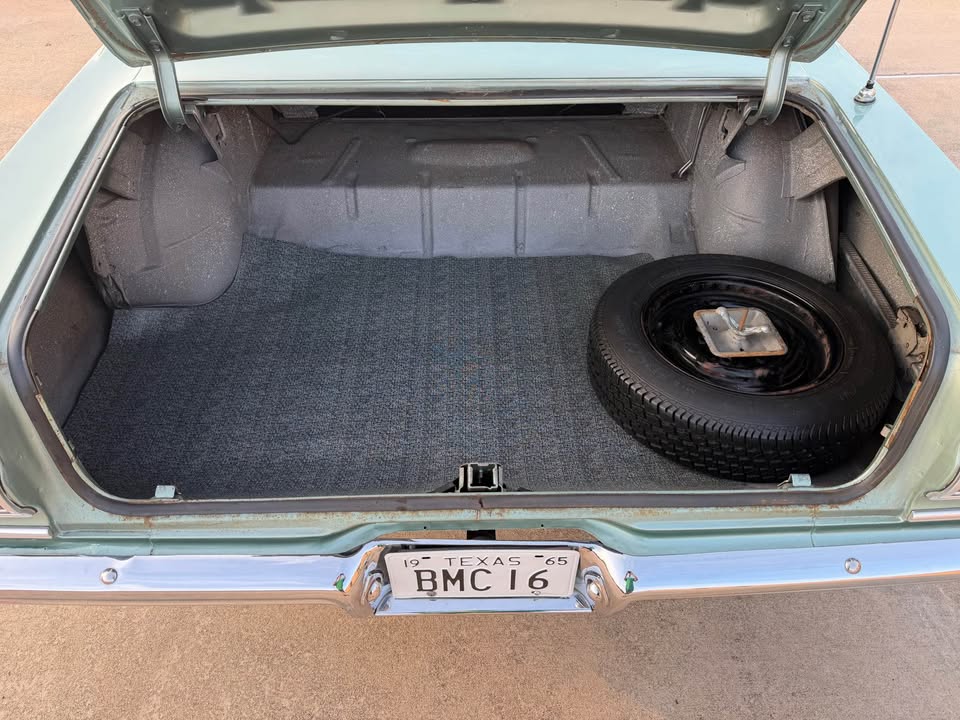
The Malibu was apparently purchased from the original “lady owner” a few years ago, and has “no visible rust or rot.” The trunk is ready for long trips, too…it’s cavernous!
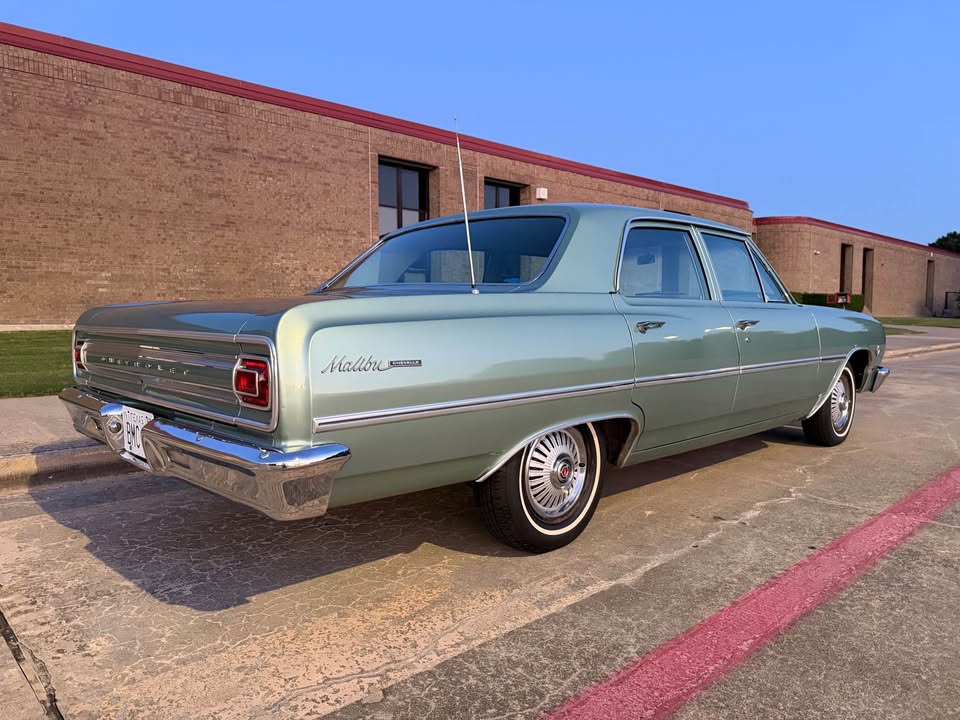
Aside from one nice repaint in Chevy’s beautiful Willow Green, this Chevelle is mostly original. If I were interested in this nice-looking sedan, I’d be messaging the seller to see if it’s an original four-barrel car, but it doesn’t really matter. The little 283 will offer good performance and decent gas mileage, and you have room for your friends and family. Plus, if you live in salt-free Texas, it’s cheaper than anything you’d buy on the lot today. Maybe a nice sedan isn’t so bad after all.

I have a friend in N.Wis. whose mom had a car just like this. It was a “300”, the base Chevelle, same color, 4 door, for 30 years that car sat in the garage, and had similar mileage in similar condition. Plastic on the seats. About 10 years ago, I saw him after a lengthy spell, and asked, what ever happened to his moms Chevelle. He said during an oil change, the mechanic noticed the frame was rusted, and unsafe to drive. It was hauled away,,,this is a great find for the future.
A lovely car.
Neat to see one in such nice shape and low mileage, and especially with factory A/C. Get it working, preserve and enjoy.
Enjoy as-is. The 283 either way is not going to make or break the value of this car. A well preserved, rarely seen example.
The brochures certainly do not feature the 4 door – for good reason.
I am always befuddled by the inescapable urge to install a new aluminum radiator in an old car like this. I would be astonished if that little 283 was not cooled perfectly fine by its factory radiator and fan shroud.
Looks like a good car in general. But the claim of no rust is less reliable when the car has been repainted, since you don’t know what repairs are hidden by the new paint. And in the picture of the trunk you can see what looks like the upper edge of lapped-in new trunk pans right above the front edge of the trunk mat. So I would want to see a lot of pics of the bottom of this car before considering anything close to that kind of money, for a 4-door.
I think the aluminum radiator is just a cheaper alternative to an increasingly hard-to-get-done recoring or a new copper/brass radiator. In my experience, 60-year-old radiators are always plugged, leaky, or both, and a Champion aluminum radiator usually costs around $250. The last time I had a radiator recored a few years ago, it cost around $400-$450, and I’m lucky to have a shop nearby.
I had the original radiator in my 442 recored four years ago and it was about $600. Now, I hear it’s around $800 / 1000 at the same shop. Still though, if you have a mostly original vehicle and you want to keep it looking that way, we’re fortunate to have a shop locally that can do the work. With the much lower priced aluminum alternatives and modern vehicles, restoring old brass radiators is a dying craft – unfortunately, like a lot of other skills too.
That is exactly why I put an aluminum radiator in my 71 Delta 88 Convertible with the 455.
I agree owning a 1971 Chevelle my self since 1988. Another story is I replaced the original radiator in my 2005 Subaru Outback at 190 000 mile with a aluminum radiator with a external trans cooler since the radiator did not have a cooler for the auto trans and the aluminum radiator for the Subaru cost $285.00. Being a Auto tech for 34 years this is the way to go on older cars since all the newer ones have plastic tanks. this 4 door 1965 Chevelle seems to be a good deal just get the A/C fixed and add dual exhaust.
My ’91 Wrongler has an aluminum radiator that I believe is original. I think are better all the way around. Cheaper, lighter, and cools better.
I have to ask Howard if “Wrongler” is an intentional typo? :) My experience with Jeeps is limited but I can see the point.
I have to ask Howard if “Wrongler” is an intentional typo. My limited experience with Jeep products makes me wonder. :)
This exactly. Very few people still do old brass re-core work. I had to pay a premium to get it done on my Monte Carlo. I just went the aluminum route on my Cosworth.
Hi Walter,,that term is coined to Jeep YJ Wranglers 1987-1995 with rectangle headlights, that I happen to like.
Agreed!
The aluminum radiator would be a better, lighter one than stock. Cheaper?, I doubt it!!
Lack of underside pics is the the common theme on BF. While I don’t see the repair trunk pans you mention, I also noticed some surface rust on the bottom edge of the trunk weatherstrip. Irregardless of where it came from, I always want to see underside pics. Other than living in Alaska where they are unfortunately starting to salt in Anchorage, I’ve seen some real rust buckets in Mn. that shouldn’t be on the road.
With the new radiator, at least they bothered to paint the top of it.
Big score this week for early model Chevelle fans! And this would be a good bridge for kids of today that PREFER 4 doors but want to be different and build an older, simpler car.
As I’ve said aud naesum when we came Stateside we picked up our then new ‘64 Chevelle TWO door 300 wagon in this color and drove the family to Sacramento before settling in Reno-with no AC, I-6 3 spd..
Good feature choice, Aaron. Thank you.
You’re welcome!
Man, It brought me childhood memories of my grandma’s aqua/aqua ’65 Nova 400 series wagon with AM/FM radio in the 70’s and had to sell it due to her aging in December ’79 and sold it to third owner in Janurary ’80 and saw it for the last time in spring ’85.
Nevadahalfrack, a 2 door Chevelle wagon with a 6 and a stick? I’d love that. And in the same color as this sedan? Even better. That’s a great experience!!!
-Dave
Certainly a sweetheart. I’d do 3 things, add power steering & brakes & fix the a/c. Then …..DRIVE!
And swap over a 700R4 transmission.
And I forgot to add. Throttle body injection system. (Sniper?)
very clean indeed but i would not say it is a survivor anymore with it being repainted. for 13k seller should charge up the a/c
I prefer four door sedans. And I like low-mileage survivors. But this one raises questions as above-mentioned, and it is therefore too optimistically priced. I also live in the rust-belt, and these cars are notorious for early and evil structural rust-problems. My present Grand Marquis has 415,000+ miles and only some surface rust in spots: the frame is solid and clean, and no rust-holes in the body. And yes, I drive it all winter. Since I would need a daily driver, I must pass on this one, despite the novelty of having the only surviving Chevelle anywhere around here.
“What’s in the trunk?”
“You don’t want to look in there.”
You are one year off. The one in the movie is a ’64, but I love your reference. Please take note of my avatar.
Knew it was a year off, but when opportunities present, details may need to be overlooked . . . .
One of the few cars of this era that I think look better as a 4-door. The styling gives purpose to the set back rear axle giving the car a more generous rear door opening. Passengers don’t brush their clothes across the door jamb entering or exiting the vehicle. This one looks sharp with the repaint and would surely benefit from new upholstery in front.
Hello Mark, please explain to me how you owned a 1971 Chevrolet in 1988. Must be time travel.
Seems relatively simple to me since 1971 is 9 years prior to 1988.
He apparently purchased a 9 year old car.
He claims he owned a 1971 model car in the year 1988 not the other way around.
Opps
Try 17 years…
When I see 60’s midsized american 4 door sedans like this my mind tends to go to beefing up whatever is under the hood. Then doing the same with the suspension and brakes.
Low key cruisers that can get out of their own way and drive circles around most obstacles.
Oh, almost forgot, a 4 spd.
Miles of smiles.
Why alter it? I never understand these people who want to “muscle-up” or “sportify” an old family sedan and give one a 5-speed standard shift! Why can’t they leave it as an easy-going automatic? Those of us who like a regular sedan simply would drive it as originally equipped, as a daily driver. I would not touch this one, much as I like it, because I live in the rust-belt, and these are infamous rust-buckets. For that reason, the only time you see one anywhere around here, is if someone is visiting from Florida. I am an old man, and I drive like one. Of course I drove like one when I was 20 also — I never wanted a “hot” car — just something that would safely GET you there and back, at legal speeds, and not burn rubber.
I agree. It’s fine as it is, although I would add power steering and disc brakes for safety, but then again maybe not. $$$
If I bought one, I’d keep as much as I can as stock as possible, while also upgrading what needs to be upgrading. Among the needed upgrade would be the front disc brakes, and seat belts for all occupants. I’d install a CD player, smart speakers, etc.
Not a factory intake, suspect this was a 195 hp 2 bbl. All small block V8s in 1965 had the oil fill tube in the front of the intake and no fill holes in the valve covers. Looks to have been nicely done, I’d love to have this in my garage including the 2 extra doors!
Beautiful car. 1965 is my favourite year for the Chevelle and Malibu-bu, until the 1970-71 model year.
My Mom bought a 4-door 1965 Malibu when I was in college. We (I) drove it to Kansas and back with her, my sister and sister-in-law plus an 18 month old child. Plenty of interior and trunk space and good handling. Only trying to panic brake when a car turned in front of us and I learned what brake fade felt like was there any problem. Married into a 2 door 1965 Malibu that year and enjoyed it as well. I actually like the lines of the 4-door better, but at that age, having a 2-door was cooler.
I have seen the car in person and can attest to the fact that the car is as advertised. I checked all of the suspect areas for filler and found none, the trunk floor is original and solid. I inspected the underside and again found no rot and no arears that have been repaired or replaced with very minor surface rust. The intake is a GM factory 4 barrel intake. The seller does have all of the original parts including the intake manifold, 2 barrel carb, radiator and fan. The engine code aligns with the options and build date of the car perfectly. If I had the room right now, it would be mine and I’m not an easy sell.
Thanks OldCarGuy! Yes, I own this vehicle and it is as described. If anyone is interested, let me know.
Thanks OldCarGuy for setting the record straight on the 65. Enjoyed the visit and showing you the car. If anyone is interested in the 65, let me know. Someone is sure going to get a nice one!
Thank you, Old Car Guy. Your comment cautions against assuming what one does not absolutely know. And I would buy this car if it were closer to me geographically, if the price were a bit lower, and could I give it the kind preservation which it deserves. But I am looking for a low mileage reliable daily driver from the pre-airbag era, and I live in the rust belt. My 1988 Mercury Grand Marquis has seen every snow and wet-salty road in more that 415,000+ miles, and it has only slight surface rust spots (nearly all of which began as paint-dings exposing metal). But 1965 Chevelles rotted-out quickly, because they could not defend against the tin worm; whereas I have never seen a Panther Platform Ford product with significant rust. But this Chevelle is far more interesting, for sure! And it looks just fine with four doors! Just another midsize when new, it looks utterly classy now, because newer cars look so ugly by comparison — this is rather like a dowsized luxury car, and I would be proud to own and drive it. But I drive in the wintertime, so I need to pass on this one, regretfully..
Thanks OldCarGuy! Yes, I am the owner of “Willow” the 1965 Chevelle Malibu. Vehicle is as described in the ad. Someone is going to get a nice one. Open to real cash offers.
Frankly, I surprised at the amount of interest that a plain Jane 4 door Chevelle has generated.
I’m not knocking the car by any means, it’s certainly a clean example. I just wouldn’t have thought that it would have generated this much excitement.
But then I guess that sums up car guys and gals, they always appreciate a nice one.
The car was SOLD on Sunday 5/17/26. Buyer was here in Texas. Thanks for all the discussion.
I hope whoever bought it enjoys it.