
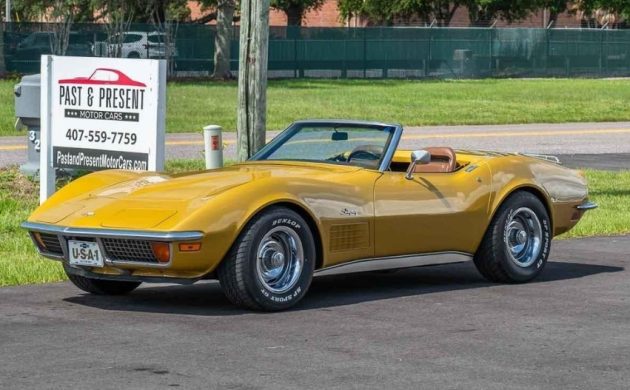
There are few experiences better on a summer’s day than slipping behind the wheel of a classic Convertible with the sun on your back and the wind in your hair. That is the opportunity provided by this 1972 Corvette Convertible. It appears to be an unmolested survivor that features its numbers-matching drivetrain. It has no apparent needs and could be ideal for enthusiasts favoring preservation over restoration. I must say a big thank you to Barn Finder Curvette for spotting this drop-top listed here on eBay in Ocoee, Florida. The bidding sits at $15,503, although that figure falls short of the reserve.
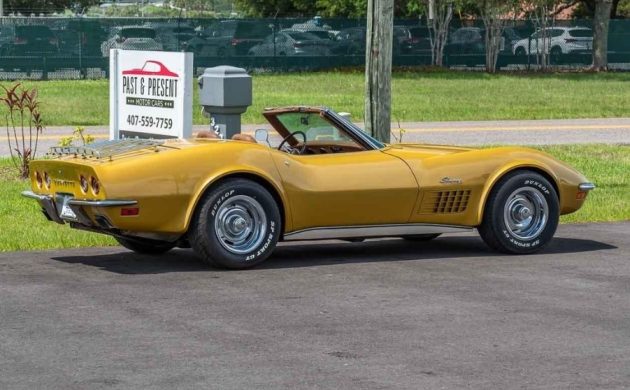
The 1972 model year marked the end of an era for the Chevrolet Corvette. The vacuum-operated windshield wiper door would be consigned to the pages of history the following year, as was the removable rear window on the Coupe variant. However, it was also the last time that Chevrolet would offer the ‘Vette with chrome bumpers at either end, with a urethane front bumper installed from 1973 to comply with changing safety regulations. As had become standard practice, the company offered buyers a choice of ten paint shades on the 1972 Corvette color palette, with 2,550 owners selecting the War Bonnet Yellow found on this car. The seller provides limited information surrounding the car’s history, although they state that its few minor blemishes are consistent with its age. That suggests that it might be a genuine survivor. The paint shines nicely, there are no fiberglass issues, and no mention of rust that would spoil the ownership experience. The Black soft-top fits nicely, and the color-matched factory hardtop adds to the desirability. The trim is in good condition for its age, and there are no glaring glass problems.
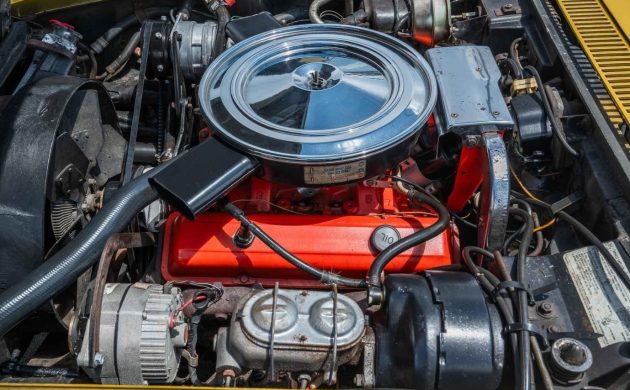
Powering this Corvette is a 350ci V8, and since this is the entry-level ZQ3 version, it delivers 200hp and 300 ft/lbs of torque. The power feeds to the road via a four-speed M20 manual transmission. The engine’s power and torque figures may seem dramatically lower than those quoted in 1971, but there is a good reason why this is so. Manufacturers began quoting Net numbers in 1972, abandoning the previously common practice of utilizing Gross figures. Emission regulations also played their part, but the losses brought about by legislative requirements weren’t felt too heavily at this point. The seller indicates that this Corvette is numbers-matching, which is always a consideration when assessing any classic’s investment potential. They believe the odometer reading of 37,146 miles to be genuine, confirming that this beauty runs and drives extremely well.
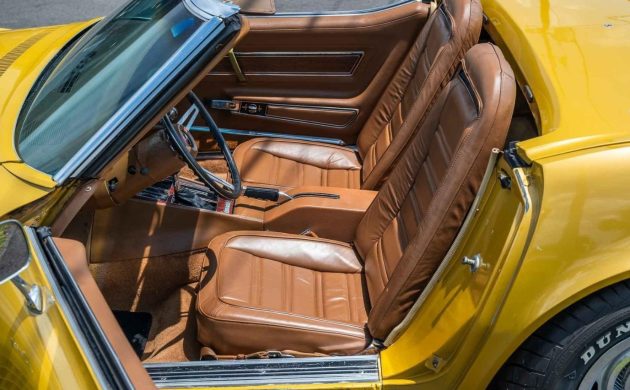
The Corvette ticks a few boxes for those seeking a touch of luxury, courtesy of its air conditioning, tilt/telescopic wheel, AM/FM radio, and the Saddle leather trim. I can’t spot any aftermarket additions, and driving this baby with the top down won’t cause any shameful feelings. The upholstered surfaces are excellent, the carpet is impressive, and the plastic looks exceptional for its age. This interior carries the hallmarks of a classic that has been treated respectfully and hasn’t been abused.
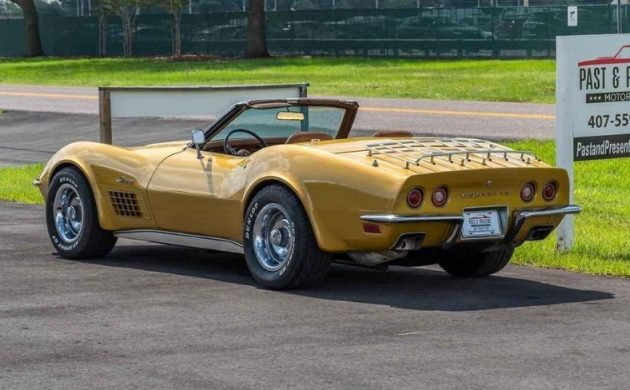
This 1972 Corvette Convertible ticks many of the more desirable boxes for enthusiasts seeking a classic to park in their garage. It is unmolested and remains numbers-matching. It is also a chrome-bumper example, considered among the most desirable of the C3 Corvettes. It has no apparent needs and is ready to provide its new owner with classic motoring pleasure. Recent successful sales suggest that the price should at least double before the hammer falls, and the listing statistics indicate that this will probably be the case. That leaves me with two questions to pose. The first is how much you might be willing to pay for this Corvette. More importantly, are you tempted to pursue it further? I wish you luck if you do.




Nice car although the color doesn’t excite me. Looks like an old persons color choice.
Old person here…never cared for gold cars, but favorite Corvette gen.
I actually had a vehicle refinished in Burnt Orange with War Bonnet Yellow as an accent color in the late 1970s. I’ve always liked it.
The last year of the good ‘Vettes(IMHO)
Squeeze some ponies out of that SBC and you got a fun driver.
Had a ’71, 350/4-gear rag, dark green white interior, in the early 90’s. Loved the car, but was always problematic. Spent more time working on it than driving it.
White interior? Must have been a rare car.
I agree. White was not a factory offering.
Orange, green and gold were the hot ‘70s colors on cars, shag carpet and appliances. Ontario orange was the top selling color in ‘72 with Elkhart green second and War bonnet yellow Fifth. The best shot of a corvette in War bonnet yellow is in the movie Apollo 13. This car on auction looks like a very nice stock example which is your best bet these days for continued value. The selling dealer has the car listed on their website for $47,972, too much for me although if the miles are original I think it’s worth $40k or so.
There is a great scene in the 1971 movie Billy Jack featuring a similar gold-colored Corvette convertible. Check it out!
“You drove a $6,000 car in the ocean because he told you too”! Loved that scene lol!
War Bonnet Yellow, 350,4-speed,Convertible with hardtop is peak 1972 Corvette. The dealer knows that.
So… Barn finds is advertising for small car companies now? 2nd time that sign has popped up in less than a week.
It wasn’t intentional. Just two good finds.
A nice Stingray! Can ANYONE who really knows clarify the power output business? I have heard two different stories over the decades about ’72 Stingrays. Version one is what seems to be alluded to in the write-up: that apart from quoting horsepower at the rear wheels as opposed to the crank, that in ’72 THERE WAS INDEED A SMALL INCREASE IN EMISSIONS THAT LOWERED POWER SLIGHTLY. Version two, is that THERE IS ABSOLUTELY NO POWER DIFFERENCE BETWEEN a ’71 and a ’72 EQUIVALENT…that if say you need to rebuild a ’72 350 or 454, absolutely everything is the same: the compression, the cam lift, the carb, etc. Which of these two versions is the correct one?
The 1971 and 1972 small block and big block engines are virtually identical. What changed is the dyno method used to measure engine output. Many 1971 GM engines received a power drop from 1970 due to a lower compression ratio. This was mandated by Pete Estes who insisted that all GM engines would be required to run on low lead or unleaded fuel. The basic difference between 1971 and 1972 is simply the test method. In 1971 engines were dyno tested with no auxiliary drive components, little or no exhaust system (sometimes headers were used), no air cleaner, and optimum ambient conditions. This gave a gross horsepower figure. In 1972 all of the above changed whereby full exhaust systems, accessory drive components etc were all present as you would see in the real world. This yielded a net horsepower figure which was of course lower even though the basic engines were largely the same except for potential fuel and spark mods from year to year. I worked at Chevrolet Engineering at the time and fortunately was blessed to see this first hand.
Correcting myself it was Ed Cole who mandated the lower compression ratios, not Pete Estes.
I have never heard this explained better even though I knew the answer. So many people think it was the difference between measuring at the flywheel vs at the wheels. No manufacturer ever advertised horsepower at the wheels.
Thank you, Jack for your reply. So, it turns out that there was NO DECREASE IN POWER, except for the different ways of measuring horsepower. Thus the 270 ponies at the crank for a base ’71 ARE THE SAME as the 200 at the rear wheels quoted in ’72.
While many an enthusiast decries the loss of power between ’70 and ’71, I am not sure I would find living with 11:1 compression to be very practical. None of the octane boosters available, to my knowledge, will be able to handle that…and high-octane aviation fuel is now much rarer than it used to be, as planes such as DC-3s have virtually disappeared…and having to drive out to your local major airport every time your thirsty classic needs filling up is also unpractical. Raising the compression on a ’71 or ’72 to around 9 or 9.5:1 would be ideal. Thanks again, Jack.
Laurence the 200 hp rating in 1972 was not hp measured at the rear wheels. I don’t know of any manufacturer who rated in that way. Rather the 200 hp 1972 rating is also at the flywheel as was the 270 hp rating in 1971. The reason for the large difference is test method as I had already explained. There may be a small difference of maybe 5 hp due to fuel/spark calibration but most all of the difference is test method.
$47,972 on the dealership website.
Adam, you need to find a different dealership to browse. Yes, better than the Miami shyster, but promoting a dealership on the opposite end of the spectrum with unrealistic pricing is a turn off too.
He has some interesting cars that’s for sure. But has anyone noticed where the backdrop to all of his cars are taken from? There are a few questionable sites or entities that promote themselves with a seemingly unscrupulous intent and a parking lot rear seat office.
Sold my 71 Stingray convertible in 2007 for $14500. Numbers matching 350, 4 speed, red with black interior. Kinda regret selling now. This is a nicer car than mine.
Sold my ’70 convertible in 2014 for $21K. 4 speed, base engine, factory hardtop. Green with tan interior. This is nicer than mine was too. And same here, kinda regret selling, but it went to someone who was really excited about it.
He has some interesting cars that’s for sure. But has anyone noticed where the backdrop to all of his cars are taken from? There are a few questionable sites or entities that promote themselves with a seemingly unscrupulous intent and a parking lot rear seat office.
So what was the HP difference between the the 2 years?
If tested against the same test criteria there was little if any difference
This car sure is a nice one, clean, very original, factory A/C, (modern compressor), low mileage 4 speed roadster with 2 tops, very well optioned. Not a fan of yellow, but this shade is not objectionable. This car is a good find, not $47K good but $39k sounds about right. Save some money in reserve because this car will need something, they all do. I would like to see some under carriage photos. Yep, this looks like a very nice one, someone will really enjoy adding a few miles to it.
War Bonnet Yellow always looked like the ‘gold’ in my kid’s diaper. Yuck.
The car checks all the boxes…except price. About $8k too high.