
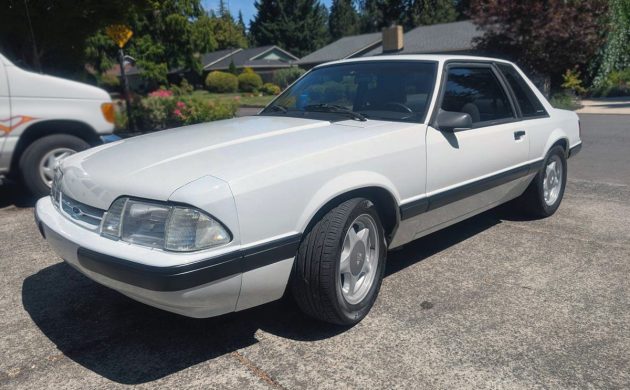
Change the gears, exhaust, and throttle body, add sticky tires, and a nearly stock 5.0 Mustang of this vintage would turn a quarter mile in the 13s. This notchback body came in under 3000 lb, half a ton lighter than today’s bloated performance Mustangs. As taught in high school Physics, if you want to accelerate twice as fast, you can either halve your weight or quadruple your horsepower. Dollar for dollar, lighter cars take the advantage. This 1989 Ford Mustang LX in Vancouver, Washington started life as a four-cylinder econo-notch before having its applied physics altered by a stroked 351 Windsor and other performance goodies, all while keeping a sedate exterior, changing this plain white coupe into a wicked sleeper. Check out more pictures and details here on Craigslist where $14,600 inks the title. Thanks to reader Barney for spotting this wolf in sheep’s clothing.
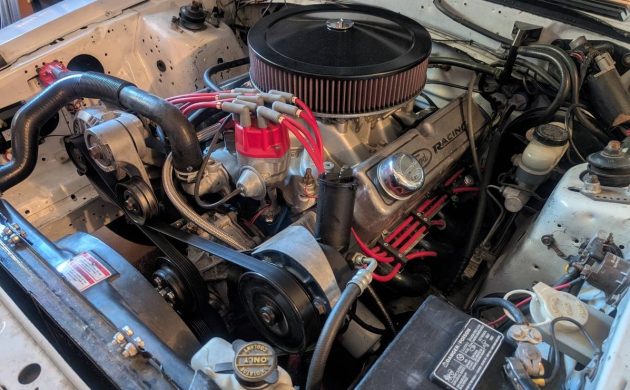
Still considered a small block like the ’89’s optional 302 (5.0L), this 351 accepts the 5.0 accessory drive and fits the V8 motor mounts. A larger deck makes the 351 wider and it normally takes special motor mounts and/ a K-member to get a 351-based mill under the stock Fox hood. This one’s stroker kit (crank, rods, and other bits) bump the cubes to 408 cid (6.7L). That plus curated performance parts render a stout 401 HP at the wheels. An old-school carburetor fuels the amped up 408.
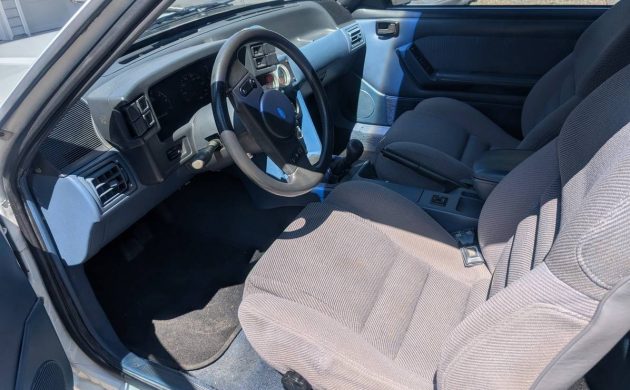
The ubiquitous ’80s gray interior looks neat and clean, and a five-speed manual transmission handles the gear changes. The handsome 1989 two-spoke wheel snuck in just before larger air-bag-containing units took over.
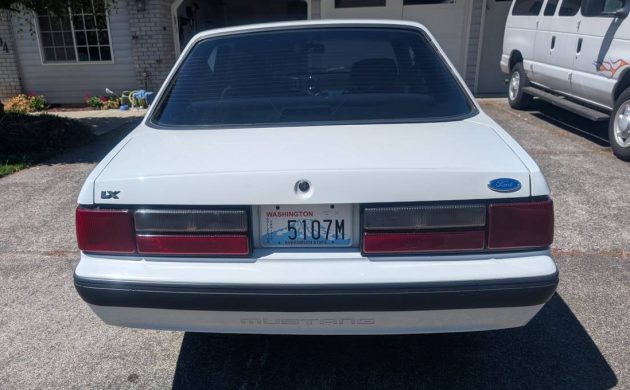
The notchback may sacrifice some sportiness and cargo-swallowing capacity, but the more upright rear glass comes in lighter and metal structure behind the rear seats means less flex in cornering compared to the more popular hatchback. Fresh out of college and newly employed, I marched into Castle Shannon Ford with plans to factory-order a 1989 5.0 five-speed LX notchback with crank windows and optional 3.27 gears to make my own sleeper. We crunched the numbers and the salesman slashed the price of a loaded LX 5.0 hatchback on the lot to undercut the special-order notch. I succumbed; why not have a little luxury with your performance? I still own the black 5.0 today, the only new car I’ve bought for myself. It cracked a quarter-million miles this summer, the never-removed 5.0 still thwarting people’s intentions to smoke a V8 Mustang.
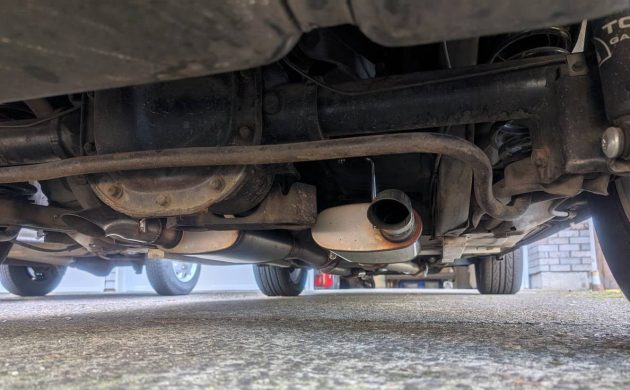
Like the carburetor, these turn-downs may not pass muster in all states, but they do exit behind the passenger compartment, keeping up the sleeper vibe compared to the long stainless tips fitted to factory 5.0 cars. Would you change anything on this potent stroked sleeper?


Maybe remove the aftermarket gauges to complete the total sleeper pkg.
Fitch I thought 3.27 gears were only available for AOD equipped foxes, and 3.08 was the deepest for stick cars ?
Love your hi-miler hatchback 😎 👍
Hi Stan. You could be right; it was a long time ago! The one I bought off the lot had 2.73s so I lived with those for a while. When I swapped in a ’93 Cobra rear axle with discs and owner-swapped 3.73s it was like I added a blower. With the 2.73s, though I could get over 400 miles on a tank and 30.x MPG on the highway. Now I’m lucky to get 25, but my FPG Fun-Per-Gallon is much higher.
Sounds like a great conversion, added the disc’s too👍 Sweet.
If the description is accurate and it’s a clean as it looks in the pictures it’s a great deal. What’s surprising is the listing has been up for 8 days with no takers.
Steve R
Great build. love it.
Oh, and hate to be a pedant, but someone wasn’t paying full attention in physics class… Newton’s second law of motion, f = m a
– if you want to accelerate twice as fast (assuming the mass, weight of vehicle stays the same) you need to double the power, not quadruple it.
Hello ClassicCarFan. Thanks for your reply, and I respectfully submit this as process improvement for anyone who discovers this thread. I’m no expert but I’ll assume Newton’s law applies only in a vacuum? We’re talking applied physics here. For a gut check, please submit a list of 400 HP cars that accelerate twice as fast to 60 (or any other speed) as 200 HP cars. This is from brainly: “To double the speed of a car, you must increase the power of the engine by a factor of four due to the quadratic relationship between power, force, and velocity in the formula Power=Fv.
The relationship between power (P), force (F), and velocity (v) is given by the formula P=Fv. This equation indicates that power is directly proportional to both force and velocity. When seeking to double the speed of a car, one might consider only doubling the power required. However, due to the quadratic nature of the power equation, the impact on velocity is more significant.
If you want to double the speed of the car, the velocity term (v) in the power equation becomes 2v. Therefore, the new power requirement (Pnew) is given by Pnew =F×2v. Simplifying this expression yields
Pnew=2×F×v, indicating that to double the speed, the power must be increased by a factor of four (2 squared). This relationship illustrates why achieving extremely high speeds, such as 500 mph, requires a disproportionately large increase in engine power, making it impractical for many vehicles.” I hope this helps. Cheers, Todd
This is a fun car!
Hi Todd
I think your confusion acceleration and speed. to push the speed up, you do have to take into account factors such as wind resistance, and that is proportional to the speed, squared.
The question of acceleration is simpler. f=ma. if you double the force, you will get double* the acceleration. * – yes, in reality there are other factors in play in a real machine, like frictional losses, varying levels of traction at different loads and speed, so in real-life there will be some approximation…