
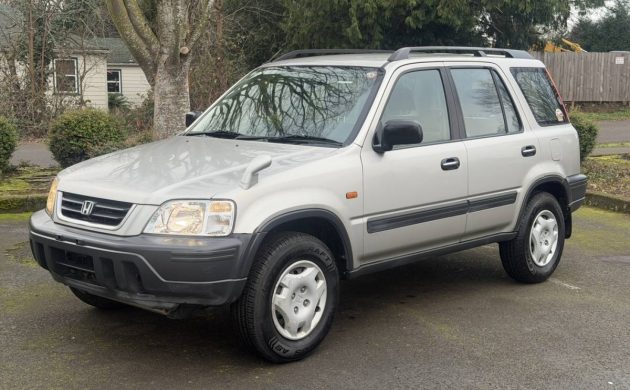
A slightly under-the-radar component of survivor vehicles are those that are used for marketing to postal carriers. Yes, this is real, especially for rural postal carriers who often can’t use the standard-issue trucks from the USPS. This is because the roads are rougher, mechanics are few and far between, and unlike most government agencies, the Postal Service seems to actually acknowledge the fact that non-government vehicles are more up to the task for rural carriers. This right-hand-drive Japanese market 1997 Honda CRV is a perfect choice for someone who delivers mail for a living, and it has just 5,000 miles. Find it here on craigslist for $14,900.
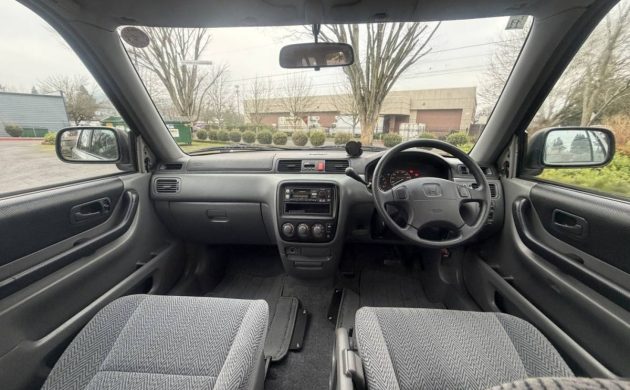
This CRV is identical (save for the RHD steering) to my dear mother’s car. She bought one of the first ones that came into the country in late 1996 after retiring her 1987 Honda Accord LX-i (my first car) and still owns it to this day. It has 100,000 more miles on it than this car, but I swear to you, it looks this mint inside because she’s a perfectionist! Regardless, this was Honda’s first major venture into the SUV world and it was long before that demographic blew up to require all sorts of monitors, airbags, navigation systems, infotainment, and more. Therefore, you can see blissful simplicity on display, with everything you need, and nothing you don’t.
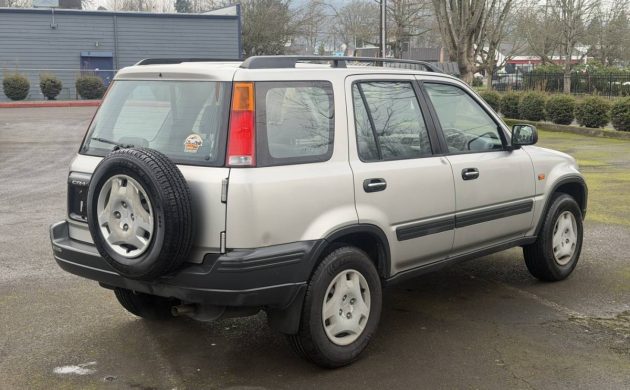
The CRV is still attractive, in my opinion, with actual fender bulges (no, it’s not a widebody, but at least there’s some character in the body lines) and interesting taillights mounted high up on the body. The plastic bumpers can withstand all sorts of impacts and poor parking, which makes it a perfect choice for a postal carrier. The B20B4 four-cylinder engine is about as interesting (in stock form) as warm yogurt but it will start up and run reliably for years without complaint, and as long as you keep up with timing belt changes and water pumps, it will be the happy heart of your CRV for decades to come. Power was around 126 horsepower and 133 lb.-ft. of torque.
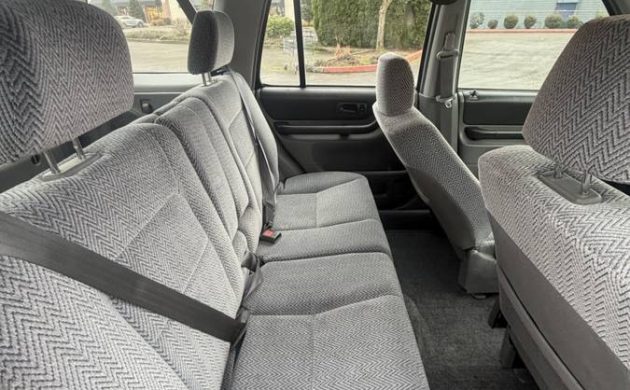
The rear seats split and fold down, which will make it useful for loading up all sorts of junk from Amazon and other shippers to bring to their eager recipients. The U.S.-spec CRV had the clever folding table under the rear cargo platform, and since that was a direct carry-over from the Japanese market trucks (amazing they didn’t try and strip it out for some inane safety reason), I’m sure it remains in place on this one. Fun fact, these are great garage tables and you can snag one out of the junkyard for a few bucks! Anyway, this CRV would also function wonderfully as your daily driver if you don’t happen to be a postal carrier, as it’s essentially like buying a brand-new late 90s Honda, which many will agree was the peak of the brand’s U.S. lineup. Thanks to Barn Finds reader Curvette for the tip.




I know, and the only reason I’m commenting on this, is a), it’s 7 degrees out, and b), my neighbor has a bit newer one. Got a ton of miles, driven it many times, and about as generic of a car for an old lady as you’re gonna find. Naturally, I don’t care for it, the seats, in true form, are awful, and heaven help her when the tranny pukes.
To be clear, I highly doubt this was intended as a mail carrier, merely an imported car( mirror on left fender) and never driven. POV, or “privately owned vehicle” routes are still used in rural areas, it doesn’t pay much, but I don’t think there are any limitations to the vehicle. If you have faith in our USPS, here you go.
I have ZERO faith in the USPS. They have proven absolutely unreliable and mistake prone in the last few years. Far cry from what they used to be.
Except the focus is on the vehicle not the Post Office. For what we pay, our mail service is very good. Not without problems of course, but whining about the post office would probably not get much sympathy outside of the continental U.S.; we enjoy very low mail rates.
The right hand drive kills it for me, it is mostly useless in the U.S. but for mail or package delivery.
@DA: Agreed on both points, if the USPS were fully privatized, rates would go sky-high, especially in rural areas.
And if someone wants a firstgen CR-V as an emerging classic, there’s way more desirable specs – an original US-market version, in a better color like red or that very ’90s dark green, maybe even a manual transmission. Conversely if you go for an RHD JDM car, most people want something kei, high performance or just not common as dirt on our own side of the Pacific in its day.
Says it’s a Japanese market vehicle. But, really anybody delivering mail should be all over this sale.
This is interesting, gotta wonder what the story is behind it. I doubt anybody bought it to save as an investment, like certain Corvettes or the ’76 Eldorado convertibles. Now what would you do with it? It’s almost 30 years old and only has 5000 mi. on it. I think that if you put to work now on a mail route it would start to fall apart. Anything rubber is probably dry rotted by now and mail routes are rough on vehicles anyway. I have seen some manufacturers market RHD vehicles to rural carriers. Jeep Wranglers seam to be a favorite in our area. I’ve seen RHD Subarus too.
Well, you can find them on a website car from Japan for $5k+/- along with almost any brand of those other mini trucks that are being imported you can also find those high-performance Honda S2000 cars popular with the street racing folks (for a lot more $$) since it’s a simple swap to change the speedometer head from KMH to miles i would question if its accurate. you definitely would want to research it out. but true to Honda it’s going to last a long time.
Everything about this car seems to be consistent with a 5k mile claim, the interior is really clean, the exterior doesn’t appear to have any door dings or other issues. The rubber and plastic trim appear to be in excellent shape. With Honda’s reputation for reliability this should have years of trouble free service ahead of it. The ask might be a little bit high but if you have a need for a reliable and economical means of transportation this could be the answer. Unless the vehicle was stored outside, which it doesn’t appear to have been, comments about plastic and rubber parts being no good are ridiculous. I recently purchased a 20 year old vehicle with less miles than this vehicle, I am daily driving it and none of the rubber or plastic has been an issue.
Great value if you need right hand drive. The first and second generation Honda CRV is a very reliable trouble free vehicle. Only use Honda ATF in the transmission, and drain & refill every 20k miles. Only use long life “blue” coolant and change per schedule. Gasket seals on the engine are more likely to go bad in the event of overheating, not due to age. Most common oil leaks if any are from the front main seal, Vtec module seal on back side of engine, and Vtec cover seal on front of engine. Inexpensive parts and not terribly hard to replace if necessary. The expectation is to exceed 300k miles with these vehicles.
If you have a good mail carrier it’s worth a fortune! I retired from USPS 27 years ago and even then it was dependent upon the individual carrier. Some guys were diligent while others were deadbeats who spent more time trying to get out of work! This little car would be a great rural carrier vehicle!
JDM’S are quite popular where I am.
It’s fun to drive an rhd vehicle. It freaks people out: “It’s European.”
Our mail carrier had a 2010 CR-V that he ran until the Postal Service handed him the keys to a new Benz Metris. Eric’s Honda had well over 300,000 miles on it…..and they were likely hard miles. The roads up here are narrow and twisty in some places, dirt in others and, in weather like this, rutted and nasty. He had to junk his because the tinworm really sank its teeth into the subframe and the underbody. Eric says the Metris is junk…..they get stuck on dirt roads and they slide on snowy streets. He’d rather have the Honda…….rusty floors, uncomfortable seats and all……..
Speaking of RHD vehicles: When 4 door Jeep Wranglers were hard to come by, I spotted a row of them sitting at a Jeep dealership my sister was looking for one.
I stopped to have a look and they were all RHD. I figured that they were special order federal vehicles, but all of them had sticker prices on them. Turns out that they were for sale, but I have no idea why they were there.
Maybe the dealership was desperate for any inventory they could get.
My sister has one of these with a 5 speed and 4wd she got it cheap and it’s her winter beater as she lives in the okanagan in bc Canada.
It has no rust and a bajillion miles and she hasn’t dropped a dime except normal maintenance.
Another tidbit is the Honda guys go crazy for the rear differential and transmission so they can awd their civics.