
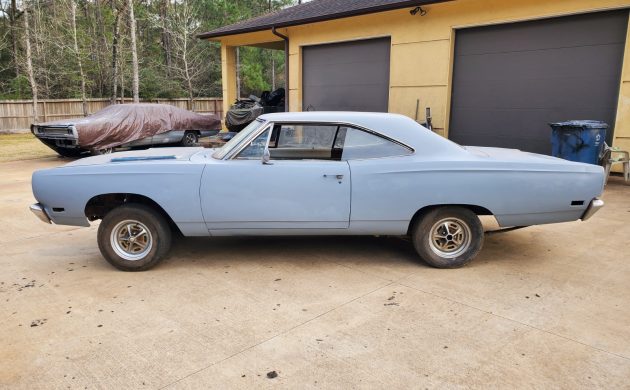
Ah, decisions, decisions. That is what the new owner of this 1969 Plymouth Road Runner faces. It is a rock-solid project candidate, but its original V8 went AWOL many years ago. The seller offers one potential solution, but the buyer may decide to follow their own path to create something genuinely unique. It will be fascinating to gauge your feedback and whether most Barn Finds readers favor a faithful approach over a custom build. I must say a big thank you to Barn Finder Curvette for spotting this promising project listed here on eBay in Magnolia, Texas. The seller set their BIN at $23,900, and it appears they are firm on that figure.
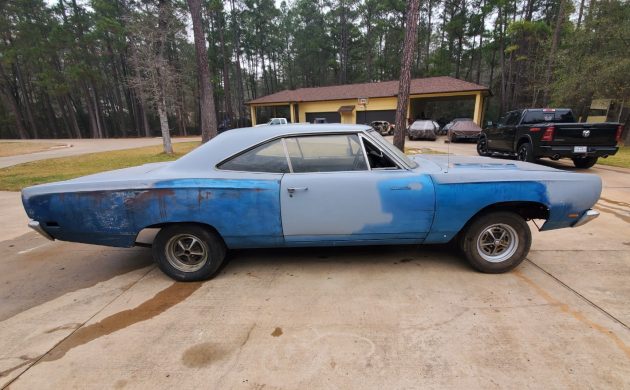
Some classics are mystery machines, but that doesn’t appear to be the case with this Road Runner. The seller located it in a dry shed, a spot it had occupied since 1984. The keyword in that sentence is “dry.” That environment protected the Plymouth from the rust issues that often plague these classics. There are a couple of minor spots, but crucial areas like the floors, trunk pan, rails, and the area around the back window are rock-solid. There are areas of visible surface corrosion, and with the car partially dismantled, it would be tempting to strip the vehicle entirely to adopt a rotisserie approach. That would be the best strategy for achieving a high-end result. If the buyer chooses a faithful approach, they could massage the steel before applying a coat of stunning Code B5 Blue Fire Poly. They will need to replace the windshield and one vent window, and some trim pieces are beyond their best. It is probably appropriate to describe the Road Runner as a blank canvas, because there is much that the new owner could change if originality isn’t a key consideration.
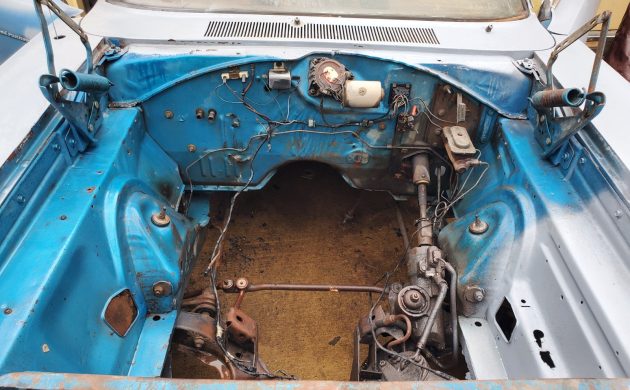
Many manufacturers are spruiking their “green” credentials as they embrace hybrid technology and electrification. This Road Runner is no exception, because it produces no greenhouse gases. That isn’t by design, but because the original 383ci V8 is long gone. However, the correct four-speed manual transmission and 3.23 Sure Grip rear end are intact. The 383 generated 335hp and 425 ft/lbs of torque in its heyday, with both figures pretty respectable for what was the entry-level V8. The seller has a virtually complete ’69 date-coded 383 that can be included for an additional $1,500, or the buyer could opt for something more potent. Some readers may consider the restomod path irresistible, and it is one option if a period-correct approach doesn’t appeal. This is a case where the world is their oyster, and the only limiting factors are their imagination and budget.
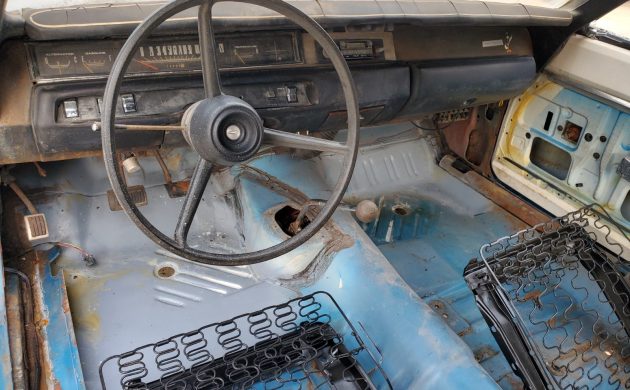
The first owner teamed this Plymouth’s Blue exterior with an interior trimmed in White vinyl with bucket seats. You must take my word on that, because the upholstery is a distant memory. The seat frames and the dash are intact, forming the foundations of an interior retrim. Once again, this is an aspect of the build that potentially lets the buyer personalize this Plymouth. Trim kits to achieve a factory look are available, but some readers may have visions of custom trim in their heads. It is a case of creating the classic of your dreams, whatever that might be.
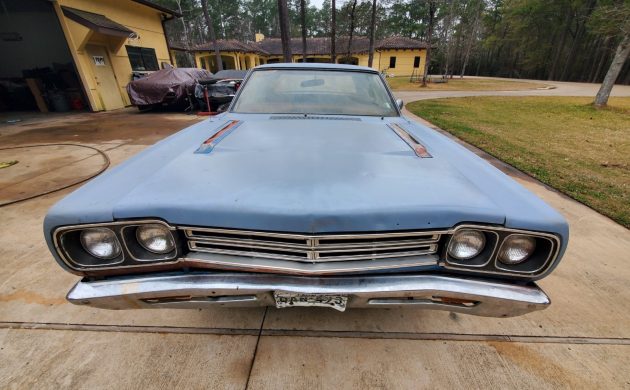
At $23,900, this 1969 Plymouth Road Runner isn’t a cheap option given the lack of an engine. Unless the buyer happens to have a Mopar V8 squirreled away in a dark corner of their workshop, purchasing a replacement is just one of the costs associated with this build. However, with no rust requiring attention, the cash typically allocated to rust repairs would help fund a new motor. The question is what path to follow. Finding a correct 383, either from the seller or another source, would be child’s play, but some may find the lure of a more powerful alternative irresistible. What would be your approach if this Road Runner found its way into your workshop?




Holly F’ck!!! Over $23 for an old car…..not running…..not even has an engine and probally needs a hell of alot of work & money for missing parts just to get drive able. That car cost like $3k brand new.