
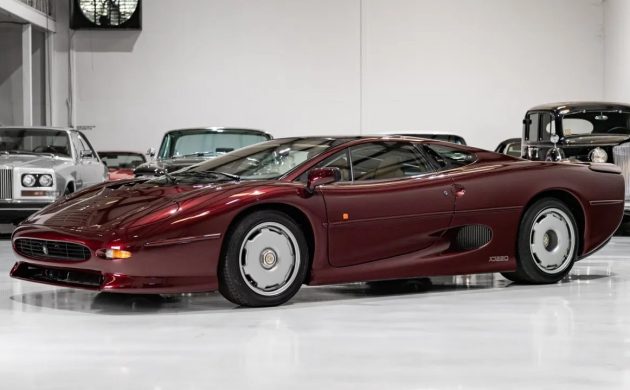
While the 1960s are considered by many as the muscle car era, some manufacturers spent the 1980s developing vehicles with the sole aim of building the world’s fastest production car. Jaguar held that honor for a period with the XJ220, and this 1993 example is a gem. It has only clocked around 1,800 miles throughout its life, and its condition reflects that fact. Only 281 of these exotics left the factory, with this one listed here on eBay in Saint Ann, Missouri. Of course, cars of this caliber are rarely cheap, with the seller setting a BIN of $599,900. However, there is an option to make an offer.
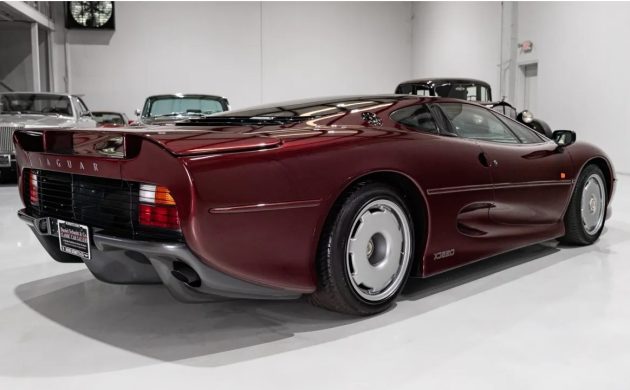
Some people believe that the Ferrari F40 was the catalyst for the development of the Jaguar XJ220. The F40 was the first production car to break the magic 200mph barrier, setting a new record. It motivated Romano Artioli’s recently revived Bugatti brand to produce the EB 100 in 1991, while McLaren entered the fray slightly later with the Gordon Murray-designed F1. However, sitting between those two exotics was the Jaguar XJ220, which hit the market in 1992. A collaboration between Jaguar and Tom Walkinshaw Racing (TWR), its model designation was meant to denote its projected top speed. That the car fell slightly short of the mark disappointed some motoring writers, although it did hold the mantle of the world’s fastest production car for a period at 117mph. That number still remains very respectable over thirty years after this 1993 example left the factory. This car’s presentation is seemingly impossible to fault, which is unsurprising considering its odometer reading. The Monza Red paint holds a mirror shine, with no evidence of cosmetic flaws or imperfections. The aluminum panels are as straight as an arrow, and rust isn’t a consideration. The lack of significant use means that the center-lock Speedline wheels are perfect, and the glass is crystal clear.
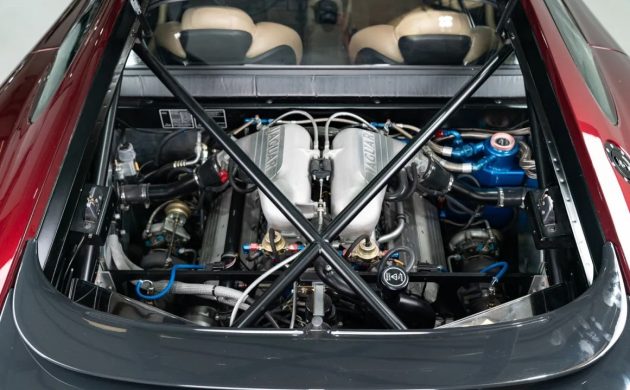
The XJ220 followed traditional exotic form when the question of drivetrain layout was considered. Jaguar and TWR elected to adopt mid-engine architecture, although the production version was vastly different from the original concept. TWR had developed a glorious V12 for racing purposes. This powerhouse featured quad-cams and forty-eight valves, developing mind-numbing power. This engine and an all-wheel-drive system found their way beneath the concept’s skin, exciting many people upon its unveiling. However, the engine proved temperamental, while the AWD system was deemed to add too much weight and complexity. Therefore, both were quietly removed from the equation. TWR purchased the rights for the V6 that had previously powered the MG Metro 6R4 from Austin Rover. Heavily revised and re-engineered, this turbocharged 3.5-liter V6 churned out 542hp and 475 ft/lbs of torque. The power is fed to the rear wheels via a five-speed manual transaxle that was produced by FF Developments. In keeping with its aim for simplicity and to reduce costs, the XJ220 didn’t feature anti-lock brakes. TWR and Jaguar aimed to produce a road car that could top 220mph, and while the XJ fell short of that mark, it remained the world’s fastest production car for approximately a year before relinquishing its crown to the McLaren F1. The seller indicates that this XJ is in excellent mechanical health. I see no reason to doubt the mileage claim, although you can be sure that the buyer will receive plenty of documentation when they hand over their cash. The car recently underwent a comprehensive service that cost $40,000, making it a turnkey proposition for its new owner.
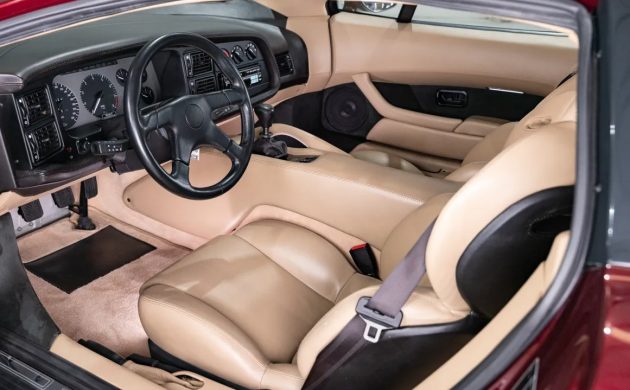
Part of the secret to the success of the Ferrari F40 was its lack of creature comforts. Ferrari focused almost exclusively on performance, meaning that buyers didn’t receive plush trim. Instead, they faced acres of bare composite materials, exposed seam sealer, and didn’t even receive interior door handles. The XJ220 followed an entirely different path, with its interior loaded with soft leather, plush carpet, and all of the luxury touches that buyers rightfully expected for their money. This XJ’s interior is as impressive as its exterior, with the Sand leather surfaces and matching carpet appearing flawless. The gauges look clear, there is no evidence of age deterioration, and the buyer receives air conditioning, power windows, power locks, power mirrors, a tilt wheel, and an Alpine AM/FM radio/cassette player with a remote CD changer.
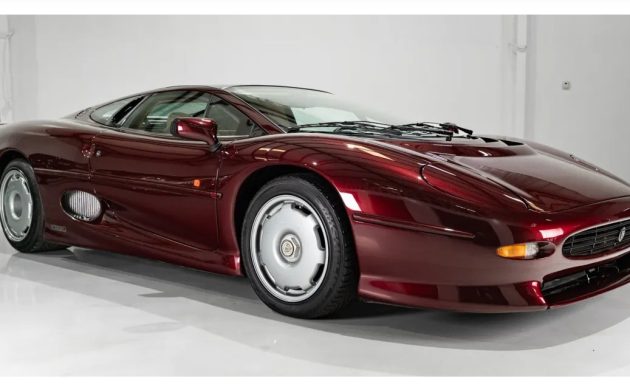
It is often said that timing is everything, and nowhere is this more true than in the automotive world. Jaguar planned to produce at least 350 examples of its XJ220, but the global recession of the early 1990s dramatically impacted sales. The company drew the curtain in 1994 after 281 cars had been built, although some of those vehicles didn’t find buyers until 1997. Originally envisaged as a golden investment opportunity, values initially plummeted dramatically, although they have since climbed to a reasonable level. The seller’s price for this 1993 example is within market expectations. However, the figure means that they will be pitching the Jag to a relatively limited pool of potential buyers. It will almost certainly find a new home at some point, but will it be as a museum piece, or will the buyer make the most of the recent mechanical refurbishment to enjoy this XJ220 as its creators intended? Only time will tell.




This is a super sexy design, can I say that? The lines , the narrow front grille area the the amazing rear design with the incorporated rear spoiler. Those sculptured wheel wells covering what 80% of the tire and those amazing fenders, it just flows. The interior is driver friendly. It’s a 12 out of 10 in my book. I especially like that red, what a name Monza red. Like the author said timing is everything and Jaguar was off a bit, but remember them changing direction a couple of times with this machine.
Spot on Cadmanls. Awesome looking and performing machine. Interior looks very inviting too😌🇬🇧
If I recall correctly, a number of people cancelled their reservations for these after it became clear that a V12 and AWD weren’t going to happen. That, and falling short of the top speed target, put a big asterisk on this car when it was finally built.
The color combination alone…Jaguar nailed it! As always a fantastic write up. Rarely do you see these cars come to auction. This is a museum quality piece that is destined to be viewed within the confines of four walls unfortunately.
My Fiesta ST will do 117 mph! I think you meant 217 mph.
Beautiful car. I can only hope to win the Powerball to be able to purchase something like this.
personally I don’t want to be in a Fiesta at 117, but some would
although it did hold the mantle of the world’s fastest production car for a period at 117mph – did you mean 217? Because my old Cutlass could surpass this!
Remember when Jaguar tried to appeal to enthusiasts rather than the vapid Louis Vuitton crowd and their $3000 bags? Pity they couldn’t bring the XJ220 to life in its original form; customers and the press alike were not happy with the substitution of the rather pedestrian V6.
Not street legal in the US; can only be driven on the track or at shows. Hence the low mileage. Swapping the V6 for the promised racebred development of the V12 also iced the desirability by those who could afford it. There is exactly one source for the tires in the UK.
One of these resides in a museum in Newport RI. It is stunning. It is huge.
If they have documentation proving it first entered the country at least 25 years to the day after its exact date of manufacture, it should be fully street legal under the NHTSA exemption on imports over 25 years old.
I wonder if Jay Leno has one of these
Why would he?
What was the MSRP on these?
$705,000.
WOW! I want it but my spouse won’t give me a 4000 year advance on my allowance
Richard, why is it not street legal?
This dealer has outrageous ideas, about what car values are. What they have is a collection, not an inventory.
A number of years ago I was in the UK on business (Glaxo) and went to Lord Montague’s estate, Beaulieu (the English pronounce it byoulee, not exactly the French pronunciation), where there is a wonderful car museum attached to the estate. I got up close and personal with one of these monsters in charcoal gray with black interior. It’s a surprisingly large car.
I can’t believe the buy-it-now price. Take that to Mecum or B-J and it’s a million dollar car. Love the color combination.
There is a ’93 on BAT right now, bid 300k!
https://bringatrailer.com/listing/1993-jaguar-xj220-4/
If Jaguar had been successful with the V12 and AWD system, these would be million dollar cars today. They should have enlisted the help of Lotus or Porsche of McLaren.
Hey Richard, why is this Jag not street legal
I’m not Richard but I took a quick internet search because I was curious. The car IS street legal. Apparently there was a C version for homologation. That car might have registration issues. But the “normal” 220 has a VIN and can be tagged.
At least so says the internet. I do not and don’t expect to have any actual experience
It did not meet federal emissions or safety requirements.
I know it wasn’t street legal in 1993, but now that it is more than 25 years old, maybe it can be legally driven today? If you have the $$$$’s and the desire, it would be worth checking out :-)
I believe these were not street legal in 1993, but now that they are over 25 years old your may be able to drive them legally? If you have the $$$$’s and the desire, it may be worth checking out :-)
Test drive 5
This was the fastest production car in 1992-1993 at 217MPH track test.
Wonder if it would start without a jump
Hey Richard, why is it not street legal?
Wasn’t there a race series featuring these? Why, yes, Frank. There was:
Still, perhaps the most unusual aspect of the Jaguar XJ220’s history is the bespoke made-for-TV racing series that Jaguar built to try and raise the company’s (and the car’s) profile with American audiences. Called “Fast Masters,” it launched in 1993 in partnership with ESPN and made use of a fleet of bone-stock XJ220 supercars being driven exclusively by former (and a few contemporary) race car drivers were at least 50 years old.
In the early ’90s, I was working at ASC as the topstack (convertible top) engineer on the new SAAB 900, soon to be called the 9-3. SAAB was renting track time at Millbrook in England for some vehicle development. Millbrook is the former Lotus test track/proving ground. Millbrook layout includes an oval. The oval had three distinct marked lanes to keep test vehicles grouped safely by test speed. The 220 was being tested there the few times I was there. When the 220 was on the oval, all other vehicles were off the track. Even though I was probably a 1/4 mile away the howling sound of the car at speed and the Doppler shift is still a strong memory today.