
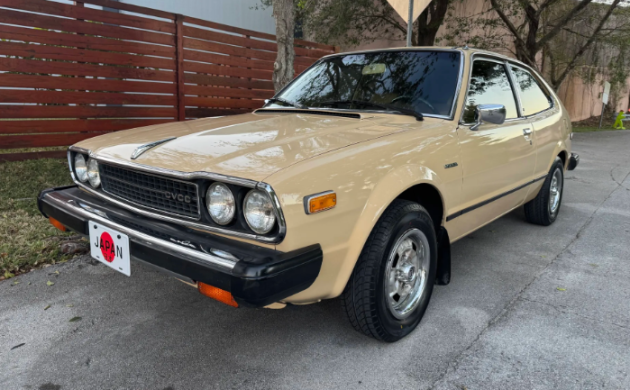
The Honda Accord arrived in 1976 (aka Honda Inspire in Japan) as a mid-size automobile. Its worldwide popularity grew, especially in the U.S., where it would become a best-seller year after year in the 1990s. This edition from 1979 looks like a time capsule piece, yet the car may have 150,000 miles, new paint, and an engine rebuild. Located in Miami, Florida, this Japanese jewel is available here on Hemmings, where the asking price is $8,900. Bravo to “Curvette” for this cool tip!
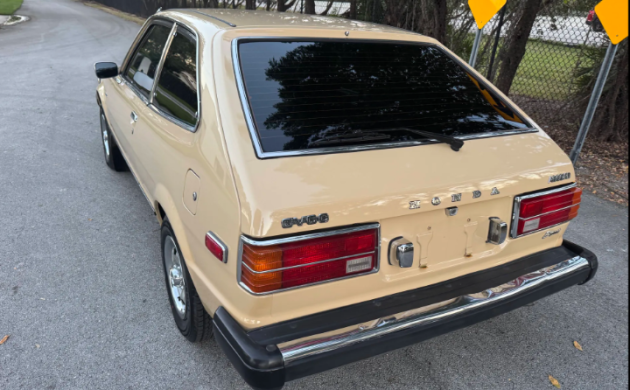
Early Accords were sold as 3-door hatchbacks with the popular 4-door sedan arriving a few years later. The inline-4 in these cars carried CVCC badging, which stood for Compound Vortex Controlled Combustion, a process developed by Honda. The 1751-cc engine in the seller’s car was rated at 72 hp with a 5-speed manual transmission and delivered decent performance and good gas mileage.
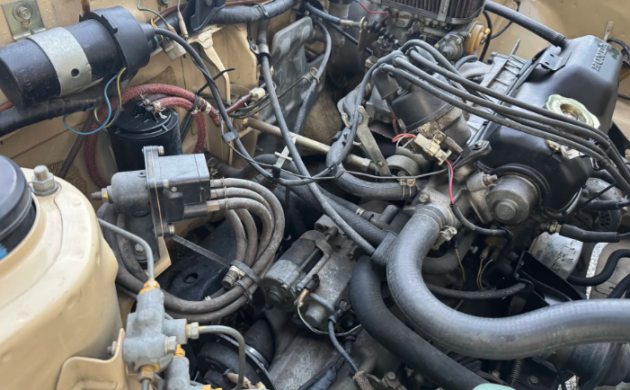
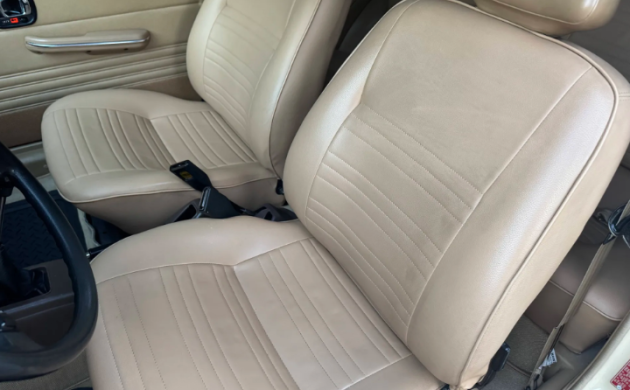
The seller’s listing is confused about the mileage. The car is advertised as having 49,000 miles, yet we’re also told the engine was rebuilt at 99,000 miles. So, does the car really have more like 150,000 on it? That may not matter a great deal if the power source was refreshed along the way. There is no rust on the Honda, and the beige paint has recently been reapplied. The interior is said to be impeccable, which is a testament to the materials Honda used, if original.
We’re told the Accord has been recently serviced, but what does that entail? For certain, that includes new brakes, tires, and head gaskets (did the old ones leak?). Also, a clutch kit has been installed, but what about the rest of the transmission? All-in-all, this looks like a solid ride, the kind that enabled Honda to claim such a large footprint in the U.S. market.




Someone sure wants to capitalize on the 5 digit speedo, 150K EASY, or more, especially from the Shunsine State. Engine rebuilt at 100K, seems typical, I know, many say my Honda has umpteen million miles, and that is entirely possible, but for many unaware of how an engine works, 100K unmaintained miles is all you get. Mostly head gasket from overheating, or belt breaks, interference motor is toast.
The Accord to most, was the Civic on steroids. Looked similar, but just a bit bigger. The Accord was probably THE most important car to get Honda out of the econobox group. They knew there was a bigger calling. Honda has sold an astonishing 18 MILLION( as of 2020) Accords in the US, and still with passenger car offerings limited, remains the #1 all time seller. It’s unusual to see one of these without the fenders dangling and doors falling off. Amazing find, no doubt.
One more thing, it should be noted, and I’m very proud to say, this particular Accord was made in Japan, but since 1982, the Accord has been made in Marysville, Ohio and employs between 4500-4700 AMERICAN workers. It’s NOT a foreign car anymore,,,dad,,, in fact, just the word “foreign” doesn’t seem to apply anymore. Honda continues to sell between 150,000-200,000 Accords every year. Way to go Ohio!
It seemed funny in 1989 to say that the best selling American-made car was the Honda Accord. Meanwhile, most of the Ford Crown Vic parts were sent South, assembled in Mexico. The American Corporate Average Fuel Economy ratings suffered with the Crown Vic in the lineup, so they technically made it an import, so it wouldn’t be counted against them!!
This car reminds me of Pulp Fiction. “I had to crash that Honda, baby.” LOL
I don’t think the upholstery’s original, I think all the US-market gen 1 Accords had cloth seats or at least cloth inserts. I may be wrong though.
Our ’79 was an LX model and had attractive maroon cloth interior. Not sure what the DX models came with.
I had this car in the early 90’s. It used a quart of oil every 75 miles. Good thing I kept it as a local commuter.
I had a ‘78&’79 accords. Both were this motor but not inline. It was front wheel drive. Maybe some were inline as this one is no doubt front wheel drive, not inline!
“Inline” refers to the engine cylinders only. These had inline 4s, transversely mounted. Longitudinal refers to the engine orientation that is front to rear, like early Toyota Celicas.
This is what you get your newly licensed teen driver after they learned to drive with all the technology junk on today’s car’s so here they actually have to pay attention to the road
My parents had the 1980 4 door Accord this exact color. Was a great car. It was roomy and very dependable. I remember the Power steering didn’t leak, which was something my Ford family wasn’t used to having always had a Ford.
Maybe the reason it didn’t leak is it didn’t have power steering?
All Accord 4 doors had power steering. I had a ’79 sedan and it had power steering as standard equipment.
In fact, there was a callout on the horn button that said, “POWER STEERING” if it was so equipped on this generation of Accord.
The question about the condition of the transmission at this mileage is valid. As they had weak 2nd gear syncros. And the head gasket because of a timing belt failure is quite likely a reasonable scenario. Generally, good reliable cars. And yes, just an overgrown early Civic. These engines, like the 1237 engine in the early Civics have a cooling system air bleeder. Many times I have seen “mechanics” reinstall coolant as part of maintenance or repairs and not “burp/bleed” the trapped air in the intake manifold and the engine overheats 3 miles down the road. Hello head gasket failure.
If I was in the market I would still give this car a look over for possible purchase.
Not to mention that the water pumps on the early Hondas were prone to failure at about 50k miles since their belts were often over-tightened.
Our ’79 was the first of many Hondas for our family. Had a water pump failure at 20K miles and needed a new camshaft pretty early on too, for some reason. Then there was the rust…Still, with all the issues, my dad permanently switched to Accords because they were fun to drive and got good mileage.
My Harley Davidson Ultra Classic has a bigger engine than that car! LOL! But I remember my college girl had the Civic CVCC. Easiest engine to work on no doubt!
As a line mechanic in the early 90’s we had to call in the VIN to the dealership to get the correct manifold set up.
79 they produced 4 different intake / exhaust set ups.
I had to braze the exhaust manifold back together.
For the period; it was a throw away car, but! The owner paid.
It has been over 20 years since I have seen one of these on the road.