

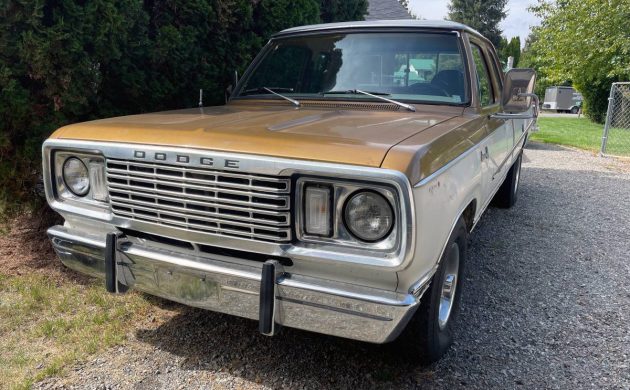
Sometimes a truck needs just a little extra space without adding extra doors. Enter the happy compromise of the Club Cab, as featured on this 1978 Dodge D200 Adventurer SE pickup. You’ll be reclining the driver’s seat in no time if you head to Hayden, Idaho with $9500 to grab it before it’s gone. Check out the original listing that Curvette found here on Craigslist.
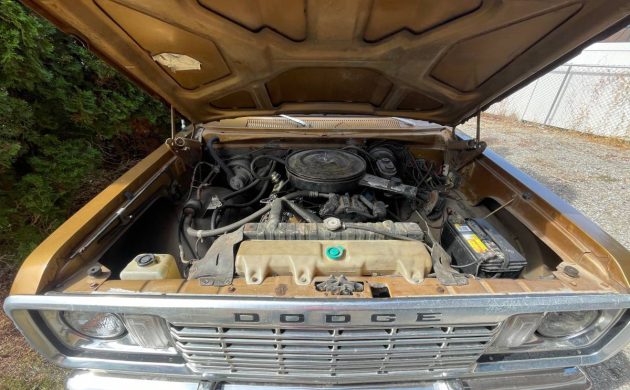
As the fuel crunch and resulting regulations of the 1970s chipped away at emissions and engine sizes, big block displacements became harder to find by the end of the decade. One exception was the Dodge D200 pickup, where the heavy duty option was the 440 cu. in. 7.2 L Big Block V8 powering this truck. Mated to a 3-speed A727 Torqueflite automatic transmission, you could expect about 220 horsepower and 340 lb.-ft. of torque coming from the rear wheels. My info (read: the internet) tells me that fewer than 1000 Dodge D200s left the factory with this engine, making it somewhat of a rarity.
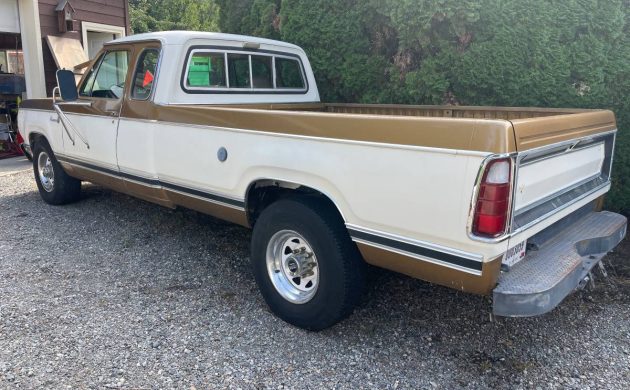
The seller describes this as an “Eastern Washington dry desert pickup” but does mention a couple of rust spots and a hole somewhere in the floor, though none of these are pictured, so be sure to check your local listings there. The SE was the top trim level available, and included extra brightwork and special Adventurer SE badging on the front fenders that made these trucks stand out. From the pics we do get, the body and glass (including the desirable sliding rear window) look to be in good condition; not show quality, but nothing to be embarrassed being seen in. The seller mentions one repaint in the late 90s or early aughts, and some chips and scratches–which sounds about right for a paint job pushing 30 years old on a truck pushing 50 years old. It’s hard to tell which paint scheme this is–there were several two-tone options available on the ‘78 D200–but the whites on the body and roof definitely don’t match, and it seems like they should.
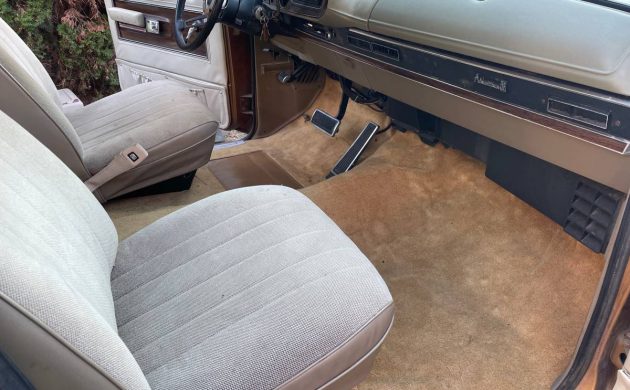
These seats look way too good to be from 1978, but bucket seats were an option for this model, and the seller does refer to them as “Dodge bucket seats” even though there’s no indication of their age. Other listed interior goodies include “factory tach, vac and volt gauge” and new carpet, though with the aforementioned rust issues, a lift-and-look is definitely in order. I also spy an aftermarket stereo and a pretty clean dash, with another preserved Adventurer SE badge just below the glove compartment. Does this Crew Cab Dodge pique the interest of the Adventurer in you?

Wow. Rare model D200 setup. Install a 5th wheel hitch, hook up the trailer and follow the sunshine 🌞 ⛱️ 🏕
Another sweetheart, and not directly dads truck, but certainly this seller got it from one. A “Fo’ Forty”, nice, dad didn’t mess around, right to the top, even though, this 440 was no Challenger 6 pak, but it had the torque up the ying-yang. In fact, I bet dad checked every livin’ lovin’ box on the order sheet. I’m confident it has 140K very well cared for miles, but it’s an awesome truck.
Now, I was just thinkin’ ( ow), we “seasoned” folks take the words “big block” for granted, but today, I wonder if some younger folks don’t know what that is. Big block? Big block of what? Wood? For those confused, American V8 motors generally came in 2 sizes. Small blocks were smaller in size for smaller cars, and ranged from 215ci(GM) to I think 400(GM) was the biggest from the factory. Big block motors, are larger and are generally bigger displacement, say 332(Ford) to over 500ci(Caddy) and for larger or high performance cars. To add confusion, Pontiacs V8 was neither a small block, nor a big block. Now you know. :)
Might as well take it a little further for the young folks and let them know that “Big Block” is just a marketing term Chevrolet used exclusively. There are no Mopars that were ever marketed as Big Blocks. Now that we have large displacement engines that are the size of small blocks, like the LS engines, it’s even more confusing. Some would argue that an 454 LSX is a small block engine given it’s size and given the original definition.
Thanks, I never knew that, see, at 71 you can still learn new things. The words “big block” had the same meaning as all gelatin is Jello or all Tissues are Kleenex, etc. Regardless, I’m not sure younger folks understand the concept anyway.
I thought all the old Pontiac (or was it Buick?) engines were the same size externally from what? 350 to 400 to 455?
My memory of lessons learned here recalls something like that.
With Chyslers the only terms that really get used are “A”(273,318,340, and 360; some also include the V6 in this group) “B”(350, 361, 383. and 400) and “RB”( 413, 426 wedge, and 440). The latter term ‘RB’ denotes a block with a raised deck that the smaller displacements lacked although even that isn’t cut and dried as the 383 existed in both a low deck version and a raised deck version(in the ’59 and ’60 Saratoga and Windsor):
https://www.motales.com/engines/two-383s.php
Needs an eyes-on before committing to buy but otherwise appears to be a clean, solid and useful for its age.
On a different tangent, the updates (new writers, messaging option, quicker ‘thumbs-up clicks, etc.) are great. Nice job.