
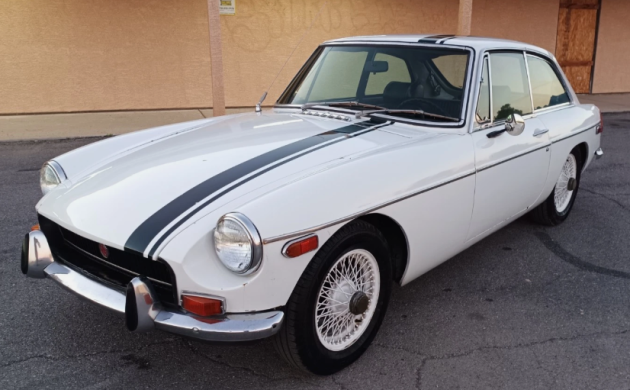
MG owners are a hardy bunch, but back in the 1950s, a chorus of buyers was clamoring for a closed car option. In 1956, the MGA coupe finally followed the MGA roadster to market. However, as elegantly styled as it was, the coupe afforded little extra cabin space, and what space it did offer was noisy and stuffy. British Motor Corporation fumbled the ball once again when the MGB was launched in 1962 as a roadster. In a familiar refrain, fans pined for the practicality of a hardtop. So, nine years after its last closed car was made, BMC – having hired Pininfarina to design a coupe – brought forth the MGB GT. This example, for sale here on eBay, is said to be a barn find, rescued from a 25-year slumber somewhere in California. The seller is asking $10,900 or best offer, and the car is now located in Pahrump, Nevada. Thanks, T.J., for finding us this tidy sports car.
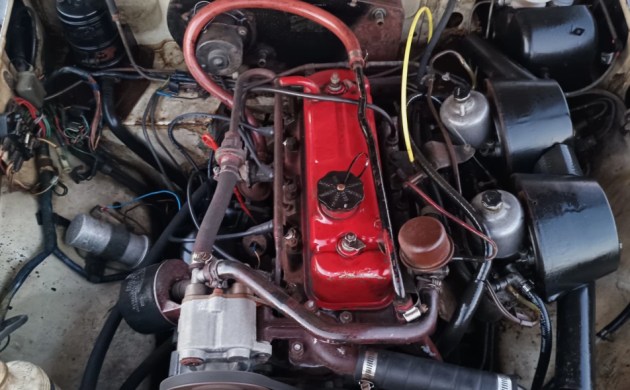
While early MGB roadsters received a three-main 1800 cc four-cylinder, the engine was updated to five-main construction in 1965, coinciding with the GT’s launch. These engines generally last longer, though the free-revving three-main can be coaxed to a long life as well. Output drifted down over time; US spec cars in 1970 claimed about 90 hp. By 1970, the four-speed manual had synchros on all gears, and overdrive was an option. Lockheed front disc brakes are paired with rear drums and a dual-circuit master cylinder. This car wears twin SU carburetors; five years down the road, only one lonely Stromberg would perform carburetion duties – thanks to emissions regulations. This example has a new fuel pump, rebuilt brake and clutch hydraulics, new batteries (two six-volts), and new tires. The seller notes that it drives well.
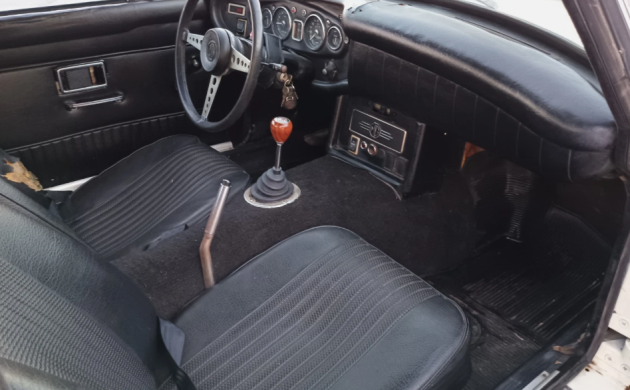
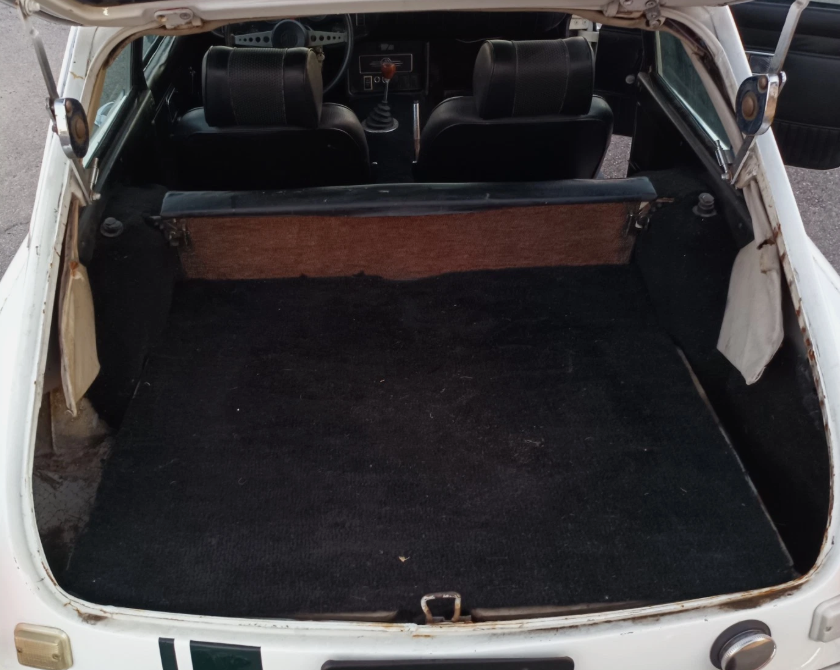
The GT provided roomier quarters than the roadster, including a cargo area and tiny rear bench seat. The back panel of that seat folds down to expand carrying capacity. Golf clubs? No problem, especially if you don’t have a passenger. Groceries, bags of gravel and bark, a dismantled bicycle – all of these have fit comfortably in the rear of my own MGB GT. In fact, I’ve used mine to haul car parts to swap meets. But if you need to pick up that washing machine at Home Depot, better bring the F-series. At first glance, this interior appears tidy, but the driver’s seat is torn, and one of those readily-available plastic covers is installed over the dash. Yes, that e-brake needs adjustment, and it’s missing its plastic cover.
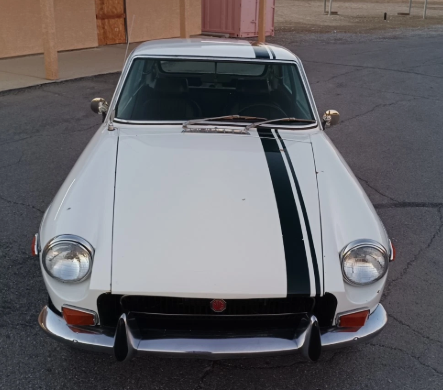
The seller represents this car as a survivor, but it is not. No GT came from the factory with white-painted wires and a stripe. Speaking of the stripe, yes it’s hard to figure out how to angle it. Everyone has an opinion, but mine is that the stripe should have paralleled the driver’s side bonnet gap, or been centered. Laying out your design with pinstriping tape before applying paint affords an opportunity to debate the style for a while.
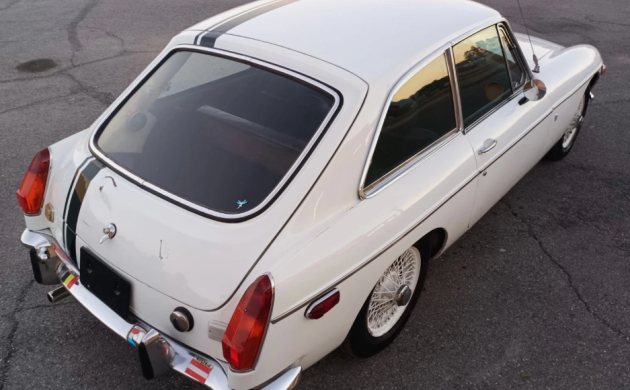
This car wears a few dents, but is presentable enough for a driver. Considering its overall condition, I think the seller will need to settle for a four-figure number to move this one along. My own GT would be the last car I would ever sell – but I drive mine a lot, have had it for over twenty years, and am emotionally involved in its well-being. An unbiased examination of the market reveals that MGBs are trading hands for less these days, and though the GT sold over 125,000 copies when it was new, it’s not as desirable as the roadster. Would you be tempted to buy this car if its price were lower?


Ok, maybe I am just a curmudgeon, but white wire wheels? Seriously?
I had heartburn over the aluminized painted wire wheels on a TR4A I once purchased (very used). As beautiful as chromed wire wheels are when new or maintained. Old wire wheels are a nightmare when spokes break or become loose. Wire wheels are magnitudes heavier than alloy wheels. Nice to look at on someone else’s car, but not mine.
I’m with you. Steel wheels, please, forget the hours with a toothbrush cleaning wires….
The beauty of the MGB/GT was the bone stock version, and what is the point of a racing stripe if you’re not racing? Leave the designs to Pininfarina.
12826 is that actual miles? Agree stripe should parallel the bonnet edge! Never have I ever seen white wire wheels,that should be changed!
I scrolled down the list of BF cars rather disappointed with the land-yachts featured. Then I blurted a spontaneous “Nice!” when I saw the MGB-GT. In the early 1980’s I searched for an MGB-GT to own, but after driving a few I turned my interest to Triumph for several years. Today I am thankful that a 1982 RX7 rests in my shop. Regarding the Racing Stripe, I seem to recall a magazine advertisement featuring a BRG MGB-GT with a racing stripe that did an S-Curve over the roof? Am I confused.. was it a Triumph GT6? Nice write-up and nice car if it is solid underneath.
I had a ’53 Chevrolet that was very hard to start, so the mechanic put an additional 6v battery in it and problem solved.
Why would such a small motor need 2 batteries?
Love the writeups.
I believe the 2 6V (for 12V) batteries in A’s and B’s were placed where they were located (down low and aft of center) for reasons of weight distribution. Never could understand the postive earthing (grounding) of those roadsters.
I have no idea why but almost every British car was positive earthed until they finally caught up and used alternators instead of generators. That meant they had to switch to negative earth as I don’t think there is such a thing as a positive earth alternator.
It was an issue of packaging, two small batteries, one behind each seat. Now, however, a single 12 volt can fit into the spot that had a 6 volt. That’s how I am running mine.
What a shame! At one time this was a good looking Primrose B-GT.
With an ounce of luck those stripes may be vinyl and can be carefully removed. What I am curious about is the bonnet (hood to you Yanks). The centre of the leading edge should have a raised portion that mirrored the outline of the badge at the top of the original grille. There should also be a chrome trim around the perimeter of the grille. It’s still there on the sides (painted black) but has gone from the bonnet.
The wheels are no big deal – easily dealt with with a can of chrome paint.
Come on Chris Beebee show us a picture of your MGB GT! (formerly mine)